Forumners,
After a few months, I think it is a good time to look back at the
new Patek Philippe 5370P, unveiled during Baselworld 2015. It is a new reference but is aiming at becoming a future iconic model and from what we understand: it won't be produced at a normal rate.
Aside from the current steel cushion-shaped 5950A or the thin 5959P which are split-seconds chronographs-only (both with the same in-house CH27-525 thin movement), the new Patek Philippe 5370P is the only one which brings this complication combination with a very different in-house movement (CH29-535).
We may also have in mind the old 5004 or now the 5204, which replaced it. However, this last reference, also with the CH29-535 movement base, has a Perpetual Calendar feature.
During these last 10 months when the brand has been celebrating its 175th anniversary, we can certainly say that the 5370P is one of the most appealing novelties presented and even one of the most appealing from this last decade.
Let's make a complete tour of this reference, illustrated with fabulous pictures by Magnus B and Oliver M; Thank you guys.
THE CASEThis new reference is dressed in a
41mm platinum case that is 13.5mm thick. The proportions are very nice and give more strength and presence to the watch than the thinner reference 5950 (with a different case shape). As the dial is black, the watch looks more like a 40mm in-the-metal.
It is covered with a beautiful concave bezel.
To the choice: the little more character for the 5370P or the little more elegance that the very thin other references bring: everyone will have their own preference.
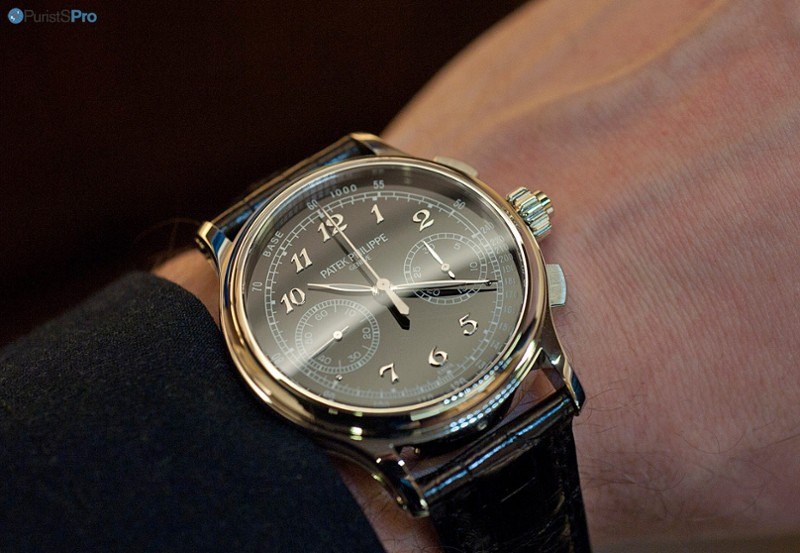
The case remains a very appealing and classical one from the face side reminding us of the reference 130, from the shape of lugs to the concave bezel.
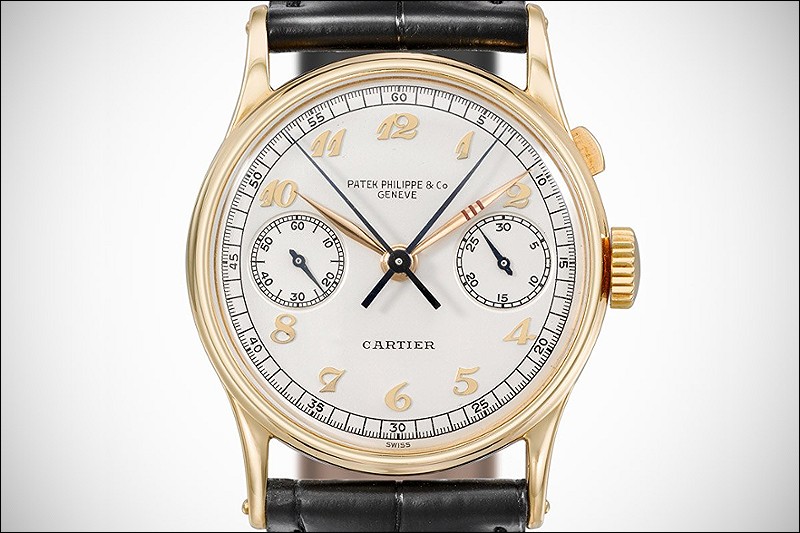
You can see here below a reference 130 version made for Boeing. You'll notice also the strap's stems coming out of the lugs (and thus why the 5370P has white gold "cabochons").
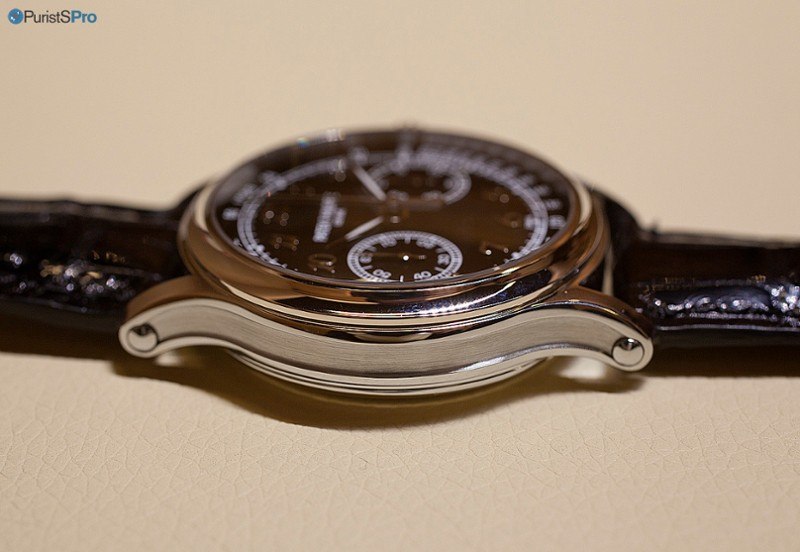
However, when you look at it from the side, you easily notice what I think is a first in Patek Philippe history with the long grooved case band, going from one lug to the other. This decorative element is brushed: making it a polished surface, aside from being near impossible to realize, would not have look as nice as it would have suited a more standard case shape instead.
I'd like to emphasize the fact that, after the dial, it is is the second element you really notice when seeing the watch "live". This case band makes it so unique like no other Patek chronograph you knew before. It gives a lot of character to the model and brings Patek's chronographs in a new aesthetical field.
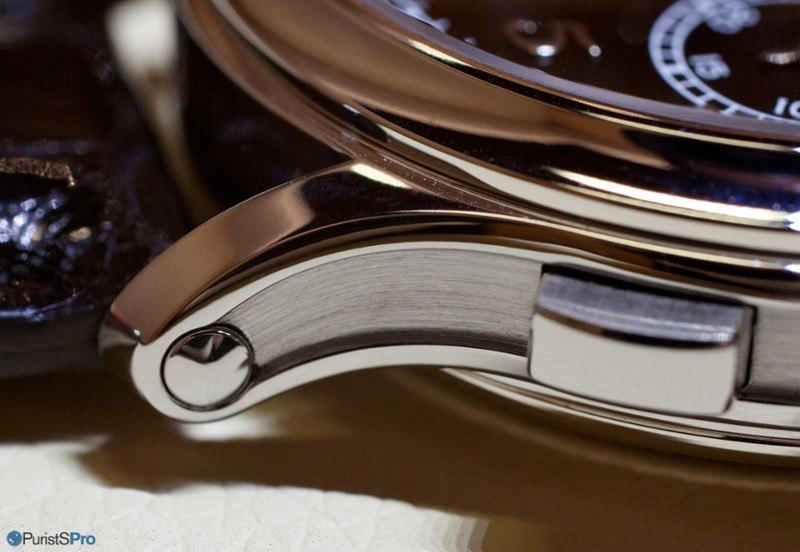
The "cabochon" parts remind us of older watches: these elements were made to hide the stem holes, back then. Here, it is decorative and a very nice detail you can't miss when reading time. You can notice in the pictures that they are precisely integrated into the lugs as the grooved end is shaped to the cabochon's diameter.
 THE CROWN AND PUSHERS
Like many here, I appreciate the
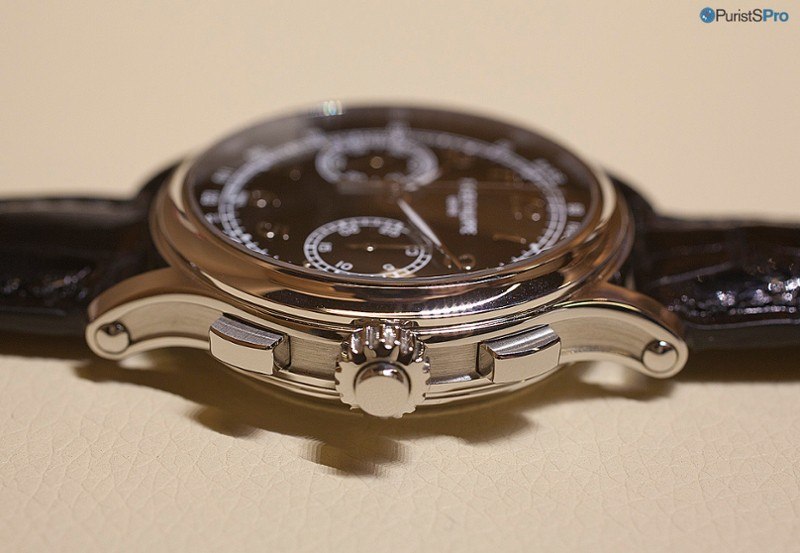
monopusher function and I especially like the fact the crown remains
small as it usually unbalances the crown side of the case when it is too big.
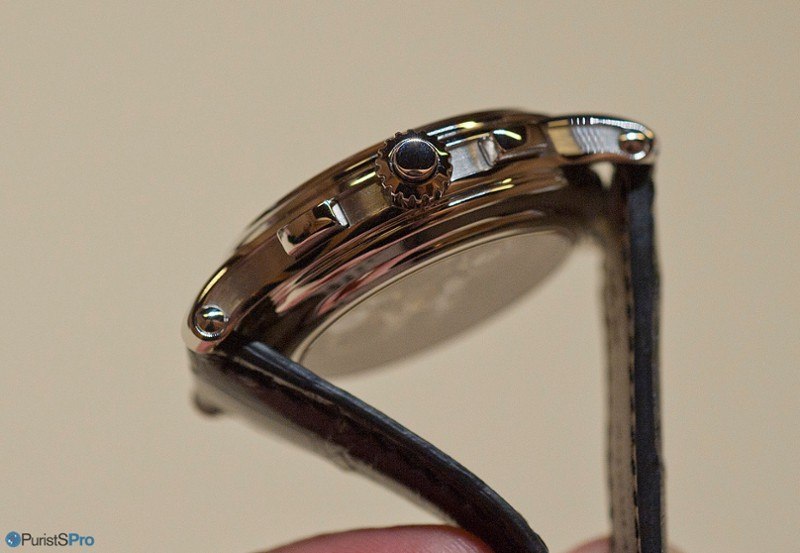
I also prefer this
symmetrical layout (monopusher with 2 standard pushers) rather than a monopusher for start/stop and a little additional unique pusher at 10 or 2 o'clock for the Split-second function. This later solution also doesn't allow usage as precisely of the chronograph function because it resets after you stopped it with the monopusher crown.
Here, it is
balanced and usable with
100% of its function.
The pushers are the way I love them: polished with brushed sides. It is hence perfectly coherent with the polished and brushed case's parts.
 THE DIAL
The dial is in
white gold and filled with enamel. The enameled material is heated at 850°C and goes through a precise cooling process until it is ready for a long polishing work.
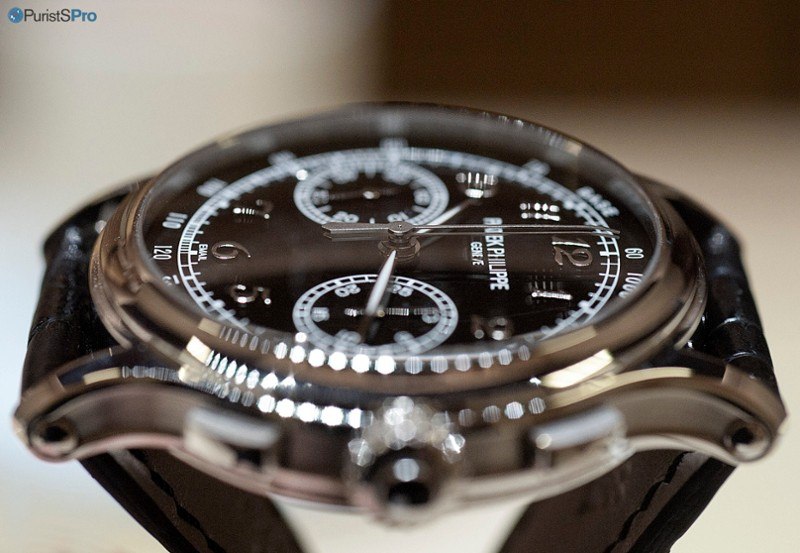
What is also really hard to master is how to make enameled dials without any impurities. These residues are more visible in a black dial than in white versions, hence the great difficulty in mastering this complex process.
On these pictures you can quite clearly observe how stunning the dial looks compared to usual painted or even lacquered ones.
I don't think there is another reference in the Patek Philippe Collection giving this result.
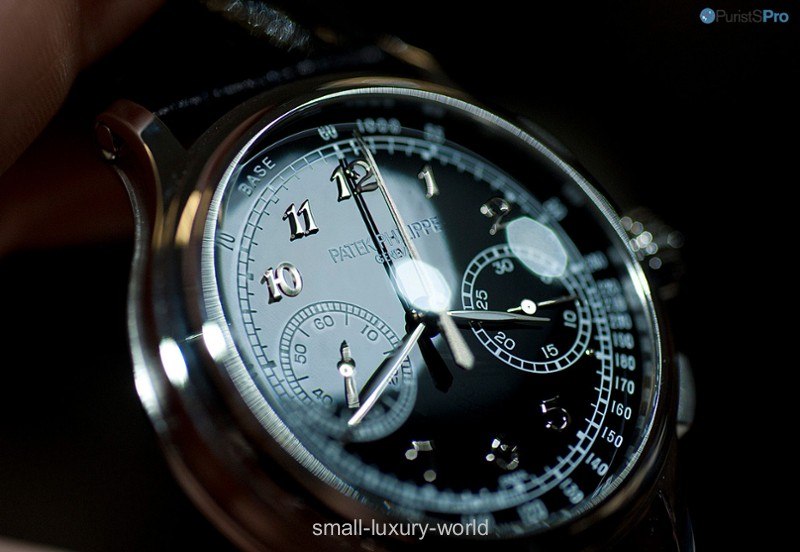
The nice Breguet numerals that we also have in the 5170G, for instance, are applied in white gold.
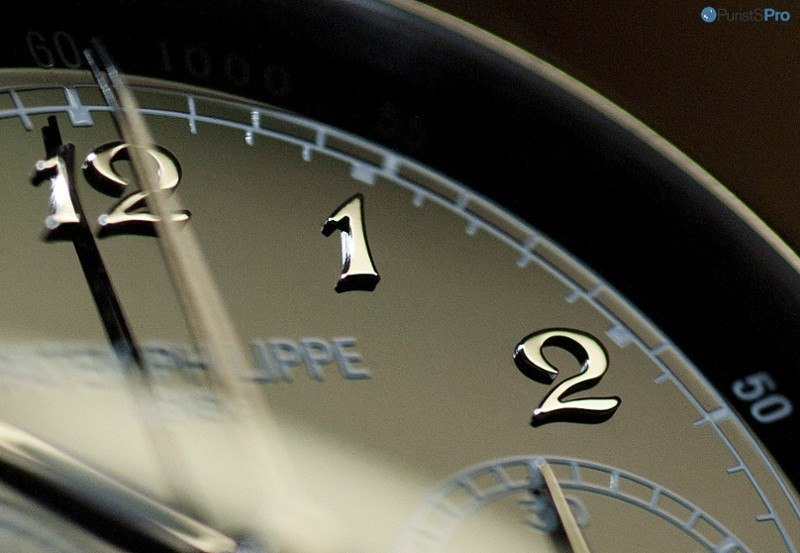
I usually pay strong attention to the
white printing on a dark dial as usually it is too contrasted and thus, lacking in refinement for my taste. However, I also understand it may bring a touch of modernism or casual touch to a usually very classical watch.
As far as the 5370P is concerned, you notice the dial is very shiny being made of enamel and very precisely polished. This allows the contrast to be more coherent because it needs to be adequate with the light reflection on the black surface.
You'll also notice in the pictures below, that the little
thickness of the markings brings sensuality and looks gorgeous.
I didn't really like the thickness of the new 5905P sub-dial printing as there it looks much less elegant and brings much more visual weight to this side of the dial.
Here, in the 5370P, I find them perfect.
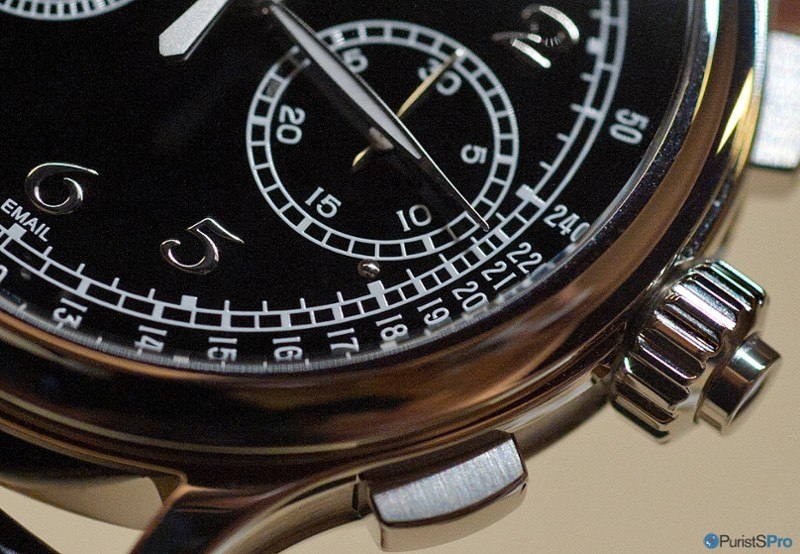
In the recent past, Patek Philippe chronographs have had different versions of
scales: since the 3970, 5070, 5970 to the 5170 or various models of the 5270 (see my post here concerning the place of the 5170G reference in the brand history:
www.watchprosite.com
). My personal favorites are used in the 5370P, whether they are Tachymetric or Pulsometric, although I have a little preference for the latter (except if the dials are too busy).
I think it perfectly balances the subsidiary dials scales and help give life to the very dark dial color. I think that with such a glossy dial, having less printings and different hands colors than we have here would have led to a very dark watch. It would have been different with a satin or matte dial finish.
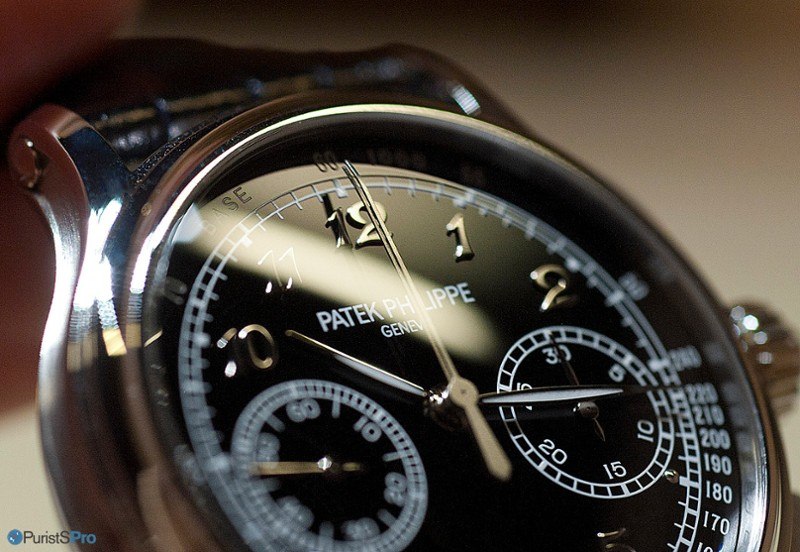
THE HANDSWhen having a closer look at the
leaf hands, with luminous coating that is usually a sportier feature, I think it makes the watch even more unique as it remains classical as well. Together with the black dial, it brings a little romanticism. I think that Stick or Dauphine hands would have had a completely different impact, more modern but less "authentic" in the look.
By the way, the
luminous coating from the hands already brings this touch of casual spirit.
That way, the watch really seems to come from the early 20th century instead of the 60's/70's period. This is something I appreciate very much for that model.
 INSIDE THE 5370P
The 29.6mm movement is the same new in-house chronograph base already seen in the 5204 reference: in this case, the
CHR 29-535 PS (manually wound, column wheel, horizontal clutch).
In this configuration it has a 55h to 65h power reserve and beats quite fast at 28,800 vph.
It has gained
a number of new patented innovations compared to the simple chronograph movement used in the 5170.
As in the 5204, the movement is equipped with an
isolator when timing is stopped to reduce friction and power loss between the chronograph and the split-second module wheels.
These are what can be noticed about
the caliber's innovations. They are not just "marketing" evolutions but interesting and sometimes very simple features:
- Clutch wheels with patented tooth profiles boost efficiency in power transmission and reduce wear.
- The mesh depth of the clutch wheels is not adjusted with an eccentric next to the clutch lever; this is done much more precisely and easily with an eccentric column wheel cap at the outermost end of the clutch lever.
- Self-adjusting hammers in jewel bearings simplify the servicing procedure.
- The brake lever that stops the chronograph wheel is directly synchronized with the clutch lever.
- The slotted minute-counter cam coasts the chronograph and split-seconds hands to a stop rather than abruptly blocking them.
These new features of the mechanical chronograph are joined by innovations dedicated exclusively to the split-seconds function:
- When lap times are stopped, a newly designed isolator uncouples the split-seconds wheel from the chronograph wheel to eliminate unwanted friction and prevent a degradation of balance amplitude while the split-seconds hand is immobilized.
- The split-seconds lever positions a ruby roller between two flat heart-cam shoulders keeps the chronograph and split-seconds hands precisely aligned as long as they are superposed.
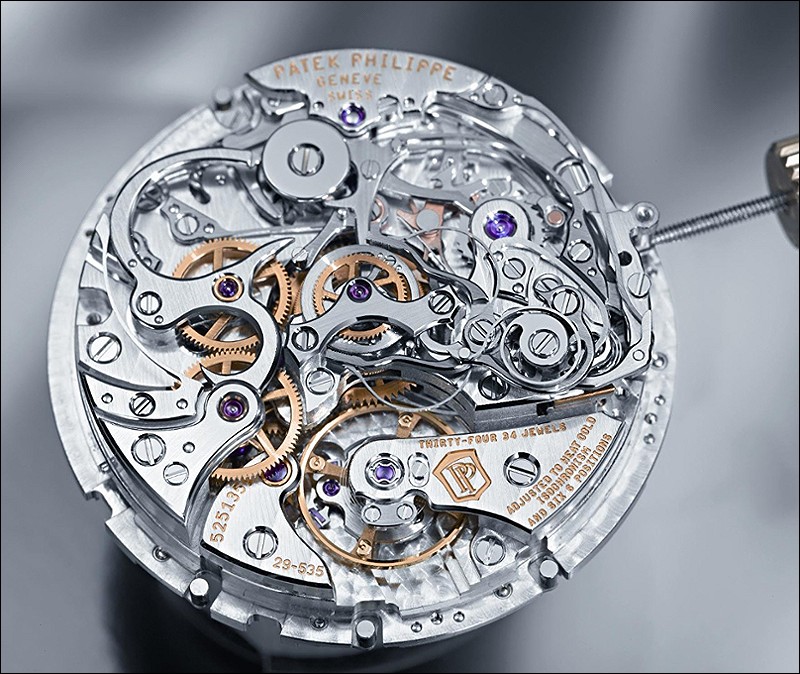
I think the technicality performance is not only assessed by how complex a movement is or by the number of component parts, but also when it brings improvement with simple solutions.
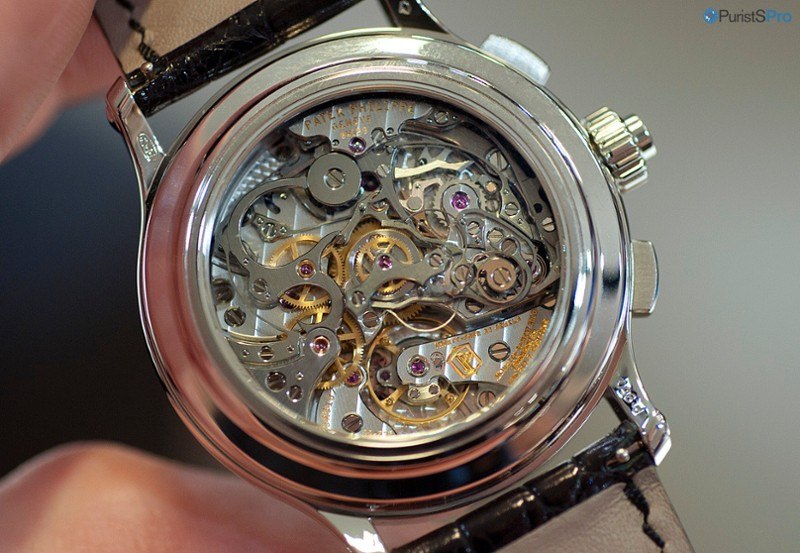
Aesthetically speaking, I think it looks gorgeous and brings this modern reference a step forward from the previous 5004 reference in terms of design (not in terms of finishing which remain equivalent). The finishing is top notch and this central bridge always amazed me. It is as impressive aesthetically, as the 5950's CH27-525 caliber.
As for the exemplary finishing, most parts (steel) are chamfered and the split-seconds clamps are highly polished.
I must say I prefer steel instead of German silver as I'm not fond of the "yellow" patina. I don't know about the resistance issue but I wonder if steel is stronger than German silver? Can someone please confirm or otherwise?
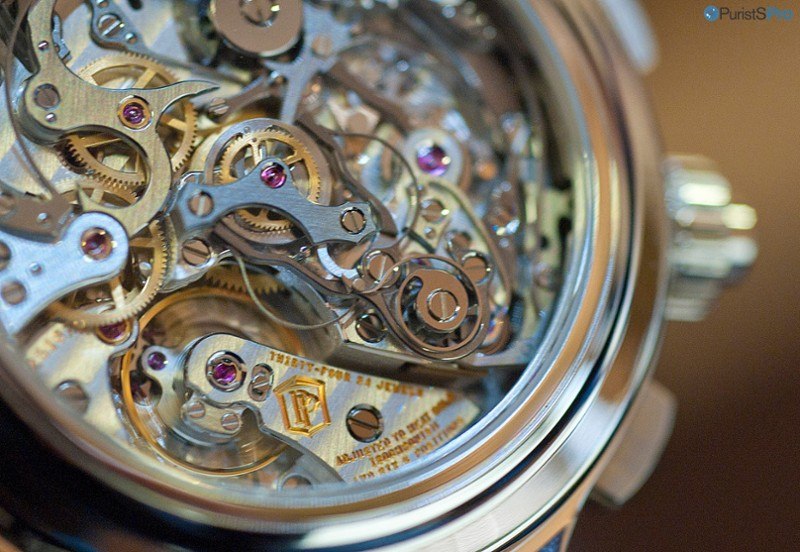
I really think there is no point in opposing or ranking these movements. They correspond with the technical expectations from the brand for each model and they reach another level from the usual, still very nice, 324 and 240 calibers.
The movement CH29-535 PS is another very significant reason to be attracted to this 5370P.
As usual, the watch is provided with a see-through caseback as well as the plain one.
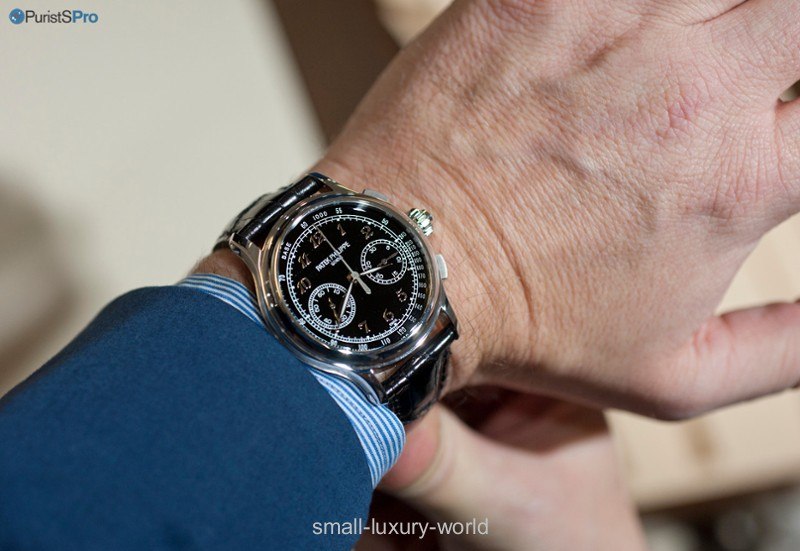 In conclusion
, I know that some members here are willing to apply for this watch and I just can congratulate them for this choice and hope they will succeed in holding it soon.
It is easy to feel how much pleasure the owner will find in wearing this 5370P. It must be a very special feeling, wearing something unique and absolutely gorgeous.
This new 5370P is a very clever composition from what the brand's knows best when dealing with finishing, aesthetics or mechanics.
Hope you enjoyed this review and feel free to share with us what you think of this new reference in the Patek Philippe Collection.
Cheers,
Mark In Paris
This message has been edited by Mark in Paris on 2015-09-14 14:32:00 


