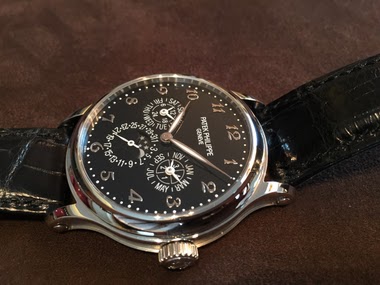
New Release
Dje's comprehensive Baselworld 2011 report on the Patek Philippe Ref. 5208 triple complication highlights the brand's commitment to grand complications. This article delves into the technical marvel of integrating a minute repeater, monopusher chronograph, and instantaneous perpetual calendar, offering a critical look at Patek Philippe's strategy in the high-horology market. Dje's analysis provides valuable context for understanding the significance of such complex timepieces.



Obviously many
here and myself first may wonder if we will ever see this watch out of the
Patek Philippe window at Baselworld or the Geneva boutique. Those who may not
wonder such question may answer "why bother?". I've read your
many answers complaining in some way about so many "Grande
complication" watches in this year's novelties from Patek Philippe.
Well if that's really that much a problem for you you can have a
look there: patek.watchprosite.com
I think, or
guess, that the truth may be that the market for such complicated watches from
Patek Philippe is essential for them. I too think that you first among others
ask always more from Patek Philippe. I finally know that Patek Philippe's
prestige is due to the historical general high level of quality of its
products, but also and maybe even more to the fascination exercised by its
permanent prowess on the complicated watch market.
Three year ago
the 5207 was revealed at Baselworld. patek.watchprosite.com
This
extraordinary instantaneous perpetual calendar based on the toubillon minute
repeater calibre from Patek Philippe was the nest for a new improvement of the
breed. This improvement is renewed with the new Patek Philippe 5208.
The new watch
uses the automatic winding minute repeater base calibre R 27 PS of the 5078,
turning it into a R CH 27 PS QI, for "Repetition chronographe 27 mm petite seconde
quantieme instantane" so if you need a translation, an automatic winding
minute repeater with (monopusher) chronograph and instantaneous perpetual
calendar with moon phases.
So if you
except the unique piece reference 3615 made between 1982 and 1986, the new 5208
is the first wristwatch from Patek Philippe mixing a chronograph and a minute
repeater. That it adds an instantaneous perpetual calendar emphasizes its
exceptional complexity. The automatic winding is a proof in some way of the
usability wished by Patek Philippe.
Beyond what is
apparent on its face, the Patek Philippe 5208 adds
The apparition of the Spiromax and Pulsomax
advances in a higher end piece (the 5208 is the #2 now in the order of most
complicated wrist watches by Patek Philippe, after the Sky Moon Tourbillon) is
the first implementation in the general catalog of the brand (although the 5208
will be limited in numbers by its complexity and sold exclusively by the Geneva
boutique for the time being). We can imagine that it is only the beginning of a
slow spreading to the whole range.
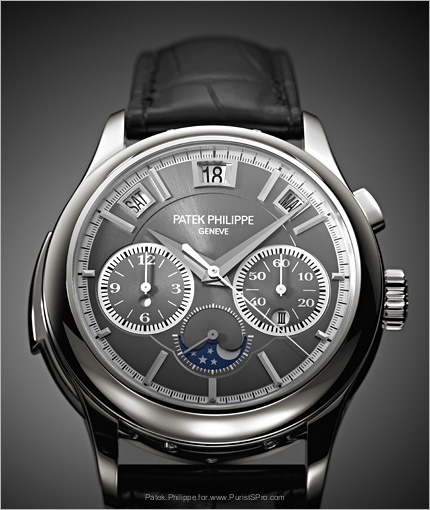
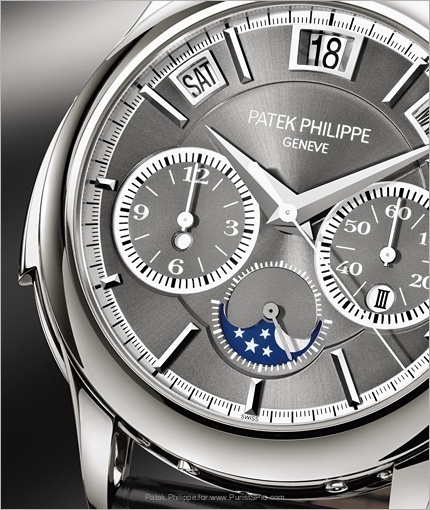
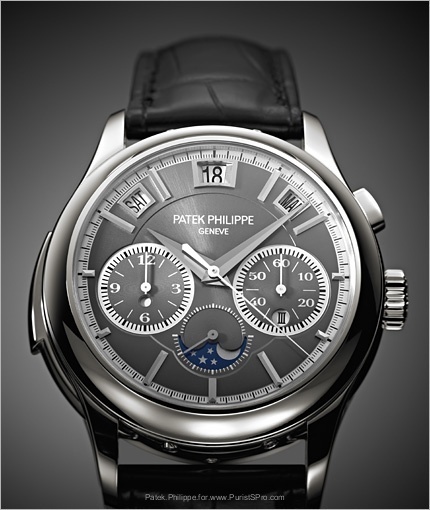
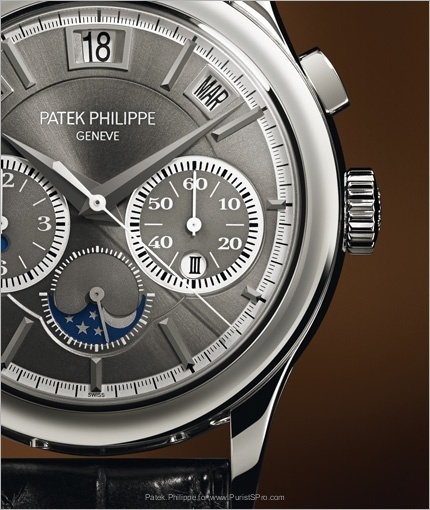
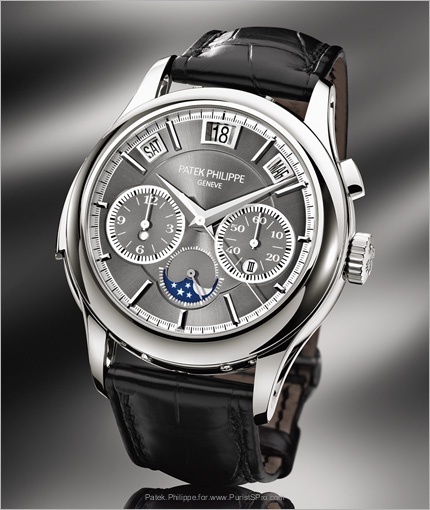
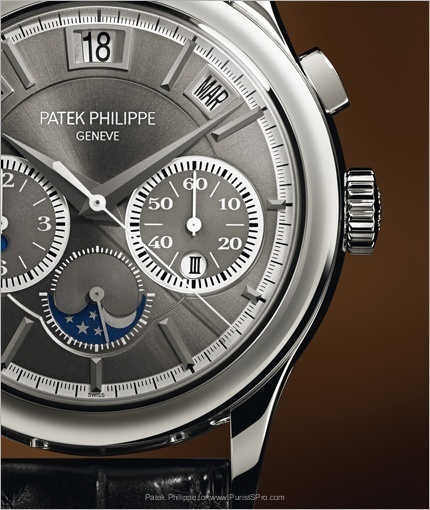
If the watch is
extremely complicated and high tech, it is surprisingly simple in its dial
organization and consequently seems easily readable, whatever information
you're looking for (and if you can't read it you can still make it
ring). The calendar is nearly on line at the top. The time is easily readable
on the vertical axis. The chronograph indications are on a horizontal line at
the middle. The moon phase is nearly alone at the bottom if someone really
wants to read it.
It is also
simply usable: only one pusher for the chronograph (start, stop reset), one
slider for the repeater!
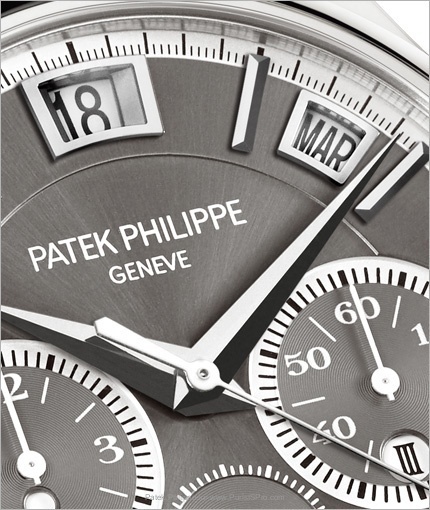
The
implementation of the chronograph parts has been done between the base plate
and the calendar plate (that is right below the dial). This was necessary as
the repeating mechanism couldn't be moved and needed all the room on the
back side. That has two consequences.
First you won't see the chronograph mechanism from the back.
Then it has
necessitated to have an indirect indication of the time as the base plate and
the dial were separated by the chronograph mechanism and the cannon pinion
couldn't go through the chronograph wheel. So the energy of the cannon
pinion is transferred laterally to pass through the chronograph mechanism and
be sent back to the middle of the watch dial to drive the minute and hour hands
and the instantaneous perpetual calendar indications. Only the seconds hand at
six is powered directly!
The perpetual calendar
plate is directly inspired from the 5207 plate but has been adapted to
accommodate the presence of the chronograph mechanism below. The complication
of the instantaneous indication relies in the necessity to have all indications
move at the same time of course, and as they need more energy than hands, to
have them move perfectly, without any incomplete or excessive move. Again
such constraints were analyzed there: patek.watchprosite.com
The chronograph
mechanism is quite modern too as it uses for powering the minute and hours
counters the friction drives of the Patek Philippe proprietary calibre CHR
27-525 PS of the ultra thin split seconds 5959 (and now also 5950 and 5951). It
also uses the toothing profiles of the chronograph wheels of the same calibre,
to reduce wear and increase power transmission efficiency.
Furthermore it
also uses the patented self setting hammers and brake levers of the other
proprietary chronograph calibre CH 29-535 PS of the 5170 and now 5270. This
calibre was extensively explained there: patek.watchprosite.com
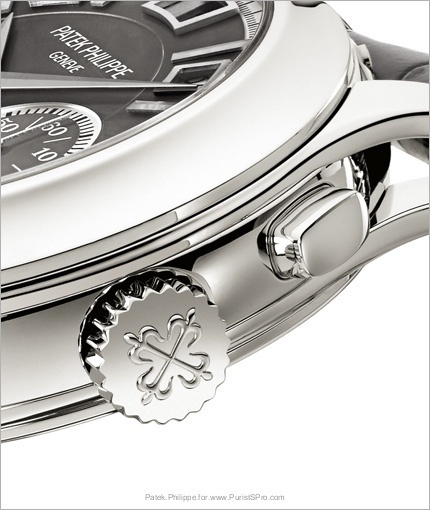
As already said
the chronograph is of the monopusher style. There's only one pusher that
always repeat the same cycle: start/stop/reset.
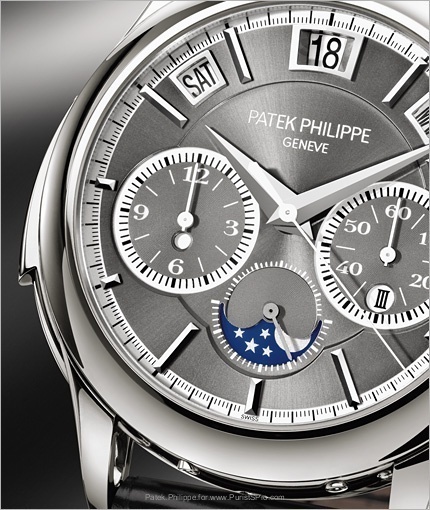
The seconds are
read on the central hand, the 60 minutes at 3H30 and the 12 hours at 8H30. You
will notice that the leap year indicator and the night and day indicator are
discreetly sunk into the chronograph counters.
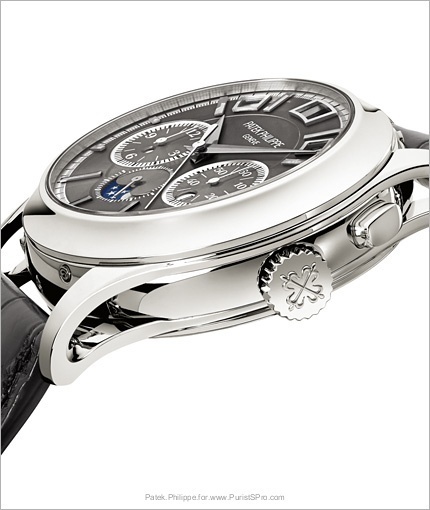
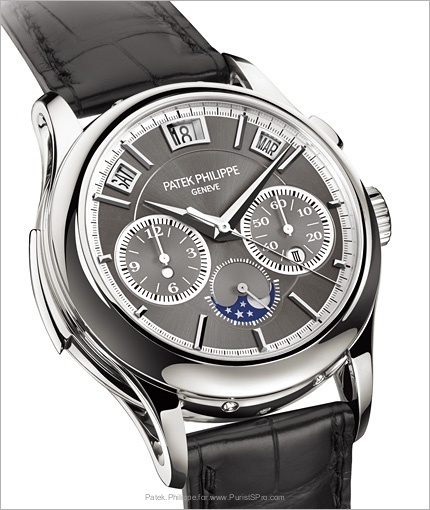
Another aspect
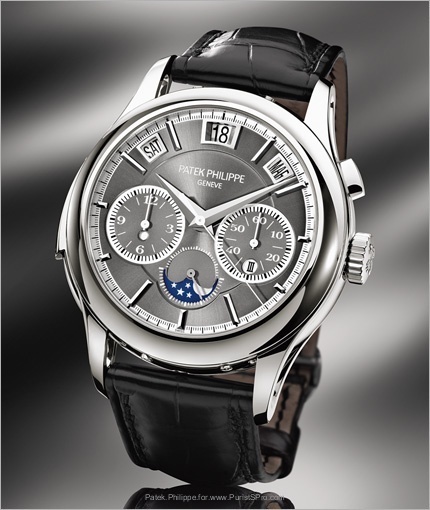
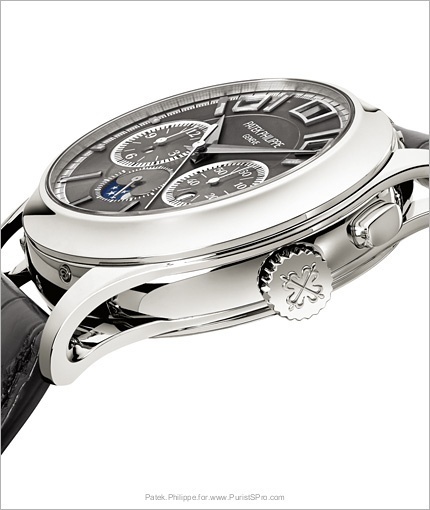
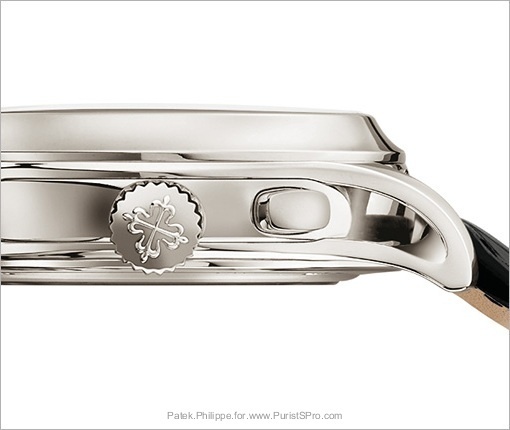
that you may easily miss is the case construction. Please look at the picture
above and you will notice a three parts construction: back, middle and bezel. But these
three parts are clenched between and screwed to two clamps. These two clamps
are also the pierced lugs. That gives a very appealing construction as you can
also see below.
The 701 parts
fit in a 44mm platinum case (thickness 15,70mm). You will find the full
technical data below.
Are you ready
to measure the time it takes to your minute repeater to ring the time ?
Dje
Technical data Grand
Complication Ref. 5208 in
platinum Minute repeater, monopusher chronograph, instantaneous perpetual
calendar with aperture displays, and moon phases Movement Caliber R CH 27
PS QI Self-winding mechanical movement, minute repeater and subsidiary
seconds. Monopusher chronograph with column wheel, chronograph hand, 60-minute
and 12-hour counters. Instantaneous perpetual calendar. Day, date, month, and
leap-year cycle in apertures, day/night indicator, moon phases. Overall
diameter: 32 mm
(repeater and chronograph 28
mm; instantaneous perpetual calendar 32 mm) Height: 10.35 mm Number of parts: 701 Basic movement with minute repeater: 331 Chronograph
mechanism: 160 Instantaneous perpetual calendar: 210 Number of jewels: 58 Power reserve: Max. 48 hours Balance: Gyromax® Semi-oscillations per hour: 21,600 (3 Hz) Balance
spring: Spiromax® Escapement: Pulsomax® (lever and escape wheel in
Silinvar®) Balance spring stud: Adjustable Functions: Two-position crown at 3 o'clock – Pulled out:
To set the time – Pushed in: To wind the watch Pusher: Three-phase chronograph monopusher at 2 o'clock: Start,
stop, reset Hallmark: Patek Philippe Seal Displays: Hours and minutes from the center Sweep chronograph hand Subdials
at: – 60-minute counter between 3 and 4 o'clock – 12-hour counter
between 8 and 9 o'clock – Subsidiary seconds at 6 o'clock Apertures: Day between 10 and 11 o'clock in a polished white-gold
frame Date at 12 o'clock in a polished white-gold frame Month between 1 and 2
o'clock in a polished white-gold frame Moon phase at 6 o'clock Day/night
indication between 7 and 8 o'clock Leap year cycle between 4 and 5 o'clock Corrector push pieces: – Day corrector between 11 and 12 o'clock
– Month corrector between 12 and 1 o'clock – Moon-phase corrector
between 5 and 6 o'clock – Date corrector between 6 and 7 o'clock Delivered with correction stylus in ebony and 18K white gold Slide Minute repeater with strike on low-pitched gong for hours,
high/low for quarter-hours, and high for minutes. Features Case: 950
platinum with pieced lugs, platinum back, and interchangeable display back with
sapphire-crystal window. Diamond of approx. 0.02 ct. between the lugs at 6
o'clock Dimensions: Diameter 44
mm Height: 15.70 mm Width between lugs: 22 mm Slide: In 950 platinum on the left side of the case to activate the
minute repeater Dial: 18K gold, sunburst charcoal 11 applied "obus"
hour markers in 18K white gold Dauphine hands in 18K white gold for hours and minutes Baton-style
counterbalanced chronograph hands, 18K white gold, white lacquered Baton-style
hands for subsidiary seconds as well as 12-hour and 60-minute counters, 18K
white gold, white lacquered Railway track scale on dial periphery 18K
white-gold frame for date aperture, hammered and diamondpolished 18K white-gold
frames for day and month apertures, hammered and polished Strap: Alligator leather with square scales, hand-stitched, shiny
chocolate brown, platinum fold-over clasp
The Patek Philippe Calatrava reference 600 is a significant early example within the Calatrava lineage, representing the foundational design principles of the collection. This reference predates many of the more complex complications found in later Patek Philippe models, focusing instead on purity of form and legibility. It embodies the brand's commitment to traditional watchmaking and understated design, setting a precedent for subsequent Calatrava iterations.
This particular reference typically features a case crafted from precious metals, often yellow gold, with a modest diameter that aligns with historical preferences for dress watches. The movement powering the reference 600 would be a manual-winding caliber, reflecting the mechanical advancements of its era. The crystal would have been a material common for the period, protecting a dial designed for clarity and timeless appeal.
For collectors, the reference 600 holds importance as an early and unadorned representation of the Calatrava's core aesthetic. Its simplicity and historical context make it a desirable piece for those interested in the evolution of Patek Philippe's most enduring dress watch collection. Variants within this reference would primarily involve different dial finishes or case materials, maintaining the essential Calatrava character.
Just stunning !!! I have no words Great pictures !!! Regards
nt
Awesome dial, great to have a monopusher, and I appreciate these " empty " lugs which give a lot of modernity to this watch. Aren't the unreasonable dreams the nicer? Best, and thanks for this great post. Nicolas.
Hi, In fact I hope to see it someday, even if 44mm is not very much Patek Philippe for me, so far. Cheers Dje
Thank you, and I guess this is not far to be ma favorite Patek (with the 5074 & 5004), I especially like the date position. I have maybe a little doubt about the upside down moonphase. This message has been edited by Borale on 2011-03-27 15:00:24
Hi, The 5074 is a favourite of mine. I've just always feared it to be slightly large. But compared to this 5208 the 5074 is a small watch, so perfect. The 5004 was a dreampiece, but on a daily basis a 5970 or 5070, or even a 3970 would be enough for me. I'm an easy guy you see. Cheers Dje
This thread is active on the Patek Philippe forum with 34 replies. Share your knowledge with fellow collectors.
Join the Discussion →