
A chat with Goris Verburg, IWC's new head for South-East Asia
Goris Verburg took the helm at IWC in South-East Asia at the beginning of August, after a stint as Regional Manager for Asia, Middle East and Africa at Schaffhausen.
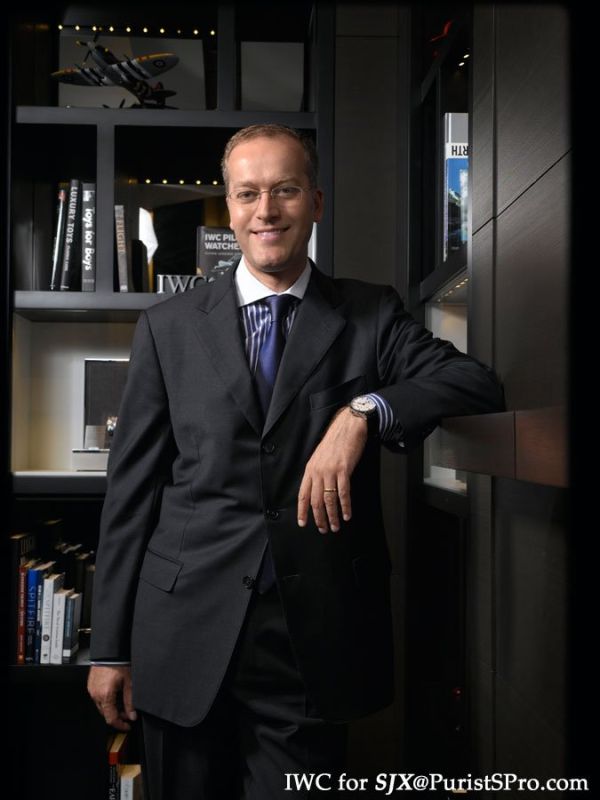
Goris Verburg
Goris possesses a coolly cerebral and efficient manner that is more management consultant than luxury watch brand manager. Unsurprisingly, unlike the average brand manager whose background is typically within marketing luxury or consumer goods, Goris began his career as a consultant at McKinsey & Co., after which he took the position of marketing manager for Estee Lauder cosmetics in Switzerland before joining IWC.
In the brief interview below, Goris makes some very interesting points about IWC’s strategy and positioning, as well as the differences in consumer profiles in different markets.
Su JiaXian (SJX): How do you see IWC as a brand?
Goris Verburg (GV): IWC has experienced a strong revival since 2003 and keeps on outperforming the market in terms of growth. The key factors at the beginning of the decade were the global expansion and taking over the distributorship from 3rd parties. Over the last 4 years, however, the growth proved to come foremost from IWC’s distinctive marketing program clearly targeted and positioned at 30-54 year old male clients with a discerning taste for individualism and mechanical movements.
Furthermore, IWC systematically developed its product innovation based on the 6 established product families. With this broad collection, IWC can cover a wide range of customer segments (from sports watches to classic watches with complications) and continue to serve repeat clients within the brand both in terms of product and pricing. We are one of the rare brands which offer timepieces from S$6,000 to almost half a million, encouraging our customers to grow within the brand.
SJX: What are your plans for IWC here in the region?
GV: IWC had a late start in South East Asia compared to other watch brands and there is still plenty of room for growth to attain its fair share compared to IWC’s global market share.
The key challenge will be to individualize our marketing program by country as the various countries in SEA are in completely different levels of watch appreciation: Singapore is considered a mature market in term of watch knowledge, in Vietnam basic ground work has to be performed and Australia has to be educated that there is a watch realm beyond the stainless steel sports watches.
As to the network, we do not plan to expand it systematically, as it has a good density. Openings and closings will balance out in the future. Occasional boutique locations will be evaluated, but no aggressive expansion. However, we want to grow our space in the multi-brand stores.
SJX: How does the watch market in this region differ from that of other areas?
GV: To put it in a generalist and simplistic way, Europe prefers the inner values of the watch, individualism and understatement and this is shown through their choice of manufacture timepieces; white gold over rose gold pieces, for subtle luxury.
The US tends to go for conformism, wearing what other successful leaders display on their wrists.
Middle East and Russia desires the most expensive complication available to them in rose gold or fully encased with diamonds without a deep understanding of the watch’s movement and history.
Singapore is parted in this respect, as it has a very knowledgeable collector’s community that carefully selects their acquisitions and then you have the more prestige-oriented clientele that goes for the image and the looks. These two distinct and strong interest groups stimulate the brands to offer an interesting a wide array of product offerings in this region.
SJX: Given the current economic situation, do you see any particular opportunities for IWC?
GV: IWC proved quite resistant in recent times due to its good price-value ratio and the wide selection of product families. Due to the improved availability of movement parts, IWC could even improve its sales quantity, though the average price dropped as more stainless steel models were purchased and less of the higher complications which is a trend fully within our expectations. These high-end complications remain self-reward pieces which are less purchased when there is no personal financial gain to be celebrated in this current economic situation.
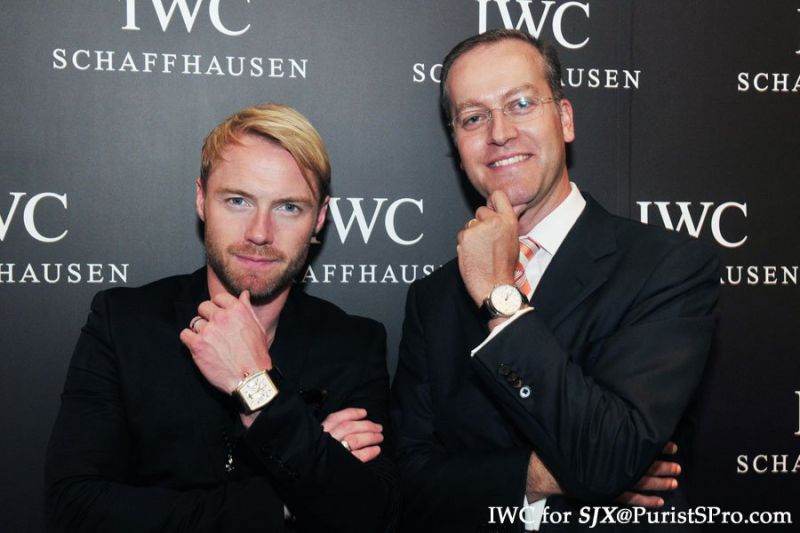
Goris Verburg with Ronan Keating at a recent IWC event in Singapore
SJX: You have had wide experience in various countries in the Western hemisphere what do you personally look forward to about living in Asia?
GV: Asia will be an even stronger driving force for global economic growth in the near future. The privilege to share just these days in the region is a great motivation. Furthermore, I love the Asian culture, the food and the work ethics in Singapore and feel very much at home after just one month.
Quite an interesting read...
Being an amateur observer of the Asian watch retail scene, I had imagined that the course upon which the brand will take AFTER setting up numerous boutiques housing only their brands would solely be to maintain, if not lessen presence in multi- brand stores in an effort to dispel potential pricing wars and to further thrust upon their boutiques the role of not only standing as glorified display showrooms but to actually serve as substantial points of sale with real volume pointing towards a new POS structure down the road of eventually phasing out presence in multi brand shops, retaining just the boutiques as sole POS for the brand.
Looking forward to see how IWC moves forward with Mr. Verburg on the helm. Thanks for sharing the interview JX.
Multi-brand stores and boutiques
destocking by multi-brand stores in the recession. Those brands operating
their own stores fared better, so Louis Vuitton did all right but not TAG
Heuer, even though both are part of LVMH. To use a handbag analogy, only the
very top brands in the segment, like Louis Vuitton and Hermes, can afford to
sell largely through their own network of stores. Celine, Lancel and Bottega
Veneta can't do that.
For watches, while I am sure more monobrand boutiques will emerge in the
future in Singapore and the region, for all but the most preeminent brands,
the boutiques will be image builders rather than actual sales volume
generators, though boutiques may sell more top-end, very expensive stuff to
foreign buyers than retailers. No watch brand makes numbers public but
multi-brand retailers still generate the bulk of sales for most brands.
Though if the profile of the clientele changes as the casino resorts open in
Singapore with more tourists, boutiques may make more sense for brands.
- SJX
Appreciate...
the clear explanation and sharing of your thoughts. Having said that, I look eagerly ahead into the near future if changing market situations dictate a change or not to the current sales structure. Thanks again...

Well, I disagree on the distinction made on
European, US, Russian, and Asian Collectors...
Some, everywhere in the world are attracted for fully paved watches, not only Russian.
To generalize is always a dangerous game...
Besides this, the funny thing is that since 2003, I have less interest on IWC watches.
I see less inpsiration, less creativity, and to say all, less Identity on IWC watches than before.
For example, the Portuguese PC with the Double moonphase was a gorgeous watch, in platinum or in Gold.
Now, the current model is less attractive, to me.
The Portuguese 7 days ref 5000 was a lovely watch.
The new 7 days is a nice watch, but less sexy than the ref 5000, IMO.
Idem for the previous Minute Repeater versus the new model, or the weird Zidane and Figo Limited Editions, or the development of the Cousteau Divers ( the first was a blast, but the others ? )
Funny how we can see things differently.
Would be interested to read others opinion on this.
Best,
Nicolas

Indeed, we all see things differently...
a matte of perception in a person's statement or even a picture.
Having said that, I do agree that current lines seem less appealing to me as well. BUT could that be a matter of the watches still being attractive but our tastes having shifted? Or law of diminishing return coming into play as strong lines of the IWC brand seemingly having less effect on us as time goes by?
VERY interesting topic, perhaps best discussed over some cold ones in lieu of the open world of the internet where one's statements can be VERY easily be misunderstood...

There are exceptions to the rule of course
Nicolas, I agree stereotypes are dangerous. But Goris' comments were generalisations for particular markets and I find them accurate based on personal experience as well as comments from other industry executives.
As for your thoughts on IWC watches since 2003, well in general I would agree with you - no dangerous game in that generalisation.
- SJX
LOL, SJX!
Of course there are some exceptions about the latest IWC watches, let's say ...A Few, in my opinion and tastes.
But I think that generalisations about people are ALWAYS dangerous.
Would a Russian be happy to see that Russians generally are considered to be fans of bling watches?
Even if that MAY reflect the market tendancies, I would appreciate more prudence and reserves on such words.
Best,
Nicolas

I was surprised with Goris' honesty in answering the questions...
However, I think Goris knows that most PuristS are aware of the industry and afforded SJX a certain respect in giving him further details about the preferences of particular sales regions. Goris was also extremely straightforward and concise. The remarks made by Goris about all the markets fully matches my perception with the buyer of that particular market.
However, Amanico is also right, stereotypes and generalizations aren't always accurate. For instance, I have met only very sophisticated watch collectors from Russia, Romania, and Slovakia who place a high emphasis on the the movement and a brand's history and gravitate towards Breguet and Patek Philippe watches.
Overall, I appreciate Goris' responses. However, once again, I have filtered what he has said to be a generalization of the market; and I understand that there are some unique individuals in certain markets that have a different perception about watches.
Goris' concise, frank and accurate answers are especially surprising...
given he was once a management consultant!
- SJX

Large common denominator
SJX,
Thanks for the chat with Mr Verburg.
It fits with current IWC strategy to go for the largest common denominator for design (re-issues) and sales will surely follow.
Weird, avant-garde, innovative and freaky designs may bring critical acclaim from a few arty types but the real value is the hordes of moderate affluent buyers of the solid no nonsense engineering from IWC.
Regards, MTF