A Watch For a Tuesday
Ok. Maybe that's a dumb title, but it's what I happen to have on my wrist right now and I feel like posting its photo and the day of the week is as good an excuse as any.
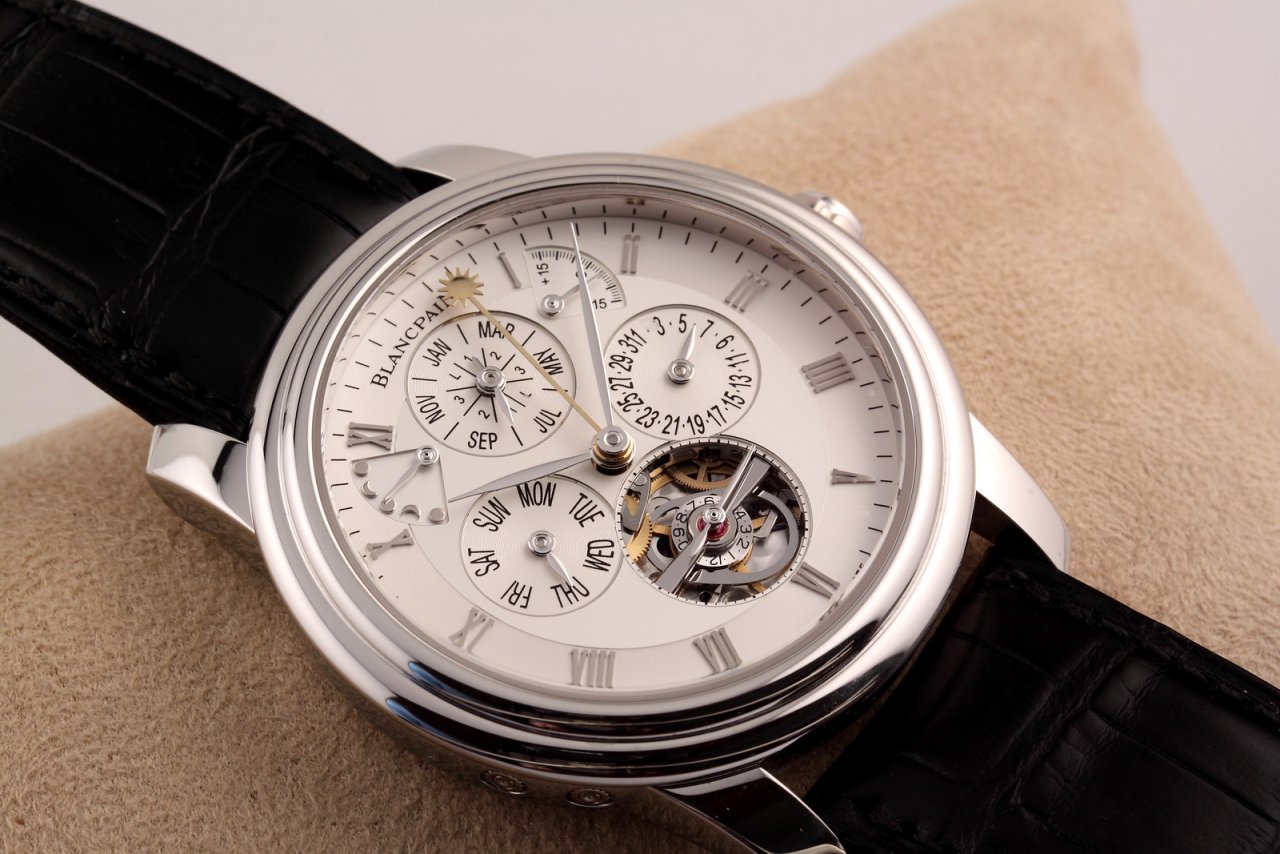
This is the limited edition Blancpain Le Brassus Equation du Temps Marchante. It's complications are two fold, or three fold, depending on how you look at it. One is the perpetual calendar. The second is the equation of time. But this equation of time is itself complicated, offering both a "standard" plus/minus indication and a running equation which uses a separate solar minute hand.
If you really want to understand equation of time, talk to someone who is passionate about sundials. Those are the connoisseurs who really deal with the details of equation of time, because a sundial always displays solar time. The sundial devotees then have to convert what their sundials tell them to civil time. The problem is of course that our regular civil 24 hour day is not replicated by the actual solar day we experience. The solar day varies in length throughout the year and so it is the case that solar time and civil time do not correspond (except for 4 days a year). The difference can be as much as 15 minutes plus or minus.
What sets this Blancpain apart is that it offers a running equation of time. Few watches offer equation of time at all and throughout watchmaking history it has been a rare complication in any form. When it has appeared in wristwatches it has until this watch always been in the form of a plus minus indication. Trouble is with that kind of indication it has never been displayed on the watch whether the plus minus indication (giving the difference between solar time and civil time) is telling you how to convert from solar to civil or from civil to solar. That is simply unsaid and it has been up to the owner of the watch to figure that out. A running equation of time is different because it offers a separate solar minute hand. Thus the watch will simultaneously show both civil time and solar time and show you which time is ahead of the other. The solar hand is the minute hand bearing the image of the sun-logical that touch. This Blancpain watch was the first wristwatch in the industry to offer a running solar hand, termed "euation du temps marchante".
Jeff

May I disagree?
It’s a watch for no less than EVERYDAY use, Jeff – I would have the hardest of times taking it from my wrist.
Nevertheless, I think one should be careful wearing this work-of-art everyday...
I loved the explanation on how it works! What a beautiful complication!!! The window at 6 is a gorgeous plus!
Can you speak about the -15 / + 15 indicator between 1 and 2? I looked at Blancpain’s website but didn’t find any info on it.
Regards,
Marcelo
The +/- indicator
Hi Marcelo:
The +/- indicator is a second equation indicator. So the watch has two equation displays, the running equation with the solar time hand and the "more conventional" indicator which gives the equation in +/- form. Obviously (or it seems obvious to me anyway), the +/- indicator is there mostly to balance the dial with the retrograde moon phase on the other side. Both of the equation indicators drive off the same elipsodial cam. The running equation is MUCH more complicated as it requires a set of differential gears in order to combine inputs from the regular running train of the watch and the equation cam.
Jeff


Tat is my only qualm
With the Le Brassus range (although I have one myself) . Its a mite too big at 42mm (not to mention thick).
I'd much prefer the Villeret or Leman when in comes to Grande Complications
Nevertheless, nice photo and write up Jeff !!
Thank you
This message has been edited by flamenco on 2009-10-13 19:42:35That sure is top of the bill!
Hi Jeff,
Gorgeous watch that is; I love those brands who keep surprising us with new complicated pieces. These are real pieces of art for me. And even if one cannot afford such beauties checking out these posts is second best.
Best,
Starman

Very elegant Perpetual Calendar, Jeff!
A magnificient piece, indeed!
Would be a perfect watch not only for Tuesday, but for everyday!
Best,
Nicolas