ATMOS clock---trying to get info on age of my clock
There are no markings on the back of the clock, nor are there any underneath the clock.
I am fortunate that the clock is still in good running condition.
I have attached some photos, and I apologize in advance for the poor quality pictures.
Any help is much appreciated.


why don't you contact ...
JLC directly from their website. give them all info you have and the pictures and they will give you more info and most likely the year the clock was made.
it is simple and reliable. you just need a bit of patience for them to look in their archive.
go to JAeger-lecoultre website :www.jaeger-lecoultre.com
then locate the contact link at the bottom of the page.
then select antiquewatches for your query and write them a nice message.

As time2tic suggested,
try contacting JLC. Few of us have access to a chart that will date an atoms by serial number.
But, of course, one of the forum members may have a clock similar to yours and will be able to help you out. Who knows!
But, if you haven't already, do take time2tic's advice and contact JLC directly. That's a sure bet.

Here is a....
website (and I think it is suitable for a link from here) which has some interesting information about ATMOS clocks including serial number estimation of date of origin.
I have no interest in it other than stumbling across it when looking for information on ATMOS clocks. There is information available on the site which will give you some indication of the origin of your clock according to its serial number as well as photographic examples of these clocks by era.
Of course, contacting JLC directly as suggested will give you the best information but you may find this site of interest.
tempusfugit

Very nice specimen, Jeremy!
Contact JLC, and provide them the same pics and the serial number, they will answer you, but don't do it before the beginning of September, as they are in Hlidays till the beginning of next week, and I guess that they will have hard time, at this moment.
Best!
Nicolas

they are brilliant clocks regardless of age. the best mantle clock made IMO
i have one and it was the best decision i ever made to buy it. its set up and apart from changing the time twice a year i dont need to touch it. it keeps time and doesnt need winding. i also have a pre 1912 Gustav Becker torsion clock which although it only needs winding once a year is a nightmare to set up and regulate. if asked i'd tell everyone everytime to go for an Atmos. mines from the 80's i think. yours has a much earlier serial number over 300,000 less and the earlier case removal method which can be a bit of a problem to operate. with mine the case front glass pops out so you level it up and dont disturb it when getting access to the dial. with yours you need to lift the whole case off which can if your not careful can upset the levels.
my advice is, if you've got it where you want it and its working then leave it well alone
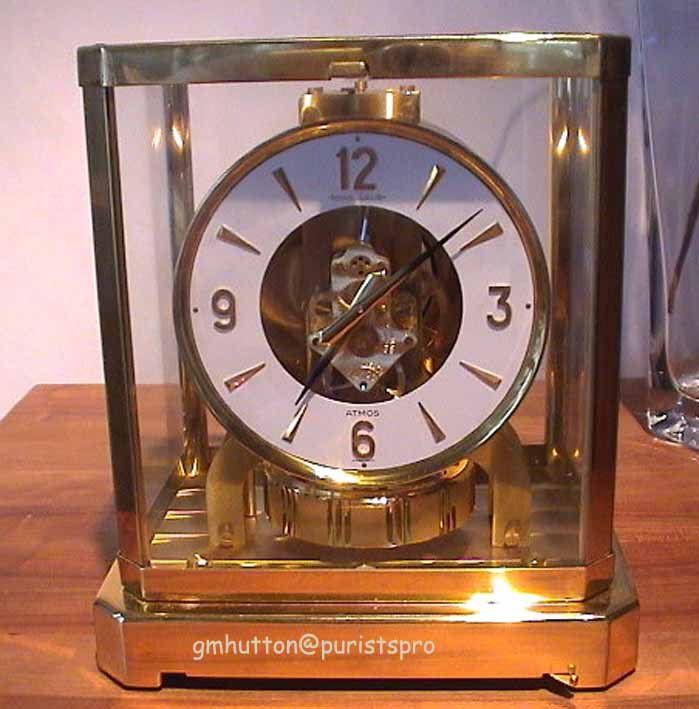

i hope you find the information you want and enjoy its effortless movement and timekeeping.
Graham
This message has been edited by gmhutton on 2009-08-12 12:01:49

Information about the Atmos II
Hi Socko,
You will find hereafter some information about the Atmos II. They are based on an article written by Mun Chor Weng and published in a special release of Timewerke.
The production of the Atmos II started in 1936. However, at the beginning, JLC had to solve logistical production issues with the airtight chamber and only very limited number of units were produced the first years. The commercial production resumed in 1939 and ended in 1950 when the Atmos III was issued.
All Atmos II do have a serial number on the movement. In your case, the serial is 11733. But not all have a second serial number on the bridge. For those wich have 2 serial numbers, the second number was stamped on the bridge when the movement was fitted into the case for the final assembly.
If you confirm us that there is no serial number on the bridge of your Atmos II (i.e. on the top of the clock between the two screws on the photo below), it means that your clock was produced between late 1945 and early 1950. I don't see any number, but it could be because of the low quality of the photo.
I hope that JLC will be able to give you more details on the precise date of production. JLC has kept records of the production of the Atmos, except for few periods of time. Between 1941 and 1949, Atmos II were produced as follows:
| Year of Production | Number of units made |
| 1941 | 959 |
| 1942 | 665 |
| 1943 | 268 |
| 1944 | ~ 369 (June production unknown) |
| 1945 | ? |
| 1946 | 2,654 |
| 1947 | ? |
| 1948 | 1,308 |
| 1949 | 1,749 |
source: Jaeger-Lecoultre
No serial number on the bridge---
Thanks for the great info.
I verified the bridge, and there are no markings at all. The only marking I can see is on the front face of the movement.
I have sent a request to JLC as others have suggested, inquiring if they can more accurately identify the year of manufacture.
Thanks to all for your suggestions.
BTW, she's still running strong and hasn't skipped a beat!