case size ALWAYS dictated by movement?
This observation got me thinking. Is there a lot of 'free space' in the case? Not to oversimplify, but for aesthetic reasons does JLC first determine the size case that it desires for this model and not change it unless the movement is too large?

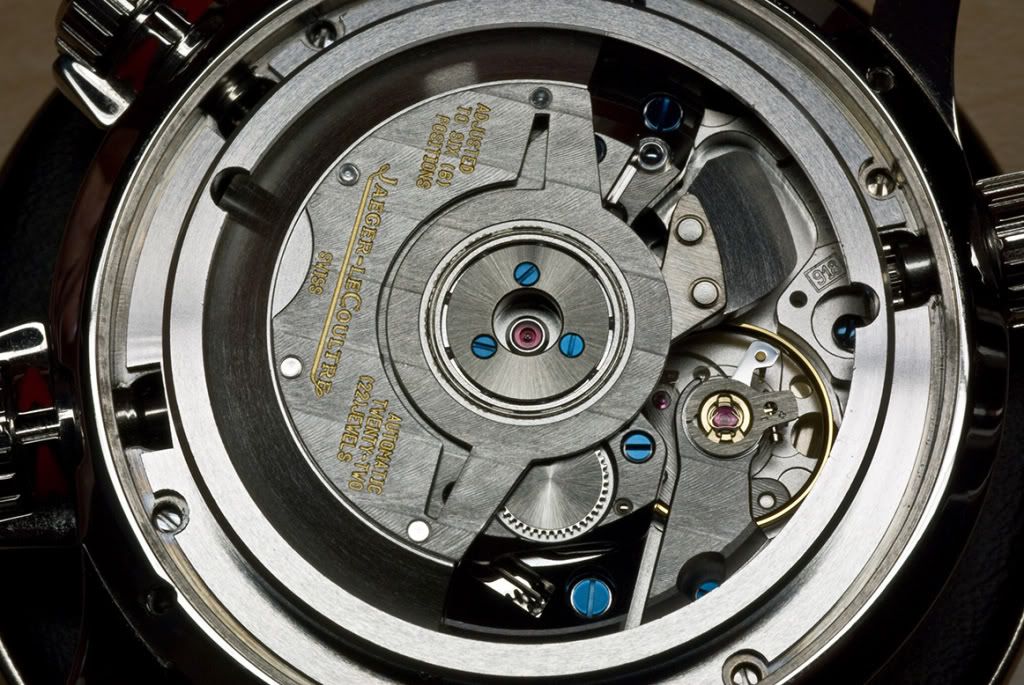
Movement is quite large - photo attached
Hello mjnoumoff,
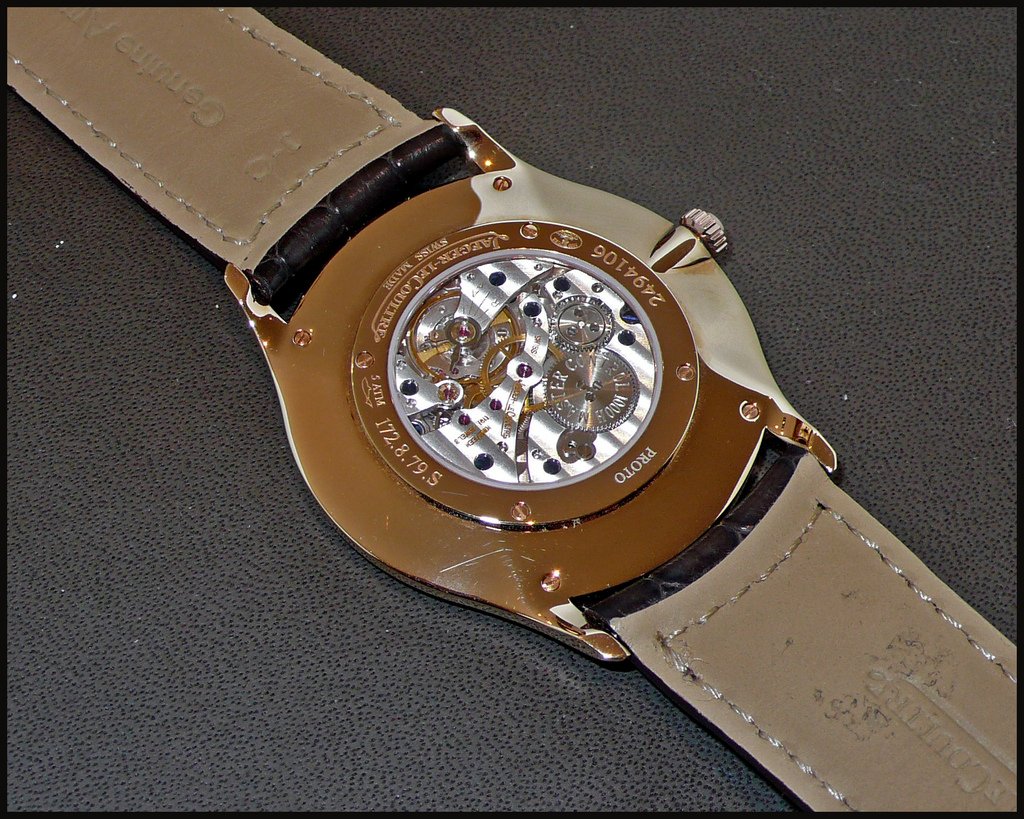
In the case of the Master Compressor Memovox, the case size is quite appropriate to the movement size. If you take a look at the photo below of my Memovox with the case back removed, you can see that the movement fills the case to a large degree. Note on the right side of the photo at about 2 o'clock, you can see where the crown for the inner rotating bezel is. There is a gear there that rotates the bezel when the crown is turned. Compared to many modern watches, this one has a movement that does fill the case.
As a watchmaker I see a lot of watches cross my bench that have huge movement spacers inside, and tiny movements. I can't speak with any certainty of JLC's overall design philosophy in this regard, but my feeling is that in general they do not make cases that are much greater than the sizes of the movements within, although there may be a few exceptions.
I hope this helps.
Cheers, Al
great picture!!
Thanks for all the great responses and for your opinions!!
great pictures from everyone!! Great Duometre picts!

You are welcome
Here is another shot showing the gong on the case back for you reference.

Cheers, Al

Case size is more a design specification due to marketing aspects these days...
When JLC designed the MC Memovox, their intent was obviously to create a modern sport watch which had all the features that were 'in the air' at the time for a watch of this segment.
Hence the size, and the compressor keys, which were a nice gimmic to be a differenciator (although technically speaking, they are not really necessary for this watch).
They used the alarm movement that was available at the time, the cal 918, which is the contemporary evolution of the old 916 of the 1970's (918 has the same size than the 916 that was fitted in 36mm diameter cases back then).
So, in that case, movement was not designed according to case size, nor the reciprocal logic.
They just happened to assemble the available movement with the required complication, with the case size they had designed to fit the taste of the day (hence the relatively large gap between movement and case as seen in the picture).
Now, for other watches, where movement has been created after that a new line has been introduced (or designed for this line, eg Reverso XGT case), movements are better fitted with case size.
But it is not the case for the MC Memovox, as you pointed out.
Relatively large gap....
You really think this is a large difference?
Certainly not debating that the case size here was a result of producing for the current market, but I personally don't see this as a movement lost in it's case like many I have encountered, especially when you take the inner bezel into account.
Cheers, Al
indeed
Yes, I think the gap is pretty large in the case of the MC Alarm.
As an illustration, almost the same movement (916, same dimensions), housed in a ref 875.
Here, the gap is very narrow (less than 1mm)
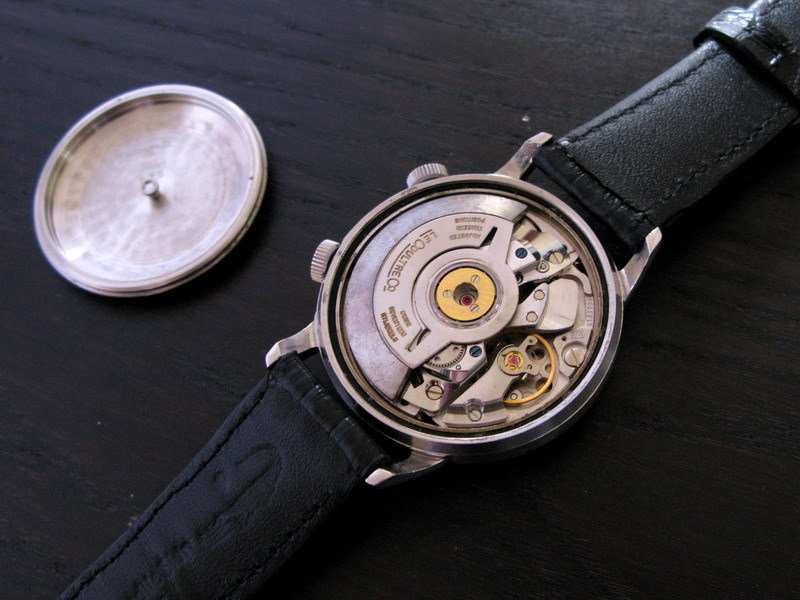
Relative to vintage...
without an inner rotating bezel, I can see your point. IMO relative to modern cases and movements, it's more than acceptable. In the case of the Master Compressor we have a 13''' movement in a 41.5 or so mm case. Compare that to some with 11.5''' movements in 44mm cases and above, and this one is not what I would consider a large gap.
But of course, we can agree to disagree.
Cheers, Al
As an aside, another example
From reading abot the development of the EWC, JLC initially had a goal of creating a watch with a 45mm diameter, but the shock absorption system and the strap changing mechanism required a case size of 46.3mm in the end.
Another interesting example is the MUT. The same movement that was in the 34mm MUT now rests in the 38mm case of the MUT38. The cal. 849 movement in the 34mm version looked small even for that smaller size case, but now looks even smaller. But I am imagining there are some critical considerations in designing a case for an ultra thin movement such as the caliber 849. Such ultra thin movements are extremely delicate, for instance. It is challenge enough to make an ultra thin movement let alone one that fits modern day size cases of 38mm or larger.
So, sometimes there are ex-movement conditions that dictate the final case size of JLC watches.
respo
This message has been edited by respo on 2009-07-21 10:32:36Not always
I have 2 perfect YES and NO examples:
The Duo Metre case was conceived in coherence with the size of the movement.
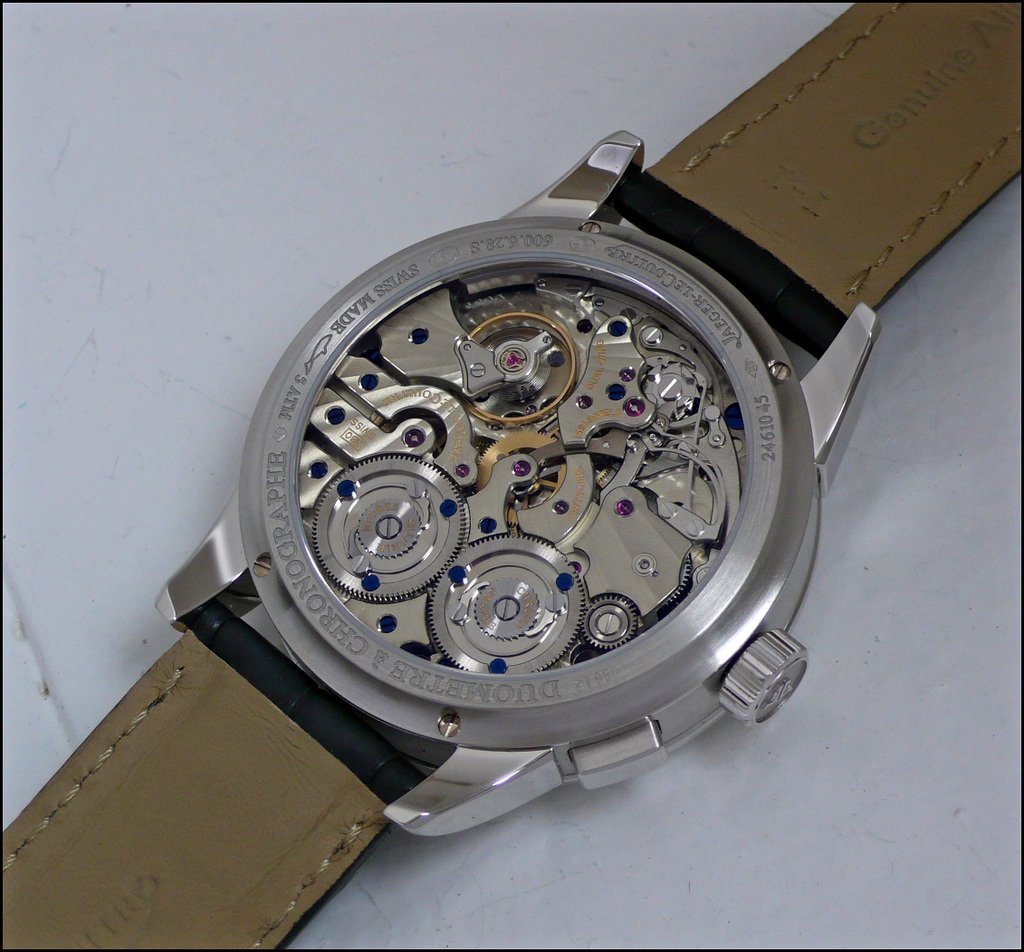
The MUT new generation ( it was also the case for the previous 34 mm version ) case was not dictated by the movement:
Best,
Nicolas
these examples
If the question is tn know if cases are dictiated by the movement
No, the MUT is not the exception...
Have a look on some Reversos, among the simpler one, and you will notice the same.
THere are several examples where a caliber was conceived for a watch regarding a certain case, and re used in a bigger watch.
Another example ? The Cal 956 which was used in the POlaris ( 42 mm ) is also used in the Navy Saeals Alarm ( 44 mm ).
But is it really a problem?
Best,
Nicolas
to me ...
by comparison, using massive nylon spacers to fit an very small calibre into a large case is a bit ridiculous.
for example, ETA calibres have been put in all sorts of case with all sorts of dimensions, with all sorts of sapcers ( including real not so sexy white nylon spacers) but we are miles away from JLC practices here.
JLC is producing for their lines some 40 calibres. I don't know many other brands who can claim the same.