Comments:


Breva Genie 01 Weather Forecast and Genie 02 Altimeter
One of the most
distinctive movements that I've seen atJCK 2015 in Las Vegas were from
Breva. This is the first time that I've ever heard of the
Breva Genie 01 which is a mechanical wristwatch that displays the
altitude and weather forecasting with a anaerobic barometer; and their
Genie 02 model with altimeter, and the Genie 03 with a speedometer or
anemometer. I am fascinated by the 03 with the speedometer
function (and I'll have a separate post on it) but let's first take a
look at the 01 and 02 models.
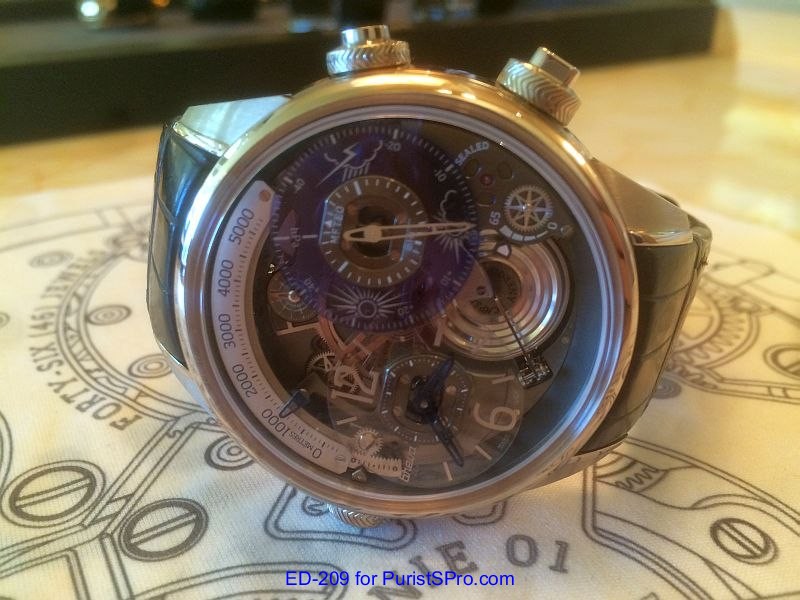
The Breva Genie 01 dial has several indicators. The hours and minutes are displayed at the 8 o'clock position with transparent sapphire subdial. I handled the platinum version that blue skeletonized hands that was fairly easy to read. Looking closely I saw a smaller grayish colored subdial near the 12 o'clock position that was partially hidden behind the blue sapphire crystal of the subdial for the barometric pressure. And on the upper left quadrant of the outer edge of the dial is a scale displaying altitude. At the 4 o'clock position is a power reserve indicator with a scale showing up to 65 hours. A little detail that I really liked was that this power reserve is shaped like compass rose instead of the typical single hand.
Most of the area between 5 and 6 o'clock is the aneriod capsule to measure air pressure. The adjustments to the barometric pressure is done by a pusher/ring at 2 o'clock which also has pusher for adjusting the altitude. 4 o'clock has another pusher for an air valve that equalizes the interior and exterior air pressure. Winding and time setting is done with the crown at 9 o'clock.
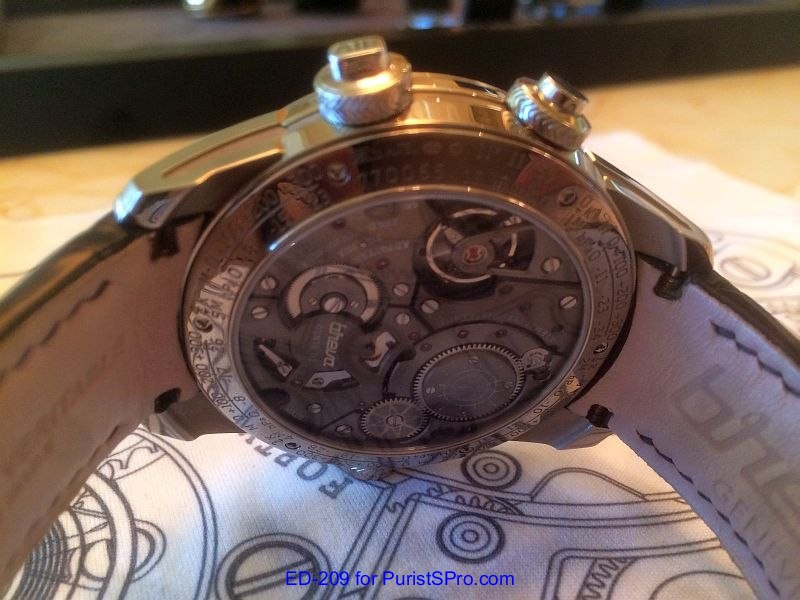
The back of the Breva Genie 01 has a transparent caseback that showcases the movement. The caseback has an engraved scale for correlations between altitude and air pressure.
I still remember when I used to go hiking and rock climbing in the Mount Lemon area of Arizona and my climbing instructors used to carry a Ambient Weather WM handheld digital meter. During one of our climbs, the pressure suddenly dropped and we can feel the static electricity in the ropes. He used the AW WM to measure the barometric pressure and we quickly descended before an approaching thunderstorm that is common during the late summers. I'd be curious to see how accurate this Breva 01 would be in similar situations.
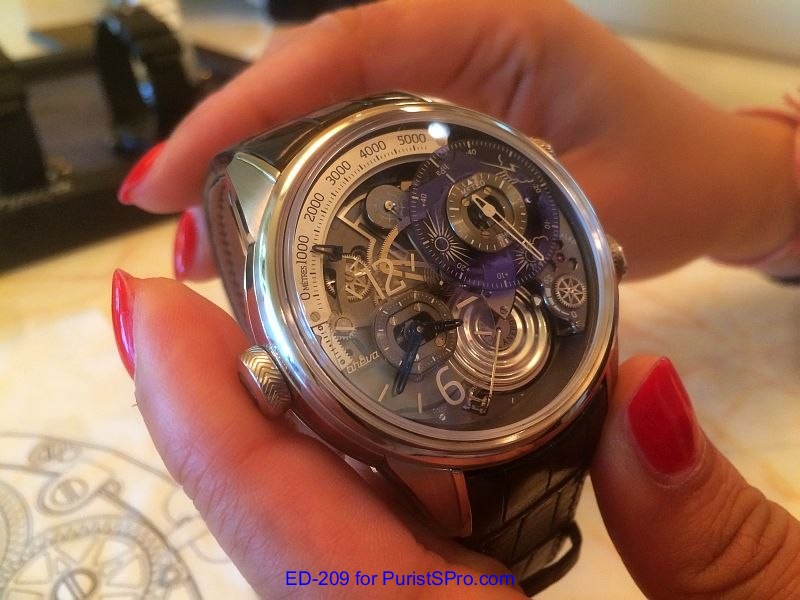
The Breva Genie 02 has a similar case and dial layout as the 01, and is offered in a regular or blackened titanium version. The upper left outer dial edge has a large scale altitude indicator and displays up to 5000 meters. A precision altimeter is displayed in the subdial at 2 o'clock.
I wish I would have had a chance to take the 02 with me on my recent business travels to La Paz, Bolivia. I could have ran some real-case extensive altitude test while I was there, since La Paz is the world's highest altitude capital in the world at 3650 meters above sea level.
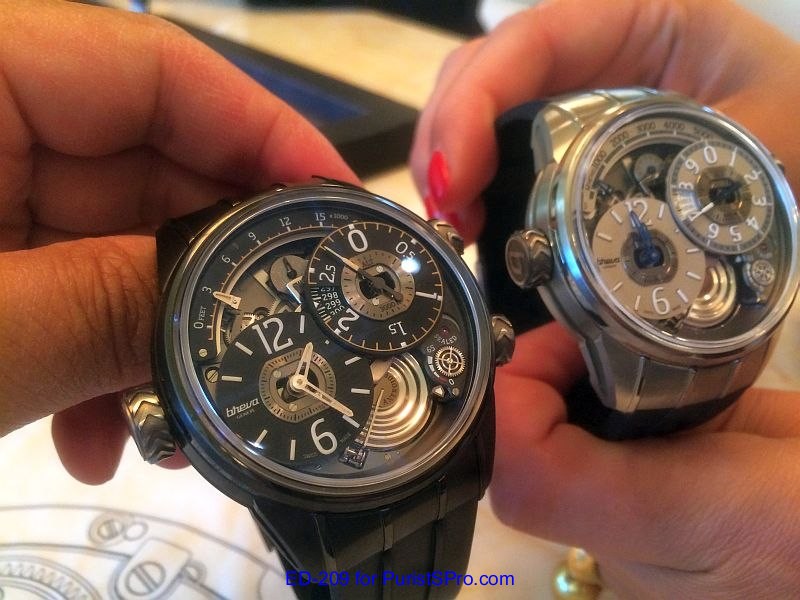
The Breva 03 is a really interesting watch that has a mechanical speedometer. I'll post this separately.
In the mean time I'd like to read your thoughts on these movements, are there any scenarios that you would encounter that you could use an altimeter or barometer? I know quite a few PuristS that would definitely use the speedometer!
Regards,
ED-209
The Breva Genie 01 dial has several indicators. The hours and minutes are displayed at the 8 o'clock position with transparent sapphire subdial. I handled the platinum version that blue skeletonized hands that was fairly easy to read. Looking closely I saw a smaller grayish colored subdial near the 12 o'clock position that was partially hidden behind the blue sapphire crystal of the subdial for the barometric pressure. And on the upper left quadrant of the outer edge of the dial is a scale displaying altitude. At the 4 o'clock position is a power reserve indicator with a scale showing up to 65 hours. A little detail that I really liked was that this power reserve is shaped like compass rose instead of the typical single hand.
Most of the area between 5 and 6 o'clock is the aneriod capsule to measure air pressure. The adjustments to the barometric pressure is done by a pusher/ring at 2 o'clock which also has pusher for adjusting the altitude. 4 o'clock has another pusher for an air valve that equalizes the interior and exterior air pressure. Winding and time setting is done with the crown at 9 o'clock.
The back of the Breva Genie 01 has a transparent caseback that showcases the movement. The caseback has an engraved scale for correlations between altitude and air pressure.
I still remember when I used to go hiking and rock climbing in the Mount Lemon area of Arizona and my climbing instructors used to carry a Ambient Weather WM handheld digital meter. During one of our climbs, the pressure suddenly dropped and we can feel the static electricity in the ropes. He used the AW WM to measure the barometric pressure and we quickly descended before an approaching thunderstorm that is common during the late summers. I'd be curious to see how accurate this Breva 01 would be in similar situations.
The Breva Genie 02 has a similar case and dial layout as the 01, and is offered in a regular or blackened titanium version. The upper left outer dial edge has a large scale altitude indicator and displays up to 5000 meters. A precision altimeter is displayed in the subdial at 2 o'clock.
I wish I would have had a chance to take the 02 with me on my recent business travels to La Paz, Bolivia. I could have ran some real-case extensive altitude test while I was there, since La Paz is the world's highest altitude capital in the world at 3650 meters above sea level.
The Breva 03 is a really interesting watch that has a mechanical speedometer. I'll post this separately.
In the mean time I'd like to read your thoughts on these movements, are there any scenarios that you would encounter that you could use an altimeter or barometer? I know quite a few PuristS that would definitely use the speedometer!
Regards,
ED-209
Altimeter in a wristwatch is not a new idea, but an idea I like a lot.
Same for the Barometer, or dephtgauge in a wristwatch. I was Lucky to see these Breva in the flesh, and was seduced by the finish, the feeling of quality.
Now, the problem is the retail...
Best,
Nicolas
the movements
Thanks for sharing your thoughts on the Breva watches. I'd like to test the speedometer version.
Regards,
ED-209
Regards,
ED-209
I was intrigued by the wristwatch barometer when the T-Touch was released ...
... however, I think that such a feature is only of limited use for weather forecasts. Unlike a stationary barometer, a wristwatch barometer is changing its location too quickly, and so many factors do influence the barometric pressure on the sensor. Even when hiking or climbing, you have to take out the altitude changes to get any environmental pressure changes, and vice versa. Even more difficult this is when the altitude changes come quickly, when going by car, for example.
For a use in predicting weather changes, such an insturment would need a protocol and/or alarm feature, announcing any sudden changes in the air pressure.
I could have needed this many years ago, when we were hit by a sudden sandstorm in the Algerien Sahara. Only after we had managed to regather our equimpment that had been blown away (save one tent, that was found the next day, several kilometers away), I looked on the T-Touch and noticed the massive drop of air pressure. An audible alarm might have given just enough time to prepare for the storm.
Marcus
For a use in predicting weather changes, such an insturment would need a protocol and/or alarm feature, announcing any sudden changes in the air pressure.
I could have needed this many years ago, when we were hit by a sudden sandstorm in the Algerien Sahara. Only after we had managed to regather our equimpment that had been blown away (save one tent, that was found the next day, several kilometers away), I looked on the T-Touch and noticed the massive drop of air pressure. An audible alarm might have given just enough time to prepare for the storm.
Marcus
I have a t-touch also
I like it, but haven't really tested all it's functions. Interesting story that you have on the sandstorm, must have been really cool to experience. We saw an awesome sandstorm back in 2009 during our trip to Dubai and we had a great vantage point to see it move across the city.
Regards,
ED-209
Regards,
ED-209