
Independent accreditation and certification
How important is independent certification of a Swiss watch to you, and would it address your concerns about “Swiss Made” and the quality (in its broadest sense) of the final timepiece?
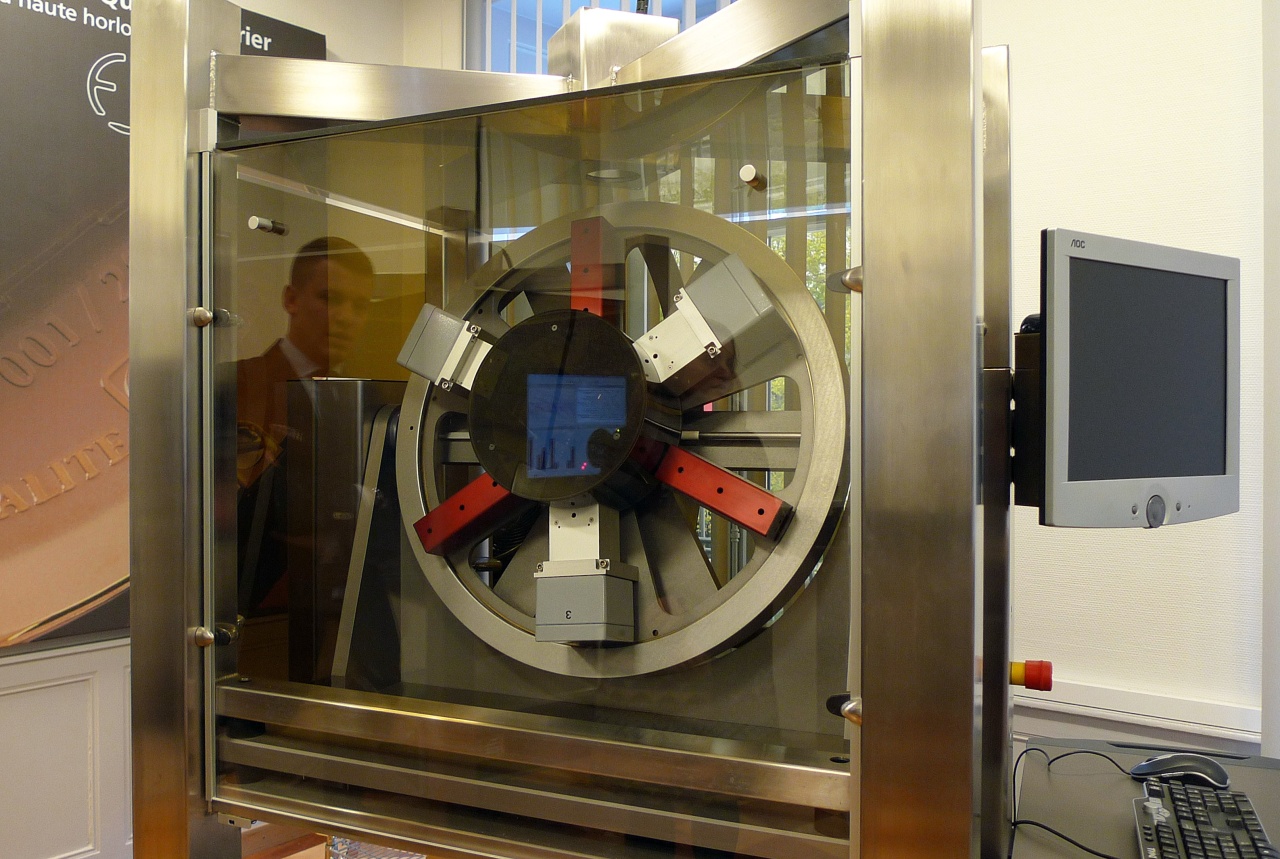
I thought about this issue when I visited the Fleurier Quality Foundation (FQF). [CLICK HERE to see more detail about the FQF testing process including video.] The FQF is designed to independently assess the quality of movement finish, the robustness of the construction of the watch, the chronometric performance of the movement (basically COSC) as well as the cased up watch on the wrist (the Fleuritest) and that the watches are manufactured in Switzerland.
Does this approach reassure you as a collector? As a member of the general buying public? Does independent testing produce any appreciable improvements in the final (certified) timepiece? Should there be independent visits to watch manufactures to directly assess their production processes? [This would likely require assessors from within the industry and there would be confidentiality issues.] Is it worth the effort or should we just let the industry self regulate (and the PR machines churn out their advertising)? How independent does the testing authority have to be and who should pay for the process?
Interested in your thoughts from any angle.
Andrew
There's no place like HoMe!


Patek Philippe Seal vs the Independent accreditation

Today's certifications are usually not satisfactory (marketing purposes)

Well said Mark....+1+1+1

+2...

It is about passion...
I agree with your remarks. But even if there is an independent organism that would do test or judge on a specific seal...would it change my mind?
We would perhaps all drive the same car if we would follow results from crash tests, breakdown figures.
In reality, we like perhaps an oldtimer that will break down sooner our later, no airbags...
So, I don't care about certification for a watch or an item that goes together with passion.
Best regards,
Dirk

Once again, the Watch Snob has the answer
I am looking at several different watches in the $8-$10K retail range. One ... model has the features that I want. Yet for virtually the same price, but with less features, they have a certified chronometer." Is there real value in a certified chronometer, or is it just a cash grab?
Unless you’re planning a solo circumnavigation of the globe without the use of GPS, chronometer certification shouldn’t be reason to part with more money.
Modern engineering and manufacturing means that it isn’t as hard as it used to be for a watch to keep time to within minus-four to plus-six seconds per day. Even a well-adjusted low-end ETA movement can achieve this, and, frankly, I think you should expect this sort of performance out of any watch you buy these days, especially one in the price range you’re looking in, whether certified or not.
Certificate tests should not be designed to allow passage.
It's like the car insurance crash tests: the testing agency makes clear that the test will involve a collision from a certain angle, so the car makers build cars that are strong from that angle. Good luck, however, if your car is hit from a different angle.
I would very much like to see a test that really checks out what a watch can do. Example: at time of test, watch must have been in its case and running for at least three years since last maintenance; watch is tested in 14 positions (2 flat, 4 vertical, 8 inclined) and under a few different types of motion as well as temperature. Watch is then retested having been subjected to a magnetic field of reasonable strength.
Of course, right now if a company sends in a watch for testing the watch simply is not sold (or is adjusted and retested). If we really want to make it fun, have the watch company send in watches in batches of 100 and the test result will reflect what percentage passed.
Pushing improvement
Perhaps a good certification process might actually push improvements in the final product?
What if COSC said that from 2015 they were going to decrease their tolerances to -1 to +3 seconds per day? Would that lead to a better, more robust, more accurate movement?
What about if they moved to the Fleuritest and tested chronometric performance on cased-up movements across every range AND intensity of movement with tighter tolerances (currently 0 to +5 seconds) per day?
Maybe then consumers would be happy to pay extra for independent certification? But clearly it has to mean something more than the paper it is print on, particularly if a CHF50 ETA movement can achieve better accuracy.
Andrew

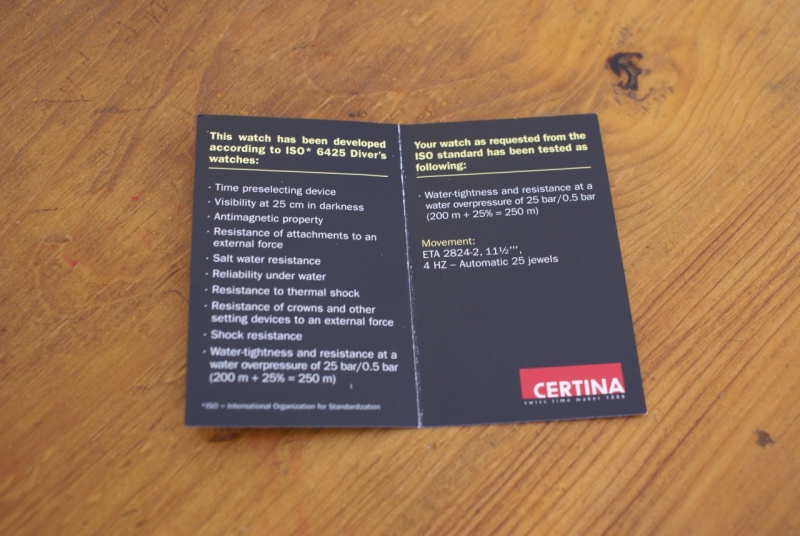
The ISO 6425 printed on my Certina diver is a superfluous detail

I am sure that it is part of Certina's marketing strategy for this watch and I bet there are a lot of other "diving watches" that cannot meet ISO 6425.
Best, Mike

Bear in mind these test are "as at", which means that x months into ownership,.........
yes, I understand. What is important to me is that when Certina

Cheers, Mike
This message has been edited by mkt33 on 2013-02-07 11:16:01
12 feet pool? That's adult pool man, I stay at the toddler side, just to be safe!! :)- [nt]
I rather no accredition or industry wide level accredition, not bullshit like PP seal
It is certainly akin to ...
... putting the Big Bad Wolf in charge of the children's nursery and the piggery.
So I see that you agree with external, independent accreditation of a facility. For this to work we have to have defined standards that the facility must be audited against. The standard could range from defining "Swiss Made" more thoroughly all the way to defining hand finishing or other aspects of manufacture that we value.
And yes, there are several Key Performance Indicators, such as returns under warranty and TAT for repair, that might differentiate companies, and in fact improve their performance if they were held accountable to their peers in league tables, or similar device for comparison.
Andrew



Having been to the Fleurier Quality Foundation I was impressed by the rigorous nature
The FQF is on the right track ...
Thanks for your comments, Mitch. I like the concept of the FQF and the fact that it covers issues like performance on the wrist (Fleuritest), robustness and build quality (Chronofiable test), parts finishing and addresses the Swiss Made fallacy. But of course I agree with you that we make up our own minds in the end and the FQF is icing on the cake.
My Fleurier Quality Foundation visit can be found by clicking here ...
Andrew