Comments:


Collecting pre-40's Breitlings is very difficult for a number of reasons, first they rarely signed their dials, cases or movements in this period and second over the past few years there has been a serious industry in faking or frankening these early Breitling watches.
The watch you show is gorgeous, but it begs a lot of questions and I'll say upfront, I'm not sure I have a final solution.
There are three things that this watch could be, (A) A very rare and early genuine Breitling, (B) A franken watch, mixing some Breitling parts with other watches or (c) A complete fake.
So here's a breakdown of my thinking on this.
Let's start with the trying to put a date on this watch. There are two obvious clues, first the fact that it is a two button watch. These did not appear until at least 1934, so this must be after that date. The second clue is the serial number 31764X, now the earliest number on the Breitling serial chart is 563659 which is dated to 1944. So in the first place we can say the serial number is consistent with the Breitling numbers. I have a watch which has the serial number 323XXX, which has been dated circa 1935, but might be a bit later, so say 1937. So considering those elements I'd have to place this watch somewhere between 1934 and 1937.
There isn't any other numbers on the watch, by the Forties Breitling was certainly putting both a serial and a product number on the watch, but not seeing one here doesn't bother me.
This is an enamel dial watch, which to be honest I can't ever recall seeing a Breitling from this period with an enamel dial, however I think the date would be fine for an enamel dial, as by the end of the Thirties I believe they were only using metal dials in their wristwatches.
Next we have the signature on the dial, well this becomes a little more tricky, as Breitling definately didn't sign their dials prior to the mid-thirties and then until about the end of the Thirties they could have signed either Breitling or Montbrillant. So in a genuine Breitling watch that is this early I might expect to see no name on the dial at all. Now I can't really determine from the pictures how the dial is signed, if it's been added on top of the enamel, or if it is fired into the enamel, the latter being better for authenticity. Having said that, IF the signature seems authentic, I believe that this would be consistent with dials by Breitling form this period - it's a 50/50 call.
Having said that the dial seems like a dead ringer for one shown in - what I believe is a 1931 advert.
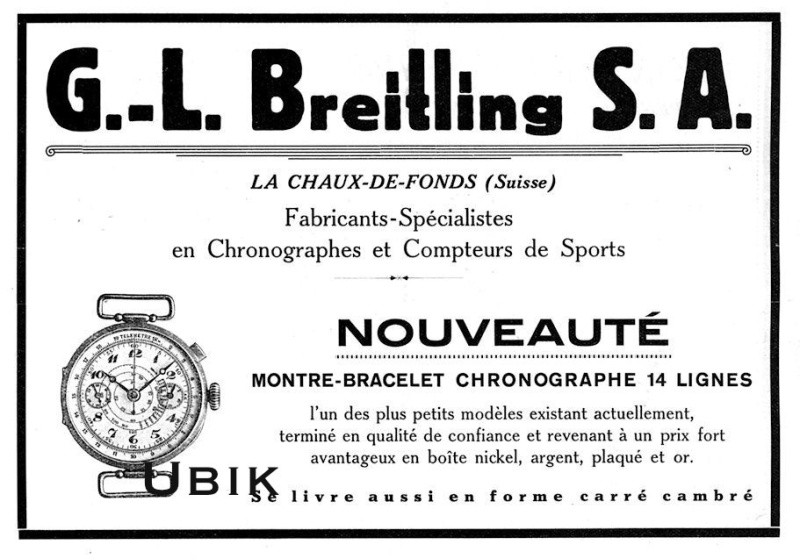
but as this second ad shows from around 1938, even by then Breitling weren't showing adverts with signed dials.
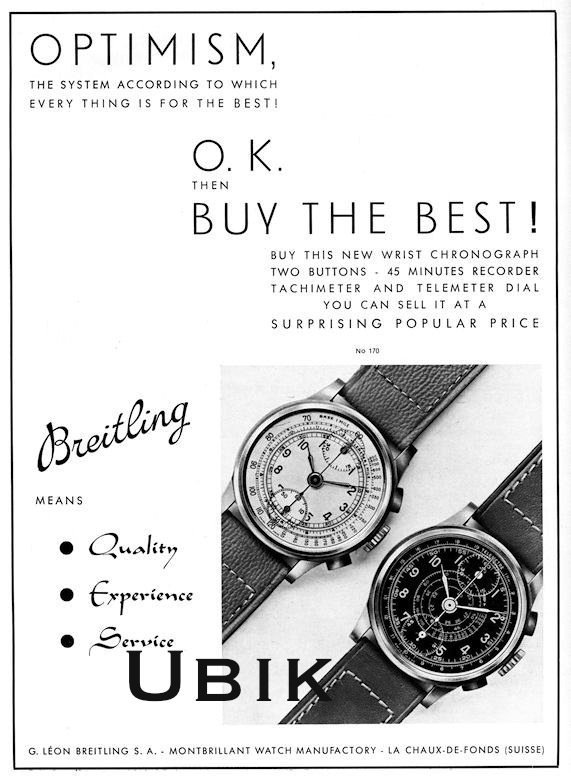
So could this be an original dial that someone signed later, to spice it up, so to speak. Possibly. Having said that, the dial is not totally conclusive as it is similar in style to many other dials from this period. Also would this dial have continued to be used by Breitling until the mid-thirties? We simply don't have enough info to make a final decision, but this makes it more tricky.
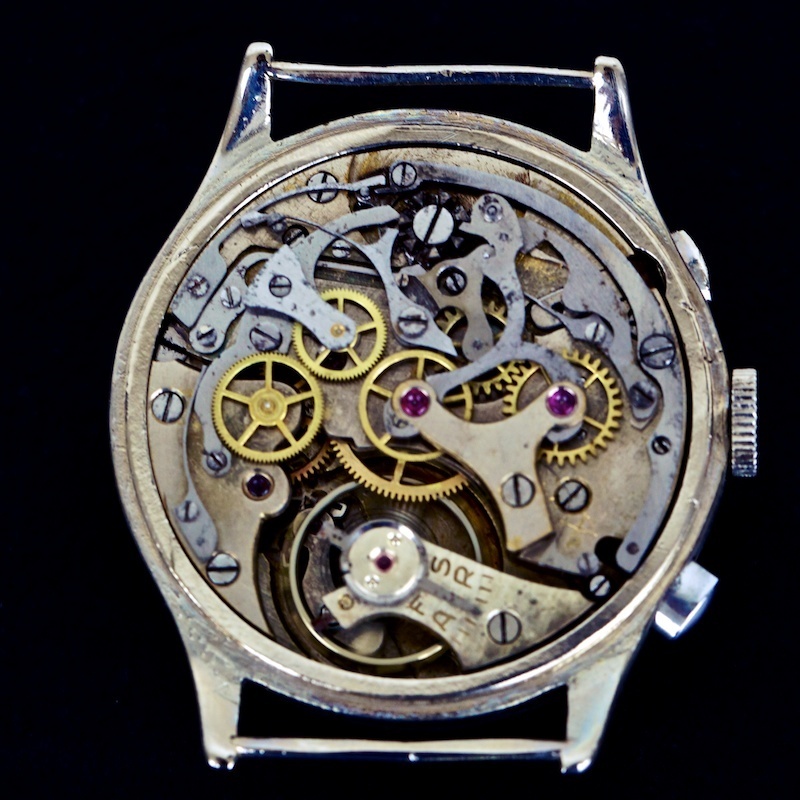
Moving on from this let's have a look at the movement itself, I did a bit of digging and I believe this is a Landeron 39 movement.
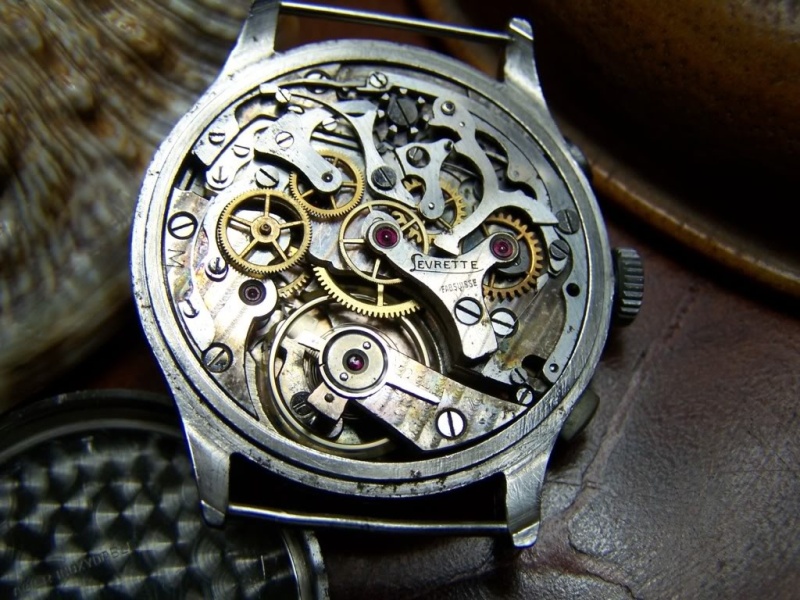
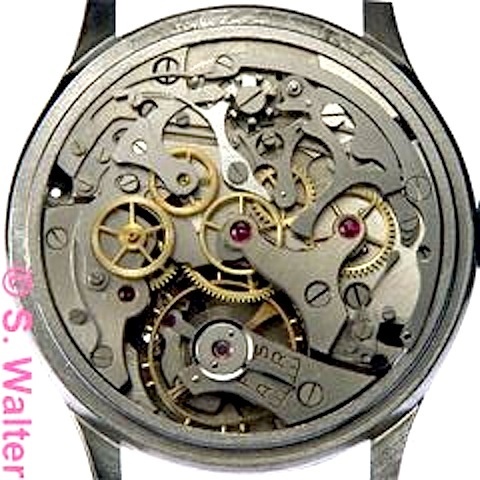
Now Landeron movements are a hot issue in early Breitlings, with many people saying they never used Landeron movements. While this is certainly true of the later watches, post-1940, there is clear evidence that Breitling did use a Landeron in earlier watches - although I would say always a column wheel movement. However, as always, it's not quite so straightforward.
The current thinking is that Breitling used Landeron movements that were altered by Dubois Depraz for them. These Landeron movements are distinguished by being absent from Landerons catalogues, if it was one of these then it would be pretty definitve it was a Breitling. However this is a known Landeron movement, and here comes the twist, the movement sheet appears in an early Breitling catalogue. Had this been any other Landeron movement I would have said no, but given that Breitling have a parts list for the 39, we have to say that it might have been used by Breitling.
So that is my current thinking on the watch, on the plus side there is nothing to definitvely say it's not a Breitling - although the signature being genuine would be key. The only thing that would potentially make this a Breitling is the signature, since the movement and dial would appear on other watches.
However there is no obvious knock out blow - that I can see at least - that would say this couldn't be a Breitling. The movement and serial number could have been used by Breitling. I guess my gut note would be to wonder if an enamel dial would appear this late for Breitling, but hey other makers were certainly using enamel dials in this period as well so why not.
In many ways it's an exciting watch for me because of the issues it makes us look at, and the bottom line is there are just not enough early Breitling's appearing for us to be able to make comparisons and in truth only in the last year or so has some new work been done on these Early Breitlings to allow us to understand more about their relationship to Landeron, but even then there are lots of questions to be answered.
If I were your friend I'd wear this mystery proudly and over time the answer will become more clear. I hope. LOL.
This message has been edited by Ubik on 2012-11-28 06:36:56

Weekend Breitling(s) - Part 10b/?
Team,
Here is the part II of the 10th post with detailed pictures from the Breitling from the 30's or early 40's:
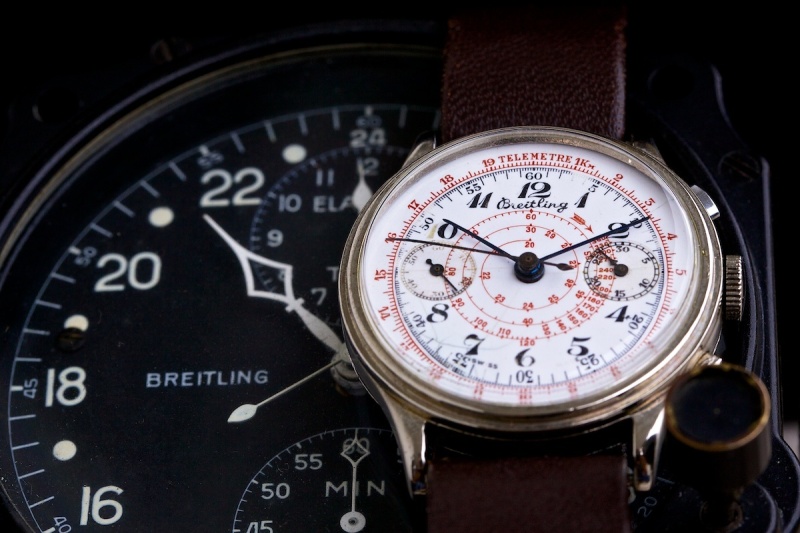
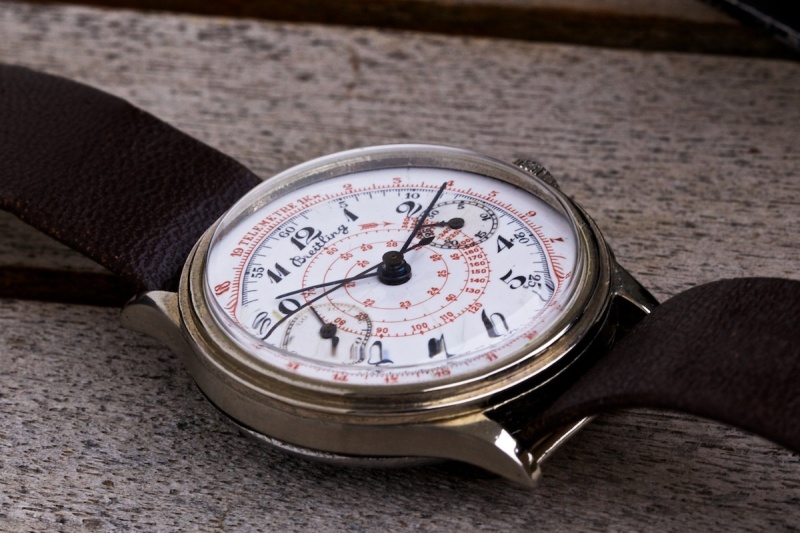
The enamel dial shows some damage around the 7. The chronograph on the background it's at the end of this post.
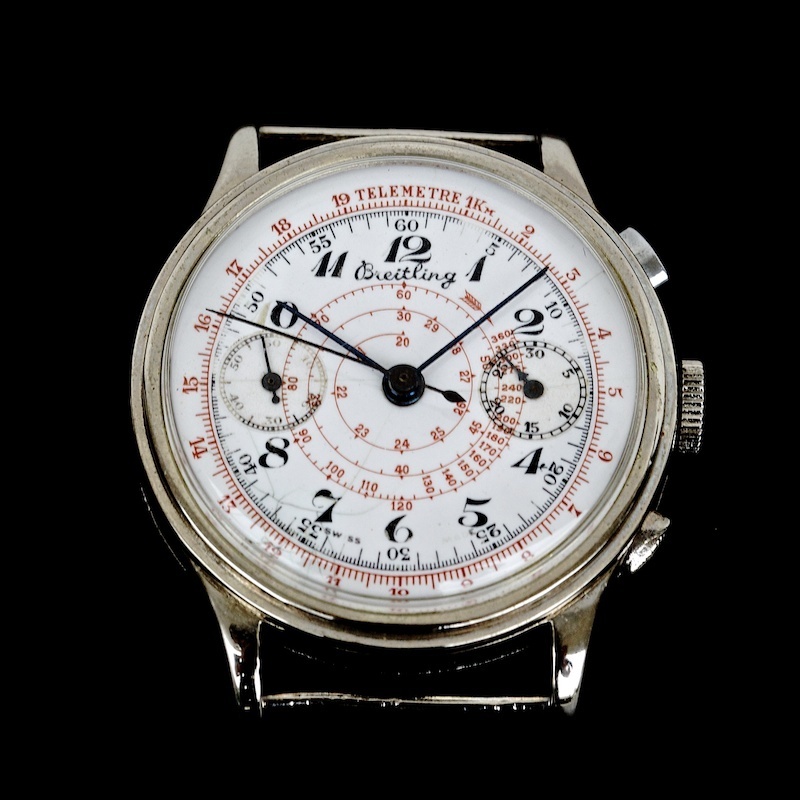
Non signed crown.
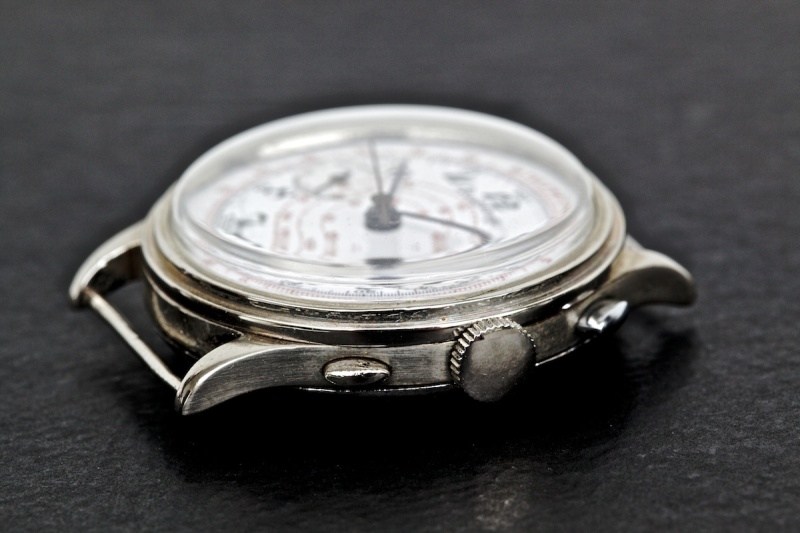
The plastic crystal:
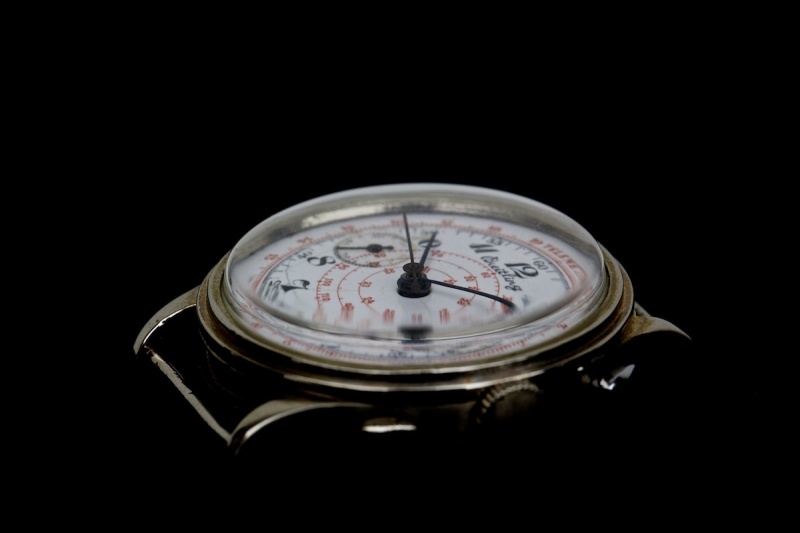
A view from the side
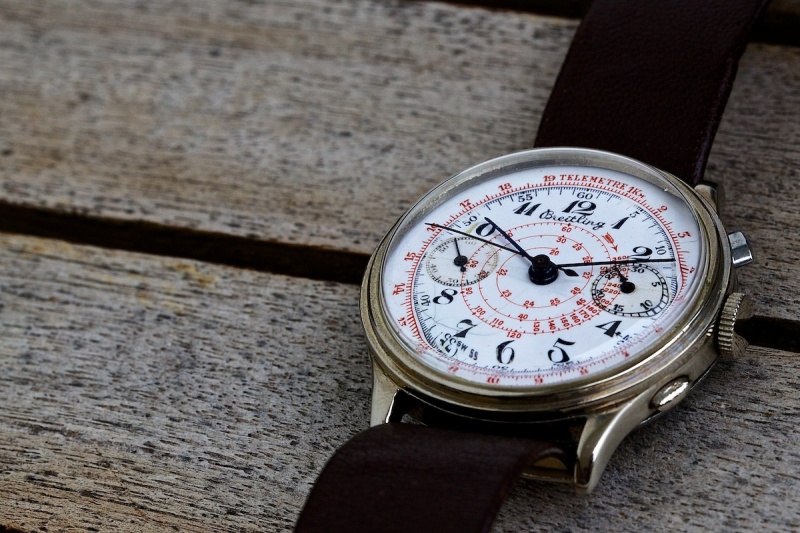
The other side of the 36-37mm case
The movement. It needs, badly, a good cleaning and oiling.
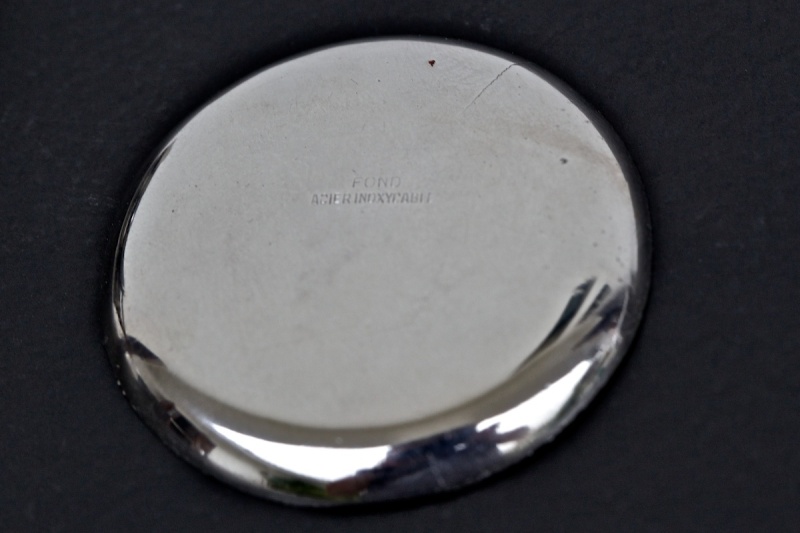
The outside of the case back.
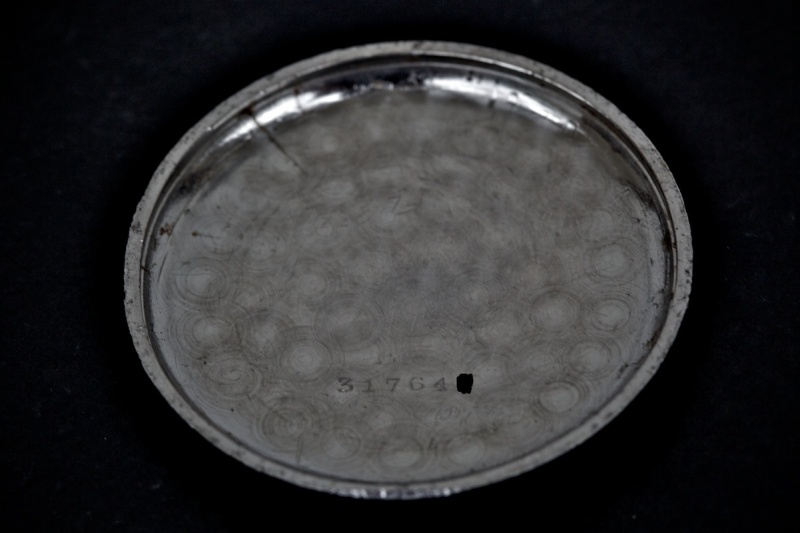
The serial number, from the inside. I masked the last digit.
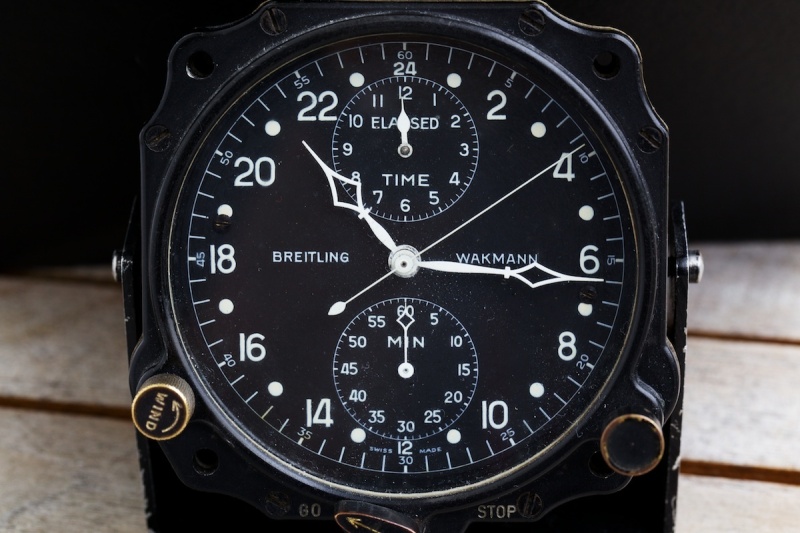
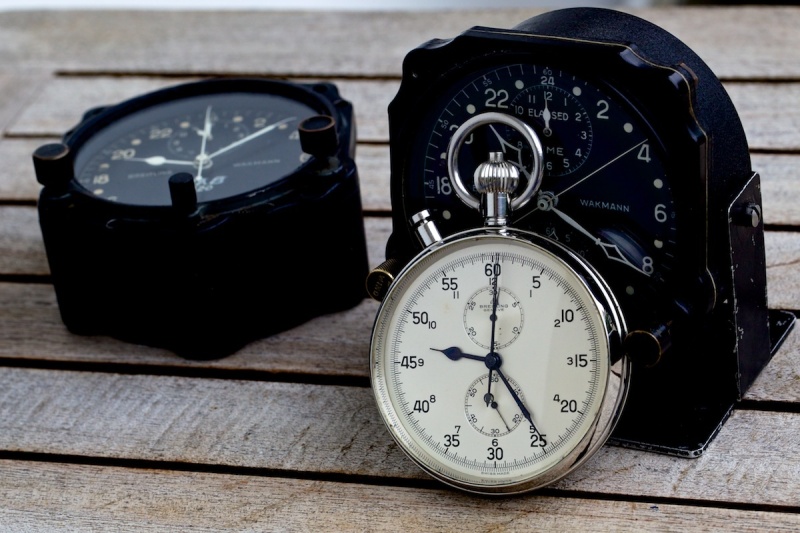
Now, the bonus part: An airplane Breitling/Wakmann chronograph
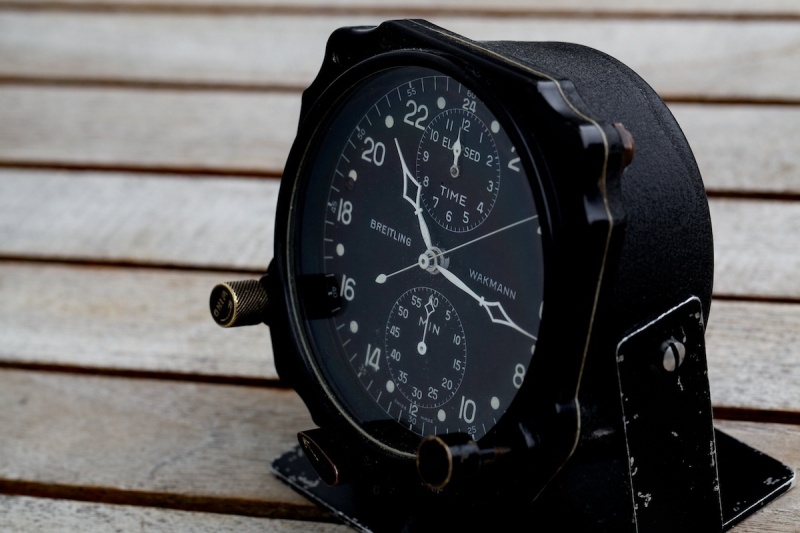
Side view. I presume that this chronograph was designed to be mounted on the airplane dashboard.
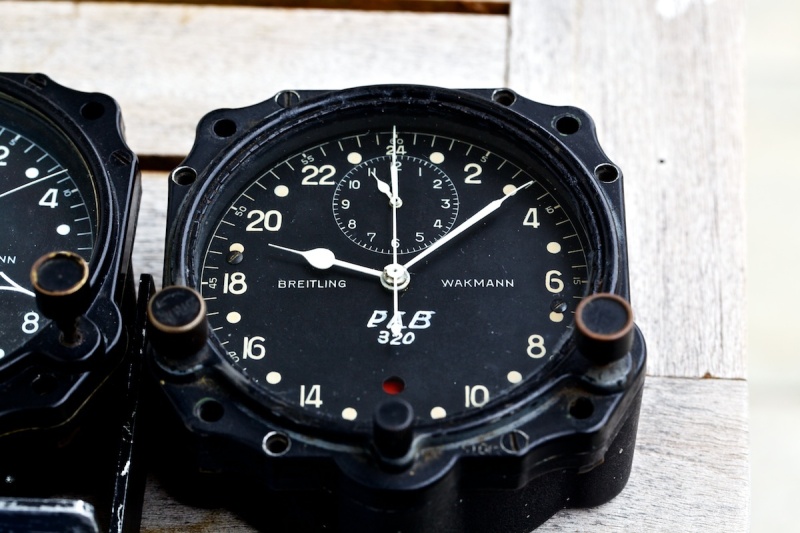
Another airplane chronograph (this one is not working)
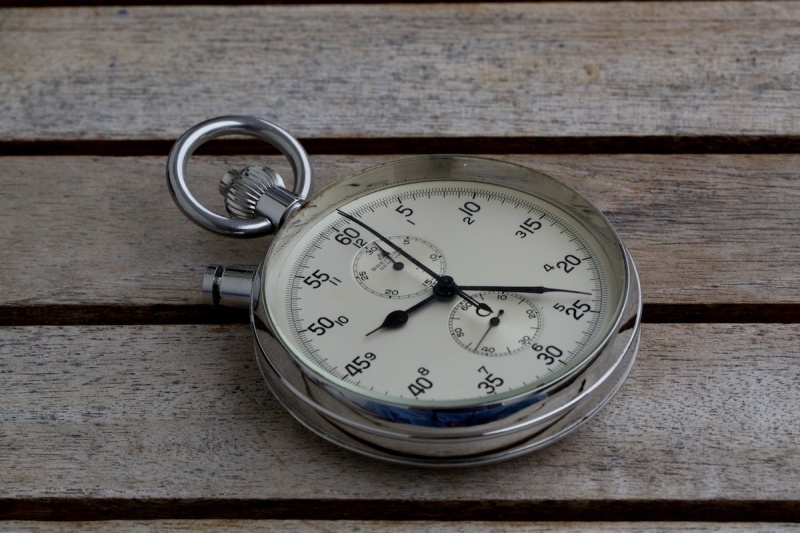
Another bonus. A Breitling pocket rattrapante watch.
A final picture of the set.
Thanks for seeing.
Cheers,
Nilo
Here is the part II of the 10th post with detailed pictures from the Breitling from the 30's or early 40's:
The enamel dial shows some damage around the 7. The chronograph on the background it's at the end of this post.
Non signed crown.
The plastic crystal:
A view from the side
The other side of the 36-37mm case
The movement. It needs, badly, a good cleaning and oiling.
The outside of the case back.
The serial number, from the inside. I masked the last digit.
Now, the bonus part: An airplane Breitling/Wakmann chronograph
Side view. I presume that this chronograph was designed to be mounted on the airplane dashboard.
Another airplane chronograph (this one is not working)
Another bonus. A Breitling pocket rattrapante watch.
A final picture of the set.
Thanks for seeing.
Cheers,
Nilo
Once again, I am in love with this Chronograph with the " snail " Tachy.
A BEAUTY!
Thanks for sharing.
Nicolas.
This message has been edited by amanico on 2012-11-26 14:13:43Funny thing is related to the size ...
Since I'm wearing a 44mm Zenith, it feels so small on the wrist.
My 4 years old granddaughter, that was "supervising" my photo session, was under the believe that this watch was hers.
Cheers,
Nilo
My 4 years old granddaughter, that was "supervising" my photo session, was under the believe that this watch was hers.
Cheers,
Nilo
It's a trend ...
All modern nice watches are big.
I decided to try and I'm doing well with this size.
Otherwise, how I go to dream with a new Amvox?
Cheers
Nilo
I decided to try and I'm doing well with this size.
Otherwise, how I go to dream with a new Amvox?
Cheers
Nilo
The Amvox II doesn't lok like a 44 mm watch. Much smaller. 2 mm less. [nt]
No message body
Great Photo Essay (Now under the correct thread!)
I find myself drawn to these old chronographs from the '20s through the '40s. From your pictures, it looks like the case is quite thin compared to most modern chronographs. I hope the materials revolution eventually leads to the development of thinner hand-wind chronograph movements. In the meantime, the original will suffice!
This is a really tricky one
Collecting pre-40's Breitlings is very difficult for a number of reasons, first they rarely signed their dials, cases or movements in this period and second over the past few years there has been a serious industry in faking or frankening these early Breitling watches.
The watch you show is gorgeous, but it begs a lot of questions and I'll say upfront, I'm not sure I have a final solution.
There are three things that this watch could be, (A) A very rare and early genuine Breitling, (B) A franken watch, mixing some Breitling parts with other watches or (c) A complete fake.
So here's a breakdown of my thinking on this.
Let's start with the trying to put a date on this watch. There are two obvious clues, first the fact that it is a two button watch. These did not appear until at least 1934, so this must be after that date. The second clue is the serial number 31764X, now the earliest number on the Breitling serial chart is 563659 which is dated to 1944. So in the first place we can say the serial number is consistent with the Breitling numbers. I have a watch which has the serial number 323XXX, which has been dated circa 1935, but might be a bit later, so say 1937. So considering those elements I'd have to place this watch somewhere between 1934 and 1937.
There isn't any other numbers on the watch, by the Forties Breitling was certainly putting both a serial and a product number on the watch, but not seeing one here doesn't bother me.
This is an enamel dial watch, which to be honest I can't ever recall seeing a Breitling from this period with an enamel dial, however I think the date would be fine for an enamel dial, as by the end of the Thirties I believe they were only using metal dials in their wristwatches.
Next we have the signature on the dial, well this becomes a little more tricky, as Breitling definately didn't sign their dials prior to the mid-thirties and then until about the end of the Thirties they could have signed either Breitling or Montbrillant. So in a genuine Breitling watch that is this early I might expect to see no name on the dial at all. Now I can't really determine from the pictures how the dial is signed, if it's been added on top of the enamel, or if it is fired into the enamel, the latter being better for authenticity. Having said that, IF the signature seems authentic, I believe that this would be consistent with dials by Breitling form this period - it's a 50/50 call.
Having said that the dial seems like a dead ringer for one shown in - what I believe is a 1931 advert.
but as this second ad shows from around 1938, even by then Breitling weren't showing adverts with signed dials.
So could this be an original dial that someone signed later, to spice it up, so to speak. Possibly. Having said that, the dial is not totally conclusive as it is similar in style to many other dials from this period. Also would this dial have continued to be used by Breitling until the mid-thirties? We simply don't have enough info to make a final decision, but this makes it more tricky.
Moving on from this let's have a look at the movement itself, I did a bit of digging and I believe this is a Landeron 39 movement.
Now Landeron movements are a hot issue in early Breitlings, with many people saying they never used Landeron movements. While this is certainly true of the later watches, post-1940, there is clear evidence that Breitling did use a Landeron in earlier watches - although I would say always a column wheel movement. However, as always, it's not quite so straightforward.
The current thinking is that Breitling used Landeron movements that were altered by Dubois Depraz for them. These Landeron movements are distinguished by being absent from Landerons catalogues, if it was one of these then it would be pretty definitve it was a Breitling. However this is a known Landeron movement, and here comes the twist, the movement sheet appears in an early Breitling catalogue. Had this been any other Landeron movement I would have said no, but given that Breitling have a parts list for the 39, we have to say that it might have been used by Breitling.
So that is my current thinking on the watch, on the plus side there is nothing to definitvely say it's not a Breitling - although the signature being genuine would be key. The only thing that would potentially make this a Breitling is the signature, since the movement and dial would appear on other watches.
However there is no obvious knock out blow - that I can see at least - that would say this couldn't be a Breitling. The movement and serial number could have been used by Breitling. I guess my gut note would be to wonder if an enamel dial would appear this late for Breitling, but hey other makers were certainly using enamel dials in this period as well so why not.
In many ways it's an exciting watch for me because of the issues it makes us look at, and the bottom line is there are just not enough early Breitling's appearing for us to be able to make comparisons and in truth only in the last year or so has some new work been done on these Early Breitlings to allow us to understand more about their relationship to Landeron, but even then there are lots of questions to be answered.
If I were your friend I'd wear this mystery proudly and over time the answer will become more clear. I hope. LOL.
This message has been edited by Ubik on 2012-11-28 06:36:56
Thanks Nico
but I still feel like the blind men holding onto an elephant and trying to describe it.
As always I'd be excited to see if anyone else has some more info/thoughts.
As always I'd be excited to see if anyone else has some more info/thoughts.
Wonderful post ...
Ubik,
Thank you for sharing this huge amount of knowledge about this early Breitling.
I suspected that this should be a complex task when I notice that the Breitling serial table starts in 563659 - year1944.
Thank you, again, for your outstanding collaboration on this series of posts.
Cheers,
Nilo
Thank you for sharing this huge amount of knowledge about this early Breitling.
I suspected that this should be a complex task when I notice that the Breitling serial table starts in 563659 - year1944.
Thank you, again, for your outstanding collaboration on this series of posts.
Cheers,
Nilo
wonderful analysis, ubik !
The usage of Landeron movements by Breitling in the 1930s and 1940 is an interesting and widely discussed subject - do not want to take this thread too far off topic, but we have been searching for definitive, correct examples for a very long time - so I'll present an example that I, along w/ several collector friends now consider such a correct piece, including the model. reference and a period correct serial number on the caseback, a ref. 761, shown here on a page from the mid 1940s catalog that - quite surprisingly - had a Landeron 42 inside.


Back to the example we are discussing here: I have never seen an enamel dial with Breitling branding on a piece I considered above all doubt, the logo (primarily the "ing") seems to have the wrong spacing for the period.
As Ubik writes, Breitling only started to use branded dials in a period when watches bore model reference numbers inside or outside the caseback - there are examples of Breitling branded dials that do sit in cases that are unbranded or branded by other companies - but all these are US imports from the late 1930s and early 1940s, all of those do bear US import codes on the balance cock and the "xx jewels unadjusted" on the movement (we have seen several Clebar, currently I'm evaluating a "Belmar"-signed case w/ a beautiful Breitling dial, correct movement and, Eitan, the elusive "EXN" ! on the balance cock that Ranfft called a "Breitling" code) - only after 1947 we see the "WOG" for Icko Wakmanns US Breitling distribution company or, for some years until 1957, the "BOW" for Breitling USA.
Beautiful piece indeed and I would wear it with pride - but quite tricky indeed, as Ubik says.
Back to the example we are discussing here: I have never seen an enamel dial with Breitling branding on a piece I considered above all doubt, the logo (primarily the "ing") seems to have the wrong spacing for the period.
As Ubik writes, Breitling only started to use branded dials in a period when watches bore model reference numbers inside or outside the caseback - there are examples of Breitling branded dials that do sit in cases that are unbranded or branded by other companies - but all these are US imports from the late 1930s and early 1940s, all of those do bear US import codes on the balance cock and the "xx jewels unadjusted" on the movement (we have seen several Clebar, currently I'm evaluating a "Belmar"-signed case w/ a beautiful Breitling dial, correct movement and, Eitan, the elusive "EXN" ! on the balance cock that Ranfft called a "Breitling" code) - only after 1947 we see the "WOG" for Icko Wakmanns US Breitling distribution company or, for some years until 1957, the "BOW" for Breitling USA.
Beautiful piece indeed and I would wear it with pride - but quite tricky indeed, as Ubik says.
Thanks for coming in Fred
I know you have spent a long time looking and trying to figure out these early Breitlings. I appreciate you sharing your knowledge, it is a map without a compass most of the time.
As you know there was recently published on invenitetfecit an article about these pre-Forties Breitlings. I corresponded with Joel the author about the article
which was originally published by him in the horology journal "chronometrophilia".
Joel spoke with Gerald Depraz in researching his article and established that they adapted the Landeron movements on behalf of Breitling during this period. In terms of the Landeron 39, it is listed in a Breitling catalogue from the period, but very little is known about its use by Breitling after that. So I think I would be inclined to give this movement the benefit of the doubt, if all else checked out.
In terms of the signature on the dial I think it's hard to make a final call on that without really inspecting the dial. For me the signature - as I can see it - while not looking as fine as I would like, is not inconsistent with other early signatures I've seen.
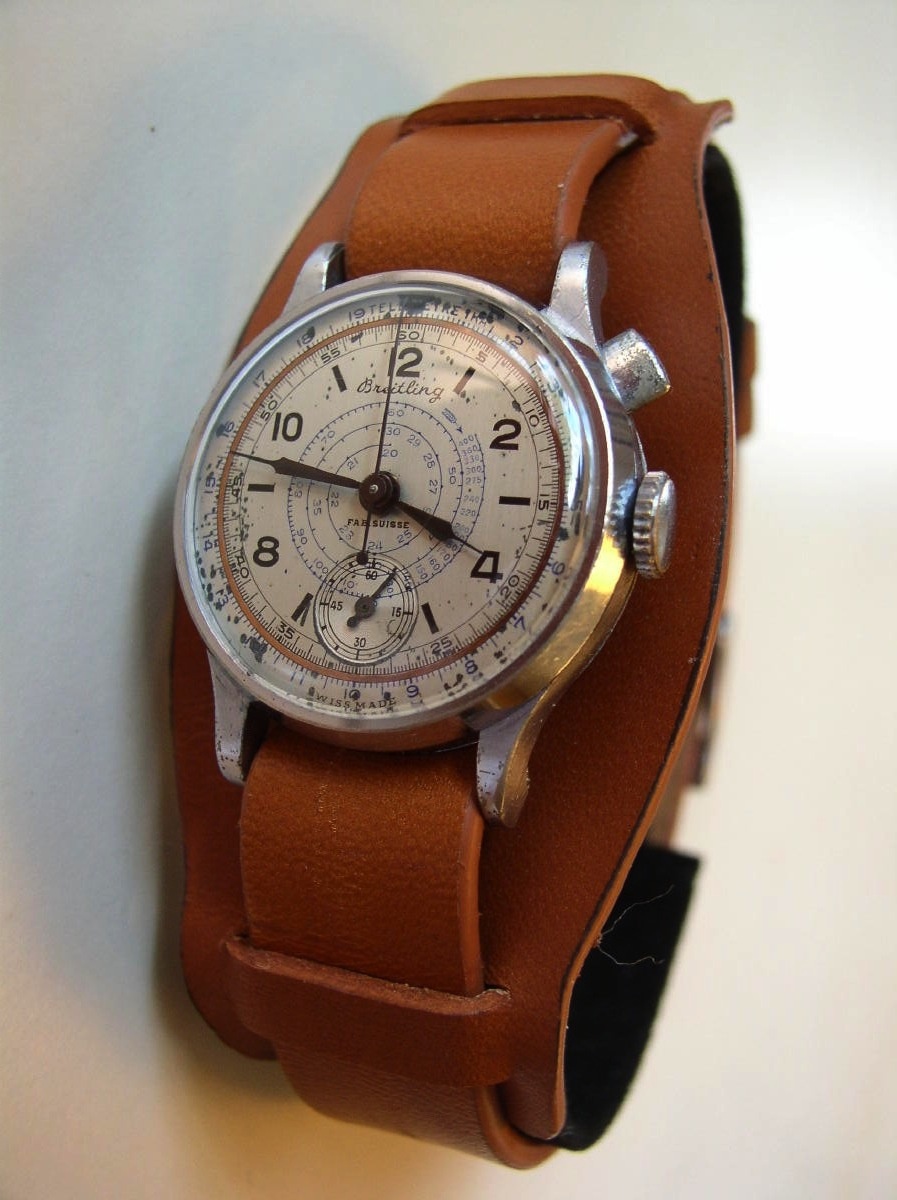
(credit - Vintage @ Breitlingsource)
"Breitling only started to use branded dials in a period when watches bore model reference numbers inside or outside the caseback"
I'd be interested to know why you say this, is this an observation or are there any refrences to it? I would say that I would always expect a serial number and post 1940 a ref number, but I've not heard it linked to a signature on the dial - either Breitling or Motbrillant.
We're inching closer to defining some clear information about the pre-60's Breitlings and in large part through your enthusiasm, digging and discussions.
As you know there was recently published on invenitetfecit an article about these pre-Forties Breitlings. I corresponded with Joel the author about the article
which was originally published by him in the horology journal "chronometrophilia".
Joel spoke with Gerald Depraz in researching his article and established that they adapted the Landeron movements on behalf of Breitling during this period. In terms of the Landeron 39, it is listed in a Breitling catalogue from the period, but very little is known about its use by Breitling after that. So I think I would be inclined to give this movement the benefit of the doubt, if all else checked out.
In terms of the signature on the dial I think it's hard to make a final call on that without really inspecting the dial. For me the signature - as I can see it - while not looking as fine as I would like, is not inconsistent with other early signatures I've seen.
(credit - Vintage @ Breitlingsource)
"Breitling only started to use branded dials in a period when watches bore model reference numbers inside or outside the caseback"
I'd be interested to know why you say this, is this an observation or are there any refrences to it? I would say that I would always expect a serial number and post 1940 a ref number, but I've not heard it linked to a signature on the dial - either Breitling or Motbrillant.
We're inching closer to defining some clear information about the pre-60's Breitlings and in large part through your enthusiasm, digging and discussions.
Surprice
Hi Ubik, I was reading your post (very interesting) and suddenly Oops .. a photo of my watch "Levrette" caliber Landeron 39.
It's very good quality, is a nice movement.
Thanks.
Rgds.
Juan
Please accept my apologies Juan
if you look through my other posts I do try and credit other people's material where I can. In this case I had the image but didn't
remember where it came from.
I'm really glad you posted to tell me though and I'd love to see more of your watch and here about it. Leverette is a brand I've never
come across before.
remember where it came from.
I'm really glad you posted to tell me though and I'd love to see more of your watch and here about it. Leverette is a brand I've never
come across before.
A little late
Hi Ubik, I show my friend the face of my Levrette and an old advertising.


Rgds.
Juan