
When was the first mechanical Digital wristwatch produced?
I am curious for obvious reason to find out when was the first mechanical digital wristwatch.
I browsing fast the web, I came across the below 'vintage' presentation which is said from 1968. Do you more and other info? Thanks in advance for sharing your knowledge on this topic.
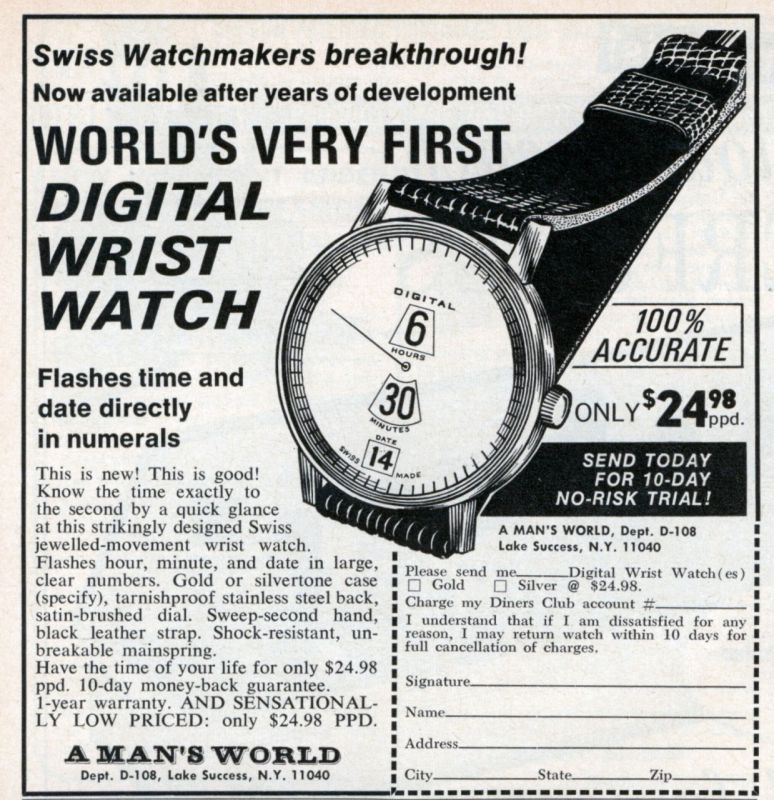

Very interesting, POY
Great Historical ad, my friend.
Your obvious reasons are so actual...

I was wondering the same when Lange launched their new Zeitwerk.
But, honestly, I didn't know, till you posted this ad.
I would be curious to see if any of our fellows, here, can give us some more infos about this watch, and more generally, about digital mechanical WRISTWATCHES.
Best, and once again, thanks, POY!
I love this kind of horological brainstorming.
Nicolas This message has been edited by amanico on 2009-05-11 03:50:16

history goes back to at least the 19th C for PW and early 20th C for WW.
IWC had pocketwatches (one called Pellaton model (?) and I know several off the top of my head in WW form factor in early 20th C. Will try to dig up some pics of watches and/or ads if no one else beats me to it.
Definitely before 1960's.
Cheers,
TM
yep, thanks, it was caught lower down in the thread.
The mind and memory...what a thing to waste!
;-)
TM


the best source for this would probably the watchismo times site
if i'm not allowed to mention the site i apologize, but he is a great source of unusual information expecially in things like digital mechanicals.
there are examples often seen in rectangular cases from the 1920-30's. i dont have a pic, but they are a regular sight on any vintage arena.
best
Graham
Thank you for sharing this info
I had already visited that site, and you are correct there is plenty to read on the subject. And many more too ;-)
Now I have a problem! is Digital Display the same as Jump Hour watches?
My initial post (right at the top) is titled 'When was the first mechanical Digital wristwatch produced? '
When I saw the first replies I got confused because may be I always misunderstood the 'Jump Hour Watches'. Therefore I am coming back at all of you with the below questions
What is a Jump Hour Watch?
To me Jump Hour and it seems that the dictionary defines it as I always understood it to be: 'A Jump Hour function displays the hour in an aperture instead of with a hand on the main dial.
What is a Digital Display Watch?
A display that gives the information in the form of characters (numbers or letters)
To me a Digital watch is not a Jump Hour! Am I wrong?
By the way I am enjoying reading all I can find on the web about this topic (and a few books I have). Very interesting, so far I am at a point where it seems that the mechanical display watches were rapidly developed to come against the electrical and quartz powered Digital display watches which actually seems to have in production after the mechanical version...
Poy, i would say that...
can only see that particular hour in the box and it jumps instantaneously. the
Chronoswiss delphis is a jump hour, but a seiko discus is a digital display as
the time discs are continuously moving.
interesting one. by definition its digital as all the digits are numeric, but
its also a jump hour as the hour jumps instantaneously.
personally exclude the ones with a minute hand, but include the ones like the
lange.
digits rotate around at the correct pac they would do if they were
hands.
"wandering hour/minute" vs "jump hour/minute"
Hi, Graham, Monsieur PoyFR
"officially" (what the heck does that mean anyway?) a "digital display" is one that displays the digit rather than an "analog" (an indicator that points to a position in a relative position scale; thus, the crescent fly backs are analog even if not a complete circle) The digit can be arabic, roman, whatever "digital" symbol, and need not be in a window ("guichet") - but the LOCATION of the read digit needs to be stationary (think the newish faddish three unit displays with the center date being the "current" date, IWC Fliegerchrono as one specimen example)
It can be a jump hour/minute, or a wandering hour/minute, the "digital display" terminology doesn't specify and doesn't require.
A jump hour or jump minute, as Graham rightly points out, doesn't "wander" but changes (nearly) instantaneously, and technically can be digital OR analog. Consider chronographs and their wandering, semi-instantaneous, or instantaneous "classification" for the minute and hour analog indicators. (do marketing departments actually try to make a big deal out of this?!? yep...oi!)
But typically and by conventional usage, jump hour or minutes usually are used for digital instant jump displays.
Thus, an analogue jump hour indicator is not technically an incorrect usage of the term (in fact, it is technically correct) but conventionally it is considered an "extended" (read: loose) use of the term.
AP produced a jump hour wrist watch as early as the early 20th century (c. 1921) upon which this piece was based (the original, which has a similar case, was a jump hour / wandering minute design. The later model, released in c. 1992, shown, added a repeater complication) -

ps: digital displays can also be wandering!
The Seiko Discus Burger is an example of this.
just to confuse matters more, "dead seconds" (seconde morte) are jumping seconds...
but usually analogue! think FP Journe...there is no real technical reason why they couldn't do a jumping seconds digital but the energy needed to turn a disc (as opposed to a second hand) once every second is not insubstantial and there isn't really enough time to "load up" a spring like there is with digital jumping minutes or jumping hours...that's why jump hours are much more common than jump minutes and very few mechanical jumping seconds.
Ironically, the very reason mechanical jumping seconds are difficult, is why quartz (or other electrical or electronic) jumping seconds are necessary - it takes too much mechanical energy over too short a time to load up (a mechanical capacitor) a spring to advance seconds indicators in single jumps; but it takes too much electrical energy to make a second hand "jump" 3, 4, or 5 times every second, as a mechanically driven, constant gear advancing system does in a mechanical watch. The battery just wouldn't last.
But in both cases, all of these "jumping indicators" can be analogue or digital, as noted previously, and analogue or digital can be wandering or (semi-) instant.
Confusing enough?
;-)
TM

To digress
Thomas,
"but it takes too much electrical energy to make a second hand "jump" 3, 4, or 5 times every second"
What of Accutrons? ;-)
:-)
Hi, BDLJ,
LOL! Obviously, Accutrons are a little different electrically and electronically than typical quartz designs; also their electrical to mechanical translations...but good point, non-sequitor notwithstanding.
Just in case others reading this are confused by the sly private "inside joke" the Accutrons and quartz watches are both powered by electricity, but regulated completely differently.
While mechanical watches as we know and love them are regulated by oscillating balances powered by a hairspring (basically) the accutrons are regulated by a tuning fork at 360hz, while quartz watches are referenced in the khz frequency range.
How quartz watches have their reference frequency translated to second hand movements vs the Accutrons (and traditional mechanical watches) is what this "inside joke" is all about...
Cheers,
TM
Thomas, you are right, 1921 AP was First. Thank you.
I made a couple of phone calls to the neutral country sides and it seems that there is no arguments, it is 1921 by Audemars Piguet Calibre HPVM10.
Professor, you are not confusing, it makes perfect sense! Thank you
I am so keen to always learn I would stop my life to find and understand the answers ;-)
Thank you again.
Thomas, I learnt to read you with pleasure
Thank you for your reply.
It is so simple yet so dam complicated! The way I am so far understanding 'Digital watches' is it is a term which I would want to reserve for watches powered by electronics or batteries, because so far I see that all mechanical watches that read time by means of aperture(s) are somehow Jump Hour/Minute. As a result I agree with your generous post/reply.
Of course mechanical watches displaying the time by means of apertures can be classified or said to have a digital display but only if I add at least another 'complication' like 'Jump'. Of course I had to be French to raise this question, as it is retained that it is the esteemed French watch-maker Blondeau (1830) who made for the king the first and one only 'Jump Hour'. Then, Joseph Pallweber (with Cortebert Comapny, French again) mass produced Jump Hour watches (pocket) in 1880
Thomas, I had the Pleasure to listening to you in October 2008. On that day, (yes it took me long ;-) I discovered your Passion of watches and your willingness to share your knowledge with ability and ease. I want to say that I am happy to know of guys like you to be somewhere on this planet. I hope that your VC will gong for a very long time.
Wow, haven't heard reference to Cortebert for ages!
Hi, Monsieur PoyFR!
You are far too kind, and I hope this discussion doesn't boil down to differences in semantics due to languages!
Yes, in colloquial English, "digital watches" are often (erroneously) used to refer to electronically controlled or powered timepieces. I think the origins of this are etymological - "digital" being used to colloquially refer to all things electronic (and, again erroneously, electrical)
Just as "digital" is literally translated in Chinese as "numerical" - "digital camera" translates as "numerical" (digital) camera
This may be the case with French as well, my French is not proficient enough to comment on this.
In English, though, digital watch "officially" (again, what is official?) refers to the display system (vs analogue or analog displays) which overlaps and is consistent with display systems in general (car displays, aircraft displays, etc etc etc)
Single digit guichet designs are (to my memory) instant jump designs; it would be strange to see an aperture with the digit in any position other than centered, which would happen with wandering designs. However, with extended window designs - Seiko discus burger, some three digit digital displays - wandering designs can work and do exist/have made it to market.
I don't recall who made the first "jump hour" movement, PW or WW; it is interesting to read you about Blondeau; Pallweber, and Cortebert. But indeed, jump hour PW were actually not that rare since the late 19th C.
It was a pleasure to meet you too in Oct; it only served to prove that one must not jump to conclusions about people based on internet secondary interactions...
;-)
Thanks for your kind words and I look forward to meeting in person again soon, to share other examples of our mutual horological fascination.
Cheers,
TM

just some additions.....
you were asking for the wrist watches in your original post - I would have to look through a lot of books, but I'm pretty sure there are plenty of digital display
ww's even at the time when wrist watches started to be "en vogue" - let's say somehwere beginning 1900's.
"Of course I had to be French to raise this question, as it is retained that it is the esteemed French watch-maker Blondeau (1830) who made for the king the first and one only 'Jump Hour'. Then, Joseph Pallweber (with Cortebert Comapny, French again) mass produced Jump Hour watches (pocket) in 1880"
I'm not sure about your sources, and what exactly means "the first" in that context (probably the first to the french king ??
) - but there are many jumping hours dating earlier. Just as an example, there is a nice pocket watch by Paul Lullin, London (MIH, La CdF) - jumping hours ("a guichet") and wandering minutes display very much/similar like "modern" Urwerk or AP's Starwheel - made at the beginning of 18th century (so 17xx). That should be at least 100 years before Blondeau. BTW, Breguet's repeating watches typically also had a jumping hour (hand, of course). If the question would be more about the general principle of displaying digitally - and without asking for ww's specifically - I'm pretty sure you could go back some more decades (if not centuries). BTW, Joseph Pallweber was from Salzburg, Austria, If I'm not mistaken and "Cortebert" was a swiss company located in the swiss village Cortebert.
Best regards
Suitbert
Thank you for re-steering back to wristwatches
Of course I know the Cortébert Village, but what I meant by 'French Company' is that that Cortébert was founded by the Juillard family which were made a noble under Louis XVI one year after the French revolution in 1790.
For the Jump hours, well I have re-read 3 sources and they all agree in saying this was the first known Jump Hour (pocket watches). Now I am going to search more, following the references you kindly provided us.
You are right my initial and continuous search is about mechanical digital wristwatches. This far I am finding a lot of references from the 50’s (electronically powered) and late 60’s (digital/jump hour)
Many thank for your help and reply.
Good news ....
I've found a reference of a nice pocket watch with jumping hour (similar design as previously mentioned, satelite with sector dial for minutes and jumping hour "a guichet"). It's from the Gschwind collection, made by french watchmaker E. Maybon a Paris and dated at 1675!
But I'm sure if I try hard enough, I'll find something else from another country a tiny bit earlier
Best
Suitbert
On a popular website by Carlos Perez
The text below is part of a post/reference titled: The Myriad Dialects of Time (October 8, 2001) In Memory of David M. Graifman
Most digital displays used in mechanical clocks and watches work on the same principle, based on rotating discs which are printed or engraved with the numeric information. When viewed though a small aperture only one piece of information is visible at a single time in effect concealing the circle of time while larger apertures can be used to show the context of time's progression. The former is the basis of the common date window which is standard on most of today's wristwatches, and the latter was utilized by Graham for his regulators. His crescent-shaped aperture showed the present hour at center, with the past hour and coming hours visible at the lower corners of the aperture one could watch the hour disc turn slowly. The advent of the jumping digital hours display brought a smaller aperture which only shows the present hour, jumping instantly to the next hour at the precise moment that it begins, using a disc showing 1-12 or 1-24. Jumping-hours pocket watches enjoyed their first brief vogue in the 1820s and 30s, though they continued to be made in small numbers throughout the 19th century. Jumping digital minutes was paired with jumping hours in a small number of pocket watches during the last quarter of that century.
In the Art Deco period jumping-hours watches came into the spotlight once more, both in pocket and wristwatch forms. During the Roaring Twenties jumping-hours wristwatches were produced by eminent names like Cartier and Audemars Piguet, but the fashion declined with the Great Depression, and was definitively ended by World War 2. Preceding the advent of digital quartz, the 1970s introduced all-digital mechanical wristwatches with jumping hours, digital minutes, and digital seconds. The fourth and present revival is a product of the post-quartz renaissance, a natural part of the reintroduction of most past forms of the mechanical watch heritage. It is likely that the revival began in 1989 with the limited edition Breguet Saltarello Souscription (50) and Patek Philippe's tonneau ref. 3969 (500). Since then they have grown ever more popular, produced by elite manufacturers and independent watchmakers, economy grade etablisseurs, and all points in between. We still find new offerings being introduced every year, including a special limited edition from Dubey & Schaldenbrand which was recently announced, and an upcoming design by Vincent Calabrese for Bell & Ross which should appear shortly.
This message has been edited by PoyFR on 2009-05-12 04:05:51
same question as below...
I knew (was in touch with, and sometimes even consulted by) Carlos when he was active on the net in horological matters.
Like the other internet sources so far quoted (and most of the others one likely finds on the 'net) I have to caution against taking all "facts" and conclusions presented literally and at face value.
In my humble experience and very limited knowledge of the field, Suitbert and very few others actually know what they are talking about, based on years of research, learning, and actually working with and talking with individuals - watchmakers, historians, academics, within the world of high horology, not just cruising the internet and assimilating information of often dubious foundation or historical context. The standards of research on the internet are really far from "authoritative" and certainly not "peer reviewed."
I hope no one misunderstands the spirit of my comments; I don't think Watchismo ever claimed to be an authority on the subjects he writes about.
(and no, I don't make such claims either...)
Cheers,
TM
Correct! I do not jump to beliefs at web publications, I sometimes use them as a base
and I learn to ask a question and read everyone, often the answers are from humble and hidden authorities: I also refer to the older books which I admit I often to fatigue to open and luckily in the end I use that old contact book and my telephone... ;-)
I thank everyone here that participates in open debates, when focused it often makes the web a wealth of treasures from the many corners of the world.
and ;-) I am far from making any claims either ;-)
Who was the first Digital mechanical watchmaker
Will appreciate any info about this. Thanks