
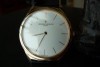
The Patrimony Contemporaine Excellence Platine (42mm)
And when I wore it, it was a relief. Don't expect from me to tell you that this watch is the most balanced one around. In fact, there is something funny with it: at the same time, the Vacheron team decided to enlarge the case and the designer started to work to reduce the feeling of size!
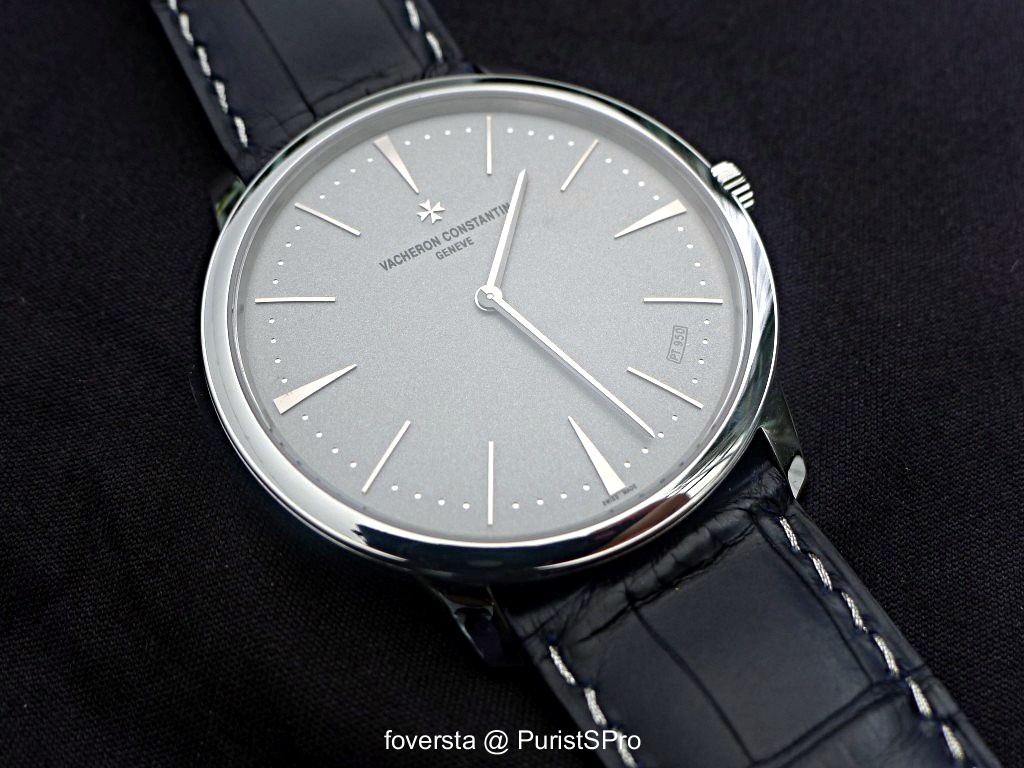
They managed to do it and it was not an easy task.
The reasons of this achievement are:
- the size of the indexes: they are long and thin and they contribute a lot in the reduction of the perceived size.
- the sand-blasted dial: a smoother dial would have been a mistake here. Sand-blasting "breaks" the uniformity of the dial. It is far from being monotonous.
- the shape of the dial by itself: it is not flat, it has downward curves close to the bezel.
- the shape of the lugs: they are short and curved making the strap very close to the case improving the feeling of "density" of the watch.
- the shape of the case: it is not straight and its complexity makes it very appealing.
- the case is thin but not than thin and absolutely not ultra-thin (7,3mm) so the ratio (diameter/height) is still acceptable.
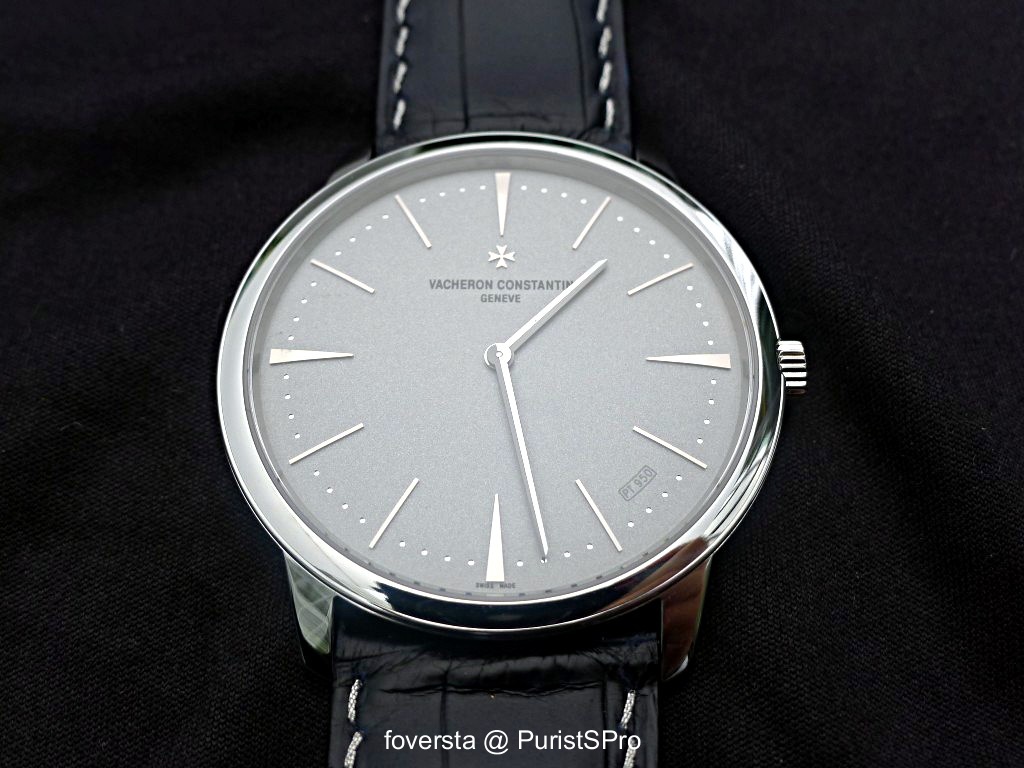
So when I put the watch on my wrist, I was very surprised: I almost had the same feeling than with the 40mm. Yes, you feel the difference but no, the watch doesn't seem to be less unbalanced.
The hands seem to be very simple but they aren't. First of all, they are efficient: you read the time very easily. Secondly, they both have two facets creating a nice light effect on the dial.
But... there is always a "but" in this kind of story, I found the 1120 movement a bit too small for the case size. Obviously, as this Patrimony Contemporaine is not a small second watch, you don't feel it dial side which is good news. The bad idea IHMO comes from Vacheron decision to put a see-through caseback.
Of course, maybe it would have been a pity not to see the very refined work on the 1120. I'm a fan of the Vacheron touch: the finishings are flawless and discret at the same time. Nothing too eye-catching, nothing similar to a X-Mas Tree, you always stay in this elegant style with the quality criteria of the Geneva Seal. The work on the rotor is beautiful... and useful: its hollowed finishings make the movement more visible and give the opportunity to enjoy a big Maltese cross.
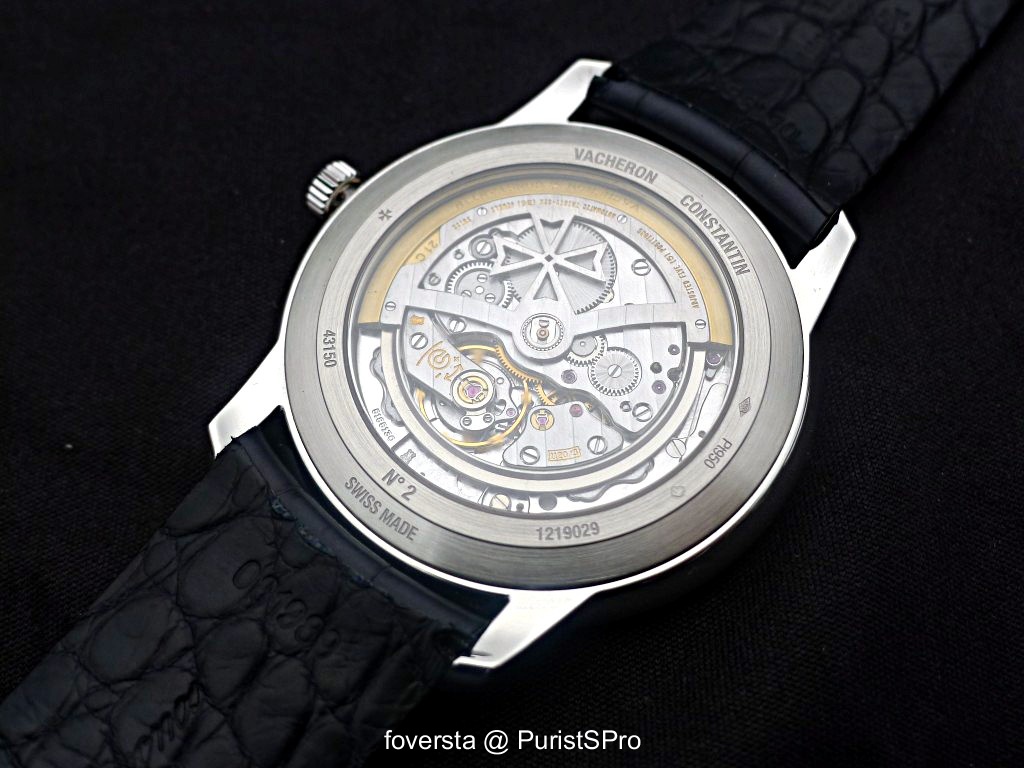
But in the context of this 42mm watch, I would have prefered a solid caseback with, for example, a nice engraving. The movement is not that small with a 28,40mm diameter... but it is for a 42mm watch.
We find again the classic performances of the 1120 with its unusual frequency (2,75hz), its 40 hours of power reserve (maybe a bit short now in the 2011 context).
Now, let's talk about the famous hallmark on the dial: the "PT950". Good idea or not? I don't have a clear answer about it. I find it far from the Vacheron way of thinking. Vacheron is not a brand which plays in the "show off" area. So why putting this hallmark on the dial? On the other side, it adds a detail on the dial which breaks its symmetry. So why not after all? It remains quite shy on the dial.
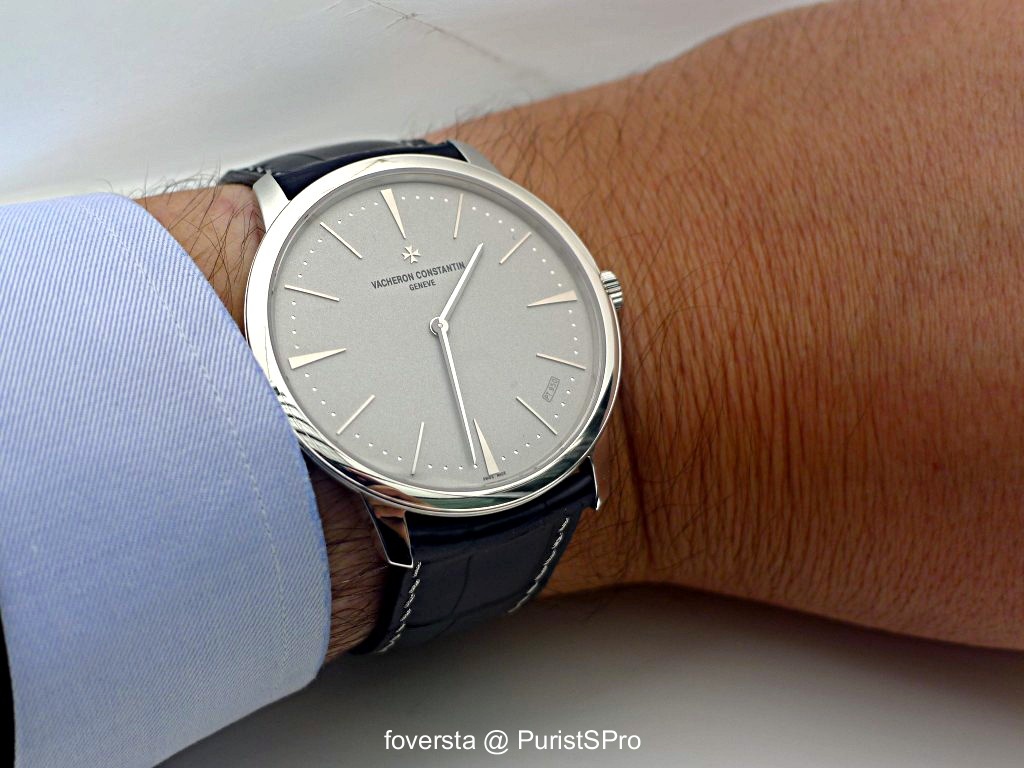
With this Patrimony Contemporaine Self-Winding Excellence Platine (Vacheron won the contest of the largest watch name !!!), Vacheron managed to enlarge the size of the case without disturbing the overall balance. The watch looks smaller than it is actually despite a thin bezel. This LE of 150 watches is slender, elegant and more complex than it appears at first glance. But I would have prefered a solid caseback even if the 1120 is well finished.
I would like to thank a lot the Vacheron France team.
Fx

Still don't know what to think about this watch.
Some negative " a prioris ", which have to be confirmed or infirmed by an " in the real " test.
I'm still surprised to see VC betting on big sizes ( WT and this one )....
The WT, I saw it in the flesh, and this is a real no go for me, a big deception, even.
This one, I have to test it.
I agree with you that a solid case back woulmd have been a plus.
Best,
Nicolas.
Well, I agree and disagree
You are right, the new E.P. is more complex than it seems, and that, to me, seems to be pure VC -- deceptively simple. The movement is finshed perfectly but not too showy. To my eye, no one creates more seductive cases than VC. No matter how simple the watch at first appears, there are always pleasant surpises to be discovered.
I think you are right in that a solid caseback may have been the way to go this piece. The movement is legendary and does not HAVE to be seen. It is enough to know that it is there, just as it is in my Royal Oak (well, its sister caliber to be more correct).
I am not sure how I feel about the "Pt. 950" on the dial. I think I would prefer it not to be there on these E.P. pieces, but it is not a deal breaker for me. Is it better than a discreetly placed diamond? And in this case, the platinum refers to nearly everything, including the dial and even the stitching of the strap.
I must see this one in the metal to be sure on its size. The 42 mm is a bit daunting for this watch, both in aboslute terms and relative to the movement within, but you seem to have found that VC made it work!
Thanks for your thoughtful commentary on this watch -- you have me thinking harder about this one.
Best,
respo

I have no reservations about this watch at all.....
I recognize that the 42 mm will be too big for some (just as the 40 mm of the Patrimony Contemporaine 81180 is too big), but for so many others, particularly in the US market, this will be a great choice. So many watch buyers have gotten used to having large Panerai and IWC watches on their wrist that they feel uncomfortable with a 35-38 mm dress watch on. The 40-42 mm of the Patrimony Contemporaine collection is perfect for them.
Bill

If I look just on the numbers ...
But maybe it is one of the watches, which have to be seen in the real world.
I can imagine, it could be dangerous because of some nice details.
My head says: No way!
My heart says: Give it a try ...
My banker says: You must be totally crazy!
My wrist says: Please, let me try ... - just once.
My ...

FX, your thoughts and observations are much appreciated. Thanks!
Oliver

I really like it but...
it just destroys overall magnificent appearance
Thank you for pictures
Sincerely
Damjan

Love it - great photos, and a VC I truly like and would want to own.
Not something I could write about a great deal of their line-up, but this one is stunning. Do prefer the exhibition back and the fact that 'YES' they have a free-sprung balance there. Love the rotor design as well.
Brilliant and congrats to VC for this one.
Andrew H

I love this watch
And this is despite
1) what's with the gold extension on the rotor? Need to create more mass because of the semi skeleton effort on the rotor? Perhaps can conceal the extra bit rotor and spacer with a smaller show back.
2) size 42mm is ok with me, as it is flatish. You call it "fried egg", Chinese Cantonese call it "ham chi peng" style, kinda a flat round salty dough.
3) the sandblasted grey dial is quite attractive. I have always maintained that slate grey is so Patek, and strangely not replicable IMHO.
4) the 1120 is not exactly a work of art, but VC has appropriately finished it, not jaw dropping beautiful, but very very warm feeling when looking at it. Monocromatic beauty
5) the PT 950 doesn't bother me. Like Respo has said, one brand uses a small discreet diamond, another uses small discreet text.
But the overall package is just so attractive.
Best,
Horo


Managed to see this when i was in Tokyo
Would have been really perfect if it was a hand wound!
As i am still hurting from the chance to own the original CEP PC back from 2006, i was initially overjoyed to hear the news of this release.
But alas, the word remontage automatique came up, and the idea of acquiring it went down the drain.
It is a nice beauty nonetheless.
Thanks for bringing us these photos!
Merci,
Stephen

Big! Bold! Beautiful!
