
3d Printing and Horology
I'll be coy and reserve my comments for a little later, but I wanted to solicit your opinions about how 3d printing will affect watchmaking in the perilously near future (article from SJX):
"Three-dimensional printing is an additive process of producing an item. 3D printing builds up an object in resin or metal or other materials. A nozzle squirts the material out a tiny bit at a time, building upwards and outwards. In contrast traditional methods like milling and drilling are subtractive - start with a large blank and whittle it down.
The possibilities for 3D printing are thus limitless, constrained only by the printer. In a milling machine the object desired can be no large than the original block of material. And unlike traditional methods 3D printers can print mobile and jointed objects, not just static items.
In horology, I first encountered three-dimensional printing at watch factories, where the process is used to make resin prototypes of watch cases to evaluate form and size. And the idea further developed in my conversations with Dr Bernard Cheong, whose wide ranging mind is fascinating but sometimes incomprehensible; he too is deeply interested in this technology. And then The Economist just ran a lengthy special report on the topic, which it calls “A Third Industrial Revolution” (accessible only to subscribers unfortunately).
Intuitively 3D printing seems much more high-tech and less wasteful. After all, man has been creating objects by removing material (chipping away, engraving, milling etc) for millennia.
Not only is 3D printing more versatile, it is much cheaper. Less material is wasted and more importantly, there are no economies of scale. The Economist cites the example of a hammer. To make one the traditional way, the head has to be moulded and cast, and then the handle turned. Both are then fitted together. Thousands have to be made to amortise the cost of the mould, which can only make a hammer head and nothing else.
But a 3D printer can print the head and handle, just one of each, at the cost of the material only and the software programming. And then it can go on to print whatever else is desired.
Additive manufacturing is the way of the future. It is even emerging as a domestic technology, with affordable printers like the Thing-O-Matic from MakerBot which prints in resin.
So what does 3D printing mean for watchmaking?
Last year in my monthly column in The Peak magazine (available at newsstands in Singapore), I covered the topic with regards to personalisation of watches. Why engrave when you can print?
“Now in its infancy but rapidly growing popular amongst the global nerd elite, 3D printers fabricate items by “printing” them… three dimensional printing will make personalisation… feasible. Traditionally such products required economies of scale to be viable… That is one reason why personalised watches have been uncommon.
But the key is the dissolution of economics of scale. 3D printing allows for items to be made one at a time at reasonable cost. There is no longer a need for economics of scale. A watch case back can be printed complete with a monogram, coat-of-arms or logo, at a fraction of the cost of what engraving a case back would cost.
So the future of watches might go like this. A client will have the choice of case materials, dials, hands and straps, with virtual mock-ups presented on an iPad inside the boutique. And he will also have the choice of personalised parts, perhaps something on the case back, or even a logo on the crown or clasp, all made possible by 3D printing.”
But that is the tip of iceberg. The Economist report cites the example of how curved, rather than milled, right-angle channels can be printed inside parts for aerospace engines, increasing efficieny.
Just ponder what 3D printing can do for contemporary timepieces. 3D printing can produce the orb-like cage for the Jaeger-LeCoultre Gyrotourbillon at lower cost than the five-axis milling machine JLC current uses. Spare parts will be far easier, and cheaper, to fabricate as well. No more turning a wheel on a lathe.
Imagine the possibilities for a printed watch case. They are today limited by the capabilities of milling machines. But with 3D printing a case can be printed with intricate detail inside and around - imagine a watch case with a lattice structure. And even better such cases can be made one at a time at reasonable cost because 3D printing has no economies of scale.
At the same time I foresee the problems of replicas growing even bigger. It is conceivable a real watch can taken apart and then scanned, part by part, and then replicated. Equally likely is the replication of valuable components for vintage watches, like a crown or hands for a vintage Rolex.
In short, watches should get better (more detailed and interesting), cheaper and easier to repair.
3D printing will further widen the divide between true high horology watchmakers and everyone else I reckon. The watches at the zenith of horology, like the Dufour Simplicity or Seiko Credor Eichi, have a special quality that cannot be printed. The same cannot be said for a simple, ETA-based, steel case sports watch.
All of that won’t happen anytime soon. High-end watchmaking after all is built on history and doing things slowly. It only started using carbon fibre (or rather carbon fibre reinforced resin to be specific) decades after Formula 1 and the aerospace business. But once 3D printing comes to watchmaking it will change the industry.
- SJX"
Distribution of spare parts, counterfeits, restoration work, etc.
Thanks for your thoughts!
_john
Edited to include body of article.
This message has been edited by SJX on 2012-05-01 18:47:20 This message has been edited by SJX on 2012-05-02 09:10:10Metal components aren't just shapes

I'm with Nick on this one . . .
Peter Schmit's clock
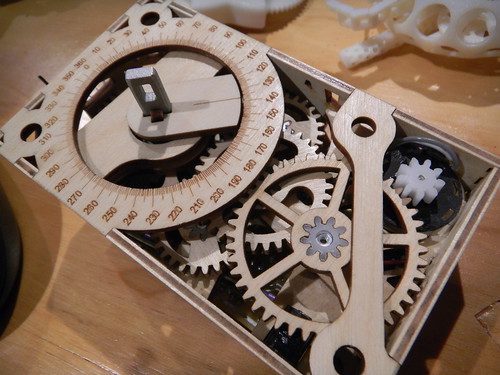
Hah, that's very interesting

The Economist...
...is the magazine I'd want to recieve my materials engineering information from, every time.  That hammer they cite example is worse than disingenuous, it's gushingly ignorant.
Printing, as it exists today, is mostly to provide physical samples....so much design is done on screen now that those samples are really helpful in understanding the scale and proportion of a part. Or to provide a quick part to check fitment, etc. Where printing is particularly good is for silicon tools. Very quick, and good for short runs.
There are metal printing processes that provide better mechanical properties, but they have terrible (by watch standards) surface finishes...
points well taken (if "disingenuous" seems a little harsh...)

Most seem to be missing the point....
The point I make is that one day, and I say that it's pretty far off, 3D printing will be big deal and revolutionise watchmaking. As it is today it won't, but that will change.
- SJX

I actually somewhat disagree
Something else to consider is that most of the industry is still a mass-production industry. Setup costs for milling and stamping may be very high, but they are can be amortized out in a way that single-piece work like 3d printing (and wire EDM) cannot
A
Well, over hundreds of years, watchmaking's been repeatedly revolutionized . . .
 .
.When...
...a laser scanner to pick up all the hard points of a part, a simple way to transfer that to the appropriate file and a way to replicate that into the correct alloy is available; and when this is more economically viable than finding a replacement part or person with sufficient skill to fabricate one only then can I see this technology as a 'threat' or alternative to the 'usual' mass manufacture (per some other comments on this thread)
Where I do see this technology as an advantage (in the shorter term) is being able to mock up, for example, a base plate of acceptable fidelity. Which will allow far easier trials/experimentation in the development of new/altered movements. Much how the technology is being used today.
Personally, I'd love my own 3D printer....

There are watches with some plastic components. That ....,

May be possible in the future commercially but...

I agree - prototyping is where it's at now
- Architectural Models
- Figurines
- Basic Appearance Models
- Concept Evaluations
- Student Projects
- Space Studies
Prototypes are produced without any support flanges or trimming, and with excellent up facing and down facing surfaces. A variety of materials, including clear, are available. Prototypes are best suited for applications where accuracy, detail and surface finish are important and the part fits within a 5" x 5" x 5" (127mm x 127mm x 127mm) build volume.
That's good for a watch!
Typical applications for prototypes include electronic components and connectors, electronic packaging, knobs, buttons, medical devices, fittings, valves and parts with complex interior features. It has also been used for tooling in low-temperature applications. It makes an excellent mold with releasable surfaces without requiring a secondary process for non-cosmetic applications.
Etc etc
Cazalea
Mostly in agreement
I think of 3D printing...
as a novel fabrication technique that watch manufacturers or restorers/repairers can chose to use where it provides advantages over the existing options. But not as a likely revolution in the manufacturing of watches or watch parts.
Quickly prototyping watch cases or case parts from resin or plastic is an examples of where it does seem to have advantages. But I'm a little sceptical about its potential use for manufacturing movement parts, at least based on the current capabilities of 3D printing that I've read of.
Perhaps if the technology matures further, particularly its capabilities when working with metals, then there may be some new options.
IMHO the availability of more conventional, relatively low cost, high accuracy CNC metalworking equipment is perhaps just as important as 3D printing.
Great topic John - interested to hear what others think.
grumio

fascinating topic
potential for progressive watchmakers
I see a potential niche for budding, aggressive, and progressive watchmakers to incorporate this technology for 'watch repair and/or restoration'.
Just as the cost of sandblasting and laser welding machines have come down and more accessible to watchmakers, so, too, 3d printers are becoming more and more affordable to the general public. As a result, I envision the day when watchmakers may use this technology to reproduce a necessary part during service of a timepiece. And, with restrictions placed by watch manufacturers for spare parts, an aggressive watchmaker will do whatever he can to offer his unique skills to satisfy customers.
It also won't be long before some watch companies will turn to it as a cost effective way of producing watch parts, etc. in order to beat the rising cost of standard materials and labor.
Thanks for posting this interesting subject on the forum.
Best regards,
Jack Freedman

I hope I live...

Less watchmaking than watch repair ...
Well, personally I place the independent "talented watchmaker" reproducing parts of a defective Rocal Oak or Lange movement into the same category of myths as the "bush mechanic" building a high-pressure fuel injection unit from scratch somewhere in Africa. Even today, watch repair is mostly based on the supply with spare parts, rather than the reproduction of damaged parts. Which watchmaker will bend a Nivarox hairspring, or make a new balance ring even for a valuable high-end timepiece? How many repair jobs remain undone, simply because the manufacturer doesn't exist any more, or won't supply independent watchmakers with spare parts?
Consequently, I thought that silicium parts would not make the situation worse than it already is, in the contrary: Here, 3d printing might become the means of choice for independent watchmakers to reproduce individual units of silicium parts. Not now, of course, but not too far in the future. Naturally, etching a silicium wafer with some hundreds of parts on it would always be the more inexpensive way, compared with printing parts one by one, even with the tolerance issue left aside. But 3d silicium printing would make it possible to replace a broken silicium hairspring, even when its producer is out of business since decades.
Regards,
Marcus
FWIW, I made this
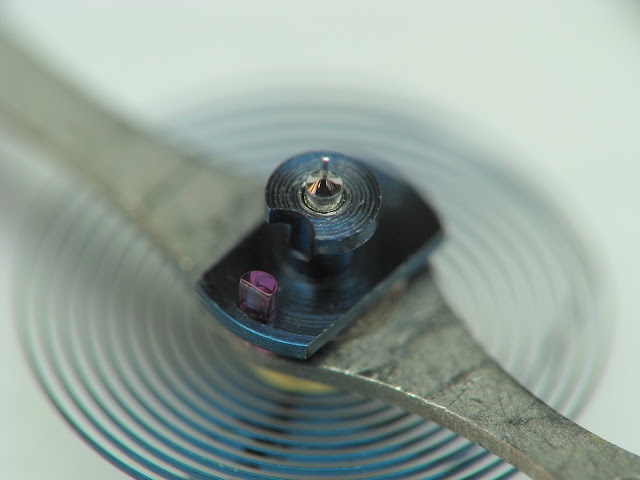
Very nice, John! But ....
My comment regarding the lack of re-production abilities rather dealt with those parts that are made from specific alloys, like Nivarox or Glcydur. I still doubt that these parts are re-made by watchmakers when broken: I rather assume that they are simply replaced, or the repair job is denied, when spare parts are not available.
Regards,
Marcus
CNC making of one off parts
Several years ago I saw a presentation (at the only BHI regional meeting I ever went to!) of a watchmaker who was managing one of the vintage watch workshops in London, talking about making a missing part for a vintage Patek using CNC machining.
I think a simple visual scan of the broken part was a starting point in making the technical drawings required.
I think it was more of a personal experimental project than something that was economic at work.
I guess we will see more of this as more watchmakers become at home with 'small scale' CNC and 3D printing.
More than just shaped metal..
This was why ....
I am sure this will eventually pose a problem in, say, a hundred years when such parts are not available any more.
Regards,
Marcus
understood
Hello Marcus,
I was simply addressing the "myth" of watchmakers making parts. The more exotic the material, the less likely it is that someone will be able to re-manufacture a replacement part for it, at least with currently available technology, and that definitely includes Nivarox and glucydur. Alternative materials could generally be chosen for those two however. Applying traditional techniques to attempt to replace something manufactured using high-tech methods or materials is especially fraught with problems when the engineering embraces the technology at a fundamental level like with the dual-Ulysse escapement or the Pulsomax escapement.
A wheel is not too challenging to fabricate from scratch if one has the tools and training, but there is a huge time investment to set up and execute to an acceptable level of precision, so to do so for a single piece is generally cost prohibitive. Unless the secondary market for a given piece holds up exceptionally well, mostly they will be mothballed rather than being repaired when replacement parts are not available. Special pieces will of course continue to receive special care.
By the way, I realize now that the picture in my previous post doesn't show scale. The roller was for a 9 1/2 ligne wristwatch movement.
_john This message has been edited by ei8htohms on 2012-05-03 10:18:39
9.5'''
With merely 3D printing, I don't think it will be revolutionary in watchmaking.
But I believe it will make certain stages of watchmaking ralatively easier.
3D printing means lesser work which results in cheaper watch? I don't think so.
Interestingly, I would like to know whether independent watchmakers are using 3D printing in their watchmaking process. If so, whether their watches will have less "soul" due to the usage of the 3D printing.
Regards
Ling