
Montblanc's 500 hour testing certificate...now for all watches?

A few months ago I wrote:
"2% of all watches are pulled randomly out of production and tested in various manners for 500 hours"
Imagine my surprise to learn, from Montblanc's website, that the testing protocol is now being expanded to include EVERY Montblanc watch with a manufactured movement. A very expensive proposition I am sure.
500 hours to simulate the first year's life cycle of each timepiece.
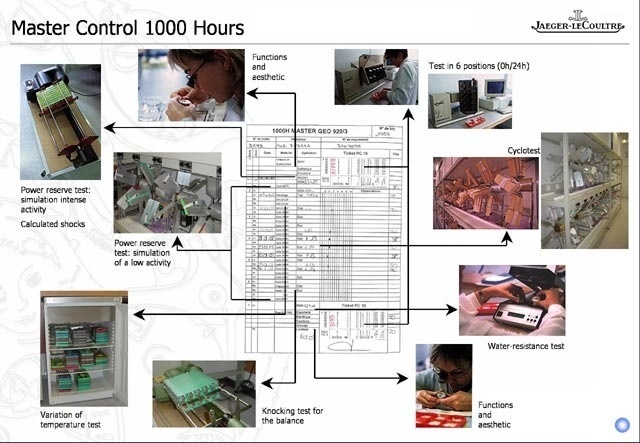
Will this certificate help sell Montblanc watches? Yes. From personal experience, the 1000 hour Master Control test was the deciding factor in my purchase of a JLC watch many years ago.
I also think it is a nice touch from a product presentation point of view if special paperwork will be issued. I still enjoy reviewing my COSC and Grande Seiko timing certificates on occasion. And looking at a Bulletin D'Observatoire always bring back fond memories of the first time I purchased my Roger Dubuis.
Now this, imho, is a very positive step for Montblanc. The company continues to find ways to establish its credibility as a watch manufacture.
Best, Mike

Wonderful news!
Mike, is this a continuous 500 hour testing?
If yes, will it cause immediate wear and tear on the parts even before the watch is delivered?
Regards
Ling
The testing program is in several phases
But, according to MB, each watch will be tested for almost 3 total weeks.
Its not just the movement...its the movement encased!
I guess you can think of it as a "break-in" period.
Best, Mike

Not much
The “500-Hour test” for All Montblanc manufacture watches from Le Locle
This “500-Hour Test” simulates the first years of life which these watches will afterwards actually experience. By subjecting each manufacture watch to a three-week-long test, Montblanc does its best to guarantee that no repairs or other maintenance tasks will be necessary throughout the interval from the moment when the watch is purchased until its first routine servicing.
Montblanc’s “500-Hour Test” is performed on all Montblanc manufacture watches, i.e. all watches encasing movements that have been produced by Montblanc. The COSC’s chronometer test scrutinizes only the movements prior to encasing, but Montblanc’s 500-hour ordeal examines the finished watches with encased movements. Montblanc decided to test the watches with their movements already encased because a watch’s individual functions and its rate behavior can be adversely affected by the mechanical forces that are exerted on the movement during the process of encasing the movement, inserting the dial and installing the hands.
The test consists of several stages, each of which is performed according to methods and monitored by devices that are recognized and approved throughout the watchmaking industry. Montblanc’s examination is unique because it combines individual testing methods and the extreme length of the 500-hour testing interval.
The “500-Hour Test” for all Montblanc manufacture watches is performed as follows:
Test No. 1 – Winding Performance (duration: four hours) Winding the movement and checking the final assembly of the watch
A so-called “Chappuis” machine, which is named after its manufacturer, is used to fully wind mainsprings of self-winding watches which are first inserted into the device and then kept there in constant rotation for four hours. The strong rotary motions, which are much less gentle than that a wristwatch would ordinarily experience on its wearer’s wrist, subject the watches to powerful but not damaging shaking. The vibrations dislodge any dust or other particles which may have found their way into the case. The shocks also further loosen any insufficiently tightened screws, which can then be readily detected and firmly screwed in.
Test No. 2 – Accuracy Test (duration: 80 hours) Continuous checking of the accuracy in all positions
This part of the test occurs inside so-called “FEMTO machines,” which rely on highly sensitive microphones (i.e. an acoustic method) to measure various parameters relevant to a timepiece’s accuracy, e.g. rate, amplitude, etc. The individual mechanical functions of the impulse-pallet, escape-wheel and pallets generate characteristic and unambiguously identifiable sounds; the temporal sequence of these sounds can be acoustically recorded with the utmost precision. Monitoring is undertaken in all positions: i.e. the watch is held vertically and its crown is alternately positioned toward the left, downward, toward the right, and finally upward, as well as with the watch held horizontally and its dial alternately positioned upward and downward.
In order to pass Montblanc’s “500-Hour Test,” a watch’s daily rate must never lose more than six or gain more than four seconds. This range corresponds to the tolerances permitted by the COSC for watches which earn the official chronometer certificate.
Test No. 3 – Cyclotest (duration: 336 hours) Checking the overall function of the movement
During the cyclotest, the watches are smoothly rotated according to a program developed by the Montblanc manufacture. This smooth rotary motion simulates the motions a wristwatch undergoes in real life.
The program simulates phases in which the watch is affixed to its wearer’s wrist, followed by phases when the watch has been taken off and left lying motionlessly.
The test consists of two cycles: the chronograph function is switched on during the first cycle and then switched off during the second phase. The power reserve is tested during each of the two cycles.
Test No. 4 – General Performance Test (duration: 80 hours) Checking the instantaneous rate and the functions in all positions
This test scrutinizes the watch’s overall performance, i.e. its power reserve, the switching of its date display, the accuracy of its rate, and any additional functions. For this purpose, the fully wound watch is placed in a drying oven. The watch remains motionless throughout the entire test, thus assuring the exact monitoring of the power reserve. In accord with a predefined program, the temperature inside the oven varies from +6° to +45° Celsius. This wide spectrum simulates the extreme temperature changes that a watch might experience in ordinary daily use. The test of the timepiece’s resistance to temperature changes exposes the watch to very extreme conditions, similar to those which it might encounter when its wearer travels to different countries and climatic zones. This ordeal is considerably more demanding than the tests administered by the COSC. In addition to the continuous accuracy check performed in test no. 3, a standard PC10 device examines the instantaneous rate at zero hours (i.e. the beginning of the test), 24 hours later, and after 48 hours have elapsed. A special “functiontest” scrutinizes the push-pieces by measuring the amount of force required, and the distance which must be traversed, in order to trigger them. The precision of the chronograph, which measures short intervals, is also measured. The watch is tested in all positions: i.e. the watch is held vertical and its crown is alternately positioned toward the left, down, toward the right and up, as well as with the watch held horizontal and its dial alternately positioned up and down.
Test No. 5 – Watertightness (duration: 2 hours)
To guarantee the case’s ability to resist penetration by water, this test begins with an air-resistance measurement. The next phase is a humidity check: the watch is first warmed on a hotplate heated to 45° Celsius and then droplets of cold water are allowed to fall onto its dial. If fogging appears on the lower surface of the sapphire crystal, the watch is not watertight.
In the final step, the watch is immersed in water to a depth of ten centimeters and the pressure is gradually increased to three bar during a fifteen-minute interval. This simulates immersion to a depth of 30 meters. This test is carried out in accord with the new water-resistance standard (NIHS 92-20, version 2010).
The quality-assurance team does not release a Montblanc manufacture watch for delivery until after it has successfully passed every phase of the “500-Hour Test,” which guarantees that the timepiece will continue to function properly throughout the coming three to five years, i.e. until the time comes for it to receive its first routine servicing.
Thanks :-) Additionally...
Good news!

I immediately had JLC in mind, when I read your title, Mike.
A good thing it is.Montblanc will be able to communicate on all the serious of the brand, the tests, the rssistance of their watches, and so on.
Thanks for the information.
Best,
Nicolas

Montblanc is doing well - halfway to the benchmark

I hope we can get a detailed explanation of the complete testing protocol soon
BEst, Mike
Mike, you mentioned a certificate but
No replies yet from MB. But I know it exists...
From Montblanc's press release for the Only Watch2013 Rieussec:
"The timepiece is presented in a special packaging and equipped with a 500 hours quality certificate"
Now if the winner of that timepiece would graciously post an image of his certificate... 
Seriously, I will see if someone can share this with us and confirm whether or not this special paperwork is being included with ALL Montblanc manufactured timepieces. I suspect it is being issued only for MBR and LL100 movements.
Best, Mike
Nicolas and Mike, I have no intention to create war here.
Does it mean that JLC's 1000 hours test is the "double effort" more than the MB's 500 hours test?
Or 500 hours test is more than sufficient and 1000 hours test is overdone?
Regards
Ling
Dififcult to say without knowing what are the tests at Montblanc which last 500 hours?
This message has been edited by amanico on 2013-11-22 21:45:35
The breakdown
4 hours – winding performance.
80 hours – accuracy in all positions; -6.0 to +4.0 required (COSC standard).
336 hours – "Cyclotest" (14 continuous days); simulates real-life wear including wrist motions and laying overnight. For chronographs, two cycles are run; one with chrono running and one with chrono off.
80 hours – General performance; includes instantaneous rate (not average as per COSC) in positions and temperatures, functions in all positions, power reserve, date switching, additional complications, push-piece function.
2 hours – Watertightness; using new water-resistance standard NIHS 92-20, version 2010.
Total - 502 hours
Kudos to MB for describing the process. Oddly, I haven't found this level of detail for the JLC Master Control 1000 Hours testing...can anyone help with this?
Thanks a lot, Tick-talk. Logically, JLC should have the similar breakdown. [nt]
fire away! Anyway you look at it 1000 hours is twice as long
as 500 hours
The question is: Does the extra 500 hours make a difference?
I think most collectors would still choose, if forced to pick, JLC over Montblanc even if the Montblanc matched the 1000 hours.
But eventually the tide will turn and more collectors will appreciate MB. This 500 hour quality certification process is a good step towards this reality. Moving Jerome Lambert to head Montblanc will accelerate the transformation and reassure doubting watch "afficiandos"
Cheers, Mike
Mike, your question is certainly relevant.
Another question: Do customers determine the purchase by looking at the length of testing hours?
Answer: Majority of the customers don't.
Regards
Ling
Actually I disagree...I think most customers do care
Assume that these customers are not uber-rich
Assume that these customers are not collectors
I think your usual customers will care.
Like you said, they may not care whether the testing is for 500 hours or 1000 hours but the fact that MB has a "Quality certificate" and a defined testing process is a huge selling point... imho it is "value added" over most brands which do not have defined testing.
Best, Mike
PS- It is confirmed by MB that each watch will be tested and shipped with the 500 hour certificate. I am working on getting an image.
MIke, if you ask the members here, I think 9 out of 10 will say: we do care.
However, we only represent a very small fraction of the market out there.
Many new and inexperience buyers will not inquire about testing hours and many sale staff will not take trouble to explain the same or they may not even know about the testing hours (What I usually heard is that: this is Montblanc's own movement. That's it).
Regards
Ling
Really? I would think the testing certification would be one of the first
lines out of my mouth to impress new or inexperienced buyers...I think their minds would be more easily influenced by this certification than collectors who would be more skeptical.
MB is a large corporation with very detailed and specific training program, I've seen training presentations highlighting specific products with their "strong selling points". I suspect we will see this 500 hour quality certificate used as a sales tool soon.

Best, Mike
The problem with these indicators
Yes, the tests selected have to adequately represent "real life"
If you accept the tests chosen by MB as adequate "substitution" then the hours tested in simulation should reproduce the wear and tear during 500 hours of ownership.
My MB sport had a 2 year warranty starting at the time of purchase. My JLC Master Control also a 2 year warranty. This time frame is already a year longer than most. But I agree, how do you translate the process into acceptable outcome which is beneficial for the owner...if MB solves this (i.e free initial service vs longer warranty) they would have a "leg up".
Best, Mike

This has Jerome Lambert written all over it...
