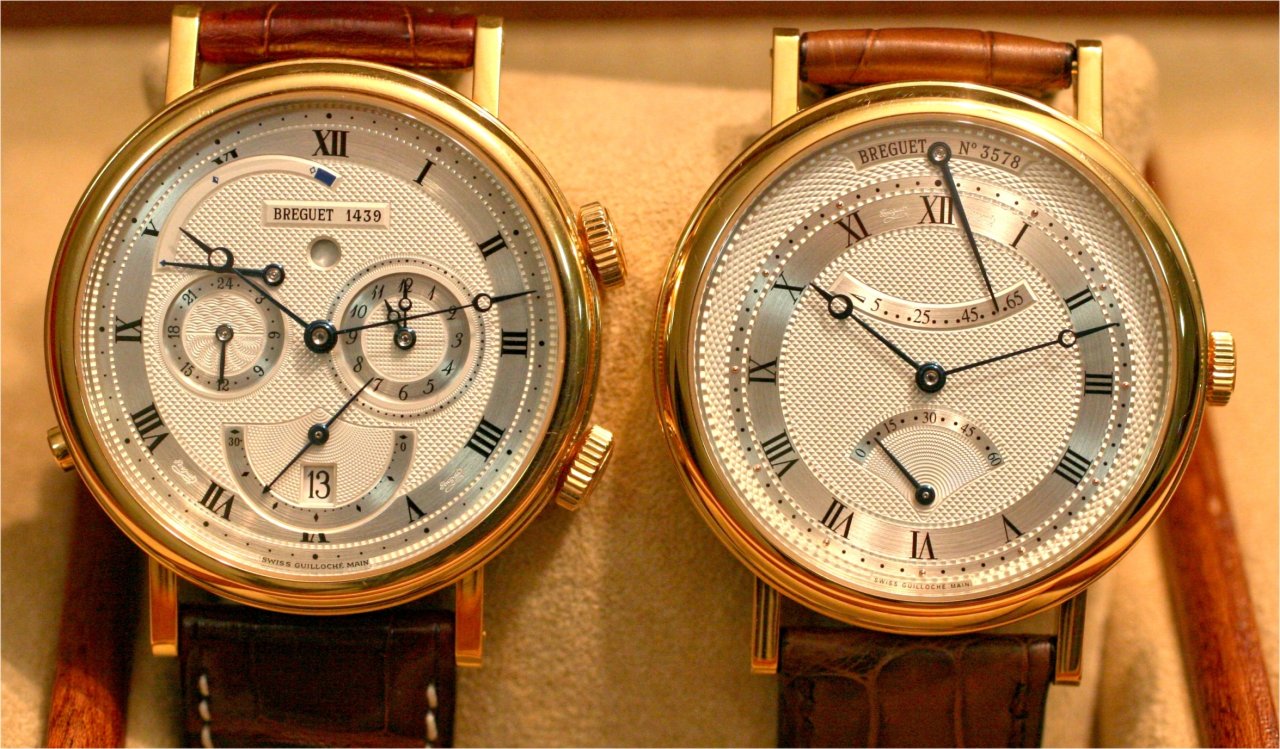
Thank you, Bigdave, my 5707 Just got a sister 5207 and
I really did appreciate you taking the time to reply. I attach a photo of the two for your interest.
Kindest regards,
Jack.


DOUBLE CONGRATS.MY FRIEND.
wow!you are a aggresive one!In 2 weeks you grabed 2 breguet?i must congratulate you!Got Dream!Got Power!
Nice duo there!Initially i wanted to have the power reserve piece but the urge died when i saw the actual 5707!Anyway,it will be a great daily wearer!agree with you.
and do post your trio instead of duo where go missing you tradition!gosh!now you have a collection!well done!hope to see them together in a family reunion!
Thanks for sharing!
Regards,
BHK9
Thanks BHK9
I know how you feel about the 5707....it is something very special, but I will have to be very, very nice to my wife before I can make it a trio.....but when I do I will send you a photo.
Remember it is your fault I bought the 5707...it was your photos that made me dream of that watch.
Thank you BHK9
Kindest regards,
Jack
My friend...My Fault and you are happy!
That's ok with me.It's my fault but as long as it made your dream came through and you are now a happy guy!I am perfectly fine with that.When we are in this Watch syndromme,either you spread or you die,my friend.So today i spread some virus 5707 to you,who knows one day you might spread other stuff to me.Thats the way it goes.
Enjoy your new toys....and pick up some daily wearer(those outdoor tought ones),you own feel that hurt when you encouter with some accident outdoors.I have posted some of mine on the main forum,check it out!
Feel free to PM me whenever you like.
Greetings,
BHK9
A family resemblance
Hi BigDave...No inner sense and not so much variety..
...I think it is just love of a fine thing that is not machine made.
I have collected antique pistols for many years and the workmanship that went into fine antique guns was very similar to fine watches. I will attach a couple of photos of one of my collection built by C.D.Tanner in the early 1800's, who was the gun maker to King George of Hannover. I hope it is not against forum code, if so please delete it.
Reason I do so is, Tanner was making guns at the same time as Breguet was making watches and it would not surprise me if Tanner carried a Breguet watch on his chain and Breguet carried a Tanner pistol, but in each case the workmanship, engineering, beauty and skills in pistols and watches is so simular. Both were finely engineered, both were engraved, both used precious metals of gold and silver.....and importantly, for different reasons, both needed to be reliable and accurate.
The reason that I was captivated by the 5707 is the complexity of a watch of that size which is practical, functional and can still look balanced and beautifull.
By practical, functional and balanced I mean that while there are many complicated watches like perpetuals, many have so much crammed into the dial that everything becomes miniturised and if you are over 40 you need to carry a magnifying glassand stand in the sun to read the information on the dial.
The 5207, apart from it's sheer clean beauty, to me fills every need of a watch. I find it a very practical watch because it has that Breguet white silvered dial with the Breguet blued steel hands which contrast well and is aways fresh, clean and easy to read.
Importantly to me is that every hand is practical in that the Hr. & Min. hands tell the time, the Retrograde hand tells at a glance that the watch has not stopped and the Power Reserve instantly tells a state of reserve. .......Simple, Practical and extremely beautiful in a classic way.
Especially nice is the fact that there is no date window ...this is good because the dial is uncluttered and I don’t have to carry a magnifying glass...OK for you young guys....but one day you will know what I am talking about.
So when might I wear one instead of the other? .....I have no idea BigDave...I just feel privileged to be able to enjoy two such fine pieces, and, may be like Tanners pistols, in around 180m years time someone may also marvel at these Breguet watches.
Kindest regards
Jack
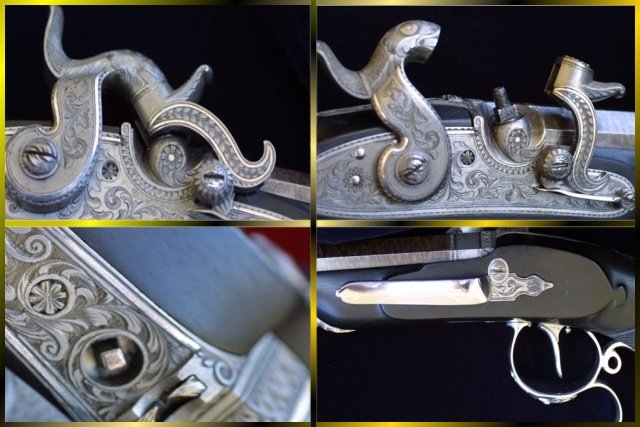

The engraving is beautiful
curious as to how it was done in the past. From what I have been told, some
modern high-end gunmakers outsource the engraving to
specialists.
Even the Kings Master Gunmakers sourced components.
Thanks for your congrats., SJX. I am delighted with both of them.
Your question as to the Master Gun Maker’s engraving being done in house is very relevant to modern watch talk today about "In House Movements" etc.
The Master Gun Makers during the peak of their art in the early 1800,s like Gastinne Renette, Le Page, C.D. Tanner etc, are the equivalent to today’s top 5 watch houses, and even back then they very rarely completely built a total 'In House' gun. Well that is the wrong wording; they built them in house .....out of parts from other specialists.
Barrels, Locks (trigger mechanisms) stocks and engraving were almost always by specialists houses and then finished shaped and polished, engraved, or not, to the design and standards of the particular gun house.
Rarely did a particular maker have enough output to employ a master engraver full time and it was not until mass production started in America in the late 1800 that engravers became ‘In House” so to speak, or barrels and trigger systems were made in house and by then it was mass production.
I am sure that many watch houses followed simular practices with everything from cases, dials, hands, winders etc.....were made by goldsmiths etc.
The interesting thing today, is that the collectors of works, by these Master Gunsmiths, never ever question if the barrel or lock was an in house movement. It was a Le page or a Tanner and that is all that matters.
The acceptance is more the overall result of the end product that that gun maker did output.
It would be interesting to know if the gun purists of the early 1800s had simular discussions as we do about where their favourite manufacturer obtained his parts from, and if they gave any credit for in house production.
For reliability it might have been better to have a barrel or trigger mechanisms built by the barrel maker or locksmith etc, and know it would not blow up in your face or fail....... and then have the overall gun assembled by the gun maker who knew how to make it all run like clockwork.
Reliability and accuracy was the key to having a “piece” that worked correctly.
Could be that maybe it is the same with watches, and we are overlooking something when we look for “in House”?
Kindest regards,
Jack
That's very similar to watchmaking
components made by specialists and then assembled, finished and labelled by the
house. Thanks for the fascinating info on gun making.
the modern gun houses like Purdey, Holland & Holland et al, in comparison to
vintage pieces?
Hi SJX....it is so hard to comparemodern with vintage,
I sent a reply to you but it went into the unknown....anyway I think it is very hard to compare modern with vintage, as things have changed so much.
Purdey and Holland & Holland always were and still are right up there....possibly the best, but are not so modern gun houses as H&H began around 1850 and Purdey even earlier, may be 1810 or 1820....but off course they are still going so modern in that respect.
Vintage guns that were the top of the tree in their day are by today’s comparison worlds apart in accuracy, range, performance and reliability of modern guns, no matter who makes them.
We can’t compare vintage against the result of using modern steel, modern propellant or today’s manufacturing technique.
You know I often wonder how accurate a new watch was when it was made in say 1825 and if the advances of watches and guns was parallel, in time of improvement.
May be they did evolve at the same pace as my Grandfather had a watch that he wound every morning and often commented that it only lost 1 or 2 seconds a day....and he may not have said this so often if that were normal, and he had a gun that he also boasted was very accurate.
That was in the 1950s and he bought both around 1915......so when did watches become accurate to within a second or two per day...any idea?
Kindest Regards,
Jack
Some thoughts on timekeeping
advent of the marine chronometer. I believe the top quality pocketwatches -
chronometers and tourbillons - of the 19th century were accurate to a
second or two. With the start of industrial production of timepieces (pioneered
by VC in late 1800s I believe), timekeepers were more accurate as parts no
longer had to be handmade one by one, piece by piece. Early 20th century
wristwatches were pretty accurate, but unfortunately quite delicate. After shock
resistance was invented the wristwatch became both accurate and
durable.