AnthonyTsai
[PuristS]
22366

URWERK debuts its new UR-106 “Lotus” model for women
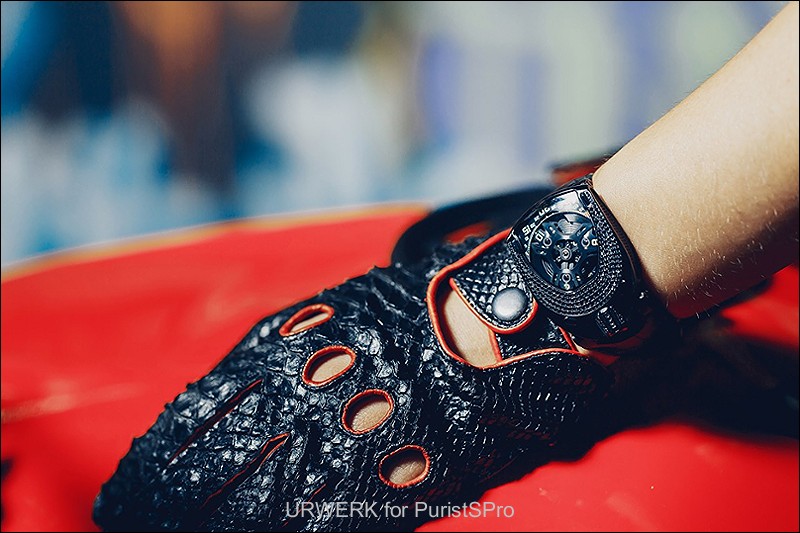
URWERK watches have the reputation of being rare, technically advanced, elaborate to the point of complexity, and classy. However, one thing lacks among the various attributes of the brand — its watches are not seen as feminine. Until now. Because the new URWERK watch, the UR-106, is the first from the independent brand that is especially made for women. Elegant slender and graceful, it shows the sensitive side of URWERK’s nature. For you, ladies, URWERK unveils the UR-106 “Lotus”.
URWERK blossoms in style with the UR-106 “Lotus” model for women
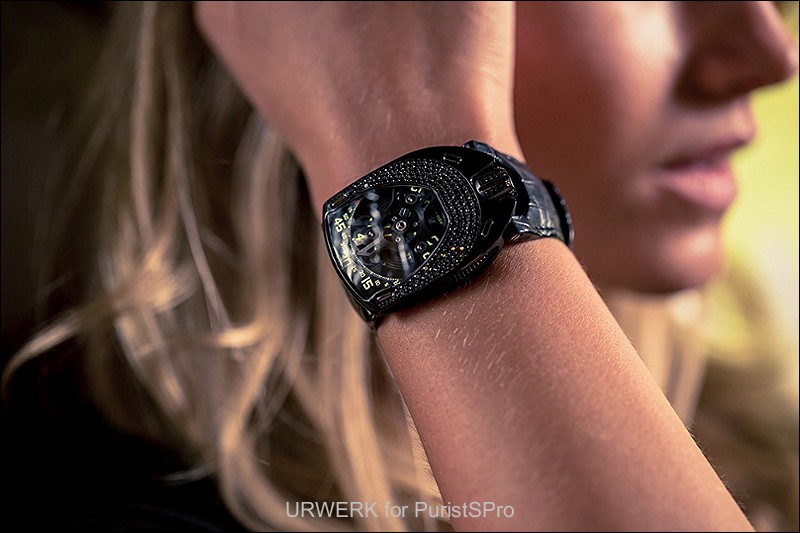
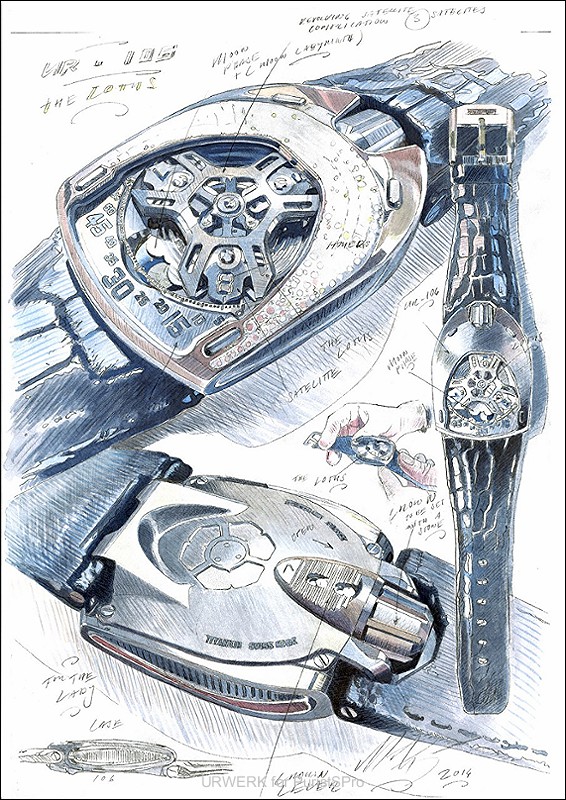
The UR-106 “Lotus” features the brand’s signature satellite hours in a guise never before seen. Three satellite hours wander across the dial to create the most graphic of horological blooms. “We never made watches for men and watches for women because we never thought in those terms when we put our ideas down on paper,” explains Martin Frei, the company’s chief designer and co-founder. “We thus embarked on a stylistic exercise that was unprecedented for us. We have of course long considered what we regard as the ultimate challenge, because creating for women is indeed a perilous undertaking. With its glittering gemstones and soft curves we created the UR-106 with one image in mind; that of the lotus flower, which in my imagination represents the beauty of women in all their complexity.”
“We wanted to create a clean and elegant watch,” adds master watchmaker Felix Baumgartner, the brand’s other co-founder. “We’ve already made complicated watches, solved some tough technical problems, put huge hands into motion and we have gone to the limits of micro technology, but I must admit that we found this new challenge quite scary. We know how to conceive a new URWERK model or extend the technological limits; after all that’s what we’ve been doing since our watch company was founded 18 years ago. But to talk to women about women is something else. Thinking about the remarkable women who have accompanied us on our journey from hesitant beginnings to our present success made us take the step.” (www.uwerk.com/urwerk106)
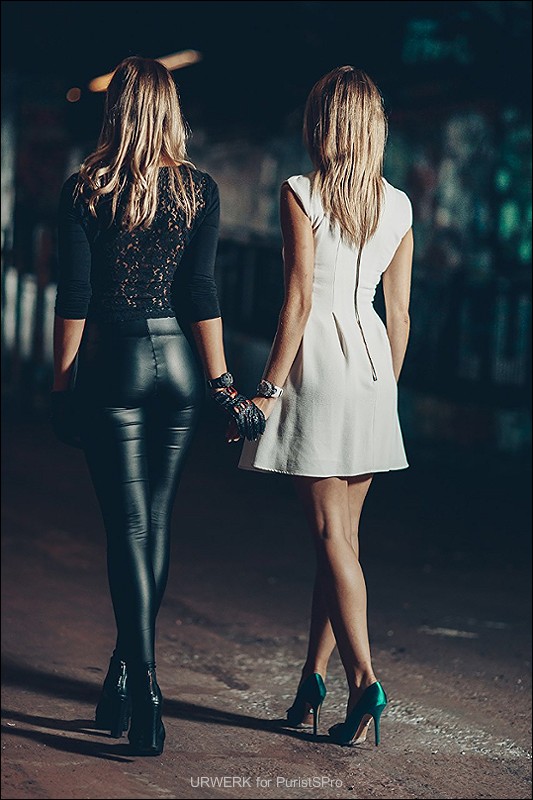
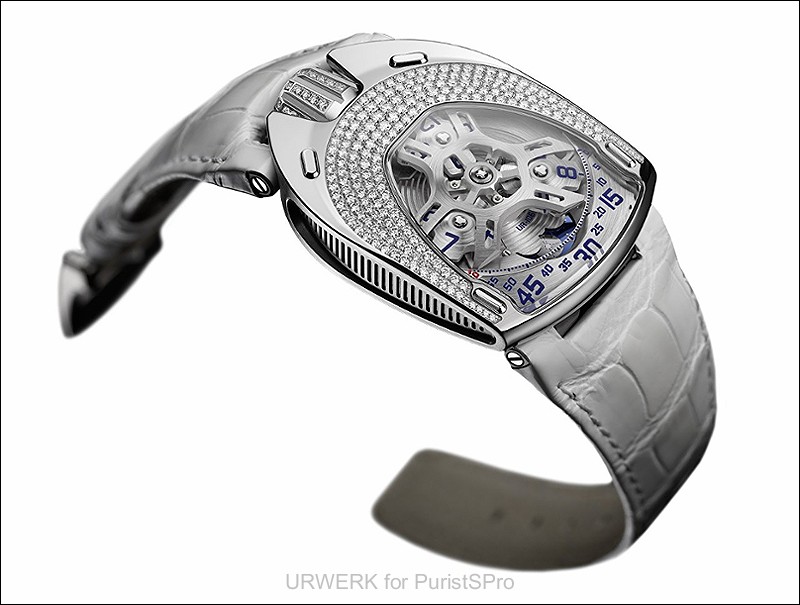
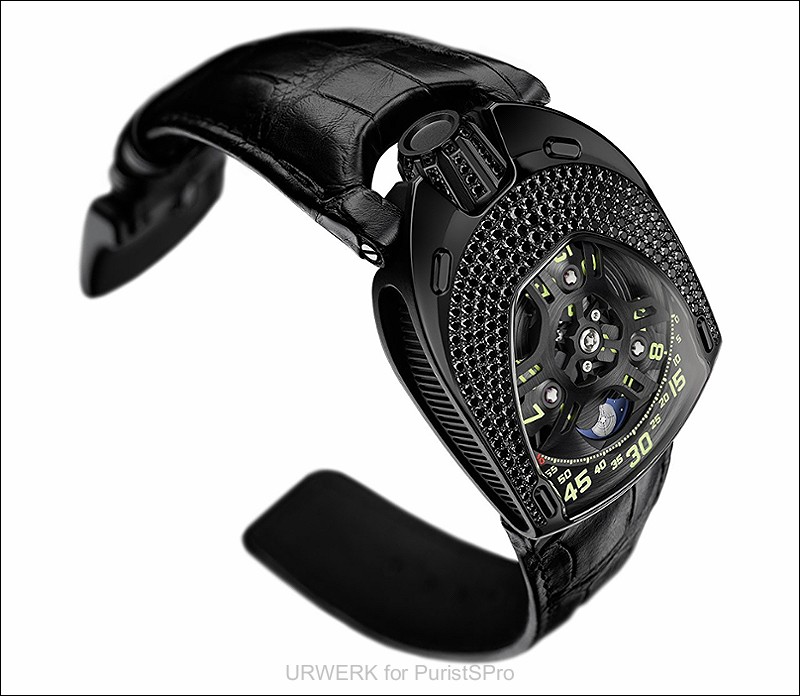
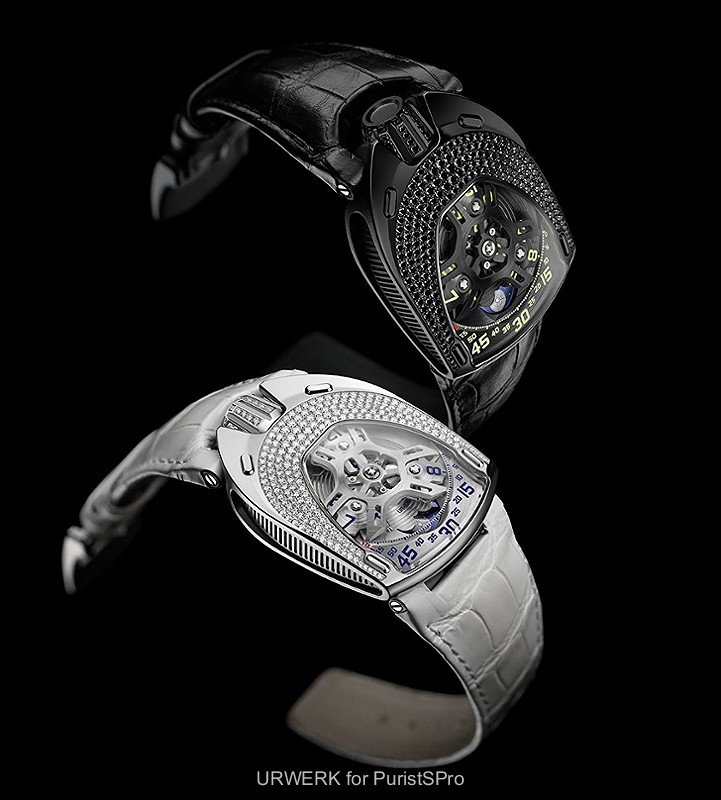
The UR-106 “Lotus” comes in two versions: one is in titanium and steel with diamonds on the bezel, crown and buckle; its antithesis is in black PVC-coated titanium and steel set with black diamonds. “We confronted the two aspects of the same watch — light on one hand and darkness on the other,” enlarges Martin Frei. “We are all creatures of light, but it is our shadows that complete, and define who we are. Tangible dualities are qualities essential to understand the nature of things. In darkness and light, the UR-106 “Lotus” is a double watch.”
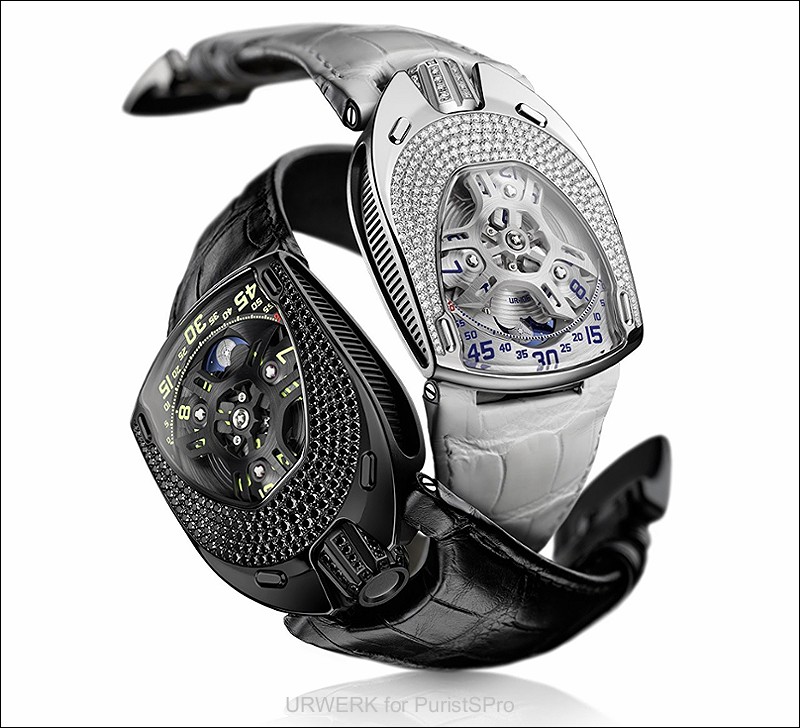
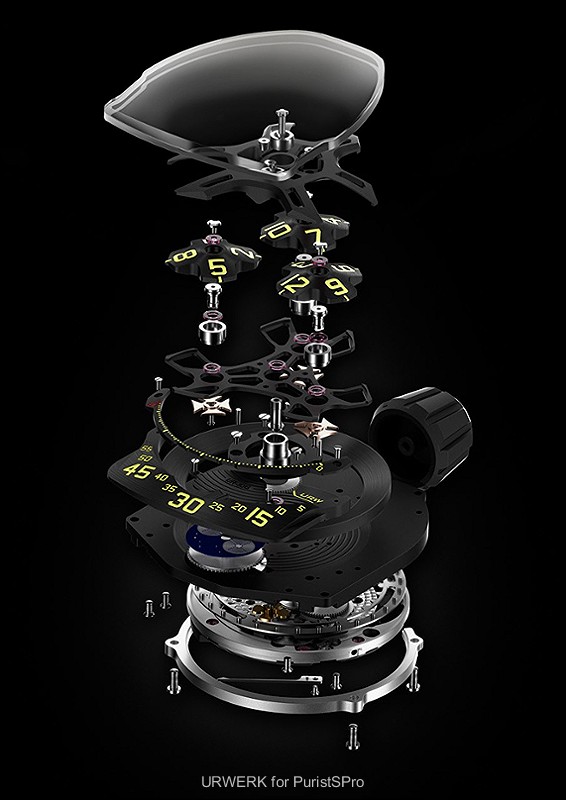
The UR-106 Lotus features a revised version of the satellite hours. Three satellites, each with four hour numerals, sweep along the minutes scale in an analogue and digital indication of time. A moonphase adds to the display. “We have taken particular care over the slightest details of this UR-106. It has taken us 18 years to perfect this concept, so we are making no concessions. The carrousel and its satellites have been meticulously satin-finished by hand, and we have painstakingly painted each numeral for the hours and minutes. The extremely fine minutes scale was fashioned in our workshops, the lapis lazuli blue of the moon was selected from hundreds of other colours, while the outline of the lotus on the back of the watch follows Martin’s design exactly. The UR-106 Lotus is just as we imagined it.”
UR-106 Lotus specifications
Movement
Calibre: Selfwinding UR 6.01, 48 hours power reserve
Finishes: Circular graining, shot peening, brushing, chamfered screw heads.
Dial
Satin-finished plate in ARCAP
Hours satellites and carrousel in titanium peened and brushed by hand
Serrated minutes scale
Lapis lazuli moon
Hand-painted hours and minutes markers in SuperLuminova
Indications
Satellite hours, minutes and moonphases
Case
Materials: UR-106 Lotus: steel case and titanium crown set with diamonds, titanium caseback (limited edition: 11 pieces)
UR-106 Black Lotus: steel case and titanium crown, PVD coated in black, set with black diamonds, titanium caseback PVD coated in black (limited edition: 11 pieces)
Dimensions: Width 35 mm, length 49,4 mm, height 14,45 mm
Glass: Sapphire crystal
Water resistance: Pressure tested to 3 ATM (30 metres)
URWERK
Founded in 1997 by Felix Baumgartner and Martin Frei, URWERK is the result of a strongly held belief that fine watchmaking is a constantly changing art.
Felix Baumgartner, a watchmaker like his father and grandfather, has time running through his veins. A graduate from the Schaffhausen watchmaking school, Felix learned the secret language of minute-repeaters, tourbillons and perpetual calendars at his father’s bench.
Martin Frei is the artistic counterweight to his partner’s technical expertise. Accepted into Lucerne’s college of art and design in 1987, Martin delved into every form of visual artistic expression from painting and sculpture to video, emerging as a mature artist.
The two men met by chance and discovered a common fascination with the measurement of time, spending hours analysing the gap between the watches they saw in the shops and the vision of their future creation.
Their first watch, developed in the early nineties, was inspired by the 17th-century night clock built by the Campanus brothers. In it, each hour on a rotating disc rises and sets in an arc like the sun. The wandering hour has since formed the basis for URWERK’s astonishing 103 watch and the latest models, the UR-202, the UR-110 and the UR-210. They all feature a highly original design, advanced watchmaking techniques and new concepts.
“Bringing out yet another version of an existing mechanical complication was not our aim,” Felix Baumgartner explains. “Our watches are unique because each has been conceived as an original work. This is what makes them valuable and rare. Above all, we want to explore beyond the traditional horizons of watchmaking.” Martin Frei, responsible for the shape of future time, helps make this possible. “I come from a world of total creative freedom. I’m not cast in the watchmaking mould, so I can draw my inspiration from my entire cultural heritage.”
That heritage goes back to the roots of time, reflected in the name of their company. URWERK means “original accomplishment,” and Ur of the Chaldees, in Mesopotamia, is where the Sumerians first observed the concurrence of the heavenly bodies with the seasons, and so developed the first measurements of time.