
DonCorson
[AHCI]
3358

Tim and Bart Grönefeld present the “One Hertz Platinum”
Tim and Bart Grönefeld present the “One Hertz Platinum”
The world's first independent dead seconds series wristwatch goes platinum
Introducing the “One Hertz Platinum”
The world's first independent dead seconds series wristwatch –
now with exclusive platinum case and sophisticated blue dial
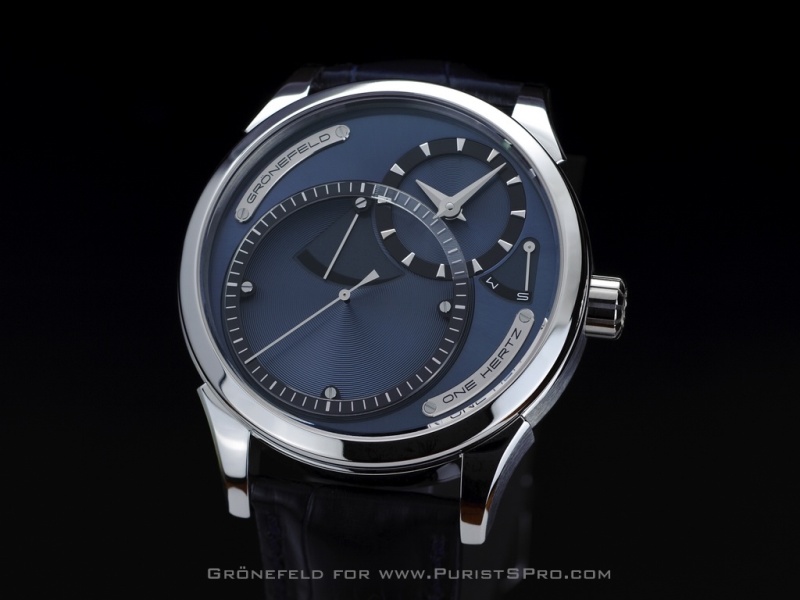
Watchmakers Tim and Bart Grönefeld are proud to present the One Hertz Platinum, a remarkable timepiece which sees the One Hertz – the world's first and only production wristwatch with independent dead seconds – receive an exclusive platinum case and cool blue dial.
While rare, the dead seconds complication – secondes mortes in French – does exist. However, to date dead seconds have been derived from other mechanisms, usually a constant force device or remontoir d'égalité.
The One Hertz Platinum features Grönefeld’s own proprietary movement of which all 285 parts are hand-decorated to the highest standards. The One Hertz indicates hours and minutes on a sub-dial at 2 o'clock; large sub-dial for the dead seconds; power reserve indicator at 12 o'clock; and an innovative setting-winding indicator at 3 o'clock. This ensemble of indicators is all the more striking thanks to the sophisticated blue dial background, which perfectly complements the regal tones of the precious metal platinum case.
The One Hertz Platinum’s setting and winding is also extremely ergonomic, selected by pushing the crown in, rather than pulling it out.
Dead seconds – where the second hand advances in full steps of one second instead of an apparently smooth sweeping action – was a very respected mechanical complication until the 1980s. However, its popularity then died with the dominance of quartz movements, which also stepped in full seconds. A smooth sweeping second hand came to differentiate mechanical from quartz.
With the One Hertz and its unique secondary gear train, Tim and Bart Grönefeld have resurrected this long-neglected complication and re-positioned it where the complication originated: On the pedestal of high precision.
The quartz-like movement of the large second hand of the One Hertz subtly signals its unique mechanism, invisible to most, but obvious to haute horlogerie connoisseurs, who will appreciate the sublime, flawless fine-finishing of the Grönefelds’ own calibre G-02.
The “One Hertz Platinum” is a limited edition of 12 pieces
History of Dead Seconds
With the introduction of the pendulum in the 17th century, clocks finally became accurate enough to measure seconds. It was then not long before a hand indicating seconds on a long clock's dial signified a precision timepiece. A pendulum with a period – the time to swing forward and back – of two seconds (the most common) resulted in a single tick per second.
The invention of the balance spring, which replaced the pendulum, enabled miniaturization. As portable pocket watches became more accurate, watchmakers naturally thought to copy the one-second steps of the second hand which signified a precision timepiece; however, the rapidly oscillating balance meant that it could not be directly driven as with the pendulum, so it required either a new mechanism if independent, or be driven from another complication e.g. constant force device. While pocket watches have featured independent dead seconds in the past, the Grönefeld One Hertz was the first wristwatch featuring independent dead seconds.
The Grönefeld One Hertz is unique among wristwatches in that its dead seconds are powered by a secondary gear train independent of the gear train for the hour and minute indications.
One Hertz
The hertz (symbol: Hz) is the SI unit of frequency defined as the number of cycles per second of a periodic phenomenon. This SI unit is named after Heinrich Hertz. One Hertz simply means "one cycle per second".
The second (SI symbol: s), sometimes abbreviated sec., is the name of a unit of time, and is the international base unit of time. To highlight the SI seconds, the One Hertz displays dead seconds with a large seconds hand in its own dial. Hours and minutes are non-SI units of time because they do not use the decimal system so are displayed separately.
Mechanical wristwatch movements often have balance frequencies of 2.5 to 5 hertz, which results in the seconds hand making tiny steps of 5 to 10 steps each second and looking like a smooth movement. The second hand of the One Hertz is either stationary (dead) or jumping in a full one-second increment each second.
The "One Hertz" independent dead seconds complication
Displaying dead seconds in a wristwatch without a constant force device is no easy task. The friction of the mechanism has to be absolutely minimal so it does not interfere with the escapement.
Tim and Bart Grönefeld used an independent dead seconds mechanism that is driven from its own secondary gear train with its own power supply. The seconds are driven from one mainspring barrel and the hours and minutes from another. Friction is with this system guaranteed to an absolute minimum and the complication has no adverse influence on the escapement and free sprung balance.
The two mainspring barrels are wound simultaneously from the crown, which features an innovative "push to set", "push to wind function", with the mode selected indicated on the dial at 3 o'clock. A power reserve indicator at the top of the dead seconds dial keeps track of the 72 hours of autonomy.
One Hertz Platinum Technical Specifications
The “One Hertz Platinum” is a limited edition of 12 pieces
Features
Indications: Hours and minutes in subdial at 2 o’clock, large seconds at 7 o’clock, power reserve, setting-winding indicator at 3 o’clock.
Winding-Setting mechanism: Push function crown for winding or setting.
Power reserve mechanism: Classic Breguet style by means of a cone moving up and down on the threaded barrel arbour.
Case and dial
Case crafted in platinum, security screws, polished bezel and centre band with hand-finished straight graining.
Case dimensions: 43 mm x 12.5 mm
Sapphire crystals: Top domed with antireflective treatment both sides, display back with antireflective treatment inside.
Water resistance: 3atm/30m/100 feet.
Crown: With engraved “G" logo
Dial: Hour and minutes subdial, raised seconds sapphire subdial (transparent over the hour and minute subdial), power reserve indicator, setting-winding indicator, Grönefeld logo and model name on individual screwed down nameplates
Hands: Hours and minutes, long thin counter-poised seconds, power-reserve and setting-winding.
Strap and buckle: Hand-sewn matte black, alligator leather with platinum folding buckle
Movement
Calibre: G-02, mechanical hand winding, independent dead seconds, power reserve Indicator and setting indicator.
Movement dimensions: 35mm x 9.4 mm
No. of parts: 285 parts
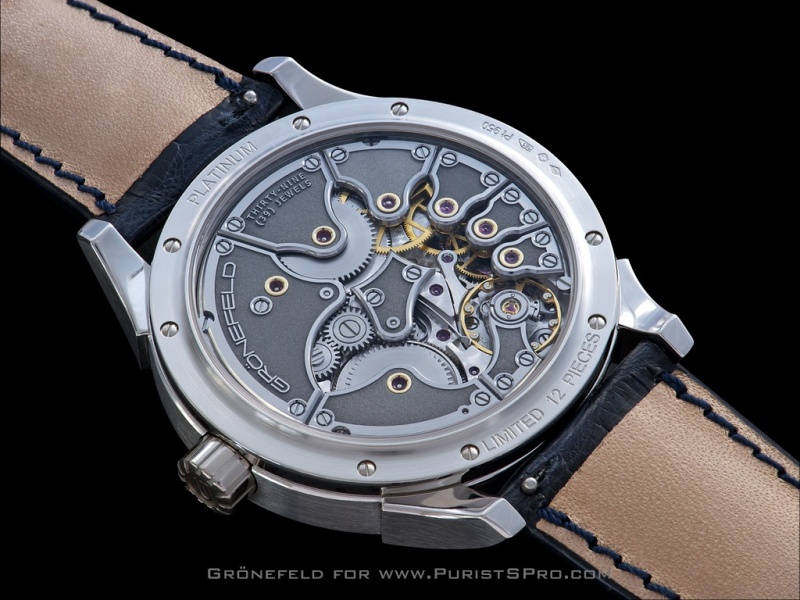
No. of jewels: 39 jewels set in gold chatons
Power reserve: 72 hours
Barrels: 2 barrels, one for the going gear train and one for the independent dead seconds mechanism. Both barrels are wound at the same speed and in the same direction
Balance wheel: 9.12 mm free sprung variable inertia balance wheel
Balance frequency: 21’600 bph/ 3 Hz
Balance spring: Phillips terminal overcoil curve, triangle-style stud
Main Plate: Spotted rhodium plated nickel silver
Bridges: Stainless steel hand bevelled, micro-blasted, circular grain on the top, relief engraved on micro blasted surface
Gearing: 2 independent gear trains each with their own energy source
Dead seconds mechanism: Independent mechanism, cam with 30 teeth on the going gear train on the second's wheel, escape wheel on the seconds wheel of the independent gear train, double lever with jewelled pallets.
Biography: Tim and Bart Grönefeld
The name Grönefeld and the art of watchmaking have a family history spanning a hundred years, originating in the ancient town of Oldenzaal in the Netherlands. There, in a shop facing the ancient basilica church from 1240, Johan Grönefeld, Tim and Bart's grandfather, began his career as a watchmaker in 1912, marking the beginning of the highly talented dynasty of Grönefeld watchmakers that continues today.
Tim and Bart's workshop is located in Johan Grönefeld's original building as, representing a continuous, unbroken watchmaking family history that is exceptionally rare to find anywhere in the world today.
Tim and Bart underwent extensive training in Switzerland, and within a relatively short span of time proved themselves adept world specialists in the production of the most coveted and exquisite horological complications of all: the tourbillon and the minute repeater wristwatch. In 2008, after working anonymously behind the scenes for prestigious Swiss brands, they presented the first watch bearing their own name, the GTM-06 Tourbillon Minute Repeater.
In June 2010 Tim and Bart presented their second watch, the One Hertz, the world's first wristwatch with independent dead seconds and featuring a completely new movement. The One Hertz Platinum, with exclusive platinum case and sophisticated blue dial, was unveiled at Baselworld 2012.

Independents
Explore dxboon's review of the Don Corson Dresdener Regulator, a unique independent timepiece. Discover its craftsmanship, design philosophy, and community insights.
45 replies13935 views

Independents
Explore Tempus Arte Group: Lang & Heyne, UWD, and Leinfelder. German independent watchmaking, manufacture, and boutique.
10 replies8071 views

Complications
Explore H. Moser & Cie.'s Endeavour Perpetual Calendar, from its GPHG-winning debut to its unique month indicator and movement innovations. A must-read for collectors.
29 replies2873 views

Independents
Discover the Grönefeld One Hertz Techniek, the world's first independent dead seconds series wristwatch. AnthonyTsai's post reveals its open dial, caliber G-02, and titanium case. Explore community insights.
9 replies1653 views

Independents
Explore the rare, discontinued Lang & Heyne Heinrich with its unique anti-retrograde date, remontoir, and dead-beat seconds. Discover Caliber V and collector opinions.
20 replies1182 views

New Release
Discover the H. Moser & Cie. Mayu 2013 collection with new red gold, rose gold fumé, and white gold silver-plated dials.
1 replies734 views
Tim and Bart Grönefeld present the “One Hertz Platinum”
Tim and Bart Grönefeld present the “One Hertz Platinum” The world's first independent dead seconds series wristwatch goes platinum Introducing the “One Hertz Platinum” The world's first independent dead seconds series wristwatch – now with exclusive plati...


You will love it! The bad thing is ...
That your wish list will be a bit longer. Best, Nicolas
I know i know..it has ben in my wish list
for a while now.....loved the RG chocolate dial...have a look at the grade5 titanium versions on their site!MAMMA MIAAAAA Too many I am going crazy.... Mo
Do a search on the AHCI forum.
I posted them once when I was back from IGOTT II, and another time when I was back from Geneva, this year. Best, Nicolas
Ah I thought that was a SS version....
but there is a Ti with blue elements on the dial and gold hands....that looks like the winner...... Mo
I love it, indeed!
This may well be one of my rare incursions in the Independants World... The watch is super cool, I know it to have tried it a lot of times, and these Gronefeld Brothers are top notch guys. Really tempting. Best, Nicolas
As mon ami says it all
The wish list grows longer by a notch! Very good job Gronefeld brothers! Stephen

Now this is what I'm talking about.
Fantastic offer from the super talented watchmaker. Go to their website to see the more avant grade looking titanium models. Really hope they do well this year. Regards Tyler
This is gorgeous!
Love the blue dial version! I wonder if they'll do a reverse black-white dial where the dial is black and chapter rings silver?