Complications
quattro's comprehensive overview of H. Moser & Cie.'s Perpetual Calendar series offers an invaluable resource for collectors. This deep dive into the evolution of the Endeavour Perpetual Calendar, from its GPHG-winning debut to its various iterations, highlights the brand's unique approach to a classic complication. Understanding the subtle design and technical changes over two decades is crucial for appreciating the brand's distinct horological philosophy.


The H. Moser & Cie. brand, named after Heinrich Moser (1805-1874), a Schaffhausen-born watchmaker, presented its first contemporary watch at the end of 2005 to mark the 200th anniversary of its founder’s birth.

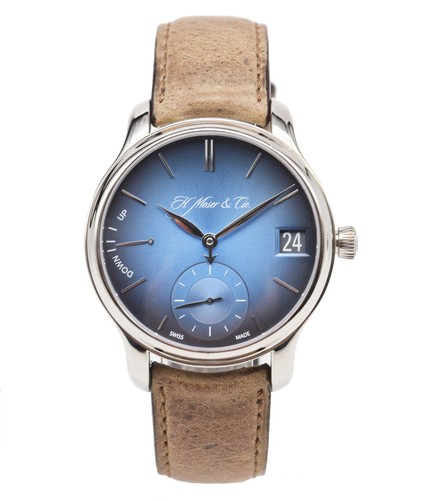
This first watch was the Perpetual 1, later renamed the Endeavour Perpetual Calendar (around 2012), and it immediately won the 2006 GPHG Complicated Watch Prize.
On the dial, the Perpetual Calendar complication was only discernable as the large date and the small arrow hand for the month, performing one rotation per year, taking over the 12-hour indication to show the 12 months.


The watch was powered by caliber HMC341conceived in collaboration with Andreas Strehler. The main features of this hand-wound movement were:

The three-part case measured 40.8 x 11.1 mm and featured:

Finally, the watch was equipped with a folding clasp.


Over the years, many different variants of the Endeavour Perpetual Calendar were made.
And the Perpetual Calendar complication was introduced in the three other lines of the brand: Pioneer, Streamliner & Heritage.
Let’s have an extensive look in the following order:
A/ ENDEAVOUR PERPETUAL CALENDARS


INTRODUCTION OF THE NEW HMC 800 CALIBER & PURITY DESIGN
Around 2016, the caliber HMC 341 was replaced by its improved version, caliber HMC 800, more reliable and easy to assemble. Concomitantly:


B/ PIONEER PERPETUAL CALENDARS
Around 2017, the perpetual calendar complication was brought to the sportier Pionneer line, featuring a 120m water resistance.
Case: diameter: 42.8 mm/height: 11.3 mm
Hand-wound HMC 800 calibre
REF. 3800-0900: case made of red gold and DLC-treated titanium


INTRODUCTION OF THE ‘MD’ VARIANT
In 2019, the MD (for month & date) Perpetual Calendar was introduced, powered by caliber HMC 808.
REF. 3808-0900 Concept MD Purple Enamel Sincere Platinum Jubilee Edition : 18k red gold with black DLC-treated titanium inserts & blue fumé dial


C/ STREAMLINER PERPETUAL CALENDARS
In 2021, the Streamliner Perpetual Calendar was introduced, powered by caliber HMC 812 with center seconds.
Case: 42.3mm diameter x 11mm height
Dial with power reserve at 10 o'clock (instead of 9) and date at 4 o'clock (instead of 3)
REF. 6812-1200: stainless steel & grey fumé dial with sunburst pattern


D/ HERITAGE PERPETUAL CALENDARS
In 2016, for the 10th anniversary of the Perpetual 1, the first Heritage Perpetual Calendar was created.
REF. 8341-0400 Limited to 10 pcs (2016)
Case: 46 x 13.8 mm, 5N red gold, engraved, enameled, and diamond-set
Dial: white grand feu enamel, flame-blued hands
Movement: manually wound Caliber HMC 341 with 18-karat red gold bridges and main plate


42 x 12.6 mm white gold case
Movement HMC 800


De Bethune DB25 Reference DB25
The DB25 represents De Bethune's entry in the 44.5mm manual-wind category, distinguished by its silver dial configuration within the DB25 series. This reference launched in 2006 and continues the brand's approach to contemporary haute horlogerie complications.
The 44.5mm case is crafted from 18k white gold with a fixed bezel and sapphire crystal. Water resistance extends to 30 meters. The manual-winding caliber DB2105 movement provides a substantial 120-hour power reserve. The watch features a leather strap attachment.
This reference appeals to collectors seeking De Bethune's technical approach to timekeeping in a precious metal case. The extended power reserve and manual-wind operation position it for enthusiasts who appreciate hands-on interaction with their timepieces. The 44.5mm sizing places it in contemporary proportions within the independent watchmaking segment.
Best, Emmanuel
Best, Emmanuel
Best, Emmanuel
This thread is active on the Independents forum with 29 replies. Share your knowledge with fellow collectors.
Join the Discussion →