
cazalea
[Seiko Moderator]
20994

Here's a bit of info; sounds dangerous!
I seem to recall Roger at the dinner talking about the plate being finely polished, then struck repeatedly in a random pattern with a tiny punch, and then another step of blasting or something to get the all-over pebbled finish.
I found this gilding process (no doubt as performed in a remote corner of the Isle of Man, not in LA with inspectors poking about):
1. Mix equal amounts of mercury and gold leaf in a mortar and pestle. Pound until you have a grey sludge.
2. Quickly dip the part to be gilded in nitric acid.
3. Rinse the item in distilled water and allow to air dry.
4. Apply the gilding paste of mercury and gold with a small brush. It easily adheres to clean brass.
5. When the part is covered, heat very gently until the mercury evaporates. If the mercury and gold is well mixed gold will coat the item.
6. Once you finish gilding, heat the part in direct flames, which will oxidise the gold and produce colour depending on how long it is left in. The colour is not from the mercury gilding, but the heating process.
and from Daniels in Watchmaking, an alternate method:
1. Polish the brass movement plate absolutely smooth.
2. Create a matt surface with a steel wire brush revolving at 3,000+ rpm. The finish that becomes brighter as you go - if overdone you have to re-polish and start all over.
3. Wash the piece in nitric acid.
4. Suspend in potassium cyanide containing dissolved gold and an anode plate.
5. Heat solution slowly to 80 degrees C.
6. A lower temperature and current will produce a paler color; or adjust color by changing chemical mix - silver in the solution produces a yellow color, etc.
and finally, from a 110-yr old textbook:
1. Gilding bath of pyrophosphate of soda or potassium hydrocyanic acid (melting ordinary crystallized phosphate of soda in a crucible)
2. Dissolve a quantity of gold in by aqua regia (nitric acid)
3. Put water in a porcelain vessel, add pyrophosphate and stirring a little while heating
4. Filter the solution and cool
5. Dip the cleaned parts into nitrates of mercury solution.
6. Put dissolved gold into the pyrophosphate and acid and heat.
7. Suspend the parts in the solution, agitating constantly until you obtain the desired finish
or
1. Ferrocyanide of potassium, yellow prussiate potash, sal ammoniac, etc.
2. Add all of the salts except the gold to the water and boil the mixture.
3. Cool and filter.
4. Dissolve chloride of gold in a little distilled water and add to the liquor
5. Gold plating from a cold solution can vary greatly in color, so adjust the electricity up to get a gold of pure yellow

Question re: movement finishing

gilded
I heard almost the same thing...
Here's a bit of info; sounds dangerous!

Frosting
Lang & Heyne

Some technical details regarding Marco's finishing...
Silver frosting

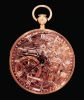
As other posters have mentioned this is something of a national English style. . .
Here are some more Roger Smith images, closer
Breguet does use this style of finish. . .