AnthonyTsai
[PuristS]
22366

AndrewH takes a look at Greubel Forsey's Invention Piece 2 w/ quadruple tourbillon
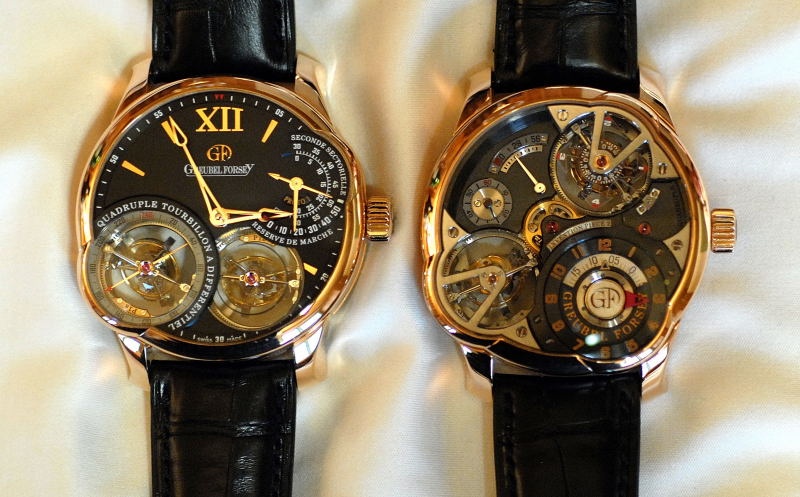
Take it from me: this is the watch of the year! I saw it first at SIHH in January; and then again, just the other week when I was introduced to the rose gold/charcoal ruthenium version. In my (perhaps) jaded and tired view of most of the watch industry, the watches that really ‘rock the boat’, are far and few between. All too often there is the hyperbol and the sound bites that this is now the "latest and the greatest" and "how could we have had any watch other than this before now!" Most are not truly inventions or innovations, but simply a wrinkle on something that already exists. Some simply repackage existing movements. And then there is an invention and the watch that showcases that invention that does deliver. Greubel Forsey presented their Invention Piece 2 at SIHH detailing and illustrating the working of their Quadruple Tourbillon with the Spherical Differential at the heart of the watch. Where the Invention Piece 2 presents a new version of the quadruple tourbillion, over the regular Quadruple Tourbillon, lies in how the plates have been cut away and the movement re-arranged to allow the inner workings of the watch to be seen. This is not simply cutting away plates to reveal the inner workings of the watch's movement, this is an entirely reworked watch and movement, with a new configuration of the four tourbillon's, the Spherical Differential , the winding barrels and power reserve, and the display for telling the time.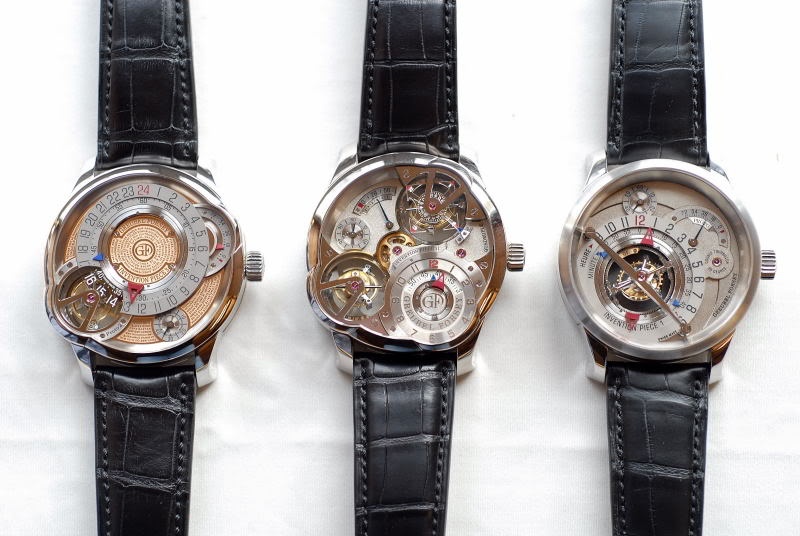
[From right to left: IP1, IP2, and IP3. In the same order, the watches show case the inventions of: the Double Tourbillon (30°), the Quadruple Tourbillon and spherical differential, the 24 second tourbillon incline.
To my mind this is a noted return to form for Greubel Forsey in their Invention Piece series. The Invention Pieces by both their numbering and design are intended to 'showcase' Greubel Forsey's fundamental inventions. I (and a number of others for that matter as the watch sold out almost immediately upon release) thought the Invention Piece 1 was stunning in both the aesthetic design and in how traditional watch making techniques (the difficult black polishing of the flat tourbillon bridge or the frosted finish on a number of different surfaces) could be used to still produce a watch that was innovative and futuristic in appearance. For Invention Piece 2, the invention is clear, visible, superbly finished, and a joy to behold. Invention Piece 3 (introduced in between Invention Pieces 1 and 2!) was a slightly different aesthetic in terms of show casing the invention. There was less in terms of cutting away the plates, and more on the creation of an aesthetic that would draw the eye to concentrate on the 24 second inclined tourbillion. The sapphire crystal with the numbers for the hours (a 24 hour dial) was created specifically to allow a better view of the tourbillon cage. As with other Greubel Forsey IP watches, Invention Piece 3 was sold out upon release and remains sought after among collectors.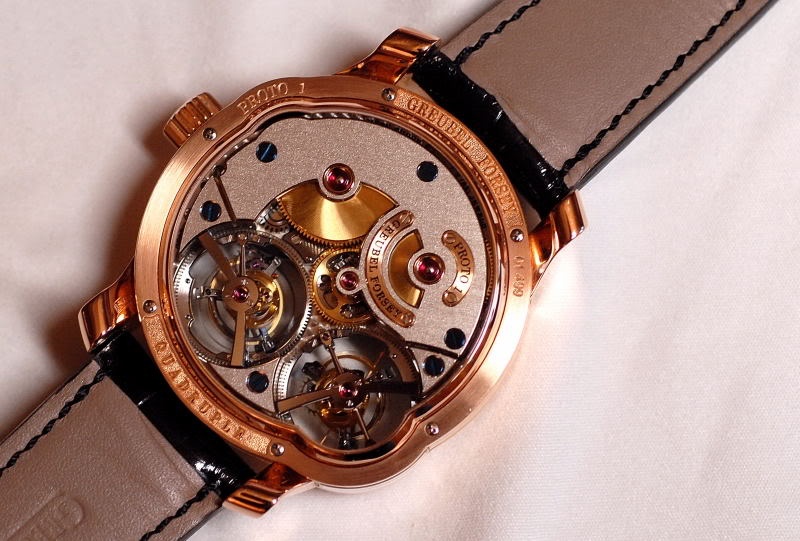
The Quadruple Tourbillon had been the watch that Greubel Forsey had entered in the 2009 International Chronometry Competition at the Musée d'Horlogerie du Locle (MIH), as Greubel Forsey felt that this timepiece had (and has) great timekeeping potential. The watch was entered at the last moment, did not fail, and completed the month long course of daily abuse and time checking. The International Chronometry Competition tests were different and less severe than the tests used as part of Greubel Forsey’s EWT (Experimental Watch Technology). The tests of Chronometry Competition were more akin to the COSC, tests on for a 24 hour cycle. Greubel Forsey EWT tests the whole useful power reserve (which equates to a maximum of three quarters of the possible running time ): which is 50 hours for the Quadruple Tourbillon, 72 hours for the Double Tourbillon 30°, and 120 hours for the Double Tourbillon 30° Technique. Hence, the EWT tests the time keeping for the watch over the most efficient level of the watches' power reserve; namely whether it is 50 hours or 72 hours or 120 hours depending on the watch. For the Chronometry Competition Greubel Forsey had to adapt the Quadruple Tourbillon specifically for the competition tests; even the rigorous shock and magnetism testing were nothing new for the mechanism, and the Quadruple Tourbillon proved itself a robust (as well as refined) mechanism for timekeeping and reliability. The EWT was always an experimental approach to understanding how one variant of a mechanism, or a change to the escapement, provides an improvement (or not) to the accuracy, consistency and reliability of the time keeping properties of the watch ( 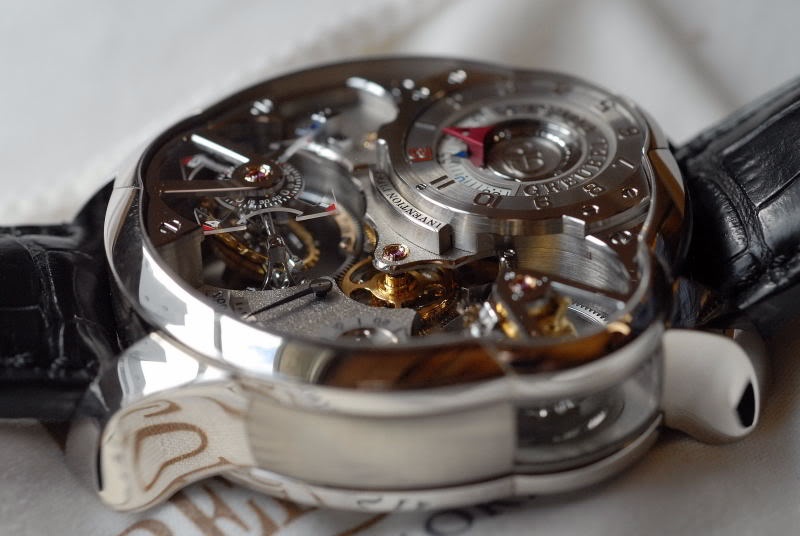
For the rest of Andrew's report in Independents forum, http://ahci.watchprosite.com/show-forumpost/fi-16/pi-4839378/ti-734788/s-0/