
asiaassoc
27

No Worries...
No worries, Graham. I took your comments in the positive spirit of discourse, as I am sure they were intended. Unfortunately, because I am in Singapore, our face-to-face will have to wait.
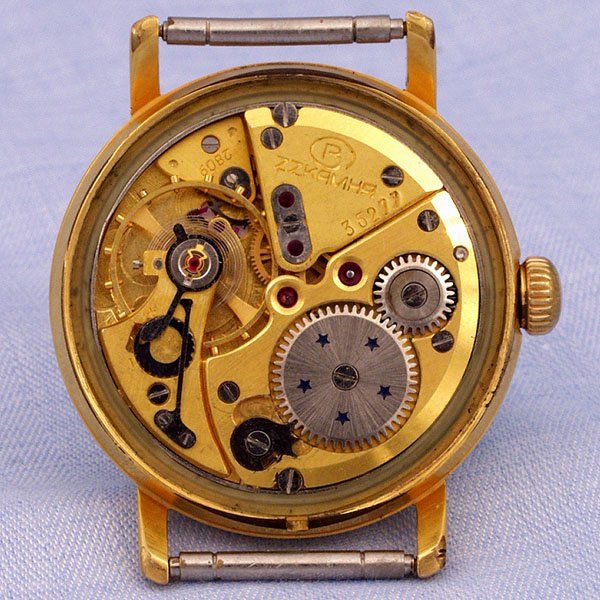
In all fairness, I should also point out that the Soviets were not above swiping a design, though they did so only rarely in the horology sector. The most notable example being their copy of the Venus calber 135 COSC certified chronometer grade movement, the 22-jewel Vostok 2809 pictured below.
In the late 1950s, in a tale that is worthy of Cold War intrigue, the Soviet Union “acquired” the Zenith’s technology, and started to manufacture their own “version” of the same movement, albeit with some significant changes. While it retained the exceptionally large balance wheel, and the overall layout of the movement, Sovier horologists improved on the Swiss design by adding 3 additional jewels, to arrive at the current 22-jewel movement. Additionally, the placement of the second-hand was moved from the sub-dial position, to the central pinion. Typical of Russian manufacturing, the highly-decorated nature of the movement was toned-down to reduce the cost and complexity of the manufacturing process.
Although the Soviet movement retained all of the key features and characteristics of the Zenith cal. 135 movement and is instantly recognizable as a 'copy', it is not identical and, in fact, had slightly improved accuracy due to the modifications that allowed for a slightly larger balance wheel. Finishing, of course, was much simpler that the Swiss original.
The 22-jewel movement was manufactured by a division of Vostok (or “Boctok” in Cyrillic), and used exclusively for the “Vostok Precision” line and the “Wolna” (Wave) series of watches. Ironically, many more pieces of this precision movement were produced in the Soviet version than were produced by Venus -- and they were available for a much more reasonable price.
However, most technology transfers to the Soviet State from the West were legal and contractual. The original Type-1 pocket watch movement was produced on equipment purchased from the U.S. watchmaker Dueber-Hampden in 1930, with on-site help from about 20 company employees who temporarily relocated to Moscow. Tthe famous Strela 3017 caliber chronographs were based on the Venus 150 and produced with equipment purchased from Venus and the famous Sturmanski 3133 caliber chronographs were based on the Valjoux 7730 and produced on equipment purchased from Valjoux (in the case of both these chronographs, the movements were significantly modified by the Soviets to improve robustness and reliability). There were also earlier collaborations with LIP (at least 2, possibly more, that I know about).
Of course, there was also an episode of technology transfer from Germany immediately after the Second World War. This is another fascinating story involving, as the Russians have characterized it, war reparations.
By the way, while the Soviet attitude towards finishing leaned heavily towards utility and practicality, they often did produced beautifully finished movements, complete with mirror polishing, Geneva stripes, etc. One of these days, I will post a selection of photos.
-- Mark

This message has been edited by asiaassoc on 2009-04-22 19:07:19
Sometimes It's Worth Looking On The Other Side...

Type 1
There were better quality watches for railroad and technical applications

Mark, were these basically copies of high quality swiss watches?
Previous USSR watch postings....
my apologies MTF for referring...
Sorry Graham, You're Wrong...
Mark, i must apologise wholeheartedly.