
Sometimes It's Worth Looking On The Other Side...
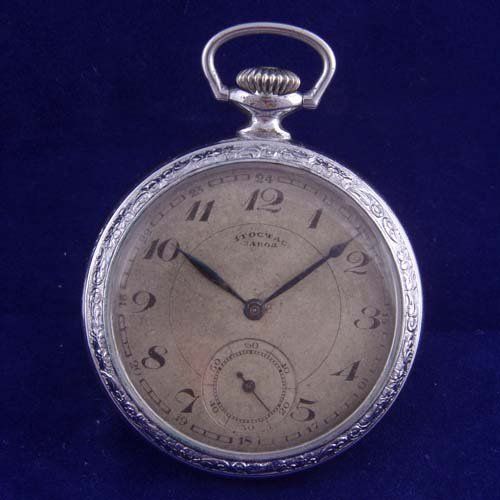
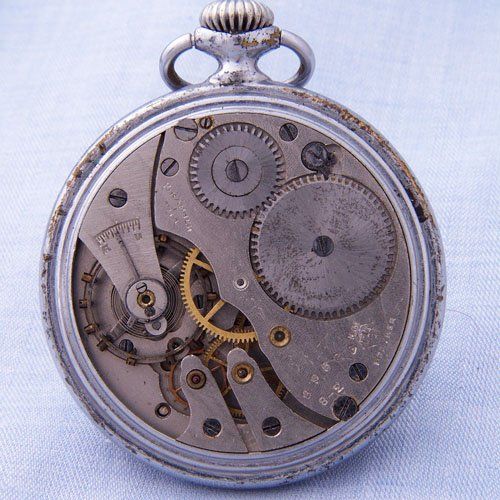
It is a 7-jewel Type-1 pocket watch in a presentation case with floral bezel produced around 1935 by the First Moscow Watch Factory.
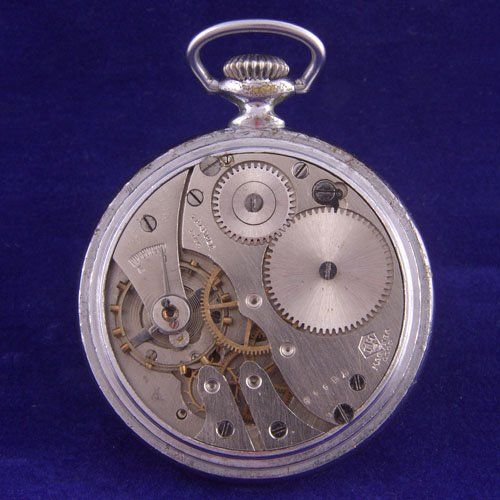
The dial is signed 'First State Watch Factory'. The movement is signed First Moscow Watch Factory - Kirov. The 2 different factory designations are the result of the name change that occurred in 1935 as a result of the tragic death of Leningrad party leader Sergey Mironovich Kirov. The factory was renamed in his honor a few months after his assassination.
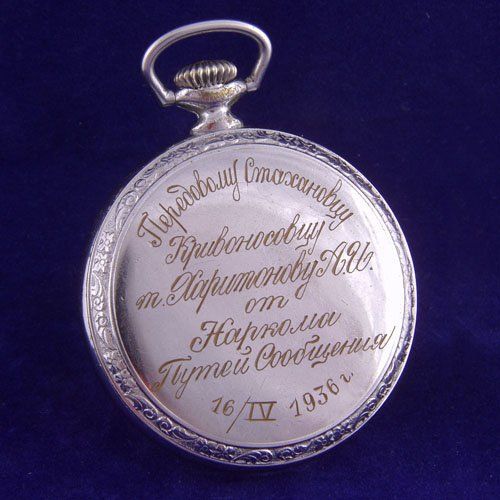
The beautifully executed inscription on the back is at the pinnacle of the engraver's art, but it is also at the pinnacle of Stalinist industrial propaganda...
“To foremost Stakhanovets Krivonosovets comrade Kharitonov A.S. from the Peoples Commissar of Railroads 16 April 1936”
Alexei G. Stakhanov was a Soviet industrial worker (a miner) who in 1935 was awarded special recognition and special privileges for wildly exceeding his mining quotas. His accomplishments were widely publicized in the Soviet press.
Pyotr (Peter) Krivonos worked on the railroad as a steam-engine driver. He was similarly rewarded and lionized by the Government after he developed methods for increasing the average speed of locomotives (apparently, he did it on two separate occasions!).
Both of these men became ‘heroic worker’ propaganda symbols. They were promoted as examples of patriotism and dedication that workers all over the country were expected to follow.
Enjoy... -- Mark
This message has been edited by asiaassoc on 2009-04-21 03:30:35 This message has been edited by DRMW on 2010-05-05 09:43:02

Type 1
Mark,
As these were Type 1 time pieces from the Commissar of Railways - no less - does it mean that they were top grade chronometers as required for the timing of railways?
Regards,
MTF
There were better quality watches for railroad and technical applications
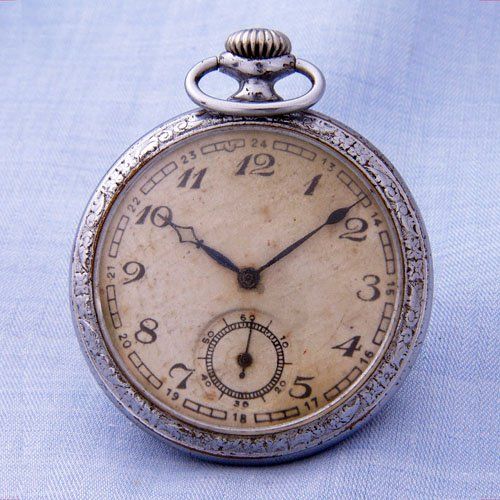
There were also military versions of the Type-1 produced in the 30s. These had much more utilitarian cases and dials. In World War Two, Russian soldiers often referred to their Type-1 wristwatches as "Coffee Cans".
After World War Two, a series of technology infusions from LIP in France and from confiscated German factories (see earlier posts on the Type-59 Soviet UROFA-Tutima) resulted in a plethora of world class Soviet watch and clock movements. But that, as they say, is another story...

This message has been edited by asiaassoc on 2009-04-21 08:38:22

Mark, were these basically copies of high quality swiss watches?
from what i've seen of Soviet watches and their watch industry they are very good at buying high end swiss pieces then producing their own pieces which are the same, but without the finish. i had a Poljot deck watch which was identical to a UN Deck Chronometer and the Kirov(?) Mig fighter clock chronograph which is a copy of the Jaeger Lecoultre previously issued.
i think it was an excellent way to provide high quality watches to the soviet masses. take apart a swiss piece, replicate it and mass produce it.
as you are our resident russian watch expert mark, is there any chance of producing a list of russian watches and the equivalent swiss watch that they used to replicate it? i'd be quite interested as a lot of fleabay sellers from the former soviet union often say 'XXXXXXXXXXXXX, the russian version of the XXXXXX chronometer calibre'. i'd like to know if they really are or if its the usual fleabay bxxxxxx.
best
Graham
Previous USSR watch postings....

my apologies MTF for referring...
site', but it was deliberately kept in very general terms.
Sorry Graham, You're Wrong...
Your characterization of Russian movements as poorly finished copies of Swiss calibers is both unfair and inaccurate.
Firstly, while the Soviet’s did indeed import technology periodically from French, Swiss and German sources. It almost invariably did so honestly, by licensing or the purchase of production equipment, and the calibers were quickly modified to meet Soviet needs and ideals.
Secondly, and more importantly, by the late 1950s, the Soviets were producing millions of pieces, in more than a dozen factories, representing dozens of indigenously designed clock and watch movements.
By the early 1960s, Soviet movements were world-class in every sense, including some very ingenious home-designed automatic movements and one of the thinnest calibers ever produced (1.85mm). They were often, in their market range, equal or superior in performance, accuracy and finishing to their counterparts produced in the West. And, in keeping with the Soviet ideal of a robust timepiece that would run well with little or no servicing, these pieces often continue to run accurately without having been serviced for decades, even today.
The Poljot deck watch is a good example. Yes, the very first models produced in the Soviet Union (in late 1951) closely resembled the UN model from which it was derived. However, within a few months time, modifications were introduced that made the movement uniquely Soviet in design. Moreover, this movement was continually refined and redesigned over a period of more than 30 years. There are at least 4 significantly different variants (which can be viewed in my collection; I have 7 pieces in total).
The Jaeger Chronoflight aircraft chronometer is another example. First produced in the Soviet Union under license in the late 1930s, Soviet horologists eventually expanded this caliber into a family of more than a dozen different specialized movements for air and naval applications. These are now prized by collectors all over the world (I have about a dozen in the collection).
I could go on and on in great detail about both indigenously designed calibers and Western-derived calibers. Like any huge industry, the story is complex. But, I think we would bore our viewers, so I will stop here. May I suggest you come by the house one evening for a coffee or glass of wine so we can continue the discussion… With lots of visual aids.
I do agree that a good reference work for Soviet watches is sorely needed. So, I am now working on a 300+ page book that will contain, in addition to the history of Soviet horology, a comprehensive collector’s guide. I hope to include all (or most) of the movements produced in the Soviet Union from 1917 until the fall of the Soviet state in 1992. Hopefully it will be out sometime next year.
As for FleaBay. The sellers to which you refer, often from the Ukraine, offer both goods and information that are, at best, highly dubious. Avoid them at all costs.
-- Mark This message has been edited by asiaassoc on 2009-04-22 07:54:52
Mark, i must apologise wholeheartedly.
in no way did i intend to demean the soviet watch industry. what i wrote was poorly written and not intended to sound as it did.
when i refer to copies of Swiss movements i was only speaking from my limited knowledge. i was aware of their use of swiss products and then their versions of those products, but i knew nothing about licencing so i happily stand corrected. that is the reason i put the header as a question as i wanted better information which you have kindly provided.
with regard to my comment on poor finish, that was poorly put. what i meant was that soviet watches makers dont concentrate on perlage, cote de geneve, engraving or skeletonisation. they concentrate on functionality.
i'm very interested in finding out which of the soviet watches are licenced versions of chronometer grade swiss watches as i like anything unusual. its great to be able to say that this obscure or unheard of watch keeps better time than a high end swiss chronometer.
if you live in UK which i suspect you do, i'd love to come over one day to look over your collection and learn more, rest assured when your book is finished i'll be getting a copy.
i'm now full of humble pie with no room for my evening meal so i hope you will forgive me my ignorance 
best
Graham
No Worries...
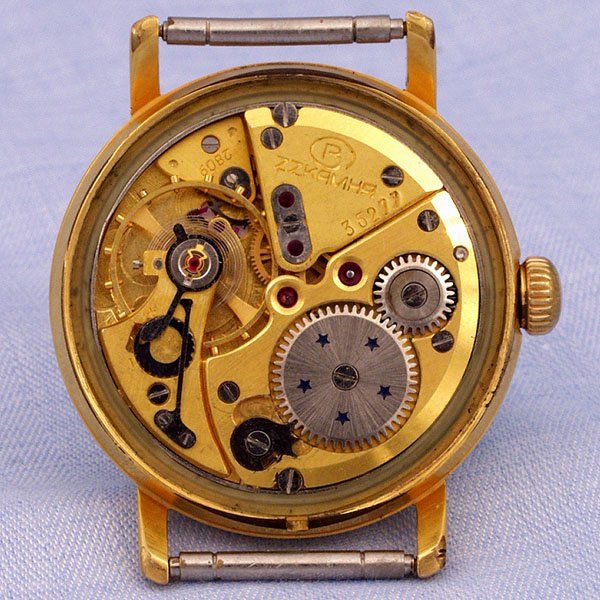
In all fairness, I should also point out that the Soviets were not above swiping a design, though they did so only rarely in the horology sector. The most notable example being their copy of the Venus calber 135 COSC certified chronometer grade movement, the 22-jewel Vostok 2809 pictured below.
In the late 1950s, in a tale that is worthy of Cold War intrigue, the Soviet Union “acquired” the Zenith’s technology, and started to manufacture their own “version” of the same movement, albeit with some significant changes. While it retained the exceptionally large balance wheel, and the overall layout of the movement, Sovier horologists improved on the Swiss design by adding 3 additional jewels, to arrive at the current 22-jewel movement. Additionally, the placement of the second-hand was moved from the sub-dial position, to the central pinion. Typical of Russian manufacturing, the highly-decorated nature of the movement was toned-down to reduce the cost and complexity of the manufacturing process.
Although the Soviet movement retained all of the key features and characteristics of the Zenith cal. 135 movement and is instantly recognizable as a 'copy', it is not identical and, in fact, had slightly improved accuracy due to the modifications that allowed for a slightly larger balance wheel. Finishing, of course, was much simpler that the Swiss original.
The 22-jewel movement was manufactured by a division of Vostok (or “Boctok” in Cyrillic), and used exclusively for the “Vostok Precision” line and the “Wolna” (Wave) series of watches. Ironically, many more pieces of this precision movement were produced in the Soviet version than were produced by Venus -- and they were available for a much more reasonable price.
However, most technology transfers to the Soviet State from the West were legal and contractual. The original Type-1 pocket watch movement was produced on equipment purchased from the U.S. watchmaker Dueber-Hampden in 1930, with on-site help from about 20 company employees who temporarily relocated to Moscow. Tthe famous Strela 3017 caliber chronographs were based on the Venus 150 and produced with equipment purchased from Venus and the famous Sturmanski 3133 caliber chronographs were based on the Valjoux 7730 and produced on equipment purchased from Valjoux (in the case of both these chronographs, the movements were significantly modified by the Soviets to improve robustness and reliability). There were also earlier collaborations with LIP (at least 2, possibly more, that I know about).
Of course, there was also an episode of technology transfer from Germany immediately after the Second World War. This is another fascinating story involving, as the Russians have characterized it, war reparations.
By the way, while the Soviet attitude towards finishing leaned heavily towards utility and practicality, they often did produced beautifully finished movements, complete with mirror polishing, Geneva stripes, etc. One of these days, I will post a selection of photos.
-- Mark

This message has been edited by asiaassoc on 2009-04-22 19:07:19