
Modernahab
1124

The Integrated Bracelet Steel Sports Watch That Time (and Everybody Else) Forgot:
I’m talking about the Glashütte Original Seventies, specifically, the Chronograph Panorama Date, Ref. #1-37-02-08-02-70. This is the smoked gray dial limited edition version on a steel bracelet. While this is the reference I happen to own, it can probably stand in as proxy for any of the chronograph or three-hand panorama date models on the OEM bracelet.
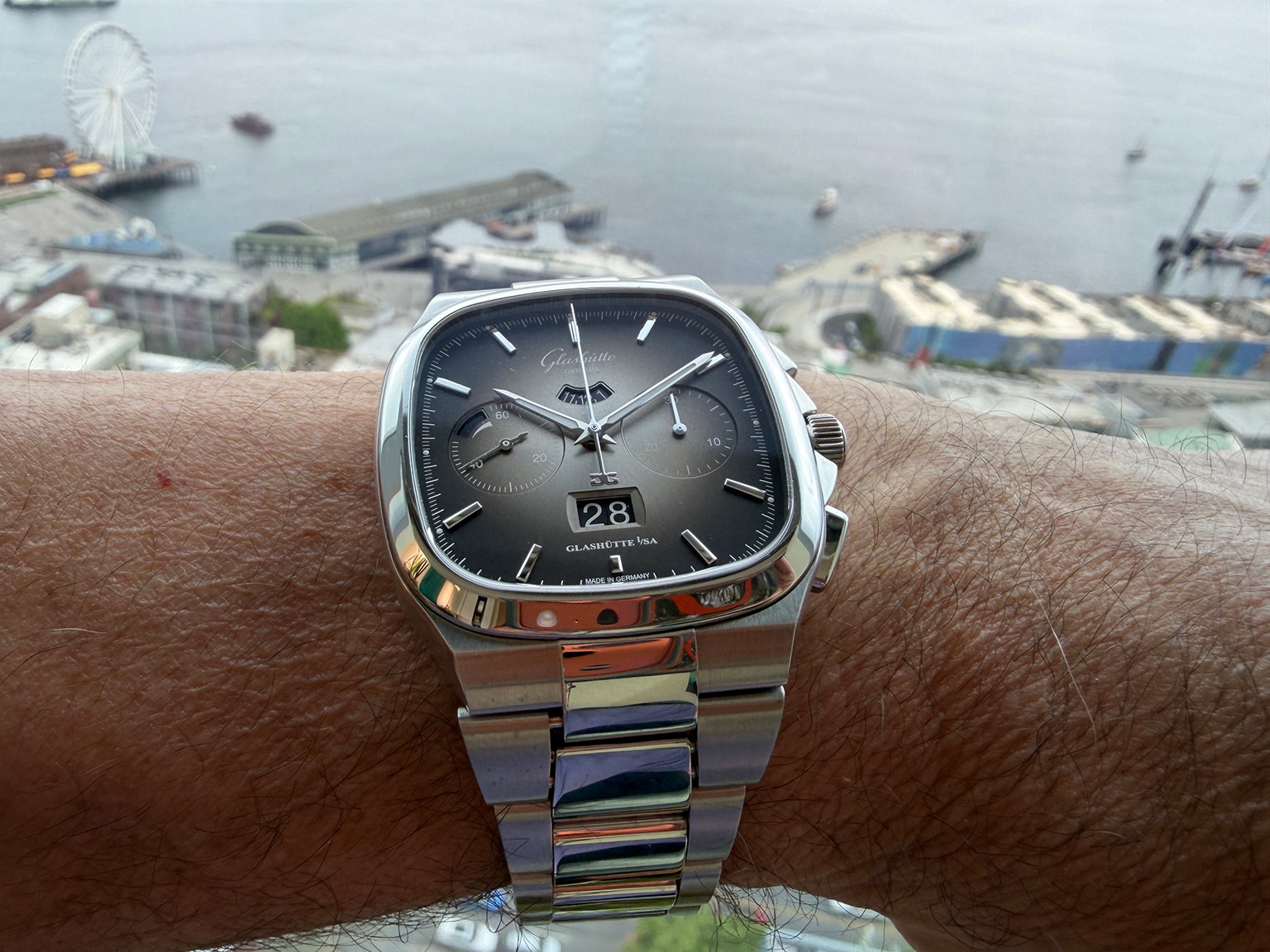
Note the loose link adjacent to the lug - my bad! I didn't turn the locking screw to retain the pin on that side. ;-(
Integrated bracelet sport watches continue to be all the rage, and much has been said about alternatives to the intensely-hyped models from a few brands, where purchasing alternatives are limited to humiliating oneself in front of the brand boutique staff and buying three watches you don’t want in order to get onto a 3-year waiting list, or paying a 100% - 300% markup on the secondary market. Frequently discussed alternatives include, among others, the Chopard Alpine Eagle, the Piaget Polo, the GP Laureato, the Bulgari Octo Finissimo Automatic, the Czapek Antarctique, the Santos de Cartier, the Tissot PRX, and the Moser Streamliner. (Though one could argue that this last has entered the ranks of hyped watches of late.)
Yet never, ever have I heard the GO Seventies described as a viable option. Why is that? Well for one thing, GO doesn’t market or position the Seventies as an integrated bracelet sports watch. Indeed, I wonder what proportion of Seventies models are sold on bracelets, as opposed to rubber or leather straps. Then of course, there’s Swatch Group. Having raised the art of brand mismanagement to a high art, Swatch Group has demonstrated exceptional incompetence in effectively positioning or promoting Glashütte Original altogether, leaving it as one of the more undervalued and unrecognized manufactures I can think of.
Looking closely at the Seventies, however, reveals a watch that admirably fills the integrated bracelet sports watch role, offering a number of outstanding features, non-derivative design, and reasonable value for its cost. Let’s start with the case design. Though the Seventies’ square case and polished square bezel might vaguely bring to mind the discontinued Cartier Santos 100, the design itself may derive from square-cased watches in GO’s 1970s back catalog, giving it an independent heritage of its own. The case, in true Glashütte style, is sturdier looking than anything from Cartier, while eschewing derivative design cues such as an octagonal bezel or exposed screws anywhere, leaving it quite distinctive among its competitors.
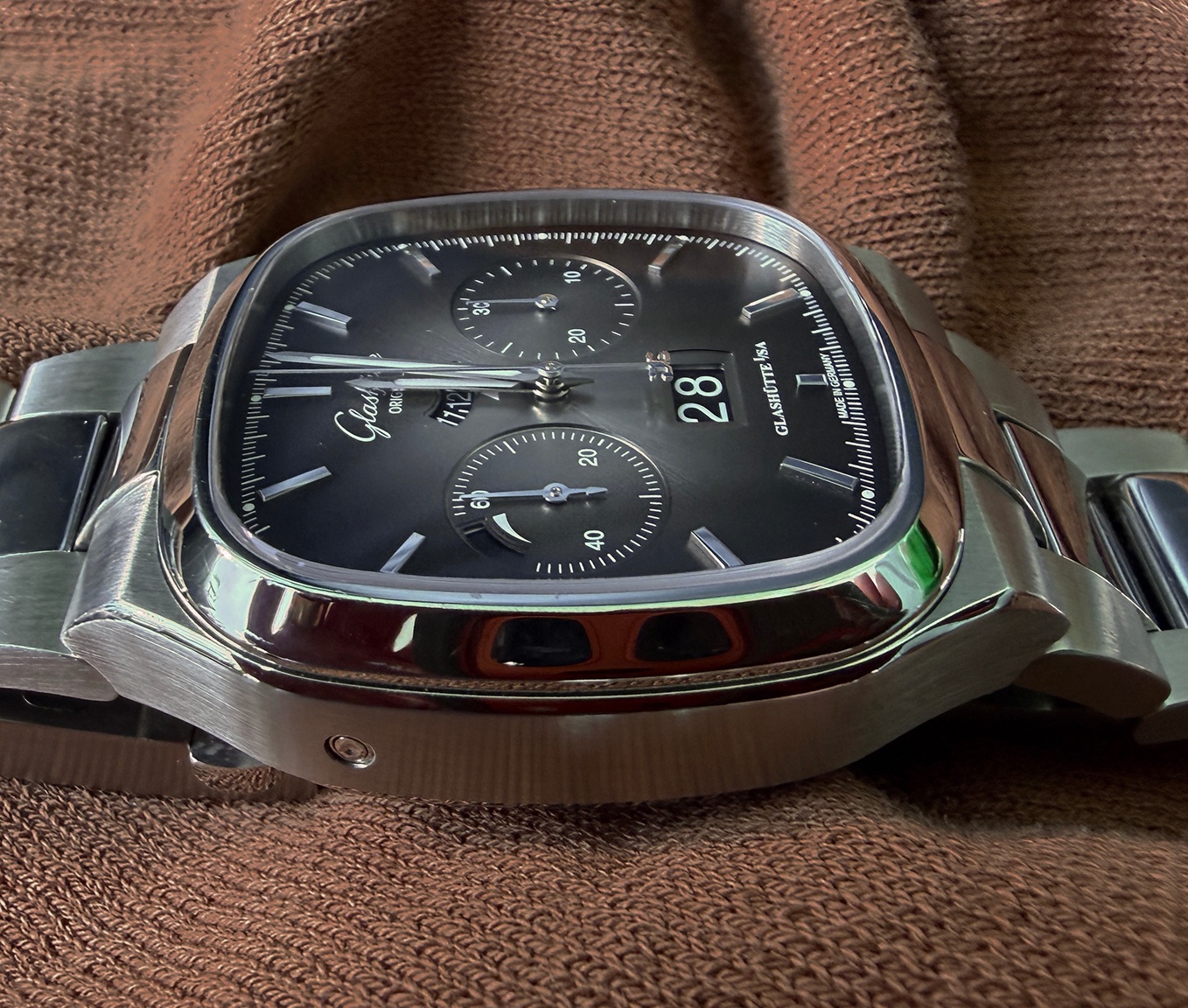
The steeply sloped bezel adds a distinctive dimensionality to the watch's profile.
The 40 x 40 mm case is also notable for strong finishing, with crisp transitions between polished and brushed surfaces. Functionally, the nicely integrated pushers respond smoothly, but with a gratifying tactile click. A screwed-down crown contributes to water resistance to 100 meters, as befits a true sports watch. With its sharply downturned lugs, the Seventies wraps comfortably around my 7.25 inch wrist, though I’m not sure how well it would wear on wrists below 7 inches in circumference. The dimensions in and of themselves are not significantly bigger than the large size Santos de Cartier, to choose another watch with a square case, not to mention the much larger full-size Patek Cubitus. (The Cubitus “medium” has the same 40 mm case size as the GO Seventies.)
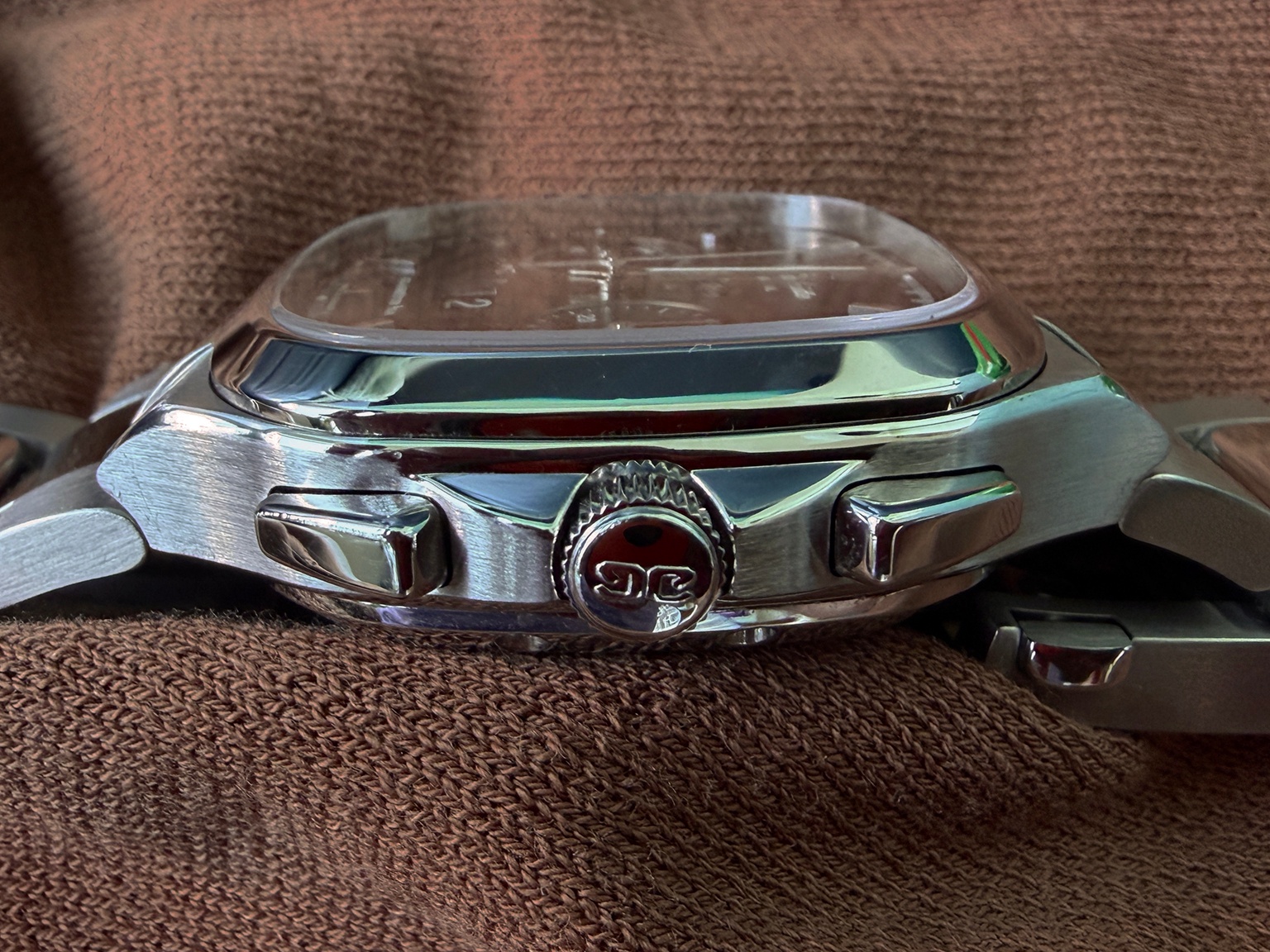
Pushers and crown guards blend neatly with the case geometry.
Moving to the bracelet, we find a three link configuration, with seamless integration into the sharply downward-turned lugs and vertically brushed outer links flanking broad, brightly polished center links. Transitions between surfaces are smooth and precise and all links present moderately convex upper surfaces, which play with light and provide visual depth in a very attractive manner. The bracelet is supple and comfortable on the wrist, as well. GO goes a step further by addressing a frequent complaint regarding integrated bracelets: a sophisticated and easy-to-use fine adjustment system at the clasp. Depressing the embossed GO logo on the clasp exterior allows for adjustment up to approximately a centimeter in bracelet length. Better yet, the clasp is designed so that no visible gaps open up as the bracelet is adjusted to its greatest length.
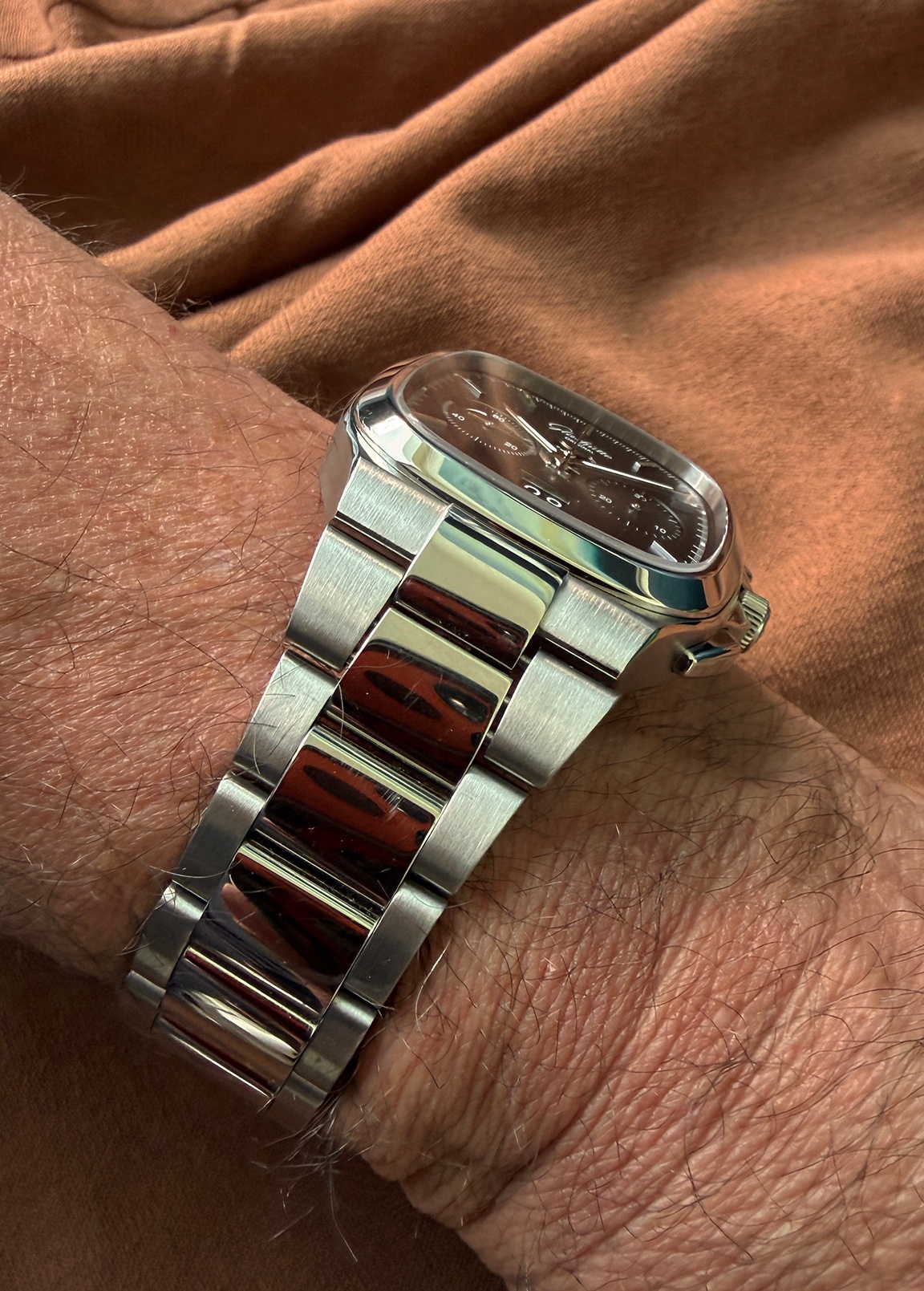
The bracelet integrates nicely with the lugs and the transition from case to bracelet appears seamless.
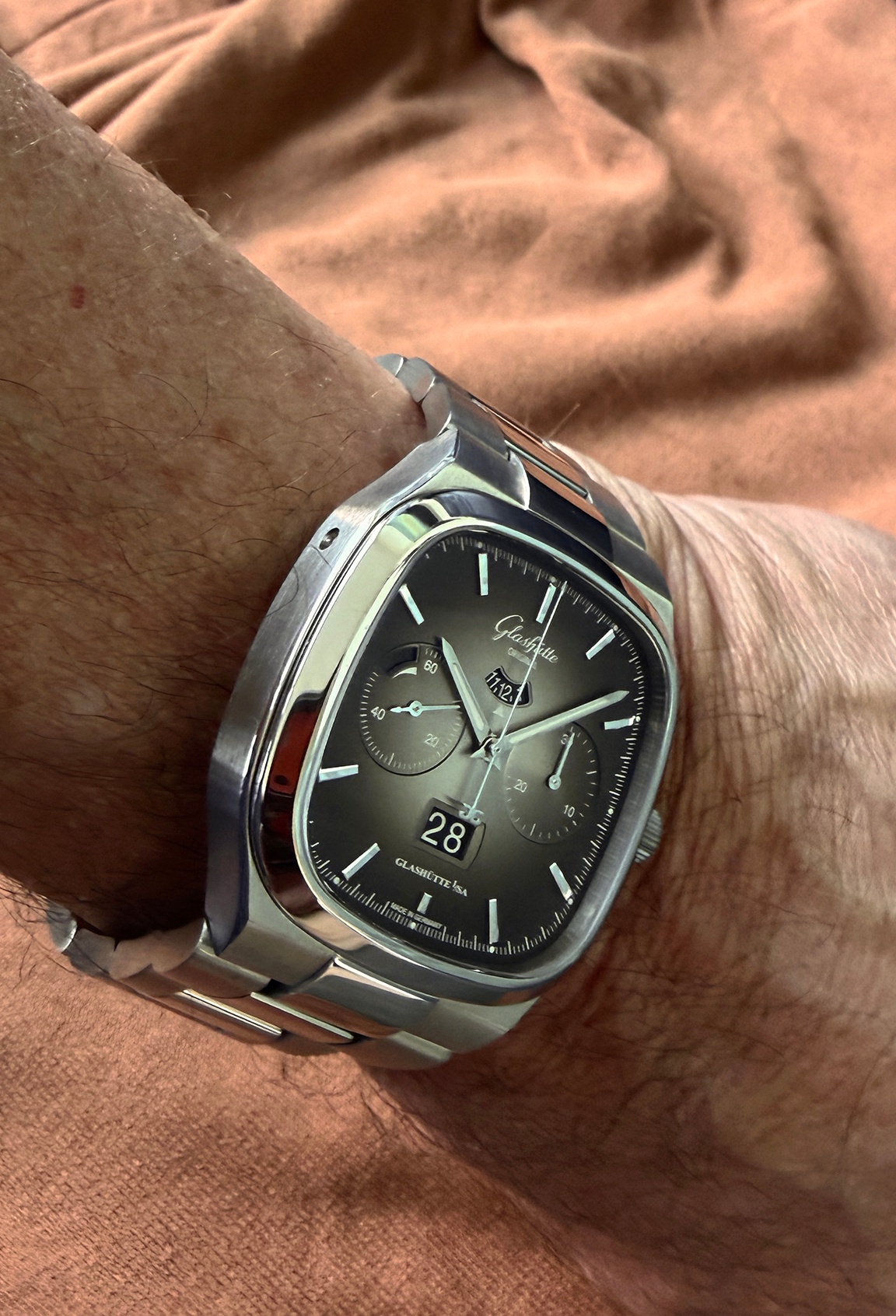
Note how the lugs wrap around the wrist.
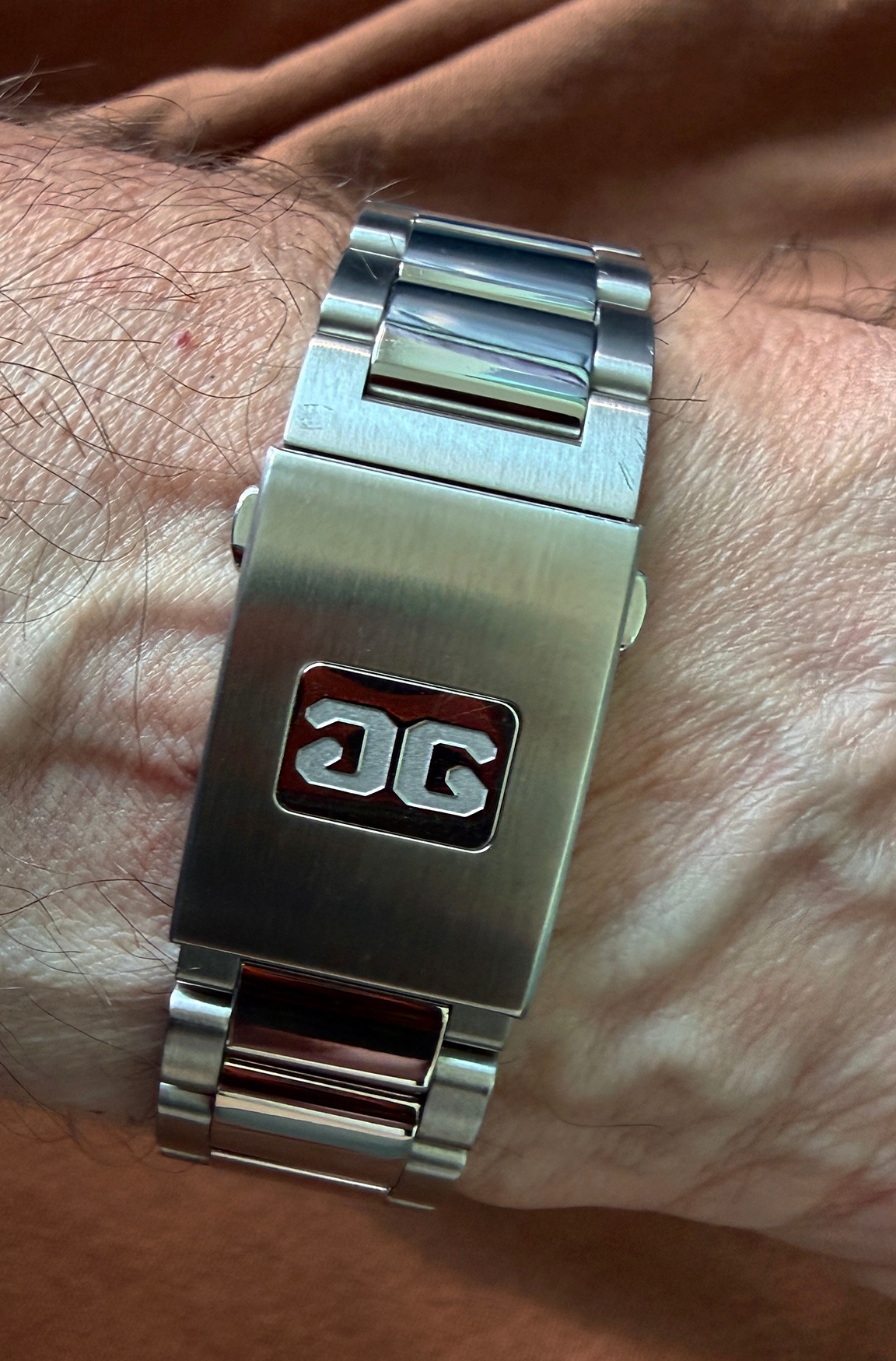
The clasp is solid and secure.
Adding and removing links on the GO bracelet for larger adjustments, while not as user-friendly as the system employed by Cartier in the Santos de Cartier, is still relatively easy and convenient. The bracelet on the Seventies uses neither friction pins and sleeves nor screwed-in pins. Instead, a quarter turn of the two screws on the underside of each outer link releases the pins, while a quarter turn back in the other direction locks the pins in place.
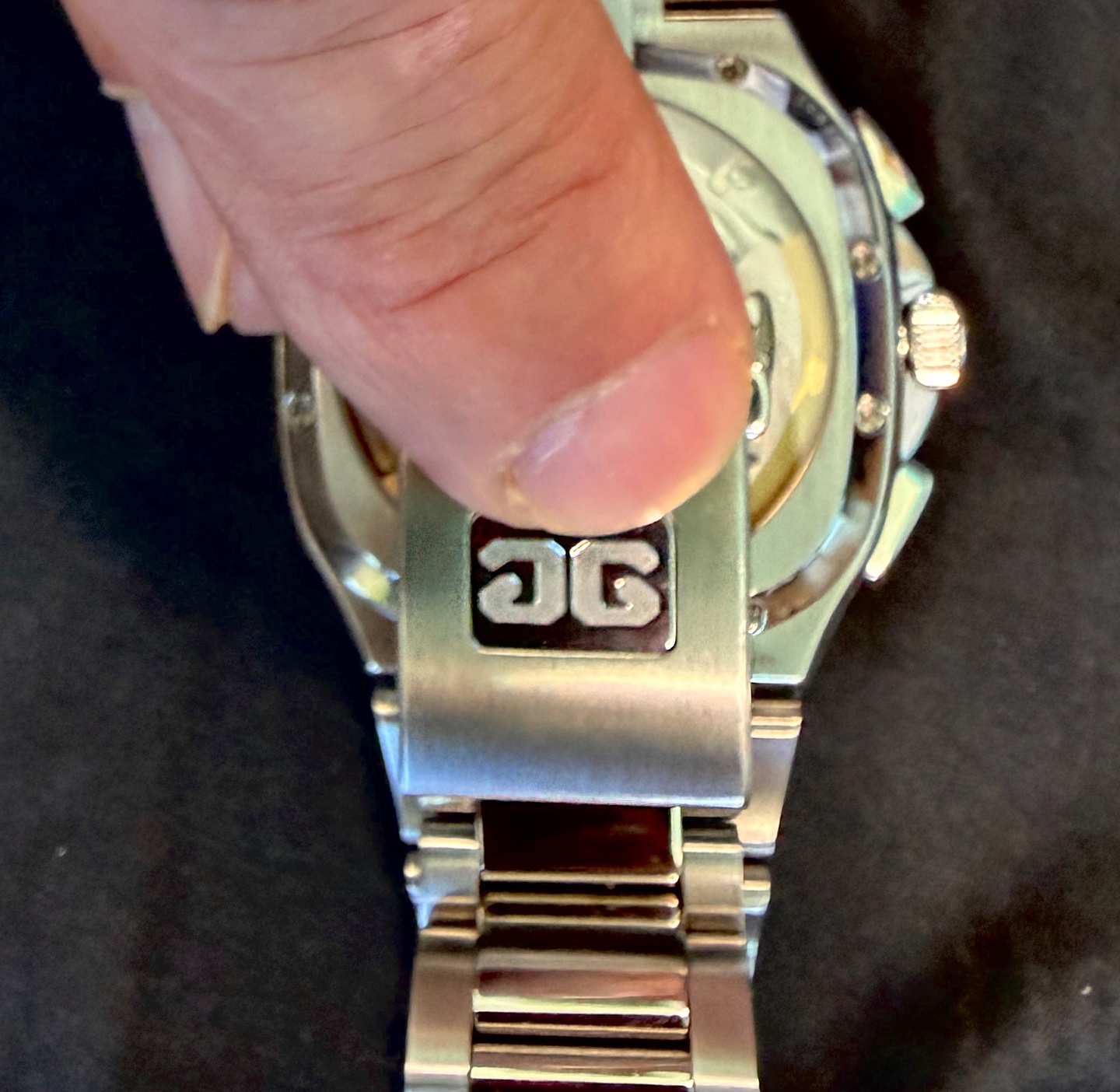
Fine adjustment of the bracelet is quick and simple, with a push-button mechanism.
Speaking of pins, each link in the bracelet is secured by three, not two pins, presumably enhancing the bracelet’s overall sturdiness. The bracelet is affixed to the lugs via the same mechanism, making installation and removal relatively easy. Unfortunately, the OEM leather and rubber straps for the Seventies do employ friction pins and sleeves, which means you’re not likely to be switching back and forth between strap and bracelet with any frequency. That said, we are talking about the Seventies as and integrated bracelet sports watch, and the bracelet works so well that I am never tempted to remove it.
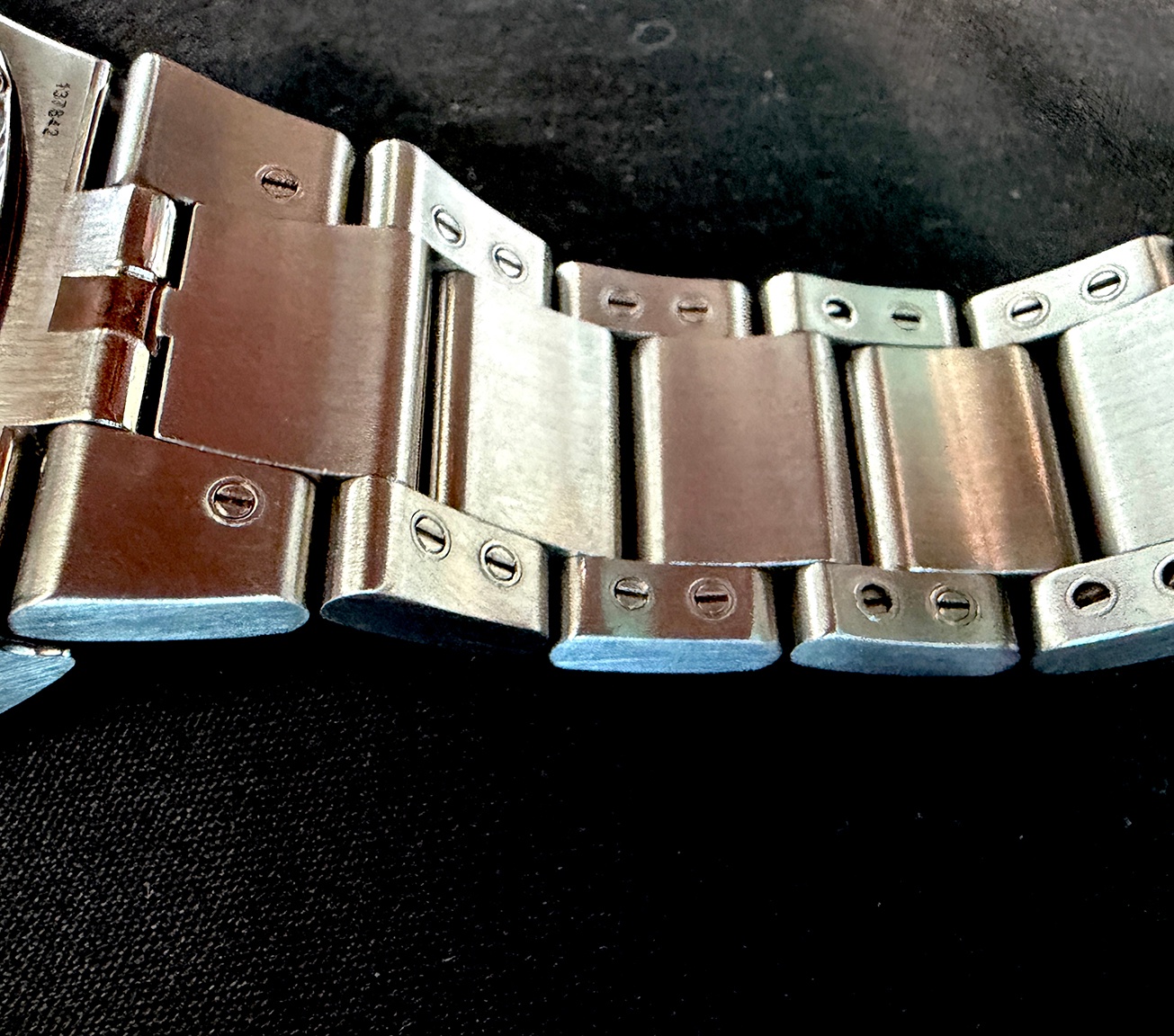
Links are easily added and removed by turning the locking screws beneath the outer links.
Turning to the case back, we see the in-house integrated automatic column wheel flyback chronograph caliber 37-02. Yes, it’s a round caliber in a square case, but I’m not as insistent on a shaped caliber in a square case as I might be with a rectangular or tonneau case. While it lacks the hand-engraved balance cock and three-quarters found on other GO automatic calibers, it does offer 70 hours of power reserve at a frequency of 4 Herz, a feely sprung balance with swan neck fine adjustment, traditional Glashütte three-quarters plate, Glashütte ribbing (analogous to côtes de Genéve), beveling on plates and bridges, and a gold weight and GO logo (albeit ugly) on the rotor. Finishing is no doubt mechanical at this price point, but clean and well-executed of its sort.
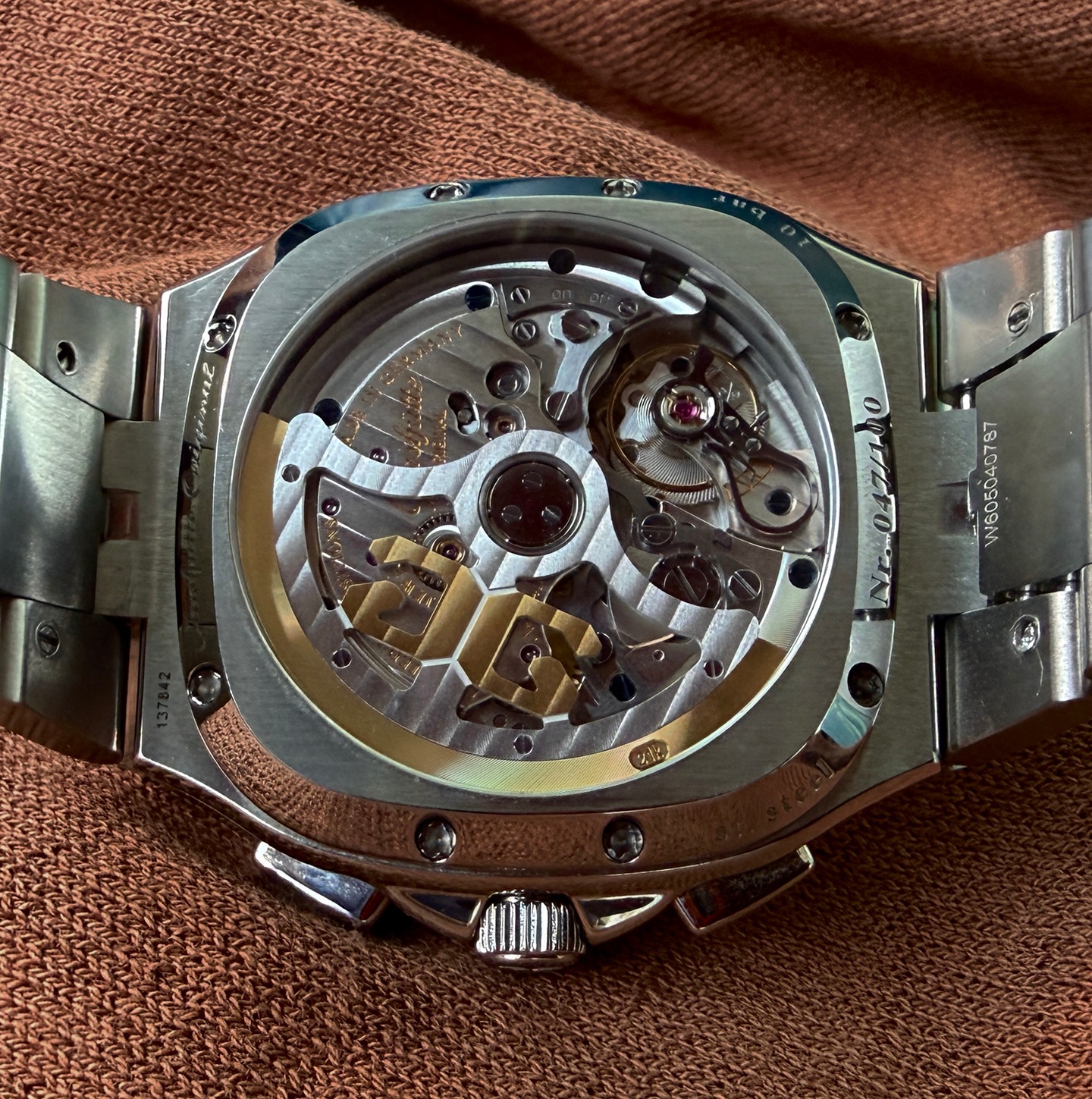
Note the polished swan neck fine adjustment.
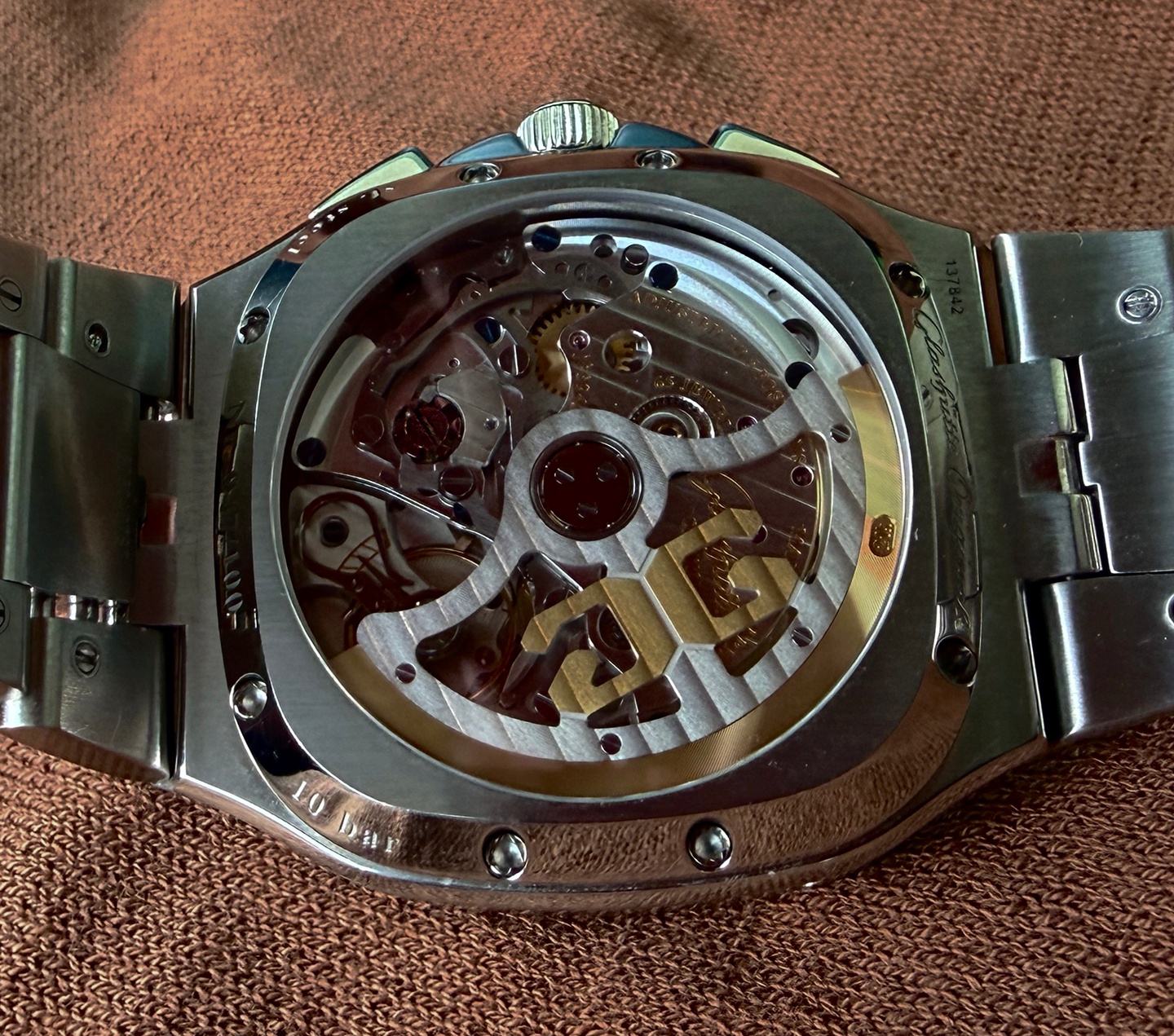
The column wheel nests alongside the traditional Glashütte three-quarters plate.
Saving perhaps the best for last, we come to the dial. GO apparently makes its own dials at a separate facility in Pforzheim, Germany, and I believe the smoked gray dial on my limited edition reference rivals anything from H. Moser & Cie. Unlike Moser, which appears to eschew anti-reflective coatings, the Seventies’ sapphire crystal reveals the dial and its finishing unobstructed by reflections. Nicely polished, lumed rectangular applied indices and a printed minute/seconds track adorn the dial periphery.
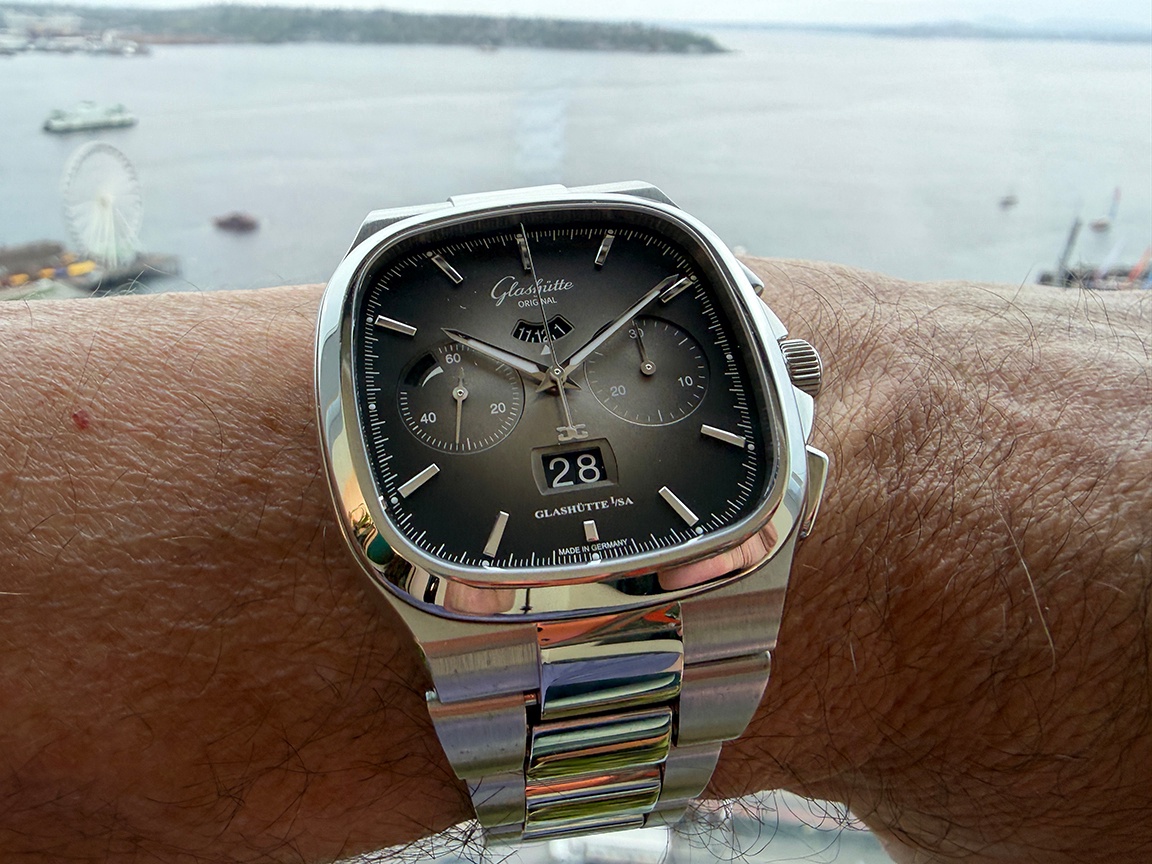
The gray fumé dial on this limited edition reflects GO's in-house dial manufacturing prowess. (Note again the user error on the left-hand outer link. The system is actually quite secure, but apparently not idiot-proof. ;-D)
Because the movement is sized appropriately for the case, the two subdials are well-placed and balanced. The sunken, snailed subdial at 9:00 displays running seconds, with a well-integrated power reserve indicator. Chronograph minutes are displayed in a symmetrical snailed subdial at 3:00. Chronograph hours up to 12, meanwhile, appear in white print on a black rotating disk revealed in an arced window below 12:00. At the 6:00 position we find the GO panorama date, displayed on nested disks at the same level in a single beveled window with a stepped frame. Dates are printed white-on-black in most of the many Seventies dial color variants, though the blue dial version has white digits on color-matched blue disks. Long, polished sword shaped hour and minute hands are well-filled with lume, while the slender, polished stick chronograph seconds hand bears the GO logo as a counterweight. (Hands in some dial color variants are blackened, rather than polished.)
Were I to criticize the GO Seventies as an integrated bracelet sports watch, I might mention the 14 mm thickness of the chronograph model, which leaves the case far chunkier than many competitors. It would also be nice, for those who seek versatility, if straps for the Seventies were more readily interchangeable. Cartier, in my experience, set the standard here with its Santos de Cartier straps and bracelets. Overall, however, I believe that even with escalating retail prices, the Seventies offers a pretty compelling value proposition among integrated bracelet sports watches. And while this can probably be said of virtually any GO offering, the Seventies remains, in my opinion, a seriously underestimated and underappreciated timepiece. The paradoxical advantage here is that prices on the secondary market – assuming you’re not seeking one of the limited editions – represent some real bargains. (Note that of this writing, the three-hand Seventies Panorama Date no longer appears on the GO official web site. I do not know when the non-chronograph line was discontinued, but plenty of examples remain available on the secondary market – at least for now.)
Thanks for reading!
This message has been edited by KMII on 2026-04-30 05:56:53
The Integrated Bracelet Steel Sports Watch That Time (and Everybody Else) Forgot:

Thanks so much for this truly fabulous review 🙌🏻👏🏻👌🏻

Thank you for this in-depth review.
Thanks, Emmanuel!

I haven’t forgotten 😊.
You were clearly perceptive and wise at the time of release!
