
ImranLondon
[PuristSPro Moderator]
6308

Patek Philippe chronographs part 3
The modern era:
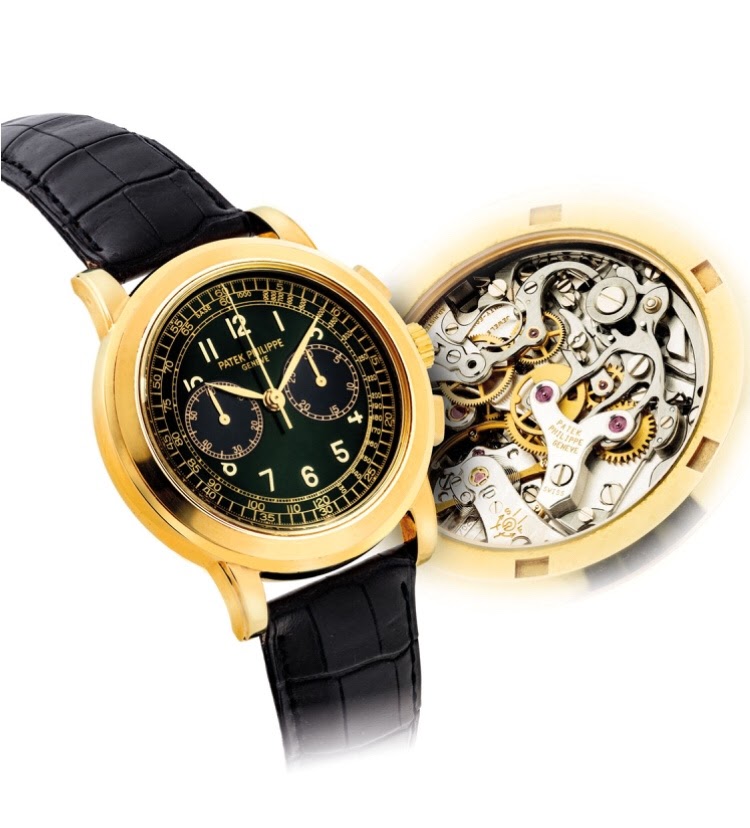
After a hiatus of nearly 40 years (the production of the ref.1463 ceased in the 1960’s) Patek Philippe launched its reference 5070 chronograph.

The new reference certainly caught attention with its outsized case at 42mm- huge for 1998. The dial took its inspiration from a vintage split second reference 2512, (watch no.867857).
 The case reminds of another classic reference 2552.
The movement was the famed Lemania CH 27-70, heavily re-worked and finished by Patek. The sapphire back allows for visual inspection of the famed calibre- the first time in a simple chronograph.


The movement was quite small compared to the case and this led to the famous step design, you could say the small movement heavily influenced the aesthetics and architecture of the case.


Ironically, the first version wasn’t an instant success. There were no waiting lists, perhaps it was a little too ahead of its time. I believe out of the initial production run of 1000 pieces only 800 or so were made.
The yellow gold model was followed by white and rose gold versions. They were produced in 250 pieces per year until 1000 pieces were made. They were then superseded by the cult 5070p version, rumoured to be around 200 pieces.


The incredible following was due in part to the rumours that the swatch group would no longer supply movement to third parties. This led a feeding frenzy and yes the waiting lists came. I guess the fear was that Patek would not be making anymore chronographs. The idea that Patek would create their own movement at the time was not really considered, as they had not done so before. Whatever the reasons, the 5070 took on a popularity that borders on obsessional even today.
During the production runs, there were a few special pieces made with salmon dials and other dials too, including a blue version for the London exhibition.


Launch of a new classic: the reference 5170

Following on from the ref.5070, was no easy feat. In fact some could say that it was an impossible an unenviable task. But I feel that in the case of the Patek Philippe chronograph Ref. 5170, the attribute of classic is vindicated. Launched in 2010, it is the first chronograph developed entirely by Patek Philippe and crafted exclusively in the manufacture’s workshops.
The new CH 29-535 PS chronograph caliber for the Ref. 5170 is a classic manually wound chronograph movement with a column wheel and a horizontal clutch. The main for Patek Philippe was to create one of the most beautiful chronograph and technically proficient calibers ever made.


The development of the CH 29-535 PS movement took more than five years spawning six new patents. As with all high end classical chronographs the CH 29-535 PS caliber is controlled by a column wheel that in the traditional aesthetic of Patek chronograph movement rotates beneath a polished cap. The cap however is not just purely for aesthetic reasons, it also firmly secures the chronograph levers in their positions – even in the event of sharp jolts – so it enhances functional reliability. The movement features an instantaneously jumping 30-minute counter, a frequency of 4 hertz (28,800 semi-oscillations/hour) and a continued power reserve of 65 hours approximately 58 hours when the chronograph is running).
Technical audacity exemplified by six patents
The new calibre rises to the top in technical prowess as demonstrated by six patented innovations:
1. Optimized tooth profile Suppression of hand bounce or rebound when starting. Vibration-free chronograph hand movement. Improved efficiency and reduction of mechanical wear.
2. Precision adjustment of wheel mesh at the column wheel The large eccentric polished column wheel cap allows the very precise adjustment of mesh depth of the chronograph wheels at the outer end of the clutch lever.
3. Optimized synchronization of the clutch and brake levers The clutch lever and the brake lever are directly synchronized with a finger at the clutch lever. The complicated involvement of the column wheel is not necessary.
4. Slotted minute-counter cam Thanks to a slot in the minute-counter cam, the chronograph counter can gently come to a standstill when reset.
5. Self-setting hammers- Self-setting return to zero hammers improve functional reliability and dependability.
6. Hammers pivoted between jewel bearings .The two hammers that reset the chronograph hand and the minute counter are independently and coaxially suspended between jewel bearings. Each hammer is pressed against its respective heart cam with its own spring. This system optimizes the precise alignment of the hammers and the kinetics of the mechanism.
The technical advantage is further enhanced with a number of additional features that improve reliability and performance. The instantaneous 30-minute counter is much more complicated than a semi-instantaneous or continuous counter. Its elaborate construction assures that the small hand jumps within a fraction of a second, enhancing precision and legibility. The driving wheel of the chronograph is another example: it is directly integrated in the wheel train and does not need to be subsequently assembled by the watchmaker. The 5170G with black Breguet dial is sumptuous rendition of this reference and is one of my favourites.
The final version was the 5170p with a gorgeous blue-black dial. The diamond hour markers proved slightly controversial- but were very discrete far from “blingy”.


There have been many debates- even heated exchanged on the 5170 v 5070. The truth is that both are very different. I would say the 5070 is arguably more sporty and the 5170 more classic. In fact they complement each other very well. They are both in their own way great pieces to own and to compare I think is a little futile. Beauty is indeed in the eye of the beholder.
As for the future?
Well who knows- but for sure I am sure the next generation of chronograph will follow proudly in the footsteps of its illustrious ancestors
We will see soon enough....

Picture credits
Christie’s
Sotheby’s
Philipps
Patek collector
Acollectedman
Patek Philippe chronographs part 3
The modern era: After a hiatus of nearly 40 years (the production of the ceased in the 1960’s) Patek Philippe launched its reference 5070 chronograph. The new reference certainly caught attention with its outsized case at 42mm- huge for 1998. The dial to...


Beautiful Patek Chronographs...
Each one is special in its own way. Thank you for posting this.


A wonderful read and background thank you.
Looking forward to the next evolution. Kindest regards,

Thanks,love this post
And ofcourse that 5070 lol Let’s see how the 5172, next chronograph, will look like. But I’m pretty sure nothing will even come close to me beloved 5070 😉
Ohh... and really hoping the 5172 will be bigger
Bigger than the 5170 White gold and a blue dial.... could be nice 👍🏻

Great review Miranda
The whole history in one article, nice to see then all together...Jim