
bernard cheong
7182

OPUS 7 Revealed!!!
Simple is Beautiful
With Opus 7, Harry Winston has once again demonstrated that prestige watchmaking still contains uncharted waters. This time, an exceptional timepiece has ushered in an approach to which few can lay claim: "complications made simple".
A wondrous movement with an open heart, but not skeletal.
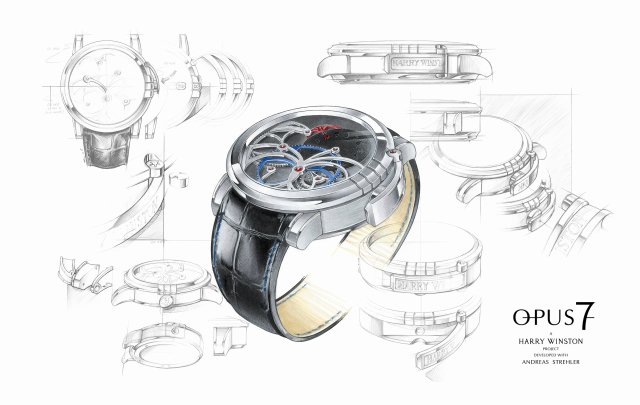
What strikes you when you look at the Opus 7 for the first time is its magnificent butterfly shaped bridge, directly inspired by Art Nouveau. Despite its delicacy, it literally fills the space and so fascinates that it is hard to draw your eyes away from it. However much your eyes seek the time on the discreet black disk at 2 o'clock, they inevitably keep coming back to the butterfly bridge, which appears to be suspended above the gear train.
No doubt it is here that all the beauty of this incredible movement lies. Generally, the gear train, the link between the barrel, the source of energy, and the escapement (the watch's regulating mechanism), comprise two large wheels and one smaller wheel: the minutes wheel (the largest), the intermediate wheel and the seconds wheel (the smallest one).
Through his minimalist approach, Andreas Strehler has devised a way to remove the seconds wheel and retain only the two larger wheels. Why? To reduce the amount of friction without consuming more energy, as the wheels, large though they may be, turn more slowly in order to compensate for the lack of the third wheel. However, this approach led the watchmaker to rethink the size and form of each of the movement's parts. The central wheel (blue), for example, the major component in the movement, is not a wheel with five radii (as found in conventional movements) but, instead, has three arms. From a visual standpoint, this difference suggests extraordinary purity and lightness. From a mechanical standpoint, a wheel with only three arms benefits by possessing a bearing capacity equal to six, which means it has greater stiffness, but no additional weight.
Alternating display: ingenious, fun and… complicated.
Opus, the great work of Harry Winston.
For the alchemists of the Middle Ages, the "great work" referred to the transformation of base metals into gold. Several centuries later, Harry Winston has found its own philosopher's stone. With the creation of Opus, ideas originating from the union of ingenious minds have been transformed into remarkable timepieces. For Opus is the fruit of an extraordinary encounter between gifted individuals devoted to creating the exceptional. This concept is so stimulating that, seven years after its launch, the magic continues to enchant with each new edition.
The years pass but no two are alike.
It all began in 2001 with François-Paul Journe, who created
Opus 1, a resonance chronometer. Eighteen watches for a first in the history of prestige watchmaking: never before had two firms worked together to accomplish such an ambitious project.Opus Two was co-signed with Antoine Preziuso: the tourbillon with a perpetual calendar on the rear face was this independent Genevan watchmaker's specialty. And so, Harry Winston went on to prove that there were still many things left to invent.
Opus 3 was a totally new watch: new movement, new form and new function. It incorporated no fewer than three world firsts. Harry Winston and Vianney Halter took their concept to places that prestige watchmaking had never before explored.
Much more "restrained" in its form, Opus 4 was no less remarkable for its virtuosity. Produced in collaboration with Christophe Claret, one of the last masters of repeater watches in Switzerland, it was entirely reversible, with a tourbillon and minute repeater, complete with cathedral chime on one side, and a large moon with the date around the edge of the dial on the other.
In 2005, Harry Winston and Felix Baumgartner caused a sensation with Opus V: three little cubes each with four numerals, satellites on a three-dimensional rotating system, displaying the hour as they rotated around two axes.
Presented at Baselworld 2006 and devised with Greubel & Forsey, Opus 6 was a dual technical feat: a tourbillon inclined at 30° that allowed the balance to oscillate constantly, in all planes and, thereby, provide the watch with perfect precision, and an invisible gear train, off-center (and, therefore, hidden) under the bridge masking the right-hand section of the dial.
Opus 7 , faithful to the Harry Winston spirit – exceptional and nothing less – and to the philosophy of Opus, should write a new page in watchmaking history and further reinforce Harry Winston as the "leading prestige brand of concept watches".
But there are more surprises in store for the eye. When you look back at the hour disk, you begin to wonder how it works. Nothing could be simpler, even though the mechanism, operating by differential, is based on the highest level of complication. The principle applied was that of an alternating display. Instead of the hands turning to indicate hours, minutes and power reserve, the disk turns, by gently pushing the crown. Press once on the crown-protector and the disk turns to bring the hour numeral opposite the wheel indicator (in the form of a triangle) positioned at 10 o'clock (on the disk). Press a second time and the disk rotates again to align the minutes numeral with the indicator. Press again and the power reserve is displayed.
Optimized power reserve
In a watch with a power reserve of 60 hours, the movement's operation gradually starts to decline, at 40 hours, until it comes to rest for want of energy to drive it. The Opus 7 movement experiences no such decline, which could undermine its precision; it simply stops after 60 hours.
The beauty is in the detail
What really makes Opus 7 an exceptional timepiece is the painstaking attention paid by Andreas Strehler and the Harry Winston team to the details of its finish. The main bridge, a single piece free of welds, is rhodium-plated white gold. The plate just below – black – provides a breathtaking contrast. While the larger wheel is blue, the smaller one is rhodium-plated white gold and, between the two wheels, is the disk, which is black with blue rhodium-plated numerals. Finally, the attentive viewer will not fail to observe that the color of the blue stitching on the alligator-skin strap is identical to that of the movement's main wheel.
The case: a showcase for a work of art.
Inspired by the Ocean's round case, the white gold case of the Opus 7 has been recrafted to espouse the movement's "simplicity" and disappear behind its beauty. Still, even with its reworked design, the case is easily identifiable as a Harry Winston design: its lines are more direct, with tauter bezel edges than the traditional Ocean case and integrated horns (which are mobile on the Ocean models). The hinge pins, so emblematic of Harry Winston cases, have been redesigned to appear flush with the case's side. The result is a more compact and more discreet appearance, which, with its larger 45 mm diameter, is also more masculine. The Opus 7 case is like a frame that accentuates a work of art. The fact that there is virtually no space between the movement and the crystal, unlike in traditional watches, is further proof of this art. In addition to being stunning, the Opus 7 has an almost tactile element: you feel you could almost touch the movement.
Opus 7: The story of an extraordinary meeting
In the tradition, so dear to Harry Winston, of constantly seeking innovation …
In early 2006, Harry Winston selected Andreas Strehler, a young independent watchmaker from Winterthur, as the ideal partner for the creation of Opus 7.
Harry Winston and Andreas Strehler: the best and the exceptional
Andreas had already designed two watches under his own name – the Zwei and a perpetual calendar – which, at first glance, summed up his philosophy: "It's complicated to be simple". Indeed, while simple in appearance, his watches housed a treasure of complications. So be it! If this complicated movement was exceptional by virtue of its simplicity, why not show it? It took just two weeks to settle the concept. The basic idea was to combine this visible movement with a second dial to display the hours and minutes, in an eight-shaped case. But Andreas Strehler was not a man to use unessential parts and this configuration required a second movement that would reduce one of the two to a mere "technical pretext".
So it was that Hamdi Chatti (President of Harry Winston Rare Timepieces) regularly met with Andreas Strehler, over a period of several months, to develop this unique project. The final form of the future Opus was rapidly conceived: a movement with visible gear train and alternating display were to be combined. Alternating? Hours, minutes and power reserve were to be displayed in succession by simply pressing down on the crown. To complicate things, or simplify them, depending on your point of view, Andreas Strehler integrated this function into the winding crown, thereby eliminating the need for one or even two pushbuttons. Offset against the movement, the hour-minute dial would require a differential; returns are out of the question because, according to the philosophy of Andreas Strehler, each part must be used for its designated function.
When genius, passion and hard work (several thousand hours) combine to give rise to a timepiece the likes of which has never before been seen in the prestige watchmaking sector.
OPUS 7 TECHNICAL DESCRIPTION
Name: Opus 7
Reference: 500/MMAS45WL
Functions: Hours, minutes and power reserve
Movement: Type: Mechanical, manual winding
Display: Alternating display of hours, minutes and power reserve by pushing crown
1st push: hours
2nd push: minutes
3rd push: power reserve
Power Reserve: 60 Hours
Dimensions: Diameter 37.6 mm, thickness 10 mm
Frequency: 18,000 vibrations/hour
Jewels: 34 jewels
Case: Material: Rhodium-plated white gold, 98 g
Components: case with integral horns, open case back, single push button winding crown
Dimensions: Diameter 45 mm, thickness 14.9 mm, interhorn 24 mm
Dial: Disc integrated with the movement displays hours/minutes/power reserve
1. Hours: Indicated by grey Superluminova Arabic numerals
2. Minutes: Indicated by blue Superluminova Arabic numerals
3. Power Reserve: Indicated by same blue Superluminova Arabic numerals
(60 minutes, 60 hours, numerals have a double use)
Crystal: Anti-reflective sapphire
Strap: Black alligator with matching blue stitching, tang buckle in rhodium-plated white gold
Water resistance: 30 meters
Collection: OPUS
Limited Edition of 50 pieces