
tempocalypse
174

Glashutte Original Panograph - Review
I've posted version of this review elsewhere on the web but since this the only active dedicated GO forum I've come across I thought I would share it here too. I will try to convey my thoughts and experiences with the watch and I hope you will enjoy the pictures too.

The story of the Panograph begins with Panoretrograph, one of the early wave of new chronograph calibers that started hitting the market after a long drought along with the likes of the Datograph and Daytona. The caliber 60 in the retrograph featured a fascinating countdown timer and striking complication. Soon after a simpler derivative sans countdown was released in the form of the Cal 61 in the Panograph. I have to say that although the watch had a beautiful caliber and presented tremendous value in SS, I was not a huge fan of the aesthetics. I find the bezel too thick, and I especially don’t like the use of thick chapter rings on the intersecting time and sub seconds dial.
Rose gold Panoretrograph

Steel Panograph
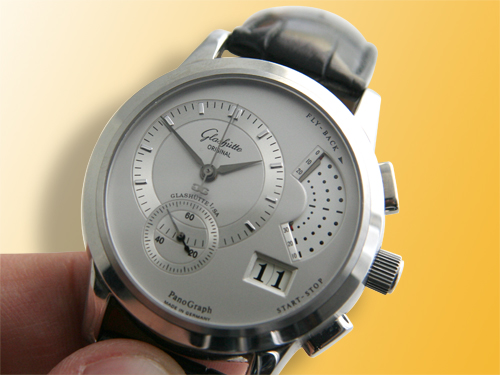
Panograph was discontinued around 2005 or so I believe before surprisingly being re-introduced in 2012 in a redesigned 40mm case in rose gold only. The bezel was made much thinner and IMO, the dial as whole, took on a far more elegant design.

I acquired the new rose gold Panograph about a year ago which was a significant year for me both personally and professionally and it has been a complete delight that always brightens up my day when I put it on.

Let’s dive in deeper. One of the most distinctive aspects of the Panograph is that at first glance, it does not look like a chronograph at all! The general layout, along with the 2012 redesign makes for one of the most elegant and dressy looking chronographs out there. It sticks with the offset dial arrangement of other Pano collection watches which I feel is well balanced despite the asymmetric design.
The main dial features the main hours and minutes along with the chrono seconds. Running seconds is featured in an intersecting small sub-dial dial below. By ditching the chapter rings from the older design, the watch remains legible despite the intersection and looks far more elegant. The dials are decorated with a circular snail pattern.


On the top right of the dial is the signature triple layer minute counter. At first glance it seems complicated in operation and readability but it is actually rather simple. Three hands of three different lengths are equally spaced apart and connected to a central spoke. Mechanically it is the same as a normal circular minute counter. The first hand is the longest and covers the first layer from 0-10 minutes. The middle length hand covers 10-20 and the shortest covers 20-30. So its not some crazy retrograde counter, the design simply hides 2 of the hands at any given time. (except at 0/30m, 10m or 20m at which point two hands will be visible on the dial. However there is no confusion as both hands will read the same time.)
Though not intuitive at first glance, once you understand the way it works, the large size of the minutes counter means it is very legible and easy to read quickly. For instance the picture above is reading 2 mins and 57 seconds while the pic below is indicating 27 minutes and 15 seconds.

The chronograph pushers are also worth mentioning. GO has unusually reversed the order here; the Start/Stop is at 4 o’clock and reset/flyback is at 2 o’clock. The start stop button is also incredibly refined in the way it feels. The pusher moves in with very light resistance and the chronograph starts or stops with a satisfying light but distinct “snick”. Its by far the best feeling chronograph pusher I have encountered and others who have tried more high end chronographs than I have have also remarked on how good it feels in some online comments I’ve seen. The flyback/reset button has slightly more resistance and makes a more typical sound, it’s still very very refined but not quite as satisfying as the start/stop pusher.

The Pano name of course comes from GO’s Panorama Date, probably one of the best implementation of the big date I have seen anywhere with a beautiful design and both digits on the same plane next to each other. The date window is beautifully done. The date can be easily quick set from the crown and changes instantaneously at midnight.

The case is beautifully detailed with brushed sides (polished between the lugs) and polished bezel. The lugs are short and curved adding to comfort and wearability. The dressiness of the design is negated to some extent by the thickness of the watch which comes in at 13.7mm. It does fit under most of my shirt cuffs without a problem but not everyone will be a fan of the slightly “chunky” overall look. I however do like the way the relatively muscular look adds presence to an otherwise understated watch.


The strap too is a thing of beauty. The dark brown lousiana alligator strap is of superb quality and supple despite being very thick. The surface is matte, I don’t know if the term nubuck is applicable to alligator hide but it has that kind of matte texture. The deployant too is very solid although it is held in place by a screw. Not really a problem as I don’t need to adjust once sized properly. The watch is fairly comfortable on the wrist but it is not the most comfortable watch I own. I found the deployant a bit uncomfortable initially but after the strap broke in and became more flexible, it now sits more comfortably.

And now the pièce de résistance, the Glashutte Original caliber 61. As mentioned before, caliber 61 is derived directly from caliber 60. Caliber 61 is a manually wound column wheel chronograph with flyback mechanism, lateral clutch, big date, 42 hours power reserve and beating at 28,800 bph. The specification is quite traditional and offers no real technical innovations on the chronograph front compared to some more recent releases. However, the appeal lies very much in the refined execution.
(GO has really been hyping up their new automatic Cal 37 which is more advanced including a free sprung balance and long power reserve, however it seems not to be finished to the same standard as Cal 61. I wonder what the future holds for GO chronographs...)

Whilst the dial side is restrained and understated, the Panograph goes all out on the movement side. The movement is beautifully decorated in the Saxon style with perlage, Glashutte stripes, gold chatons, and blued screws. The deep layout of the chronograph mechanisms create a miniature 3D city you can spend ages staring at.
Unlike some new chronographs, caliber 61 features a lateral clutch to engage the chronograph mechanism with the going train. A lateral clutch often results in slight jerkiness in the second hand as the chrono is engaged and this effect can be observed in the Panograph at times. The upside however is the visual appeal; you can easily see part of the going train (top two wheels) pivot to engage with the chronograph clutch (bottom left) [I think the terminology here is correct].

Speaking of visual appeal, the balance cock is beautifully engraved by hand and the balance is regulated by a black polished swan neck adjustment system. However, there isn’t enough space in the chrono movement for GO’s signature double swan neck system. you can’t have everything I guess!

The edges are nicely beveled and feature some nice exterior angles.


If I'm being critical, I would comment on the two interior angles I found here, they are not very sharp on close inspection, it seems only very few manufactures do razor sharp interior angles.

In a separate thread I have been trying to ascertain which components have been black polished, GO states the swan necks are but there are a lot of other beautiful and highly polished steel parts on the caliber as well. Hopefully we can find a definitive answer soon.

The column wheel and chronograph levers

In conclusion I would say that the Panograph offers a very interesting, elegant and uncommon alternative for anyone looking for a high end chronograph. Even in rose gold it is still quite good value I think compared to many other brands with similar technical specifications and its definitely more interesting than a Lemania 2310 ebauche which is still seen in a few brands. And i definitely prefer a manual movement which puts the full intricacy of a chronograph movement on display vs an automatic in a "dress chrono" of this nature.

Hope you enjoyed the pics!
ps. Im also on instagram if any of you guys want to connect: @tempocalypse
Glashutte Original Panograph - Review
I've posted version of this review elsewhere on the web but since this the only active dedicated GO forum I've come across I thought I would share it here too. I will try to convey my thoughts and experiences with the watch and I hope you will enjoy the p...

Excellent write up and review!
i love GOs and though this Panograph has eluded me and I've not been able to handle one in the metal, your experience with it and the great pictures speak volumes!
Thanks! I'm sure you'll find it as impressive as I did...
... if you come across one do let me know what you think of the chrono pushers. I just love how refined they are.

What an epic review
with superb photography. Fully agree on your judgments. Congrats to this marvel. CC

Thank you very much for this great review
To be honest this watch is nothing short of amazing such cool unique complication Definitely among my most favorite G O of all time Sincerely Damjan


Thank you for sharing the writeup! Some interesting points.
Excellent review! What camera (and setup) did you use to photograph? I agree that the new dial is an improvement on the original version. I never felt the silver chapter rings never matched well with the rose gold case, making the old gold version less de...
Thank you! Re the camera setup....
... these pictures were taken at different times over the course of the last year. Most of the regular pictures were taken with a Fuji XT1 and a Fuji 35/1.4 The photo of the watch in its box is an iPhone pic. Extreme closeups were taken with Fuji XT1 plus...
just got a reply from GO
"... Basically there were no technical changes made to the movement - we only have optimized the fine adjustment of the individual components and the design of push button as you have already mentioned. "
Appreciate the response!
Thank you for making the inquiry. The Cal 61 remains impressive, even if the technical specifications (power reserve, timekeeping, etc) are pretty standard. The Panograph continues to be one of my favourite watches and it has held up well over the years.

It is very helpful for us to have a REFERENCE review on this GREAT Chronograph.
I share your enthusiasm for this Watch even if I prefer the sophistication of the PanoRetroGraph. We tend to forget that G.O produced some very interesting Chronos. The two mentionned, and a veeery interesting Rattrapante. I am in the hunt for a steel Pan...
Thanks a lot for the kind words! ...
... indeed they have made quite a few interesting chronographs. I didn't actually know about the GO Rattrapante until two weeks ago, it seems to have been entirely missed by the community at large at least as far as what I've encountered. And putting asid...
You are right about the Datograph, and about the Duometre, as well.
The new Patek 5370P has to be mentionned, in the elusive gang of fine chronographs, too. Pfff, a killing theme! Best, Nicolas


WAAR!
What An Amazing Review! Thanks for every word. It's already late here, so I might have to read and enjoy it again. Will certainly do so. BR Kolosstt

"Ask the man . . .
. . . who owns one." Packard, 1901; and now, Glashütte Original, 2015. Exceptional review, tempo . . . thank you for sharing your thoughts with us. Your comment regarding the tactile feedback of the pushers is shared, and I'd extend that observation to th...
Thank you very much for the kind comments!...
... I would also agree that the winding action is very smooth. Didn't think too much about it when I was writing although my personal preferences is towards watches with *slightly* more resistance in the action. I think the word Justice Potter was referri...

The Pano design
The Pano design is surely a winning design for GO. The fact that it can incorporate an, unusual, chrono so easily is the prove. Not being a chrono man I feel this Panograph is the perfect symbiosis between a piece of jewellery and a chrono watch. Thank yo...
Very true the Panograph design...
.. is capable of winning over those who don't usually like chronograph dials. Apart from the larger size of the minutes counter, its proportions and layout are not very different from the PanoReserve or the Panomatic Lunar. Asymmetric but nicely balanced ...

Thanks for posting this review!
Obviously, tremendous photos and words to go with them. But what most impresses me is your passion for this watch - it is quite evident! And THAT is what it is all about. Very happy for you.
Thanks a lot
I'm always happy to share my enthusiasm about this watch with like minded folks!


Even if I am late - wonderful review - we agree on all all critical aspects...
particularly in the evaluation of the techncial and aesthetic merits of a vertical vs. a lateral (or horizontal) clutch mechanism. I enjoyed this review thoroughly - thanks for taking the time! Magnus