Kong
[Moderator]
7855

Chopard's 150th Anniversary (1860-2010) , A Relook
Louis-Ulysse Chopard would doubtless be delighted to see how his company has developed. Celebrating its 150th anniversary in 2010, the firm is still pervaded by the spirit instilled in it by its founder and nurtured by a blend of fine hand craftsmanship and daring technical developments.

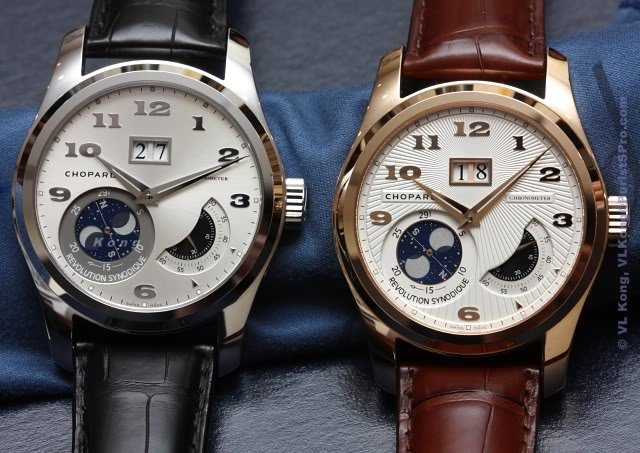
From the founding family to that of Karl Scheufele which took it over in 1963, Chopard continues to be governed by its enduring principles, including a taste for excellence, the pursuit of quality, creativity, innovation, independence, and fundamental human respect.
After modest beginnings, Chopard established itself in the 19th century as a benchmark in the field of precision watches. However, it subsequently experienced a decline that lasted until 1963 when it was bought up by Karl Scheufele. Along with his wife Karin and his two children, Karl-Friedrich and Caroline, he has shaped the firm’s meteoric and constant growth: from the first Happy Diamonds model to the latest Haute Joaillerie watches stemming from the fertile imagination of Caroline; and right through to the ultra-sophisticated L.U.C watches resulting from the unswerving determination of Karl-Friedrich, the whole world knows and wears Chopard.
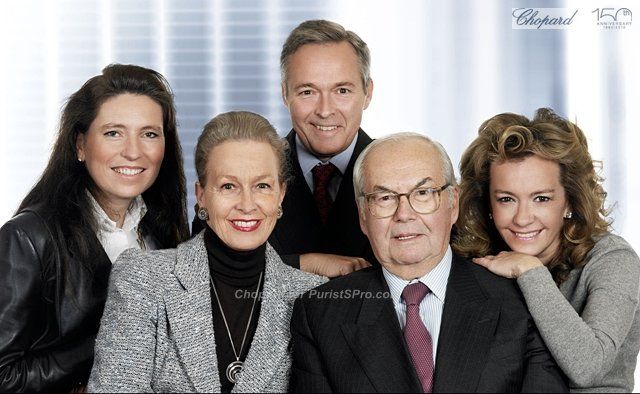
Scheufele family: (L-R) Christine Scheufele, Karin Scheufele, Karl-Friedrich Scheufele, Karl Scheufele and Caroline Gruosi-Scheufele
Over the past few decades, Chopard has explored global horizons while remaining true to its two core fields of competence: watchmaking and jewellery.
Four essential values
The three Chopard production sites in Meyrin, Pforzheim and Fleurier are dynamic and vibrant hubs where skills are handed down and expertise is cultivated. They provide a setting in which various personalities can express a shared vision and values. Very few high-end brands so clearly highlight this concept of the firm as a “House” built on four key pillars:
- watchmaking and jewellery know-how dedicated to ensuring impeccable quality;
- respect for tradition, family values; and the importance placed on passing on expertise;
- creativity backed by innovation, brilliantly exemplified by models such as the L.U.C and 1000 Miglia watches, as well as by Happy Diamonds and Haute Joaillerie creations;
- and finally, Chopard’s commitment to philanthropic and responsible patronage activities.
A global strategy
Under the impetus of Karl Scheufele, Choaprd’s design and distribution strategy was established in the 1970s and subsequently amplified by his children, Karl-Friedrich and Caroline.
Karin and Karl Scheufele continue to chair the group, while Karl-Friedrich and Caroline have been appointed co-presidents.
Karl-Friedrich, a trained goldsmith and watchmaker, is responsible for the men’s watch division, Chopard Manufacture in Fleurier and its related developments, as well as handling the technological and commercial aspects of the company.
Caroline, who is fascinated by precious stones and a trained gemmologist, is in charge of design, Haute Joaillerie, boutique organisation and management, along with fragrances and accessories.
The family members regularly consult with each other regarding decisions on corporate development involving issues such as global strategy, production, distribution, new designs and new products. Their approach is guided by a concern for detail, a cautious attitude, and a policy of small incremental steps. The determination to ensure that everything is self-financed is another of the company’s strengths.
An independent network
Various subsidiaries have been established so as to consolidate Chopard’s international presence. In 1975, the French subsidiary was set up in Paris, followed in 1976 by the Chopard Watch Corporation in New York.
In 2010, Chopard has a total of 12 subsidiaries in Germany, Austria, Spain, France, the United Kingdom, Italy, the United States, Latin America, Asia, Japan, Hong Kong and Malaysia.
Active in 124 countries, the group employs a total of 1,700 people and makes 75,000 watches and as many pieces of jewellery per year.
Independence, an essential value for Chopard, is also expressed by its independent retail network. The first own-name boutique was opened in 1983 in Hong Kong, at the same time as the retail division was established, so as to ensure direct contacts with consumers. Chopard boutiques are now dotted around the world, including in Geneva, Moscow, Dubai, Beverly Hills, Munich, London, Mumbai, Tokyo, Almaty, Saint Barthélémy, Gstaad, Marrakech, Shanghai…
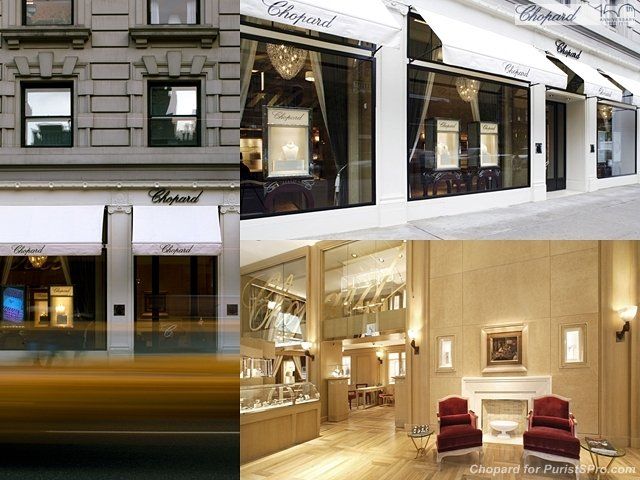
In 2007, a new boutique concept designed by French architect Thierry Despont was introduced with the inauguration of a flagship store at 709 Madison Avenue, New York – followed in 2009 by the opening of another new-look boutique in Singapore.
As of 2010, the network is composed of 120 boutiques and 1,600 points of sale.
Vertical integration
Eager to reduce its dependence on suppliers, Karl Scheufele has persistently striven to achieve vertical integration of production. “We make almost everything ourselves, from cases to straps. Ideas are almost instantly translated into reality thanks to our two watch and jewellery design studios”. Chopard is thus endowed with a considerable sum of expertise and innovative capacity.
Uniting 45 professions
The Meyrin, Fleurier and Pforzheim sites host an impressive range of engineers, prototype makers, designers, goldsmiths, watchmakers, turners, tool-makers, polishers, smelters, engravers, mechanics operating CNC machinery: all are actively involved in making watch or jewellery models, self-winding movements and other vital components.
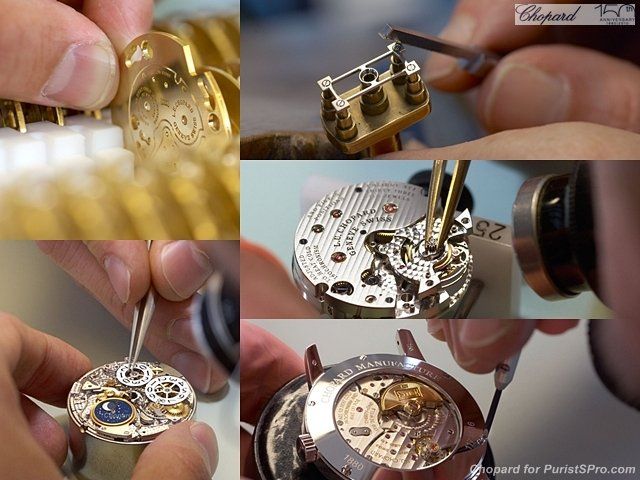
In Meyrin, Chopard even makes its own gold alloys; Pforzheim is mainly devoted to jewellery, while Fleurier produces the high-end L.U.C watches. When it comes to designing exhibition booths for trade shows and boutique displays, Chopard also has its own in-house decoration department. After-sales service is fully integrated, as are the communication and marketing teams.
Fundamental training
“Our family history is the cornerstone of Chopard, laid by artisans and handed down from generation to generation. This know-how is infinitely precious.” Karl-Friedrich Scheufele
In order to pass on its expertise and to nurture innovation, Chopard has its own internal training division. Each year, 25 apprentice watchmakers and jewellers taking four-year training courses are supervised by an apprenticeship master active on all three sites.
The 2008 Best Training Company prize awarded by the State of Geneva in the category of Applied Arts rewarded Chopard’s long-term commitment to education.
In 2010, Chopard is celebrating its 150th anniversary through a set of high jewellery and watchmaking collections expressing its contemporary touch and its long-established expertise. While offering a powerful symbolic reminder of the past 150 years, they also reflect its present and augur well for a future based on the transmission of excellence and the independence of a company built to withstand the ravages of time – for another 150 years and beyond….
Chopard-Scheufele: intertwined destinies
Their respective births in Sonvilier and Pforzheim determined the destiny of Louis-Ulysse Chopard and Karl Scheufele. Fate would one day lead them to cross paths, but for the time being the Chopard family settled in Sonvilier at the heart of the Swiss Jura, while the Scheufeles lived in Pforzheim in the Black Forest region of Germany.
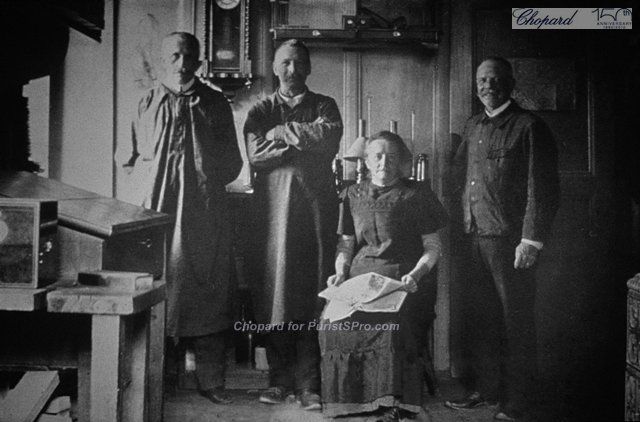
The workshop of Louis-Ulysse Chopard (the gentleman on-the-right) in the 1890s
Chopard in Sonvilier
The father of Louis-Ulysse Chopard, Félicien, was an experienced farmer and a man of tradition who encouraged his sons to learn the watchmaking trade. The younger of the two, born on May 4th 1836, showed a particular gift for watchmaking. The ambitious Louis-Ulysse quickly grasped the fact that it was the “comptoirs” or watch dealers that earned the greatest profit from the work of the farmers who assembled movement blanks during the winter season: each spring, the agents picked them up, cased them up and then marketed the finished watches. It was therefore better to work independently, and in 1860, at the age of just 24, he accordingly set up his own L.U.C watch manufactory in Sonvilier
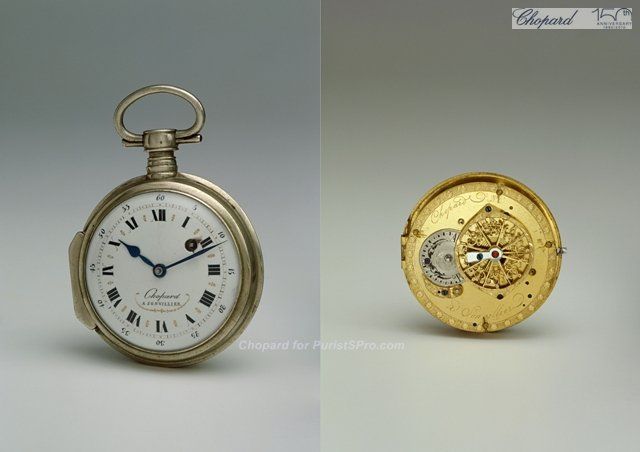
Innovation sets the tone
In order to stand out from its numerous competitors, Chopard specialised in making innovative precision watches featuring sophisticated decoration. The company canvassed customers in Eastern Europe, Russia and Scandinavia to show its finest creations, and the Tsar of Russia soon became a loyal client. In 1913, Louis-Ulysse placed its first ad for the “Fabrique de montres L.U.C L.-U. Chopard, maison fondée en 1860”. His son Paul-Louis took over the firm shortly afterwards.
The orphan turned goldsmith
At the heart of the Black Forest in Germany, the jewellery industry flourished in the small town of Pforzheim. August 6th 1877 saw the birth of a boy christened Karl Gotthilf, son of Johannes and Sophie Scheufele, in Pforzheim. His parents instilled in him several fundamental values such as boldness, perseverance, an entrepreneurial spirit, as well as a love of fine craftsmanship and of nature. However, his life was turned upside down by the death of his parents and he was placed in an orphanage in Pforzheim, where he learned watchmaking.
Having started out as a sales representative, he launched out on his own in 1904. The contacts he established in the Far East and in Russia lent his company an international dimension. ESZEHA (spelling out the first three letters of his family name as pronounced in German), the manufacturing company run by Karl Scheufele I, made pendants, medals, bracelets, as well as brooches in gold, diamonds and pearls adorned with floral motifs inspired by Art Nouveau. In 1911, rather than delivering cases and bracelets to Swiss firms, Karl Scheufele I began assembling watches and marketing articles in platinum and gold watches.
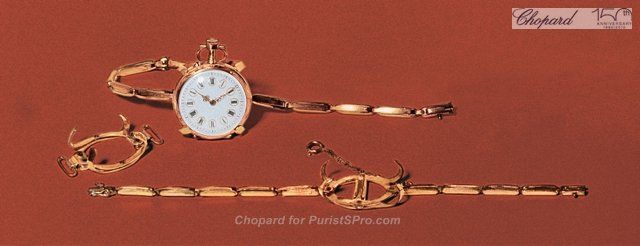
In 1912, he scored a great commercial success with a clip serving to attach a pocket-watch to the wrist or to wear it as a necklace. An innovative system at the centre of the bracelet served to house and secure the watch firmly between two ‘paws’. Women were quick to adopt this new way of wearing jewellery.
The Art Deco craze
Know-how and reputation building
Following the founder’s death on January 30th 1915 in Sonvilier, his son Paul-Louis and his grand-son Paul-André took over the family business. Chopard’s pocket chronometers were extremely popular with elegant men, and its gem-set ladies’ wristwatches were both practical and attractive. Chopard produced extremely accurate timepieces with a high degree of technical sophistication.
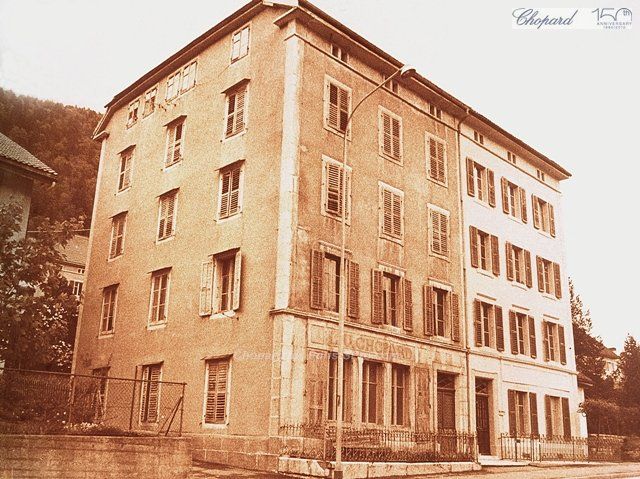
The house in Sonvilier where Chopard was founded (circa 1900s)
In 1937, having realised that Sonvilier was virtually unknown on the world map, Chopard relocated to Geneva, a renowned international watchmaking centre.
Rebuilding in Germany
After World War I had bled Europe dry, Karl Scheufele I anticipated the shift in demand by eliminating jewellery models from his product catalogue and replacing them with watches. He presented his collections in Germany, Austria, Eastern Europe and as far afield as China.
Art Deco brings a wind of change
The Art Deco movement revolutionised the decorative arts during the 1920s. Chopard and the Scheufeles made full use of this new trend.
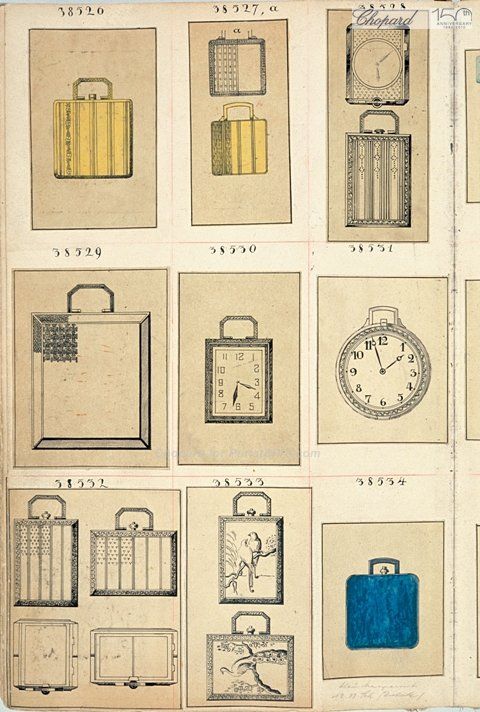
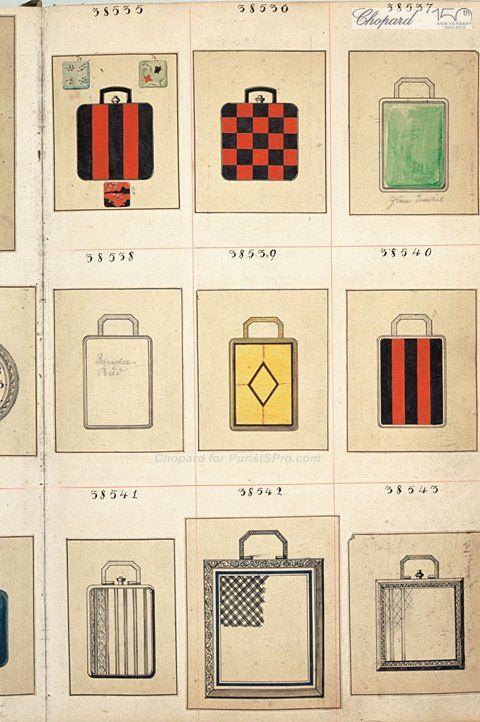
The Art Deco influence is particularly visible in Eszeha “wallet watches”, meaning watches incorporated into dedicated cases. The latter, made from Chinese-lacquered or enamelled silver and gold adorned with precious stones and geometrical motifs, concealed tiny travel clocks that were genuine pieces of jewellery.
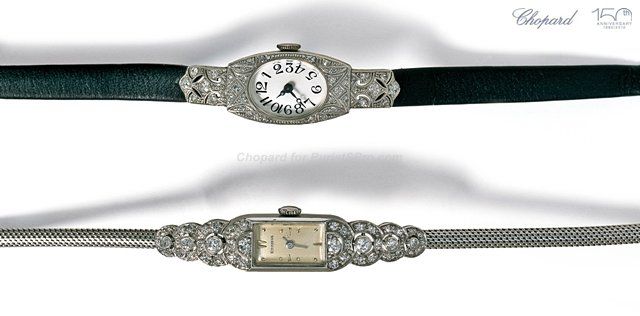
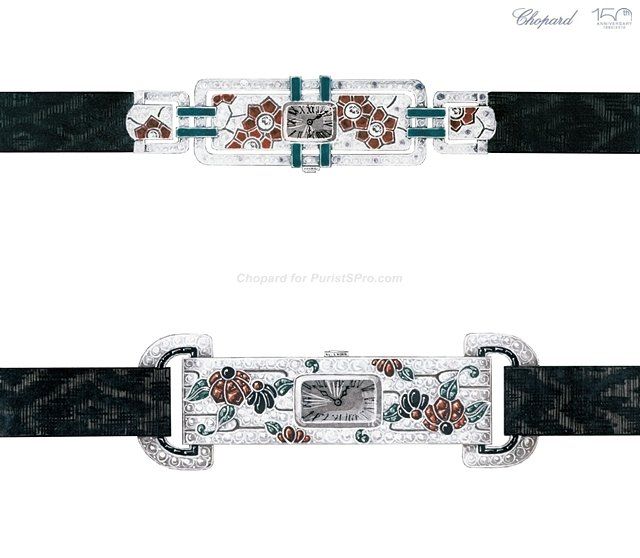
Eszeha Art Deco watch sketches
Karl Scheufele I was considering buying up a watch factory in Switzerland, but the Third Reich made such a move impossible. On August 5th 1941, while out on a walk in the Black Forest with his grandsons Johan and Rüthchen, he died after a heart attack on the eve of his 64th birthday. That same day, his son was wounded on the Russian front. Upon his return in 1942, Karl Scheufele II succeeded his father at the head of the company.
Modern times
The 1950s saw the birth of highly sought-after Eszeha models featuring original shapes: dials that were hidden or set into small crowns, undulating lugs, bracelets embellished by tiny bows, or broader versions with articulated links.
Saving the company
Weakened by his exertions, Karl Scheufele II entrusted the factory and its 35 employees to the care of his 20 year-old son, Karl III, also a goldsmith and a watchmaker. He passed away in Heidelberg on April 8th 1966.
“When I took the head of the company, it had an excellent reputation and a long-established tradition, but it was riddled with debts. Without the help of my father-in-law who served as guarantor with the bank, it would never have survived.”
Karl Scheufele III
Having inherited his grandfather’s creative bent, Karl Scheufele III began designing impeccably crafted dainty jewellery models and watches. He was keen to make his own movements, and realised the only solution would be to buy up a Swiss manufacturer.
Becoming truly independent
An unexpected event hastened the onset of this new challenge. In 1962, Karl Scheufele III learned that the Geneva-based company with which he had been dealing for years also delivered movement blanks to one of his fiercest competitors. He immediately revoked the contract with this supplier and had an advert published in a number of newspapers, openly stating his intention to purchase a Swiss manufacturing company.
Chopard slumbers
After a period of commercial prosperity, Chopard was clearly on the decline: Paul-André, representing the third generation and undoubtedly an extremely talented watchmaker, was no businessman. This 70 year-old owner was looking to sell the firm and agreed to meet Karl Scheufele III, with whom he shared the same determined attitude, the same practical good sense and innate creativity, as well as the same love of fine craftsmanship. In acquiring this manufacturing company, Karl Scheufele III entered the extremely exclusive club of great Swiss watchmakers.
“As soon as I visited the Geneva workshops and saw the venerable Mr. Chopard seated at his workbench in front of the window, I knew that our two companies were bound to get on well. After half an hour of conversation, I knew it was the right choice.”
Karl Scheufele III
Years of international conquests
Karin and Karl Scheufele
Thanks to his salesmanship skills and his passion for travel, Karl Scheufele III revived Chopard and transformed it into a truly international watch and jewellery brand. The new creations proved both playful and original, as well as of impeccable quality, bringing with them a genuinely innovative touch.
Birth of the Chopard look
The Chopard look was nurtured by the company roots in the Art Nouveau and Art Deco movements. In 1972, Karl Scheufele III reinterpreted Art Nouveau in a series of plant life-themed watches, starting with Belle Epoque and following on with other nature-inspired collections such as Cascade, Happy Diamonds in 1976, Moonlight and Paradiso.
The Chopard style signature was as multi-facetted as the men and women it won over: deliberately round watches reflected the sensual curves and vivid colours of the 1970s; while broad cuff-watches in onyx, malachite, coral and turquoise combined daring shapes and beautiful gemstones.
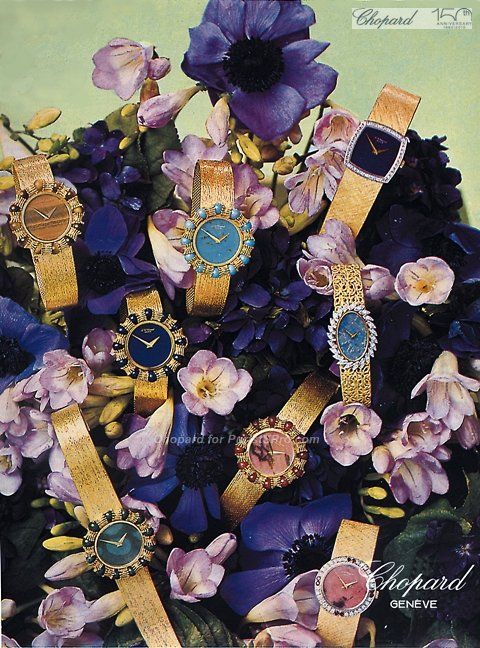
In 1972-74, women readily adopted the Jeans watch and its famous denim strap. A fresh breeze was beginning to blow through the world of jewellery watches.
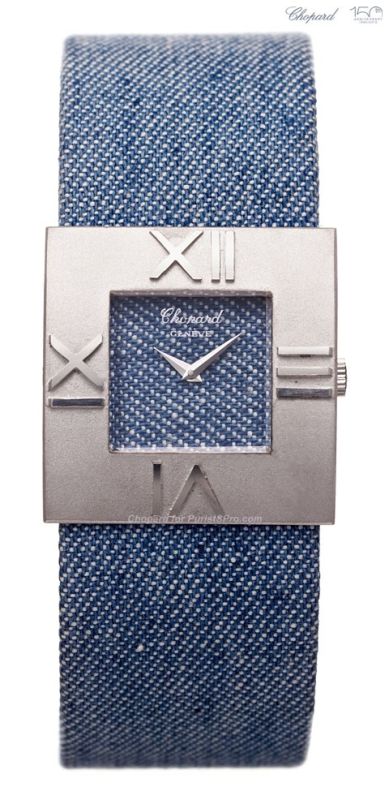
Jeans Watch
“My father had the idea of setting diamonds on the bezel of a men’s watch. He travelled a lot in the Middle East and Chopard was a pioneer on this market.”
Caroline Gruosi-Scheufele
The Golden Rose of Baden-Baden
Between 1970 and 1980, the jewellery industry equivalent of an “Oscar” was annually awarded by German professionals: the Golden Rose of Baden-Baden. Chopard won 15 trophies during this decade, including one for the Happy Diamonds jewellery watch in 1976.
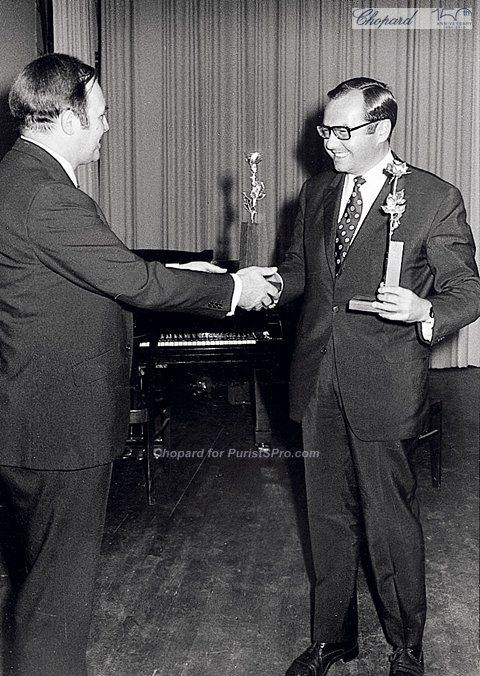
Karl Scheufele receiving the Baden-Baden Golden-Rose in 1969
In 1976, inspired by the Concorde, Karl Scheufele created the Concord watch in white gold set with onyx and diamonds. The model was distinguished by a Diamonds International Award – of which Karl Scheufele was to win three in all.
Renewed creativity
Thanks to Caroline Gruosi-Scheufele and Karl-Friedrich Scheufele
During the 1990s, Caroline Gruosi-Scheufele and Karl-Friedrich Scheufele formed a new leadership tandem, just as their parents had done before them. Each reinterpreted the family tradition in their own way: Caroline reinvented the ancestral Pforzheim jewellery-making tradition by launching splendid Haute Joaillerie collections, while Karl-Friedrich did the same for watchmaking in Sonvilier by founding a fine watchmaking “Manufacture” in Fleurier 1996. The two complementary partners already shared the same office as they wrote a new chapter in the epic Chopard adventure.
Famous models
Since the Happy Diamonds, the history of Chopard has been punctuated by iconic collections that have made their mark on the development of both watchmaking and jewellery.
Success in the masculine mode: sports watches
Saint Moritz : sporting chic
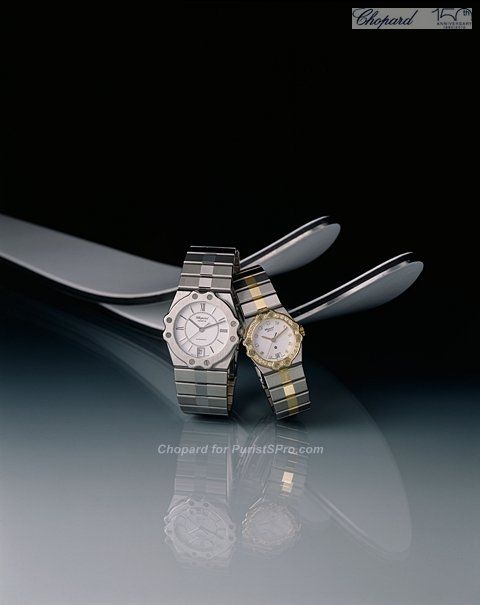
In 1980, Chopard surprised observers by creating a steel sports watch: Saint Moritz, the first model by Karl-Friedrich Scheufele. Along with his sister, he had grasped the fact that the borders between formal evening dress, smart city suits and casual wear were becoming increasingly blurred. This observation led him to design the Saint Moritz, featuring an original octagonal shape with eight screws securing the gasket between the bezel and case and thus protecting it from both damp and from variations in temperature – an impressive technical feat at the time. This grand première proved an instant success and was followed by models evoking other famous resorts, Monte Carlo and Gstaad.
Happy Diamonds : free-roaming diamonds
In 1976, an original expression of horological creativity revolutionised the watchmaking world, when Happy Diamonds gave an unprecedented twist on the theme of diamond-set watches.
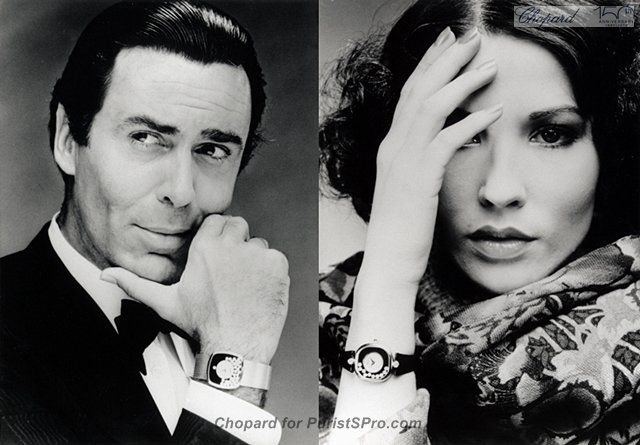
During a stroll in the Black Forest, Chopard decorator and designer Ronald Kurowski marvelled at the sight of a waterfall: the drops of water bursting from it reflecting the sunlight and shimmered like the colours of the rainbow. This vision sparked his brilliant idea of enabling diamonds to shine more brightly by freeing them from their retaining claw settings and enabling them to move about freely.
Free and thus happy
The first Happy Diamonds models were men’s watches with an onyx base. When she caught sight of them, Karin Scheufele spontaneously exclaimed “these diamonds are happier because they are set free”.
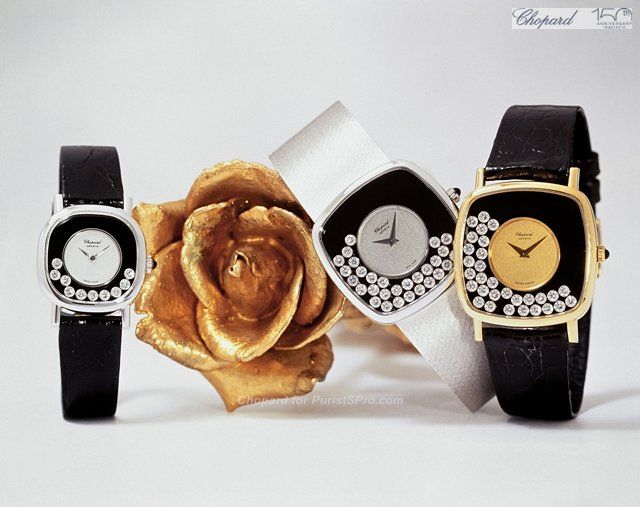
The watch was thus quite logically christened Happy Diamonds, a name that would become famous the world over. The Happy Diamonds concept consists in a dial topped by two sapphire crystal plates with free-spinning diamonds dancing between them. Their unpredictable movements around the dial exercise an irresistible fascination. Happy Diamonds watches provide scope for the most original variations. White, black or pink diamonds, as well as rubies, sapphires and emeralds, shine with radiant beauty inside their transparent ‘jewel case’.
The clown: a young woman’s master stroke
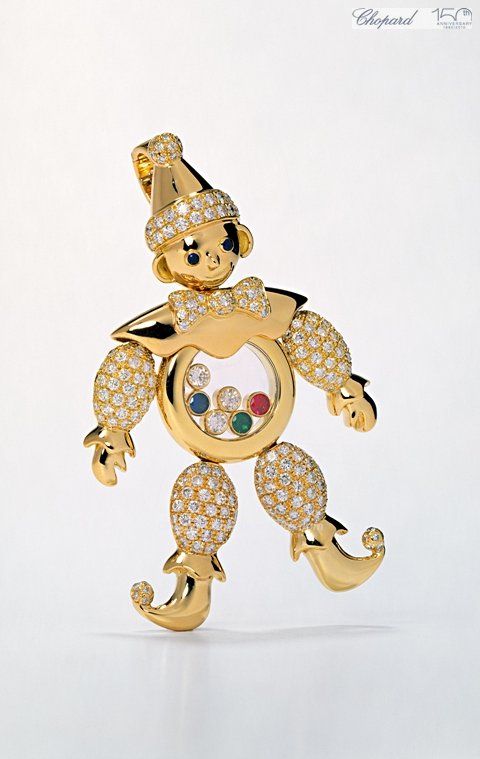
As a teenager, Caroline Gruosi-Scheufele already enjoyed drawing jewellery models. In 1985, a first major sketch of a clown with disarticulated legs and a tummy full of diamonds and coloured stones propelled her firmly into the creative world.
This humorous design rejuvenated the Chopard image and was an instant hit, to the point of becoming the brand mascot: a dramatic stage entrance for the bosses’ daughter!
After the success of the clown, Caroline created a real Happy Diamonds jewellery line, which appealed to a younger audience.
Audacious elegance: Caroline Gruosi-Scheufele
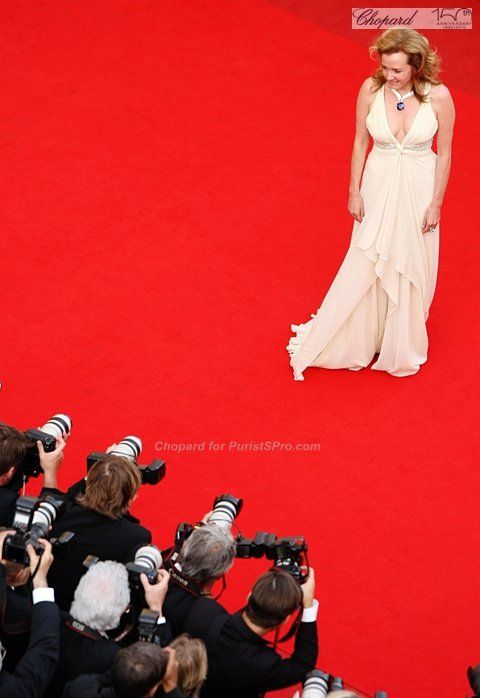
Caroline Gruosi-Scheufele devotes all her energy and passion to design, to boutiques and to accessories. Over the years, the success of her collections has gradually established her reputation in the industry. By asserting the importance of Haute Joaillerie, Caroline was in fact reviving a longstanding family tradition that has now led Chopard, which used to be a watch-only brand, to create as many pieces of jewellery as it does watches.
A fervent admirer of diamonds just like her father, Caroline Gruosi-Scheufele has adorned the finest models in her collections with these precious gems.
Whether by renewing the Happy Diamonds design and developing new collections; or by launching the gorgeous Red Carpet Haute Joaillerie collections, she is a revered designer and an astute businesswoman who got a successful head-start on the competition by linking the brand image to an outstanding array of world-famous stars and must-see events.
Her finest creations
Happy Sport : sporting femininity
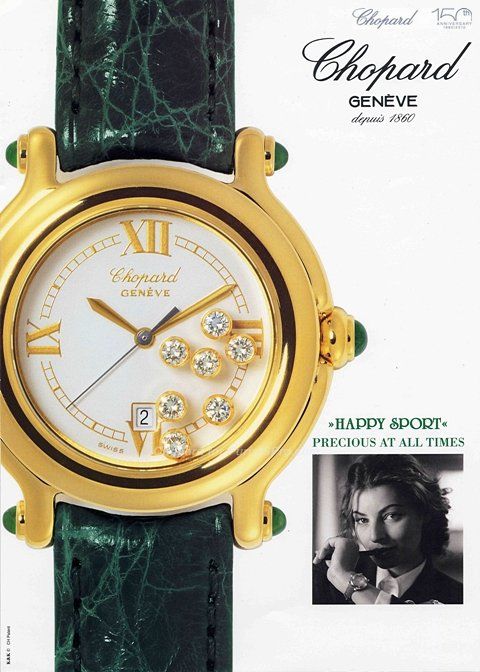
Caroline Gruosi-Scheufele’s favourite Happy Sport watch line made a memorable impact on its era. Since 1993, this original and free-spirited manner association of steel and diamonds has remained one of the watch industry’s most popular success stories. Its countless variations have made this watch every inch a contemporary classic clearly intended for self-confident women.
Impériale : my Empire for a watch !
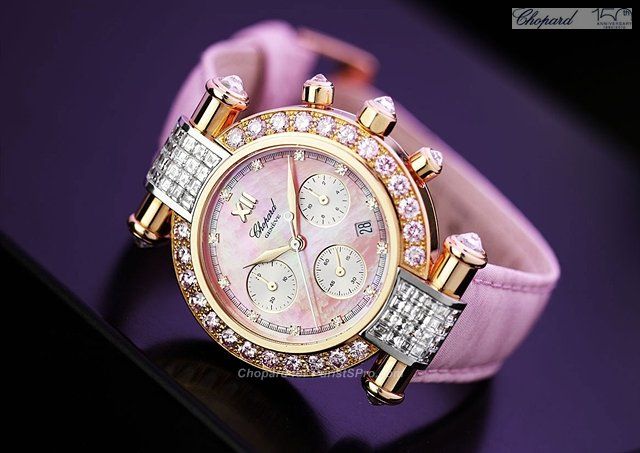
In 1994, Chopard brought the splendours of the French empire back to life with a collection comprising a series of ultra-sophisticated watches featuring imposing sizes, luxurious materials, and lugs set with cabochons on either end evoking the characteristic columns of the Napoleonic era.
La Strada: a diamond-paved road
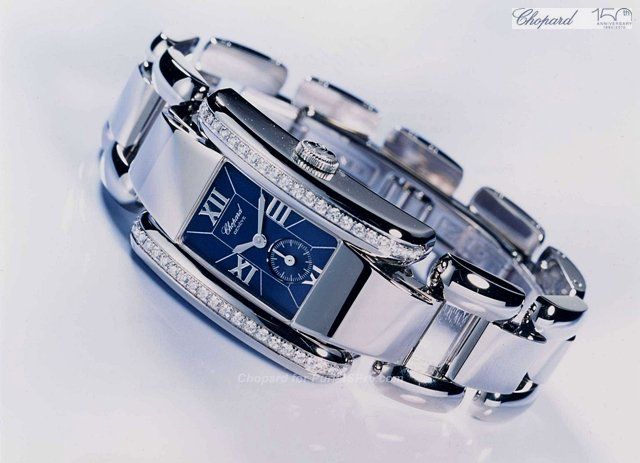
In 1994, Caroline, a dedicated film enthusiast, offered her own interpretation of Fellini’s eponymous film by creating jewellery sets and watches. The distinctive lines of La Strada collection evoke the mood of the 1950s as well as feminine curves. Its design was revamped in 2000.
Ice Cube : cool design!
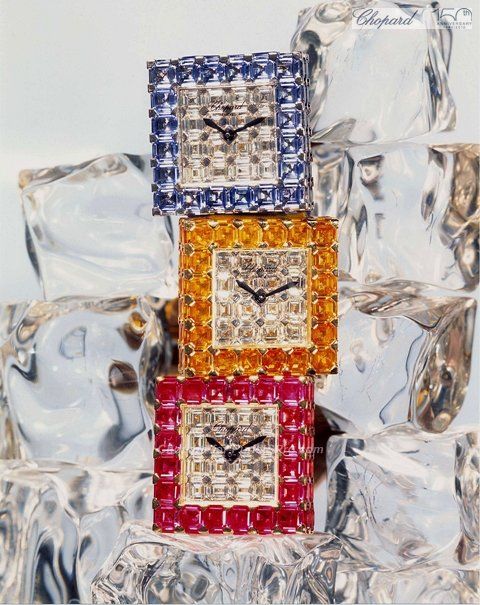
Ice Cube was a turning point in the history of Chopard design.
The first model was a white gold cube set with 76 square-cut diamonds on a full-pavé background. This extremely modern design has become one of the company’s stellar collections.
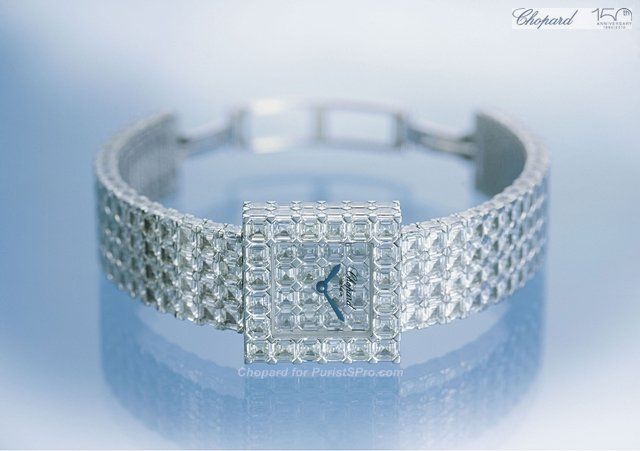
Since 1999, over 50 versions of the Ice Cube watch have been created, and more than 300 jewellery interpretations in the form of pendants, necklaces, earrings, bracelets and rings feature all manner of motifs ranging from the simplest to the most exclusive.
Golden Diamonds : the invention of a new precious stone
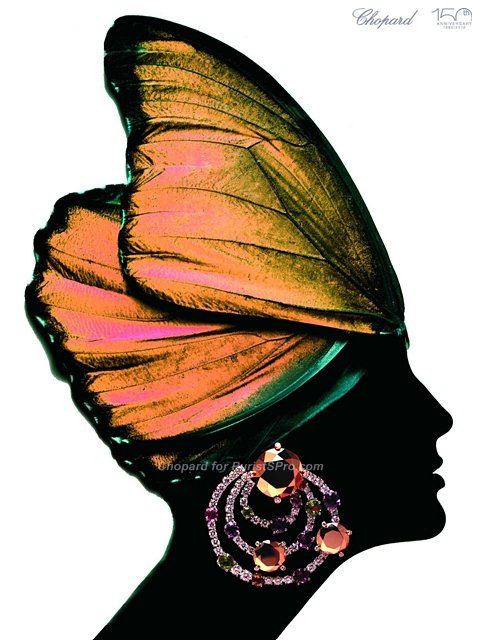
In 2002, Caroline Gruosi-Scheufele introduced an extremely surprising new stone: gold in all its colours was transformed into Golden Diamonds, a softly mysterious stone featuring traditional diamond cuts. On Golden Diamonds models, gold was given pride of place and played the role of diamonds.
Happy Spirit : bouncing pebbles
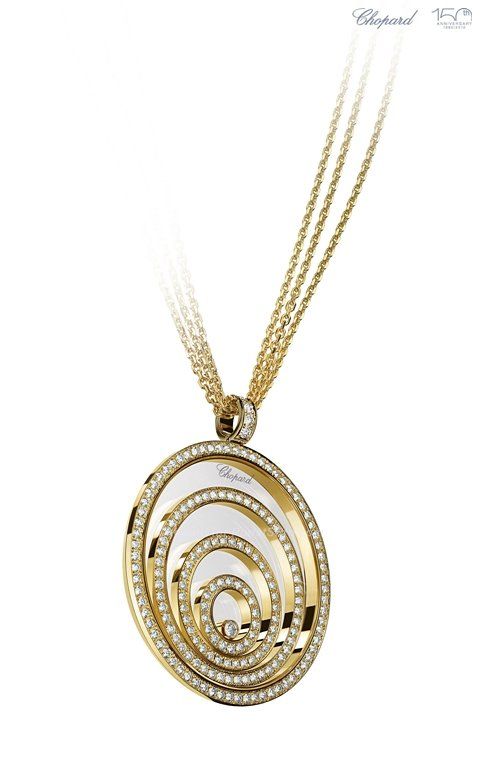
Clearly proclaiming its kinship with Happy Diamonds, the concept of free-moving diamonds that has become a timeless classic, Happy Spirit stages a diamond moving between two circles and irresistibly reminiscent of pebbles skimming across the water.
Two O Ten : The power of elegance
Anna Netrebko, who became a Chopard ambassadress in April 2007, has chosen to wear the Two O Ten, launched that same year and intended for dynamic women who are determined to remain elegant at all times.
Inside story
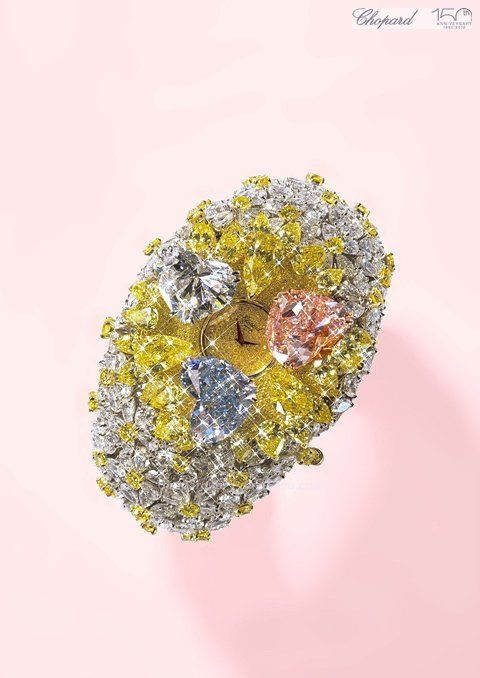
Chopardissimo , the world’s most expensive watch
Renowned for its jewellery watches, Chopard created the world’s most precious watch in 1997.
It required 2000 hours of work and sparkled with 874 diamonds totalling 163 carats.
Daring Haute Joaillerie creations
When Caroline joined the company, Chopard was already a reference in terms of elegant watches set with precious stones, but not in the field of Haute Joaillerie. Under her creative influence, Chopard launched into this challenging domain. Five collections heralded a strong and original vision of Haute Joaillerie that is truly breathtaking in terms of both the size and the sophistication of the models: Casmir, La Vie en Rose, Pushkin, Copacabana, and 709 Madison.
Casmir: precious oriental elegance
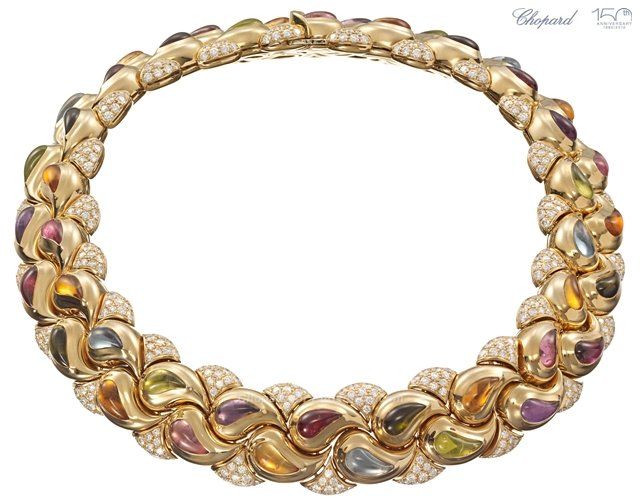
Created in 1990, Casmir evokes the splendours of the Kashmir region at the foot of the Himalayas. It also revived the trend for cabochons that had been somewhat neglected in traditional jewellery-making. Above and beyond the collection itself, Casmir reflected a pivotal moment in the brand development. This first major launch was followed by those of Pushkin and Copacabana. All three collections embodied a jewellery style decisively influenced by ethnography and travel.
La Vie en Rose : tender gems
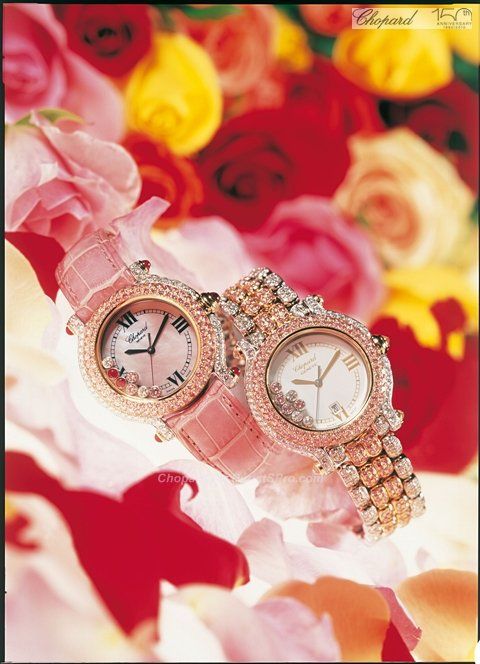
Chopard was the first company to revive the use of extremely rare pink diamonds, particularly in adorning a watch. In nature, there are in fact 10,000 white diamonds for every pink one!
Inside story
Caroline Gruosi-Scheufele was fascinated by an exceptionally high-quality batch of these rare deep ink gemstones. She purchased it even though she wasn’t sure how to use them. On December 23rd 1997, the invoice arrived on her father’s desk and Karl Scheufele was infuriated by the expense. Over Christmas dinner, he remained somewhat distant from his daughter and ended up warning her “You’d better have a good idea for your awful stones!” The stern admonishment resulted in a particularly appealing Haute Joaillerie collection.
Pushkin: Russian heritage
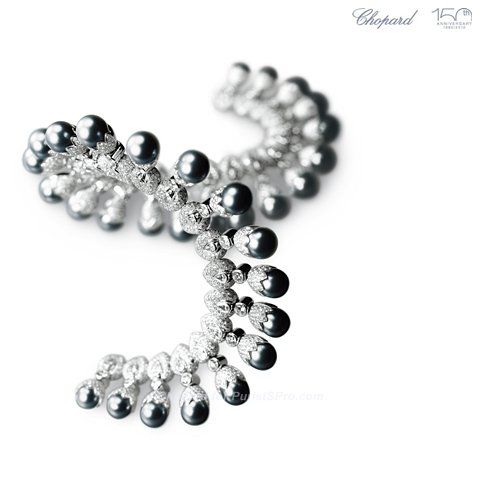
In 1999, Caroline Gruosi-Scheufele paid tribute to the Russian poet Alexandre Pushkin in the 200th anniversary year of his birth. Chopard honoured his innovative spirit by combining gold, pearls, diamonds and other precious stones.
Copacabana : Brazilian princess
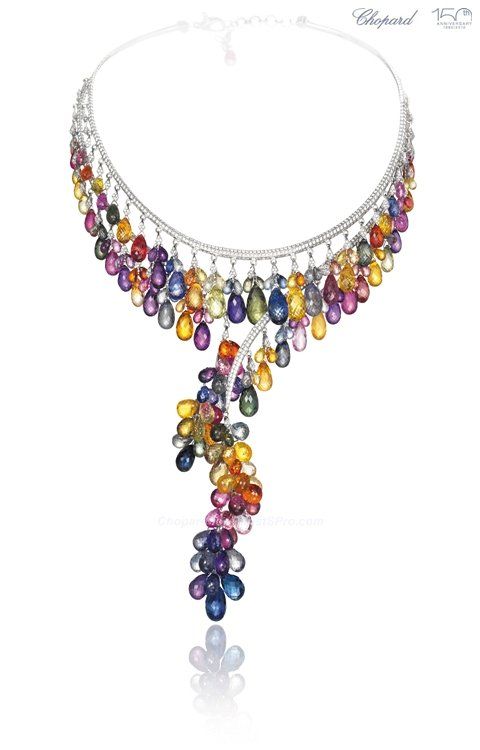
2005 was lit up by a joyful and glowing creation: Copacabana was born on Brazil’s most glamorous beach, as a vibrant tribute to the shimmering reflections of light playing gently over glowing skin.
709 Madison : New York, New York !
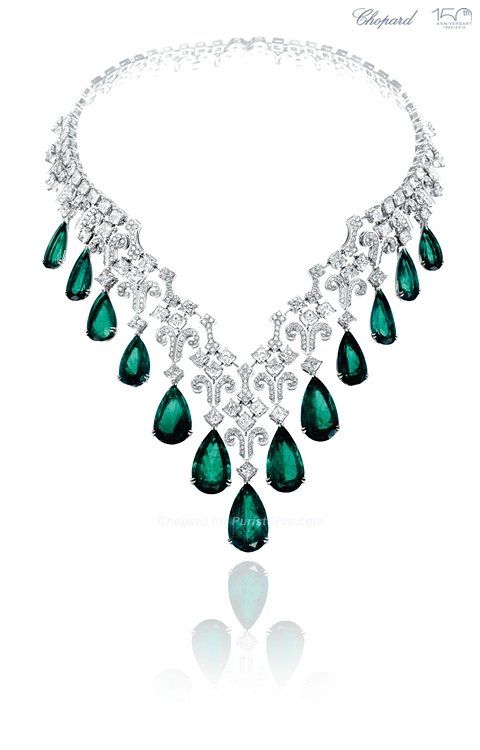
Created to mark the November 2007 inauguration of a flagship boutique at 709 Madison Avenue, the eponymous Haute Joaillerie collection by Chopard provides a fabulous vision of the city that never sleeps.
Haute Joaillerie
Each unique and every one exceptional
“Haute Joaillerie came about quite naturally. Cannes had a decisive influence, giving us the event liable to inspire the most beautiful creations. There was also something lacking on the Haute Joaillerie market. Everything was rather classic and not particularly innovative: Chopard brought a breath of fresh air and freedom to this slightly stuffy world.” Caroline Gruosi-Scheufele
The red carpet is a place where anything can happen, just as in the Chopard collection that bears its name. In 2007, the Cannes Film Festival and its legendary “mounting the steps” ritual inspired the first large Haute Joaillerie collection specifically designed to illuminate the beauty of the stars as they swept gracefully up the famous stairway, and composed of 60 one-of-a-kind models to celebrate the Festival’s 60th anniversary. Since then, in 2008 and 2009, the Chopard workshops have repeated the feat by crafting 61 and then 62 exceptional creations.
Red Carpet : extraordinary and inherently optimistic!
All women are uniquely different and Chopard responds to their innate differences by imagining Haute Joaillerie creations that appeal to their individual inclinations, to their sense of beauty, and enable them to express their personality. The collections are composed of one-of-a-kind and exceptional models combining rare or spectacular stones, expert craftsmanship and creative innovations in harmony with the traditional know-how of an Haute Joaillerie workshop.
Red Carpet therefore offers scope for infinite variations and highlights the most unexpected gems and materials in order to match a broad spectrum of tastes. This complete freedom is expressed through combinations of diamonds, rubies, sapphires and emeralds matched with quartz, coral, moonstone, chalcedony or opals… The finesse and originality of the stones are not the only vital ingredients in the magic of the Red Carpet collection, which also stems from the boundless creativity of Chopard’s co-president combined with the talent of the finest designers and the meticulous dexterity of the hand-crafted execution. The expert fingers of the greatest jewellers, lapidaries, rhodium-platers and gem-setters give shape to enchanting blends of colours and materials, as the stones are gradually transformed into priceless treasures. After hundreds of hours of work, the dreams of Caroline Gruosi-Scheufele spring to life in the shape of extraordinary jewellery creations.
The Cannes Film Festival. Chopard lights up the movies.
Chopard and the world of movies are caught up in a passionate love story punctuated by flamboyant moments and promising encounters. Acknowledged for its original and refined creations that exalt feminine allure, Chopard regularly causes a sensation on the red carpet at Cannes as well as at the French Césars, BAFTA and Academy award ceremonies. The brand is present at all the most prestigious cinema events and lends consistent support to this “seventh art”.
The film of the Palme
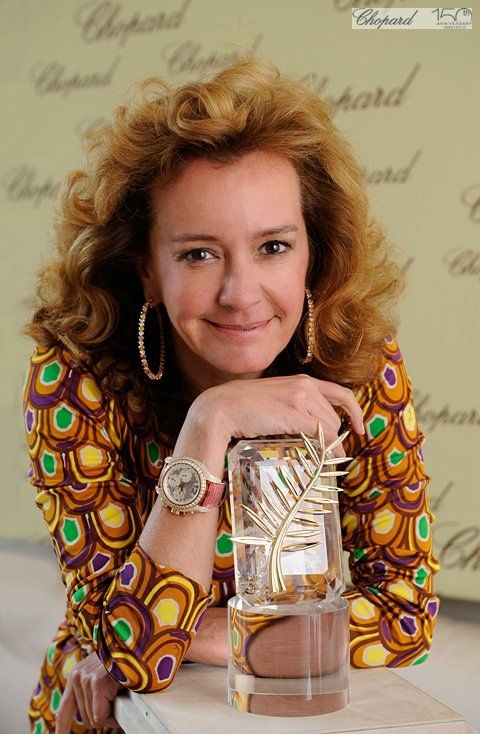
The real star of the festival is undeniably the Palme d’Or itself, a stunning piece of jewellery redesigned by Caroline Gruosi-Scheufele, crafted in Chopard’s Geneva workshops and the much-coveted prize that rewards the best film in competition.
In 1997, the festival president Pierre Viot met Caroline Gruosi-Scheufele. That same year, Chopard opened a new boutique on the Croisette. Won over by the creative energy of Chopard’s co-president, he asked her to redesign and craft the Palme d’Or. Her vision of the illustrious trophy endowed it with a fresh and delicate charm propelling it into the refined sphere of Haute Joaillerie.
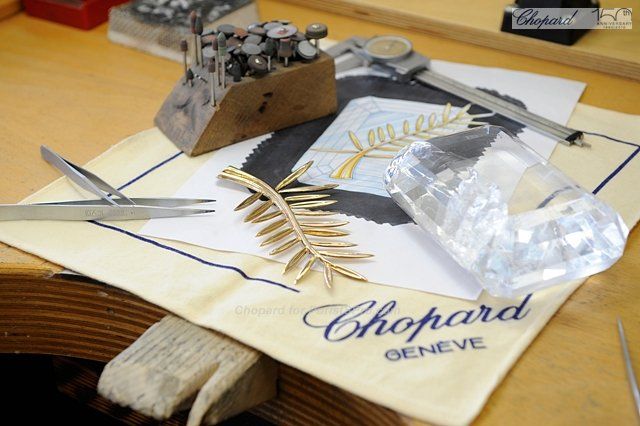
In 2000, two “mini-palmes”, replicas of their legendary forerunner, were created to reward the best actor and best actress; and the Caméra d’Or prize for the best first feature film was also redesigned. The emblem of the world’s most famous film festival is now inseparably linked to the history of Chopard.
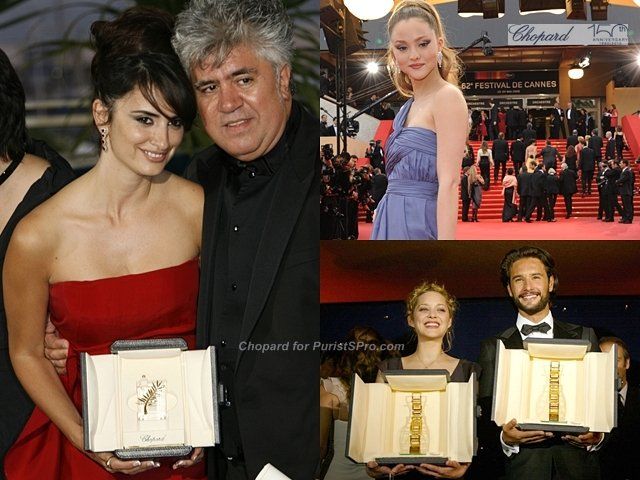
Since 1998, the brand has served as official partner of the Festival, and each year it creates new dream models and events to celebrate its enduring love of movies: jewellery sets for the legendary “mounting the steps” ritual, parties to honour films, a trophy for youthful talents, the Palme d’Or… Chopard accompanies each step of the Festival.
“There is definitely a bond between films and jewellery: a world of dreams. The decision to partner the Cannes Film Festival was thus an entirely natural choice. “ Caroline Gruosi-Scheufele
Chopard and stars
Chopard loves actresses and the feeling is entirely mutual. The various editions of the Cannes Film Festival provide an opportunity to adorn the most glamorous stars: Cate Blanchett, Zhang Ziyi, Pénélope Cruz, Diane Kruger, Charlize Theron, Marion Cotillard, Emmanuelle Béart, Isabelle Huppert, Gwyneth Paltrow, Angelina Jolie, Sharon Stone, Catherine Deneuve and countless others… Screen legends and young hopefuls alike trust the jeweller to help them shine in the limelight. Guided by the visionary insight of Caroline Gruosi-Scheufele, Chopard was the first company to grasp the magnetic potential of movie stars and of Cannes. But it is not just a matter of corporate communication. With artists like Woody Allen, Elton John or Marion Cotillard, emotions are also omnipresent. In 2006, Caroline chose her friend, super model Eva Herzigova, as the brand muse. Elizabeth Taylor once bought a butterfly brooch; Elton John collects Chopard watches and jewellery; Elizabeth Hurley ordered Chopard wedding rings for her nuptuals; while Madonna wears Happy Diamonds on the cover of her Confessions on the DanceFloor and Hang Up albums.
In 2006, Cate Blanchett wore a necklace in Cannes that really caught her fancy. She persuaded the costume designer of the film Elizabeth, the Golden Age to come and view Chopard creations. The latter was so impressed that she chose Chopard jewellery for the film. The close ties between Chopard and stars are often a matter of the heart.
The Chopard Trophy: encouraging youthful talents
Since 2001, the Chopard Trophy awarded by a jury of professionals honours two film “revelations”, with the support of the Cannes Film Festival. This prize is awarded during the festival and enables Chopard to affirm its support for young actors and for the world of cinema in general.
The list of laureates who have come a long way since receiving the award includes names such as Audrey Tautou, Eduardo Noriega, Ludivine Sagnier, Hayden Christensen, Gael Garcia Bernal, Diane Kruger, Marion Cotillard, Kelly Reilly, Jonathan Rhys-Meyers, Jasmine Trinca, Kevin Zegers, Archie Panjabi, Tang Wei, and in 2009: Léa Seydoux et David Kross.
The inside story
Chopard brings stars good luck at the Oscars
Chopard has become the lucky jeweller for movie stars. Over the past six years, seven actresses adorned in Chopard jewellery have won a Lead Actress or Supporting Actress award: Charlize Theron, Hilary Swank, Rachel Weisz, Helen Mirren, Marion Cotillard, Kate Winslet and Penelope Cruz.
Discreet elegance: Karl-Friedrich Scheufele
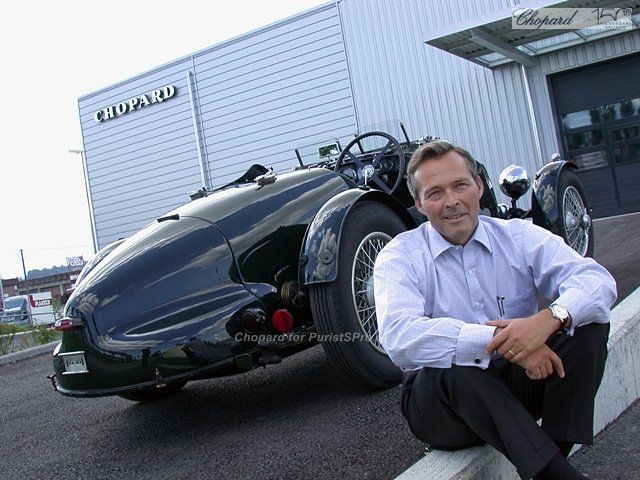
An affable and modest man by nature, Karl-Friedrich Scheufele has succeeded in asserting a new vision of Chopard, guided by his twin passions for classic cars and fine watchmaking. He is also known for his perseverance, a quality vividly displayed in establishing the brand’s reputation through the world of Classic Racing; and in founding Chopard Manufacture. His wife Christine provides invaluable support in the areas of marketing, production and finance. The philosophy of this almost secretive individual is a blend of rational and emotional elements that prevent him from ever viewing things from a purely statistical angle.
Classic Racing: a love of fine mechanisms
Devotees of fine automobiles tend to have a weakness for beautiful timepieces, and vice versa. In both cases, sporting elegance and the quest for performance play a decisive role. Lifting the hood of a car provides an understanding of what is going on inside the engine, and the same goes for horological mechanisms that may be admired through a watch case-back.
Today, true aficionados can be recognised by their choice of watch: a technical enthusiast will go for a complicate mechanical watch, while car-lovers will opt for a 1000 Miglia, a Jacky Ickx or a Grand Prix de Monaco Historique model.
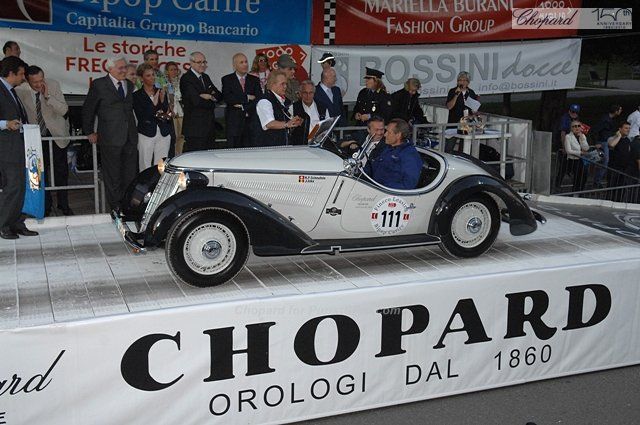
Karl-Friedrich shares his father’s hobby. Together, they have built up a collection of remarkable cars, with the son showing a preference for pre-war and post-war English and German Cars (Bentley, Ferrari, Aston Martin, Porsche… and Mini Cooper); and the father for elegant post-war sports models. It was thus obvious that Chopard would become involved in the world of classic car racing. In addition to the Mille Miglia and the Grand Prix de Monaco Historique, the brand’s commitment to Classic Racing goes back to the 1980s – and in fact even earlier, since Karl Scheufele’s grandfather was already fascinated by these finely tuned mechanisms. Historical highlights include Chopard’s participation in the Rallye des Alpes in 1993; and an unexpected race around Moscow’s Red Square in 1994.
Mille Miglia: only victory counts
Chopard and the Mille Miglia have become inseparable. The adventure stemmed from Karl and Karl-Friedrich Scheufele’s personal passion for collectors’ cars. The son discovered this particular race, and he and his father took part in the 1987 edition at the wheel of their own classic cars. A year later, Chopard became the event sponsor, a partnership that has enabled the Mille Miglia to earn an international reputation.
Rebirth of a legendary race
In May 1977, the legendary Mille Miglia race was reborn after having been interrupted in 1956. In 1984, it became an annual event in which Karl-Friedrich first took part before convincing his father to do likewise. In 1988, Karl Scheufele competed with Albert Carreras in a 300SL Mercedes with gull-wing doors; and his son drove alongside Jacky Ickx in a 1955 Ferrari Monza 750. Since then, Karl-Friedrich has taken part in the race every single year.
Only classic cars that actually took part in the Mille Miglia between 1927 and 1957 are entitled to compete in the modern-day event.
At the 2009 edition, 375 exceptional cars that have become rare items and are lovingly preserved by passionate enthusiasts lined up at the race start. The goal of the teams is to comply as closely as possible with the allotted race times while driving through the magnificent scenery of central Italy. The landscapes are indeed doubtless the reason Enzo Ferrari called the Mille Miglia “the world’s most beautiful race”.
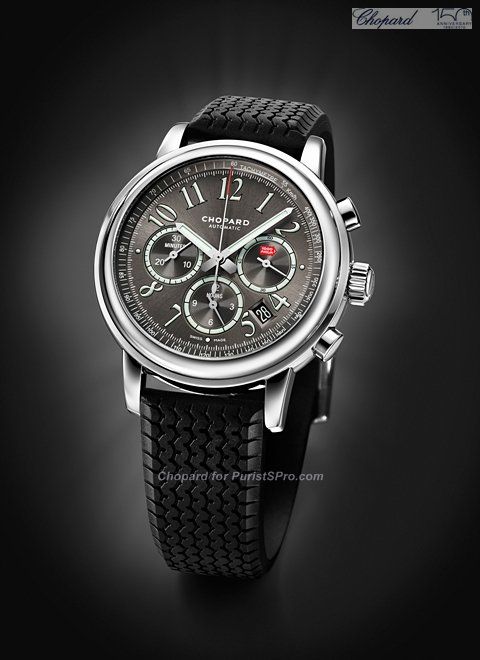
Chopard also sponsor the 1000 Millas Sport in Argentina and the Festa Mille Miglia in Japan (which was held at the foot of Mount Fuji for the first time in 1990), as well as the California Mille race in the United States.
“Whenever the Mille Miglia is mentioned, the name of Chopard immediately springs to mind. Likewise, Chopard has significantly contributed to the global renown of this race. We have never wished to be associated with a single car manufacturer. The Mille Miglia represents all of them.”
Karl-Friedrich Scheufele
Racing watches
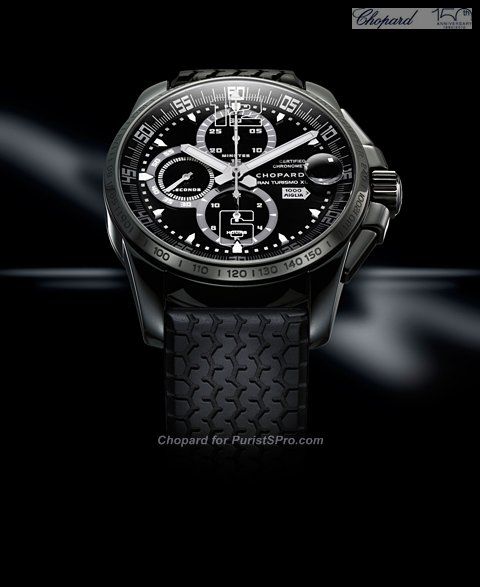
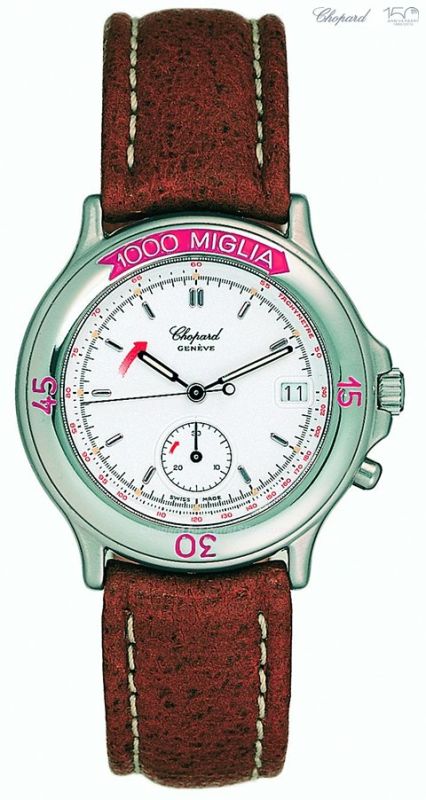
Sponsorship of this rally has given naturally given rise to the 1000 Miglia watches. For this collection, Karl-Friedrich Scheufele imagined sporting lines and an ultra-precise mechanism designed to time races, thereby giving rise in 1988 to one of Chopard’s most sought-after collections. Each year a new limited-edition model is presented, and competitors receive one engraved with their own starting number.
Grand Prix de Monaco Historique: “Gentlemen, please start your engines!”
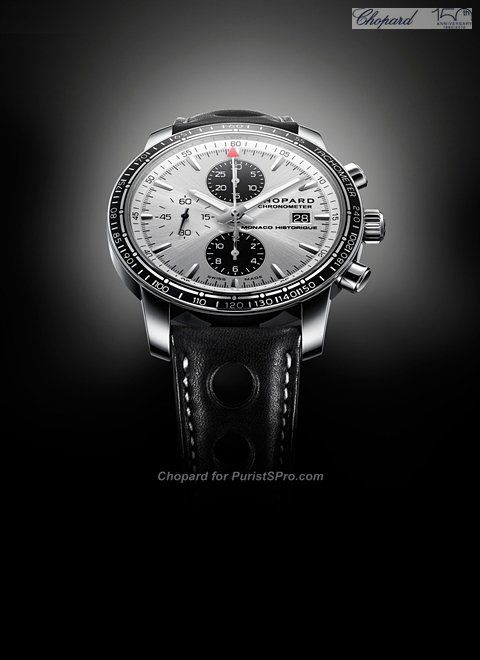
Considered as one of the most beautiful classic car races, the Grand Prix de Monaco Historique unites sports cars daring from 1926 to 1978 and divided into seven categories that compete on the Formula 1 Grand Prix circuit. First organised in 1997 to commemorate the 700th anniversary of the Grimaldi dynasty, it was intended as a one-off event. However, the enthusiasm generated by this gathering of legendary cars led the prestigious Automobile Club de Monaco to hold the race every two years. In 2002, Chopard became official timekeeper for the event, and has also developed refined and classically inspired sports watches, forming the Grand Prix de Monaco Historique collection. They are awarded to the winners of each category. Passion, emotion, stringent quality criteria and extreme precision are just four of the common denominators between the world of cars and that of watches.
Rebirth of the “Manufacture”
Watch companies that develop and produce their own movements and watches entirely in-house are a rarity.
Convinced that the company should make its own watch movements in order to honour its horological past, Karl-Friedrich Scheufele persuaded his father – and the family council – that the future lay in mechanical watches. Although somewhat dubious, Karl Scheufele allowed his son to proceed with preparations, and the project was secretly launched in 1993.
Complexity meets innovation
In order to create an original calibre, Karl-Schuefele chose the most complex path: the movement was to be equipped with a micro-rotor to ensure maximum flexibility; automatic winding in both directions to enhance reliability; a substantial power reserve; and the possibility of integrating complications. It was also to feature original execution and aesthetics. The fledgling “Manufacture” was set up in the Val-de-Travers to ensure discretion, and work on Calibre ASP 94 began in 1993. However, having proved to be far too noisy and unsuited to the desired production strategy, it was subsequently abandoned.
The final version of the new movement was presented at Christmas 2005 in the form of 20 prototypes of Calibre 1.96.
Producing excellence
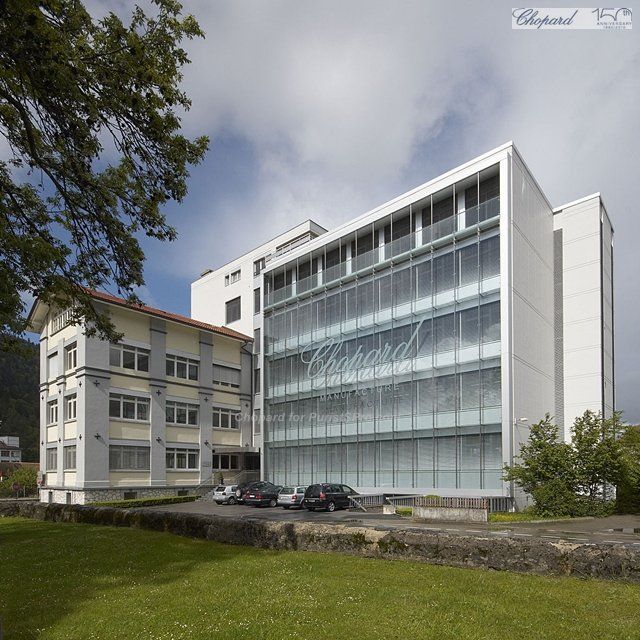
Operational testing on the new movement was conducted in Fleurier, where modest rented premises accommodated the ultra-modern production unit in 1996. As activities began to expand, the building was bought up and completely restored in 2000. From the initial dozen or so employees, the workforce in Fleurier has grown to 145 people. Over 45 million Swiss francs have been invested. In 2006, to celebrate the 10th anniversary of Chopard Manufacture, Karl-Friedrich Scheufele, an avid timepiece collector, inaugurated the L.U.CEUM, where historical watches and clocks dating from 1500 to the present day rub shoulders with models from the Chopard L.U.C collection.
(For a virtual tour of Chopard Manufacture at Fleurier, please click here.)
A new history of time
Within a few years, five different calibres were designed and produced: the L.U.C 1.96, the L.U.C 1.98 (featuring four-barrel Quattro technology); the L.U.C 1.02 (Tourbillon); the L.U.C 3.97 (Tonneau) and the L.U.C 11 CF chronograph movement. Some of them are equipped with new technologies developed by Chopard Technologies, the Chopard group research and development division.
Over the years, they have been meticulously optimised and fitted within exceptional timepieces such as:
L.U.C 1860
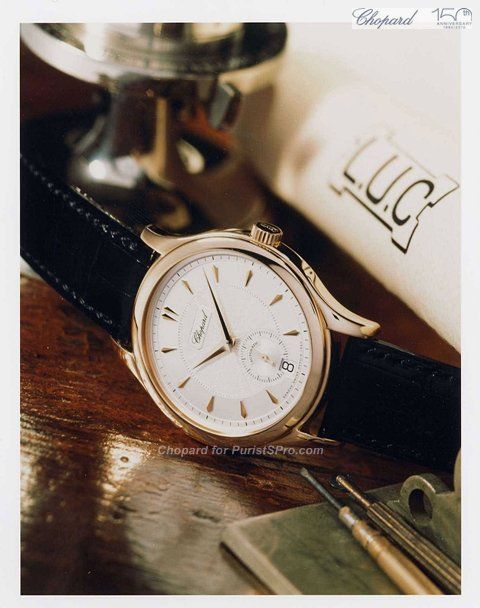
1997: the first model in the L.U.C collection, equipped with Calibre 1.96. Issued in a limited edition of 1860, this watch was voted Watch of the Year in Switzerland.
L.U.C Quattro
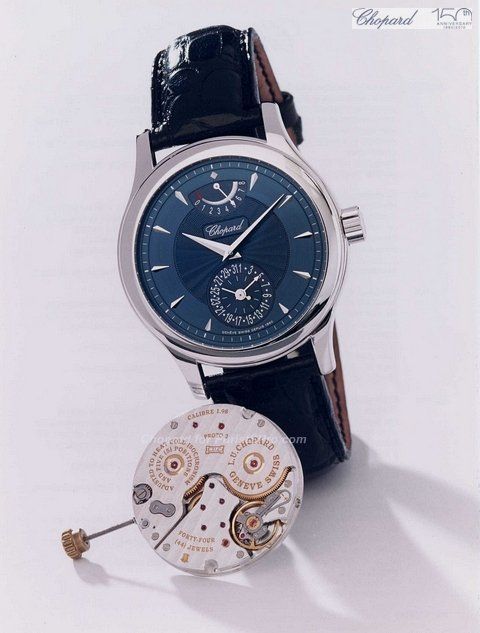
2000: an authentic patented innovation. Its four barrels (two sets of two stacked barrels) guarantee a nine-day power reserve.
L.U.C Tonneau
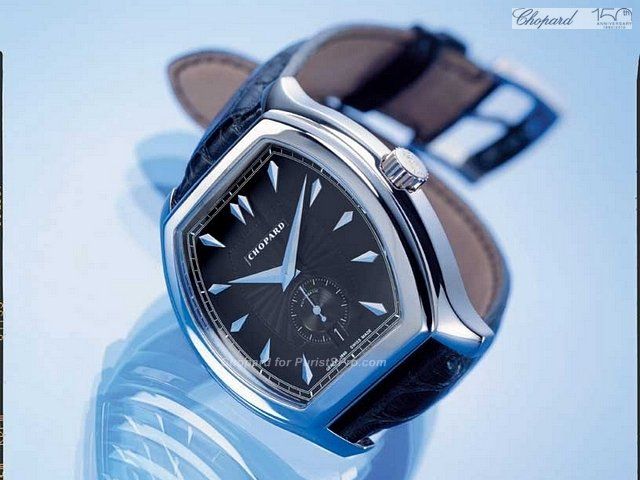
2001: featuring a tonneau shaped self-winding L.U.C 3.97 movement equipped with a micro-rotor.
L.U.C Tourbillon
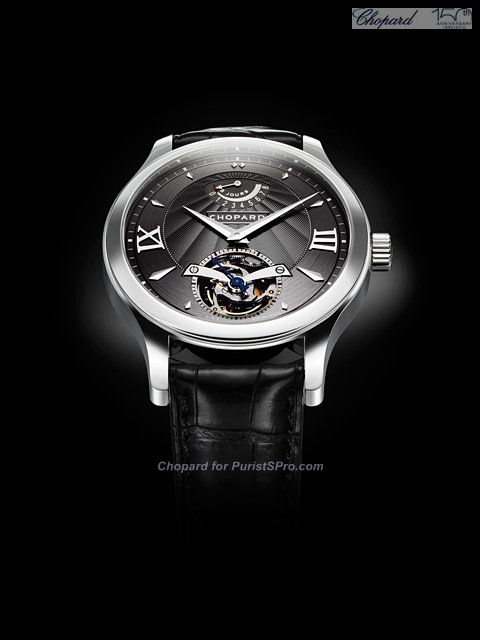
2003: by launching its own COSC-certified tourbillon movement, Chopard Manufacture earned its place in the watchmaking stratosphere. This movement boasts a series of innovative technical characteristics including the world-first Chopard-patented Variner variable-inertia balance ensuring enhanced rating precision.
L.U.C. Regulator
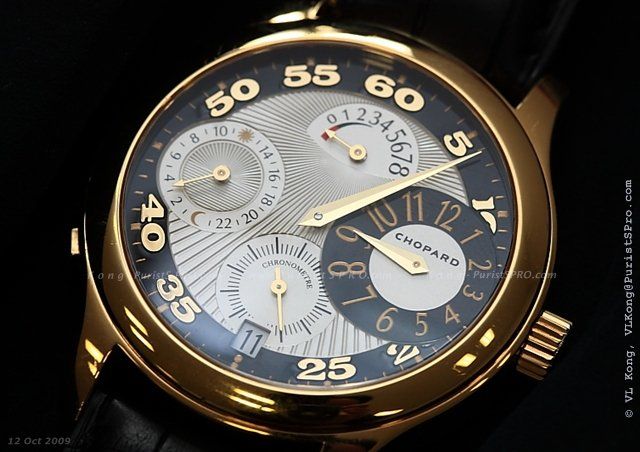
2004: a miniaturised version of the regulator clocks historically used by watchmakers to set their watches. This model with off-centred hands was voted Watch of the Year in Switzerland.
L.U.C Lunar One
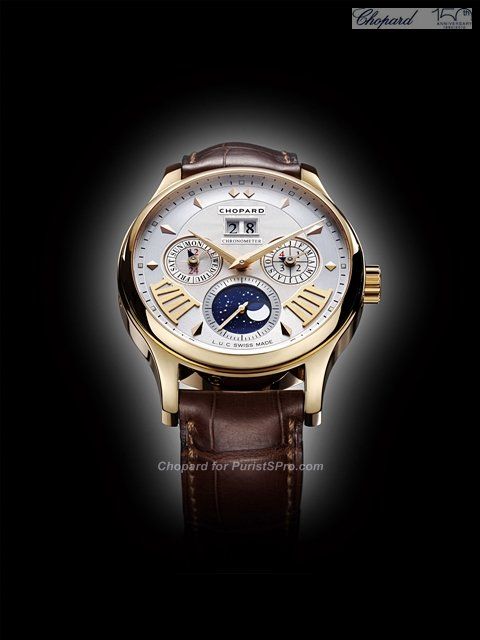
2005: perpetual calendar model with an original orbital moon-phase display, equipped with the L.U.C 96 QP movement embodied a wealth of sophisticated horological expertise.
L.U.C Chrono One
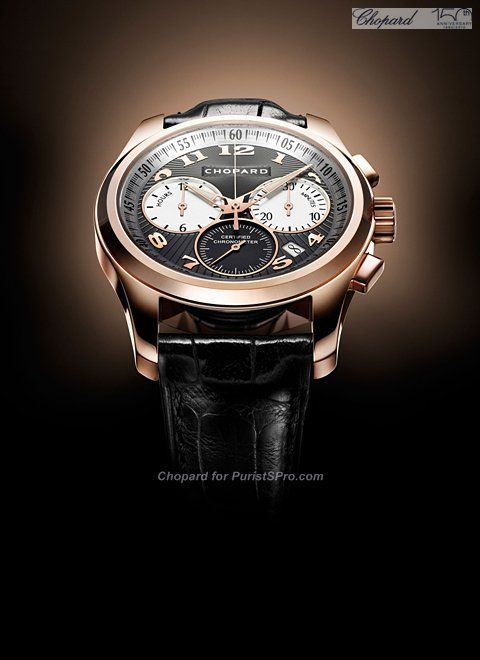
2006: presented to mark the 10th anniversary of Chopard Manufacture, this model is powered by the L.U.C 11CF calibre – the first integrated chronograph movement from the Manufacture and featuring several major patented innovations.
L.U.C XP
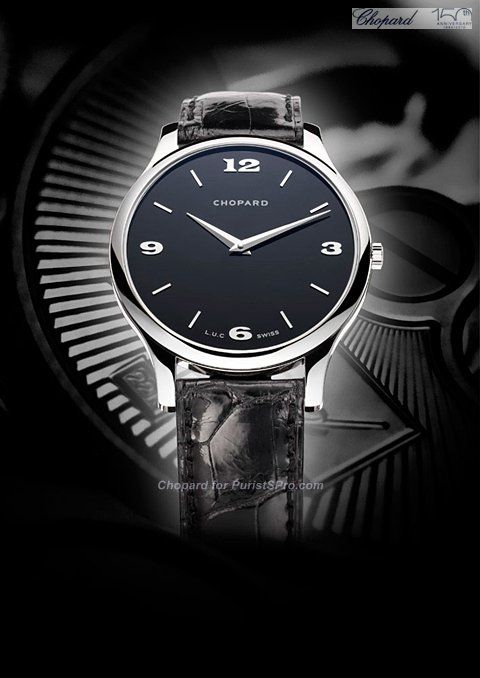
2006: the first ultra-thin watch in the L.U.C collection enshrining the principle of “Less is more…”. This model won first prize in the ultra-thin category at the Geneva Watchmaking Grand Prix.
L.U.C Twist
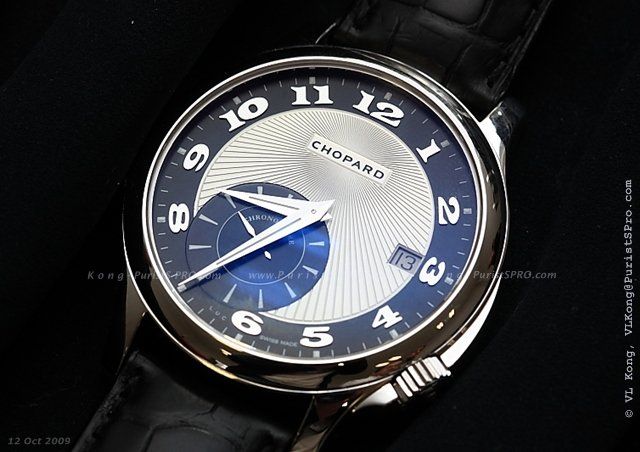
2006: this original model has an offset crown at 4 o’clock and small seconds at 7 o’clock. The off-centred crown ensures optimal comfort on the wrist.
L.U.C Strike One
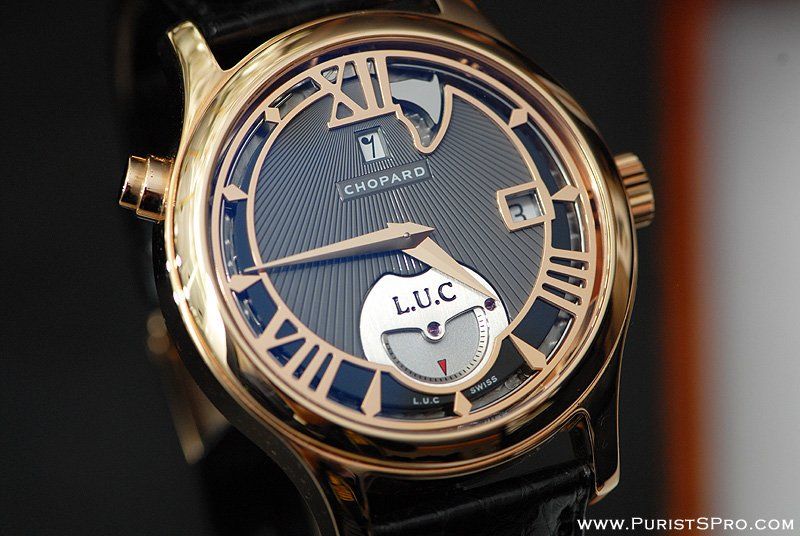
2007: the first L.U.C model automatically striking the hours in passing.
L.U.C Lunar Big Date
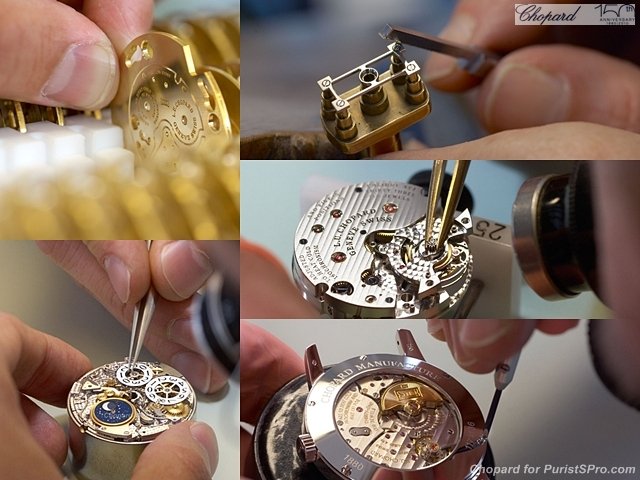
2009: model with orbital moon phase and large date.
Some of these models have been subsequently introduced in “Tech” versions, a contemporary expression of the L.U.C collection at the crossroads between tradition and avant-garde. These include the L.U.C Tourbillon Tech Twist, of which a 100-piece limited edition equipped with Chopard’s first silicon escapement was introduced in 2009.
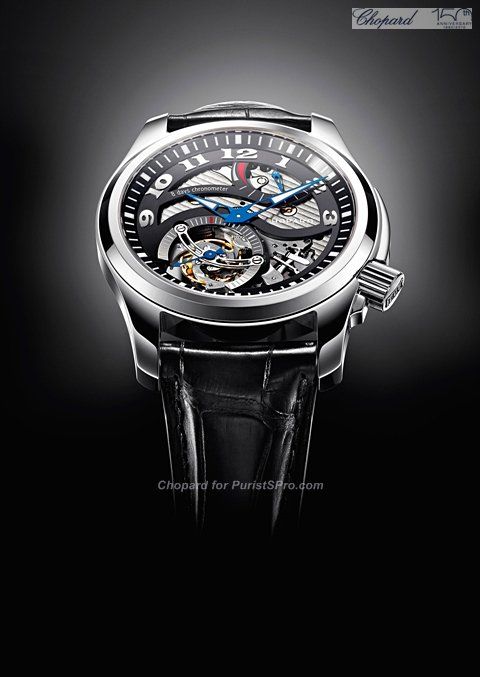
Entirely hand-crafted and decorated by expert artisans, L.U.C watches are chronometer-certified by the COSC (apart from the L.U.C XP which bears no seconds hand) and many of them also bear the prestigious Poinçon de Genève quality hallmark. Two models have also received the Fleurier Quality Foundation certification.
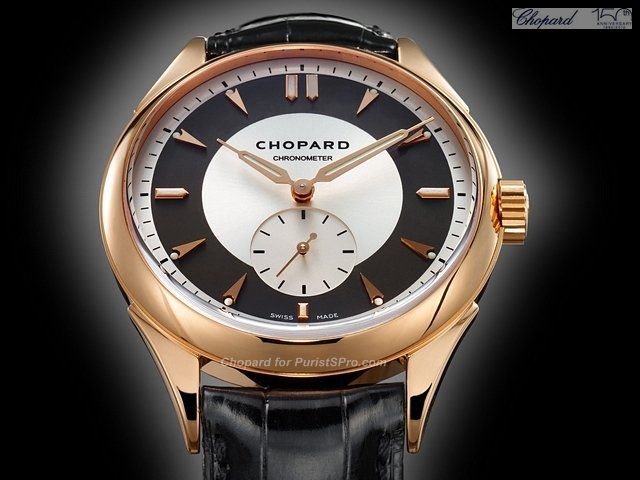
Throughout the production process conducted between the Meyrin premises and Chopard Manufacture in Fleurier, all L.U.C watches are subjected to a battery of stringent test procedures.
Thanks to these creations combining classic lines with amazing innovations, Chopard is steadily establishing its reputation in the demanding world of Haute Horlogerie.
Fleurier Ebauches: promoting freedom of movement
In keeping with its determination to achieve vertical integration, Chopard has created Fleurier Ebauches, an entity owned by the Chopard group and producing watch movements blanks in order to enhance verticalisation and increase its movement and component production.
Reinforcing vertical integration
Over the past few years, and like his father before him, Karl-Friedrich Scheufele was keen to free the company from its dependency on movement suppliers. In December 2007, Chopard invested in a 6,000m2 production site by acquiring a former industrial building located in the village of Fleurier. Chopard’s estimated 15 million Swiss franc investment in a site it has chosen to name “Fleurier Ebauches” is in fact a nod to the region’s rich watchmaking history, since the current Chopard Manufacture building at number 20 on the Rue des Moulins once housed Fleurier’s “Fabrique d’Ebauches” or movement blank factory between 1920 and 1932.
This industrial building will now host Chopard’s movement blank production activities. In July 2008, Fleurier Ebauches S.A. was officially set up as a logical complement to the existing Chopard Manufacture. Working on a more all-round, less specialised basis, it will develop and industrially manufacture movement blanks while maintaining high production and quality standards. The first “FE 151” calibre (with “FE” standing for Fleurier Ebauches) is a series-production movement that is already in an advanced testing stage. Its fundamentals were developed during the construction of the L.U.C 11 CF chronograph calibre.
The goal of Fleurier Ebauches is to supply movement blanks to the Chopard group and to thus increase the production of Chopard watches equipped with mechanical movements, particularly in the brand’s sports segment. Within the next five years, the aim is to reach a production rate of 12,000 units per year, of which two-thirds will be self-winding movements and one-third chronograph calibres.
In due course, the two Fleurier sites will be capable of accommodating two hundred employees.
The first “FE 151” movement
A self-winding three-hand calibre with instant date change and stop seconds function. Over 60-hour power reserve. Balance moment of inertia: 11.2 mg/cm2, 28,800 vibrations per hour. Movement diameter: 28.8 mm; thickness: 4.95 mm. A first batch of “FE 151” calibres has successfully earned the “Chronofiable” certification (three weeks of tests involving an accelerated ageing process).
The Scheufele family regards serving just and noble causes as a natural duty. Building on its success, Chopard devotes its talent and its reputation to the most vulnerable members of society. The company has been involved for many years now in a number of patronage activities covering a variety of fields including medicine, ecology, art and culture. The José Carreras Leukaemia Foundation, the Elton John AIDS Foundation and The Prince’s Foundation are all dedicated to improving the well-being of others.
“When you’re lucky enough to lead a charmed life, it is only right to help those for whom life is a trial.” Caroline Gruosi-Scheufele
Fondation José Carreras contre la leucémie : funding research.
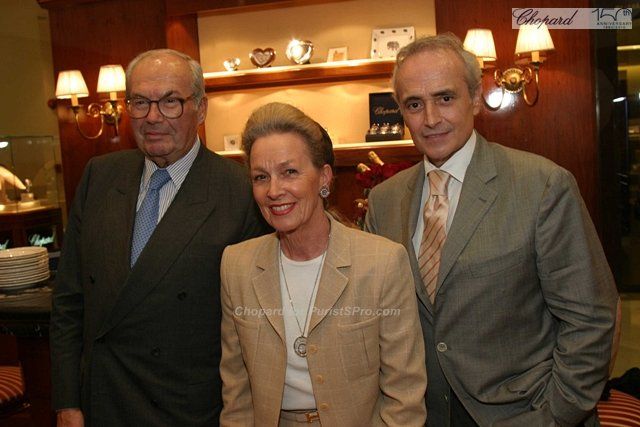
In 1987, after having been struck by leukaemia and successfully cured, José Carreras created the José Carreras International Leukaemia Foundation.
As friends of José Carreras, the Scheufele family has chosen to support the charity organisation and its Swiss-based Fondation José Carreras contre la leucémie, by creating limited series designed to help fund research. The first Wiener Staatsoper series was launched in 1996, followed by the Deutsche Staatsoper in 1997, and in 2000 by the Grand teatro del Liceu model equipped with the L.U.C 3.96 movement. To celebrate the tenor’s 50th birthday in 2008, Chopard issued the L.U.C XP the 50th anniversary of José Carreras Edition.
Elton John AIDS Foundation: time to fight AIDS
Having first met Sir Elton John at the Cannes Film Festival in 2000, Caroline Gruosi-Scheufele designed a collection reflecting the singer’s flamboyant style and designed to help his foundation in fighting AIDS. The models are all issued in limited steel or gold editions paved with precious stones.
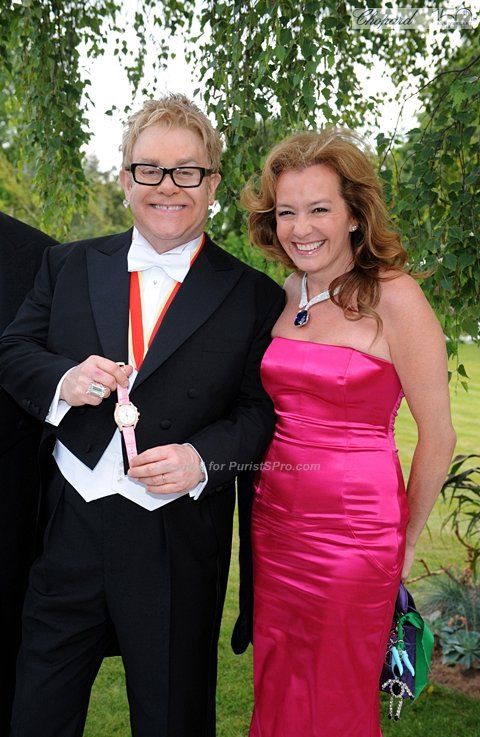
As part of its support for this cause, Chopard sponsors Elton John’s Oscar Viewing Party held in Hollywood each February, and has been partnering the annual White Tie and Tiara Ball in Windsor since 2002.
“These timepieces are a wonderful way of directly supporting the Elton John AIDS Foundation and of raising the money required to fund our projects around the world. I cannot thank Chopard enough for its unfailing assistance over the past few years.”
Sir Elton John.
“I have always admired Elton John, who is an incomparable artist as well as a dedicated watch and jewellery collector. Over the years, I have come to know both the person and the artist, and we have established a deep friendship. The chronographs we have imagined together vividly reflect his personality and his generosity.” Caroline Gruosi-Scheufele
The Prince’s Foundation: the jeweller of stars supports a princely cause
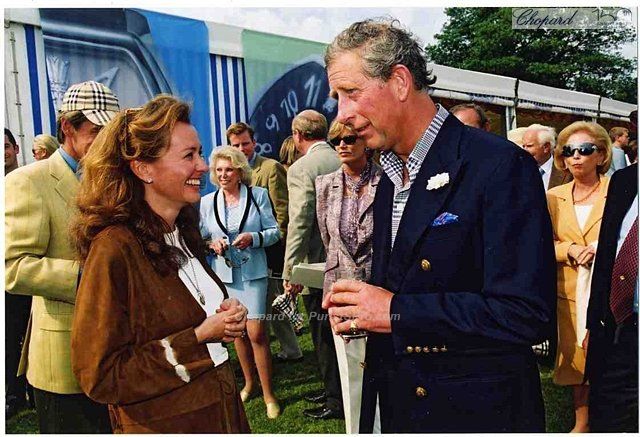
On June 13th 1998, during a polo tournament in Windsor that was disrupted by heavy rain, Caroline Gruosi-Scheufele crossed paths with Prince Charles; they agreed to work together on behalf of The Prince’s Foundation. Chopard created a watch named The Prince’s Foundation: a large tonneau-shaped model with curving sides, powered by a L.U.C movement. The prince’s coat-of-arms tops the dial at 12 o’clock and the name of his foundation is engraved on the case-back.
Chopard milestones
1836: May 4, birth of Louis-Ulysse Chopard in Sonvilier, in the Swiss Jura.
1859: Birth of Paul-Louis, son of Louis-Ulysse Chopard
1860: 24 year-old Louis-Ulysse Chopard founds a high-precision watch manufacture specialising in pocket-watches and chronometers, in Sonvilier, Switzerland,
August 6, 1877: Birth of Karl Gotthilf Scheufele in Pforzheim, Germany.
1904: Founding of the “Karl Scheufele” brand specialising in jewellery watches distributed under the name Eszeha.
1912: Louis-Ulysse Chopard travels to Russia through Poland, Hungary and the Baltic States. Tsar Nicolas II becomes a client.
Karl Scheufele I invents the clip-watch
1913: First ever advertising campaign for Chopard, referred to as “Fabrique de montres L.U.C L.-U- Chopard, maison fondée en 1860”.
1921: Paul-Louis Chopard, who has taken over the family firm, opens a subsidiary company in La Chaux-de-Fonds.
1925: Karl Scheufele I sends his son Karl Scheufele II to New York for two years with 50 dollars in his pocket.
1937: Chopard relocates to Geneva.
1930-1940: Chopard has around 150 employees making pocket-watches and precision wristwatches.
1942: Karl Scheufele II succeeds his father.
1943: Paul-André Chopard, son of Paul-Louis, takes over the Chopard company.
1958: Karl Scheufele III revives Eszeha after a tough period for the company.
1963: Paul-André Chopard sells Chopard to Karl Scheufele III.
1968: Paul-André Chopard dies on October 14.
1972: Launch of the Belle Epoque collection.
Chopard wins the Golden Rose of Baden-Baden for the Améthyste watch.
1973: Chopard wins the Golden Rose of Baden-Bdaen for the Pasodoble watch.
1974: The company moves from the centre of Geneva to the new Meyrin-Geneva site.
1975: Creation of a first subsidiary company, “Chopard France”.
1976: Creation of the first Happy Diamonds watch.
Chopard wins the Golden Rose of Baden-Baden for the Happy Diamonds and Cascade watches.
Chopard wins the Diamond International Awards for the Concorde watch.
Creation of the American subsidiary company: “Chopard Watch Corporation “.
1980: Launch of the first sports watch: St. Moritz.
1983: Launch of the Monte Carlo collection.
Opening of the first Chopard boutique in Hong Kong.
1985: Launch of the Alta Moda collection for Chopard’s 125th anniversary.
1985: Creation of the Happy Diamonds Clown, the start of jewellery-making at Chopard.
Karl-Friedrich and Caroline Scheufele are appointed vice-presidents of the Chopard group.
1986: Launch of the Gstaad collection.
1988: Start of the partnership between Chopard and the Mille Miglia, the legendary classic car rally in Italy. Chopard creates the 1000 Miglia sports watch collection.
1989: Opening of Chopard’s first European boutique, in Vienna.
1990: Launch of the Casmir collection.
1993: Launch of the Happy Sport collection.
1994: Launch of the La Strada and Impériale collections.
1996: The company returns to its roots and founds a watch manufacturing company in Fleurier, in the Swiss Jura, dedicated to the production of mechanical L.U.C movements.
Creation of watches on behalf of the Geneva-based affiliate of José Carreras International Leukaemia Foundation, the Fondation José Carreas pour la Lutte contre la Leucémie.
1997: The first L.U.C 1860 watch, equipped with a L.U.C 1.96 movement, is voted “Watch of the Year” by the Swiss Montres Passion/Uhrenwelt magazine.
Creation of the world’s most expensive watch at the time, Chopardissimo.
1998: Chopard becomes official partner of the Cannes Film Festival and Caroline Gruosi-Scheufele redesigns the Palme d’Or, from now on crafted in the Chopard workshops.
Launch of La Vie en Rose collection.
1999: Launch of the Pushkin and Ice Cube collections.
Partnership with the Prince’s Foundation founded by the Prince of Wales.
2000: Presentation of the world-first L.U.C Quattro watch, equipped with a L.U.C 1.98 movement featuring four barrels (two sets of two stacked barrels, patented L.U.C Quattro® technology), endowing the watch with a 9-day power reserve.
2001: Launch of the L.U.C Tonneau model, equipped with the first tonneau-shaped self-winding movement (L.U.C 3.97), fitted with an off-centred micro-rotor.
Creation of the Chopard Trophy at the Cannes Film Festival
Caroline and Karl-Friedrich Scheufele become co-presidents of Chopard.
2002: Presentation of a new jewellery concept with the launch of the Golden Diamonds collection.
Chopard becomes official timekeeper of the prestigious Grand Prix de Monaco Historique, a classic car race held in Monte Carlo.
Launch of the Elton John watch collection on behalf of the Elton John AIDS Foundation.
2003: Presentation of the first L.U.C Tourbillon model, a major technological accomplishment in the field of fine watchmaking.
Launch of the new Happy Spirit collection.
Creation of a line of Jacky Ickx watches.
2004: Presentation in Baselworld of the L.U.C. Regulator watch, which wins the “Watch of the Year” prize awarded by the Swiss magazine Montres Passion/Uhrenwelt.
2005: Presentation of the L.U.C Lunar One watch, driven by mechanical self-winding L.U.C 96 QP movement, featuring perpetual calendar and orbital moon-phase functions.
Launch of the Haute Joaillerie Copacabana collection.
2006: Presentation of the L.U.C Chrono One watch, the first chronograph in the L.U.C collection equipped with Calibre 10CF, to celebrate the 10th anniversary of the Chopard Manufacture.
Inauguration of the L.U.CEUM in Fleurier.
2007 : Launch of the Two O Ten watch collection.
Inauguration of the new flagship boutique in New York, featuring the new interior design concept, and presentation of the eponymous collection 709 Madison.
Introduction of the first Haute Joaillerie Red Carpet collection dedicated to the Cannes Film Festival.
Founding of the Japanese subsidiary company, “Chopard Japan Ltd”.
2008 : Launch of the new Elton John chronograph collection in Moscow.
“Best Training Company Prize” in the “Applied Arts” category awarded by the State of Geneva and honouring Chopard’s long-term commitment to the field of training and education.
Creation of the Fleurier Ebauches SA company.
2009: Baselworld presentation of the L.UC Tourbillon Tech Twist watch equipped with a silicon escapement.
Presentation of a high-frequency (10 Hertz) escapement developed by Chopard Technologies.
Inauguration of a new flagship boutique in Singapore reflecting the new interior design concept.
2010: Celebration of Chopard’s 150th anniversary.
This message has been edited by Kong on 2010-03-21 18:38:05 This message has been edited by Kong on 2010-03-21 19:04:56 This message has been edited by MTF on 2010-04-07 07:12:58
Chopard's 150th Anniversary (1860-2010) , A Relook

Will see if ....


I very much enjoyed this post, Kong!

may be getting old, now always enjoy reading history...

A glorious and history-rich company!

Thanks Kong for a historical tour of Chopard
Wow! Thanks Ed for the pic ...
Yes, she has a matching happy diamonds...
Have a look at this year interesting 150th collection...

Very successful brand...