Service
Marco (mkt33) embarks on an ambitious journey to restore a vintage WWII Vetta Chronograph featuring a Valjoux Caliber 22 movement. His 'Thirst for Knowledge' series documents the intricate process of bringing this historical timepiece back to life, offering a detailed account for aspiring watchmakers and enthusiasts.


It's no surprise Stefano loves mechanical watches. He is a sound mechanical engineer with a passion for his work. As soon as we discovered our common interest in watches, he started talking about this watch he got from his father long ago. It's easy to understand how big a treasure he feels it is. So I learned about the time in which his father was a war prisoner in 1943, and how this watch was used to measure sentry duties. At last he brought me the watch, no longer running, to see what could be done for it. That happened in March 2008, one year ago.
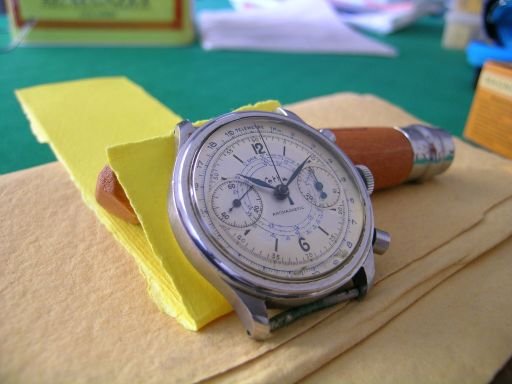
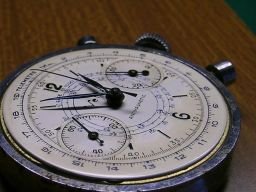
Well, I knew it would have been a good watch, but I was not prepared to such a beauty.
A 1940 chronograph, and maybe even older, is something you may have heard of, something you could have read about on books, but certainly it's not something you can handle or look at on a daily basis.
This Vetta isn't small even by today's standards, I can barely imagine what could it look like in the '40s. It should have been quite an expensive watch, even if the steel of its case speaks of war, when gold was needed for less fancy things than making a watch.
|
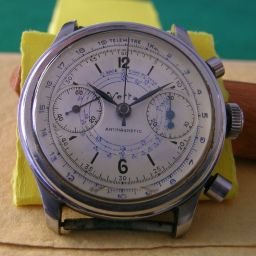 |
Apparently, the dial have been restored – many years ago, in an era in which watchmakers were readily available and knew their job – and have been likely regularly serviced for years before being left in a drawer just to be worn on special occasions. More signs of restoration are found in the two smaller hands. Looking at the small seconds hand, it's easy to spot that it's much longer than its subdial's chapter. Looking at its color, some doubt arise on the minute accumulator hand too (the one with a big counterweight).
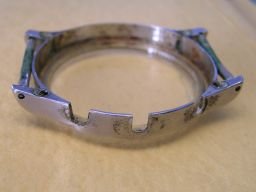
This watch features a two-part case, so when the heavily tilted screws on the back are removed you need to gently push with your fingers on the crown and buttons – having care not to push too much – and the upper part is out. De Carle, see reference, describes this very case in chapter "water-resistant cases".
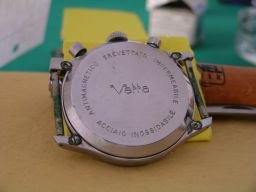
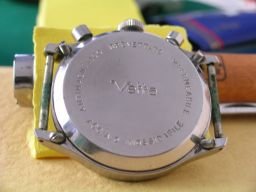
It took me a while to figure how to get to the movement. Finding how to remove a split stem is never easy – especially on a watch this old, with no manuals available and the constant fear to break something.
This kind of split-stem is described by De Carle, see reference, as 'snap-on'. He puts it simple writing that you just need to carefully pull the stem out by gripping the crown with ordinary cutting nippers. In this case A. I didn't know it was a snap-on stem and, B. would you have the guts to try this on such an old watch? Rust, for instance, may had found its way through the stem making it prone to break.
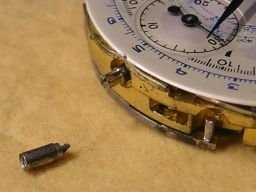
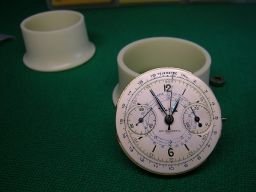
Eventually I found a small dent on the dial near the crown. Looking from above, the stem is clearly visible. So I put the blade of a 0.8mm screwdriver perpendicular to the stem, acting as a brake, and carefully unscrewed the crown. It worked! When I first looked at the movement I felt quite surprised ...but more about that in a while.
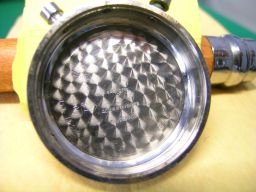
Even if I was prepared to that, the perlage applied on the inside of the caseback made me smile like a child looking at a new toy.
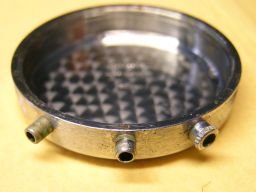
As expected, I found lots of watchmakers' signatures on the caseback. This is a good sign of care for the watch. One of them clearly reports 1957. Stefano later confirmed that the watch had not been serviced in decades, so 1957 is likely the year of its last overhaul. I wonder what do lubricants look like after 50+ years.
The pushers are quite different each other. The start pusher appears to be replaced. Similarly to the crown stem, the reset pusher is split in two parts. And it's broken. Only some stubborn dirt was keeping the pusher from falling away.
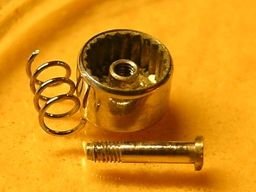
The case, showing different tubes for the two pushers |

The non-original pusher (start/stop) |

Broken part of the original pusher (reset) |
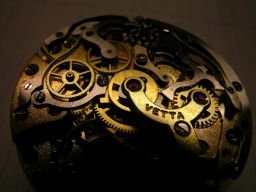
Some dust apart, the movement looks like perfect. Almost no stain on the steel levers, brilliant gilt bridges, screw heads in decent condition (though some better than others). It may not be finished to the finest standard, but I find it appealing indeed.
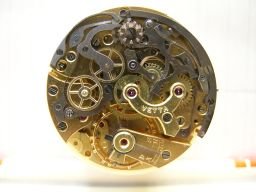 |
|
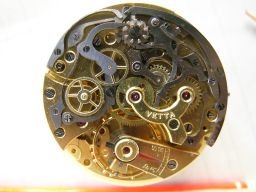
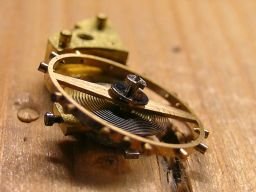
There's no shock absorbing device on the balance jewels (Incabloc had yet to come) and there are some unjeweled holes, though apparently still in good condition.
So far I have a broken chrono pusher and two small cracks on the crystal. And more troubles for sure are waiting round the corner.
As soon as I dismount the balance cock, it appears clear why the watch is not running. The balance staff is broken both at the upper and lower pivot tips, evident result of a jolt.
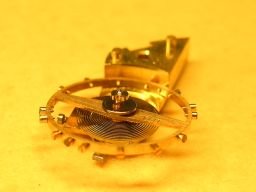
Making a new staff is far beyond my skill. Replacement parts are no longer available so the only chance is to find something used or new old stock. That won't be easy.
I'm also worried about where do the broken tips are. They may be stuck somewhere in the movement and this is not a good thing at all.
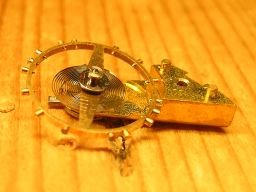
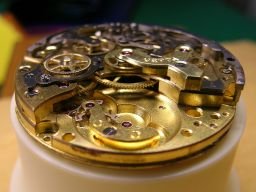
Despite the broken staff, the balance moves when put dial down (well, at least it tries to do so, at a poor amplitude and with lots of sideshake) so chances there are that the rest of the movement is still fine.
Another issue arises. The dart (guard pin) on the pallet fork is badly bent, but that's a fix I could handle.
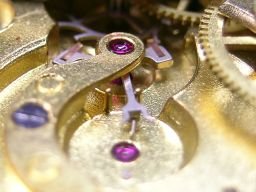
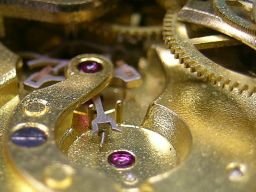
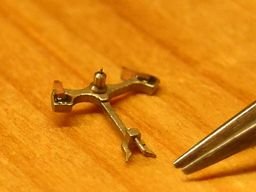
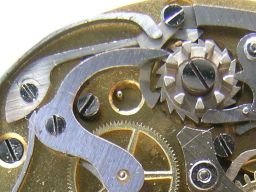
The face of the entry pallet jewel is lightly chipped on a corner, but it seems to have little influence on the impulse, if any. Both the run to the banking (draw) and the depth of locking are symmetrical. The drop on either stone is secure, no skipping observed on a complete revolution of the escape wheel (I've made two actually, just in case...)
I can't find the click and the watch is fully wound. Granted I don't want the pallet fork to fly away into the hyperspace, so I have to find some way to keep the movement from discharging at full speed – possibly damaging something else. The barrel is partially exposed on the movement side, but I don't want to put my thumb on it. Eventually I end up dismounting the pallet cock while gently braking the fourth wheel with a toothpick.
Immediately after that, an article from Mark Headrick came to my mind. "The click is under the hour clutch lever" explains Headrick speaking of a Valjoux 72. There it was, even in this Valjoux 22, the little pin at the very center of the picture below, at the left of the column wheel. Good to know there's such a lot of information on the internet... ;-)
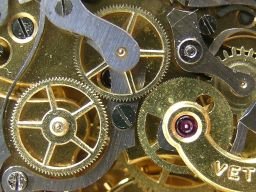
Now that the mainspring is unwound and the balance is removed, I can check the power train. I test the train by giving the winding stem half a turn. The train moves freely for several seconds before stopping. A gentle tap and it starts again, keeping in motion for a few more seconds. This could be caused by a lack of grease in the barrel, giving an unsmooth torque supply from the mainspring. But maybe this is simply due to friction induced by old dried lubricants or dirt in a jewel hole. I note that the pallet stops on the exit pallet almost every time I repeat the test but, alas, I'm not knowledgeable enough to comment on this.
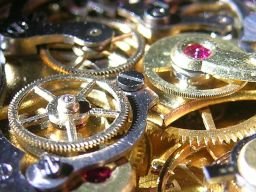

I find the gears wonderful, even if the finish may not be top-notch. The chrono gears do not feature the usual epicycloidal/hypocycloidal teeth shape found in a wheel/pinion coupling. Instead they feature fine triangular teeth to ensure a smoother chrono engagement and to reduce those annoying 'bumps' transmitted to the chrono seconds hand.
One of the things that make watches so interesting to me is that they are made to last. In a world where everything new, becomes old in months, and useless in years, it's a joy to spend time on something still appealing and – potentially – working after seven decades.
However, I'm not skilled enough to even start thinking about repairing this amazing product of watchmaking craftsmanship.
So the watch lied on my desk for weeks, awaiting to tick again.
But Stefano kept searching for replacement parts over and over. A new movement, a new balance, a new staff. And I continued my readings, article after article, book after book. Anything that could help us.
This message has been edited by mkt33 on 2009-05-12 06:06:21 This message has been edited by mkt33 on 2009-05-13 16:30:00Weapons For The Challenge At last Stefano found a set of three original N.O.S. Valjoux 22 balance staffs. We were ready to go. I made a knowledge on staking tools. Learned about punches and stakes, their diameter, their use. I spent days searching for the right tool on internet auctions and watchmaking shops. I even considered buying a specialized tool, the Platax, just for removing the old staff. The Platax, actually much smaller than it seems in this picture, is a highly specialized (priced ac
Wonderful reading. Love the watch and the report. Good job! /// Christian
nt
No message body
A huge thanks for taking the time to write it and to show all those wonderful photos.
...well written, well laid-out, excellent photographs. An inspiring read. Thank you very much.
This thread is active on the Independents forum with 13 replies. Share your knowledge with fellow collectors.
Join the Discussion →