
Manufacture
DonCorson offers an exclusive sneak preview of Peter Speake-Marin's groundbreaking in-house caliber, the SM2, detailing its design philosophy and technical specifications. This report provides early insights into a movement conceived with robustness, repairability, and watchmaker accessibility at its core, marking a significant milestone for the independent brand.


Sneak Preview – The Speake-Marin caliber SM2
Don Corson, 30.10.2008
Yesterday I had the pleasure to visit Peter Speake-Marin in his workshop to get a first view of his new caliber the SM2, a caliber that he will be successively introducing in his watch models beginning next year.
To start, the vital statistics:
- Diameter 32.6mm
- Height: 6.2mm
- Bidirectional automatic winding
- 29 jewels
- Hours, minutes and center seconds
Peter let himself be influenced by the calibers that he was most impressed by during his years in watch repair and restoring in England. Robust calibers that never wear out. Calibers that can be repaired if necessary with reasonable means. Calibers that are conceived with the needs of the watchmaker in mind, with access and visibility of all the parts to allow easy and precise adjustments. A simple 3-hand caliber of the very highest quality and accuracy. This was the kind of caliber he set out to make. He has succeeded.
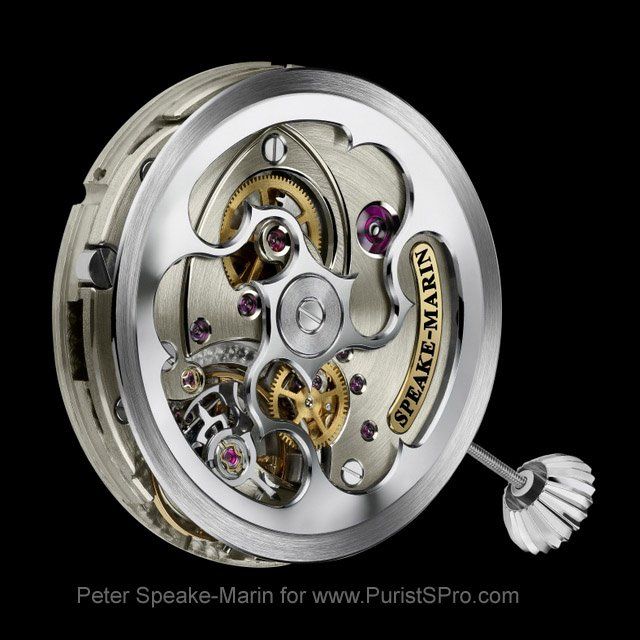
Above we see the completed movement with Peter's signature the winding rotor. Below we will take a look deeper inside to get a better idea of all that is happening unseen inside.
Please note that although I did not take these pictures, I did see these movements and these parts. This is not a phantom, but reality in the metal.
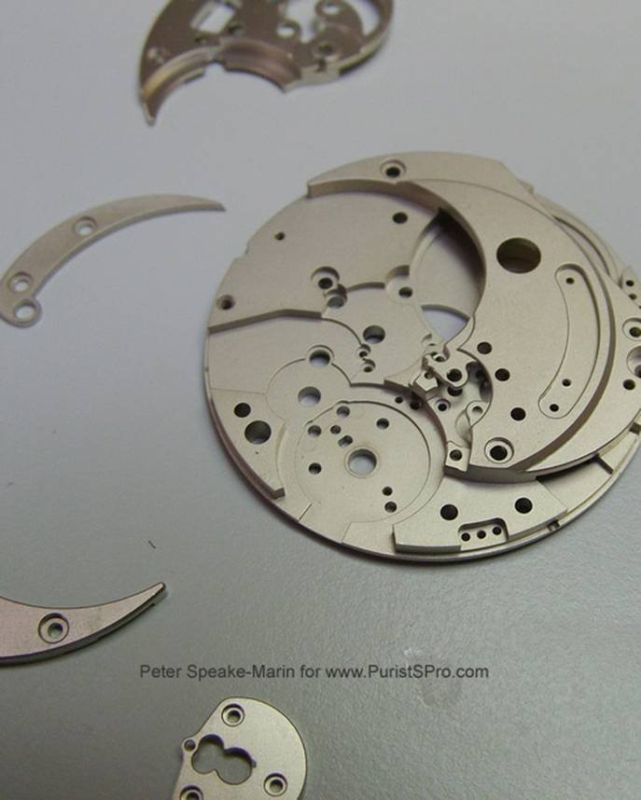
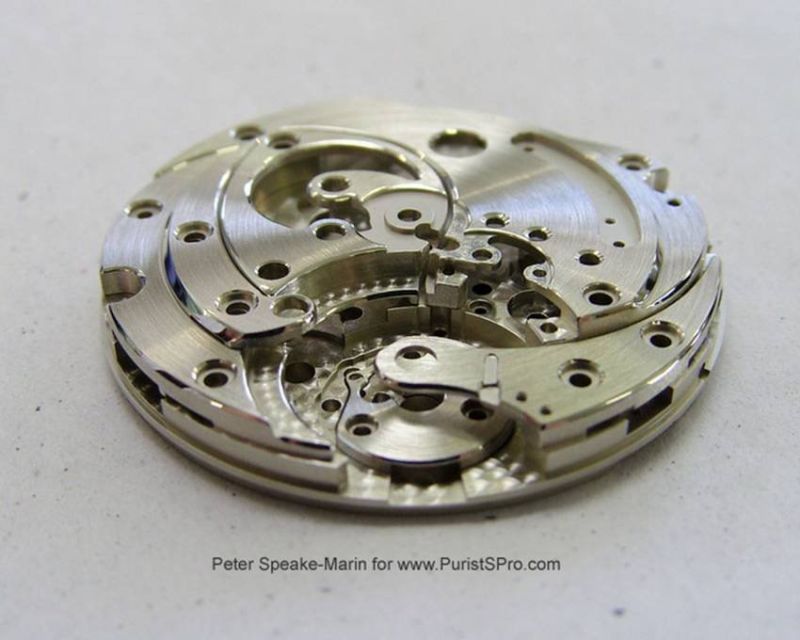
The movement is made of german silver, maillechort. After machining the pieces are deburred using micro-sandblasting which leaves the surface quality shown above. We see the plate and portions of the escape, train and anchor bridges. The barrel bridge is on its place on the plate.
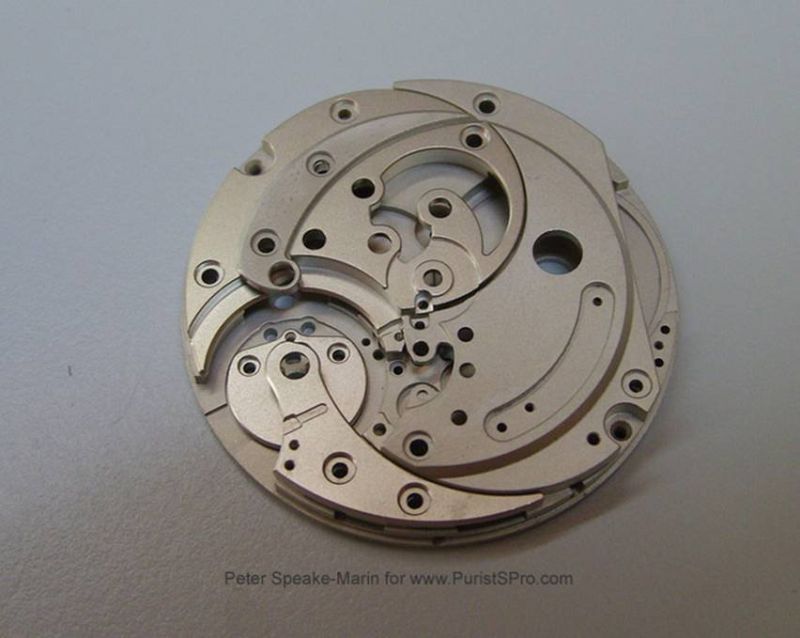
Here is the rough movement with all the bridges in place.
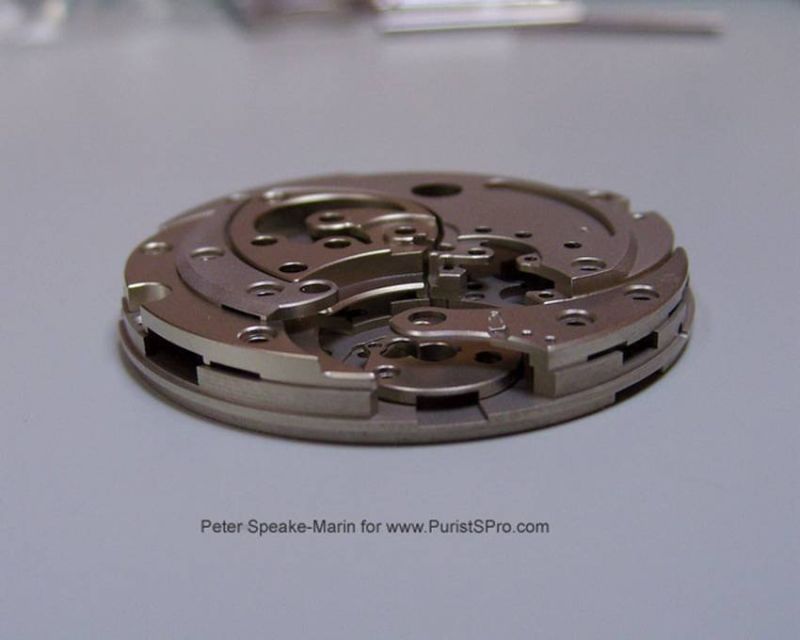
The movement has a great feeling of depth, a massiveness in witness of its designed robustness.
Here the same pieces after decoration. For the decoration Peter has taken his queue from his own "Foundation watch". Cerclage with polished bevels, the internal surfaces and dial side are finished with spotting.
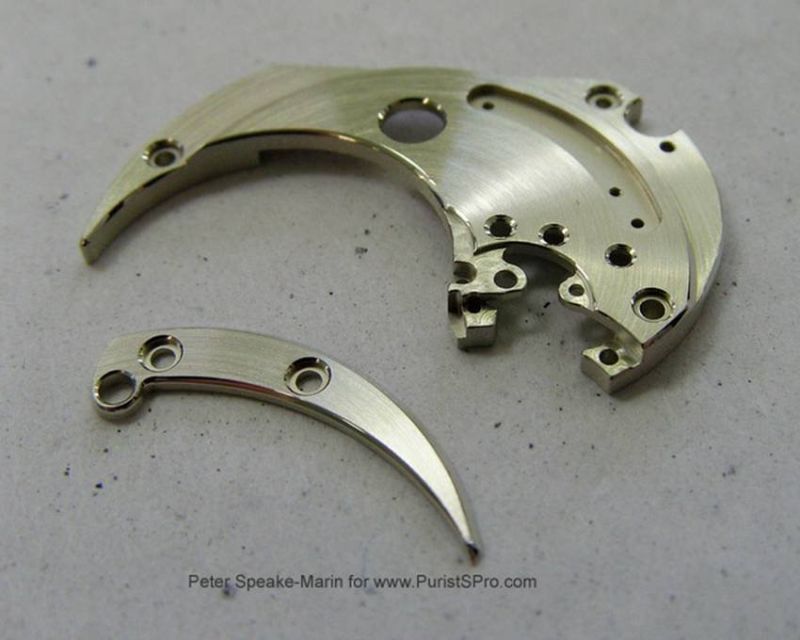
The barrel and escape bridges.
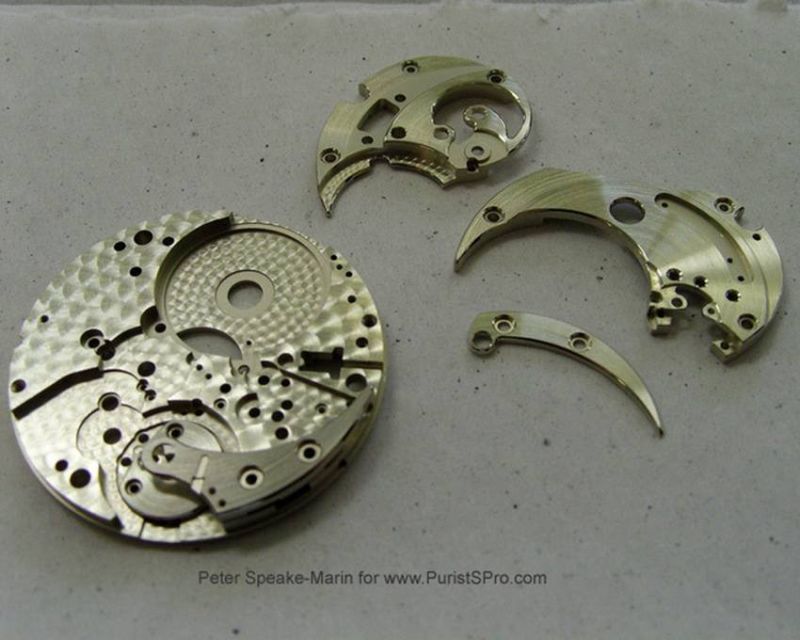
The finished plate, barrel bridge, train bridge and escape bridge. The anchor and balance bridges are mounted. The escape wheel bridge is mounted on the main train bridge and can be removed separately to allow the escapement to be removed with out dismantling the whole train, when it is removed a window appears that has been machined in the lower bridge to aid assembly and control of the wheels underneath.
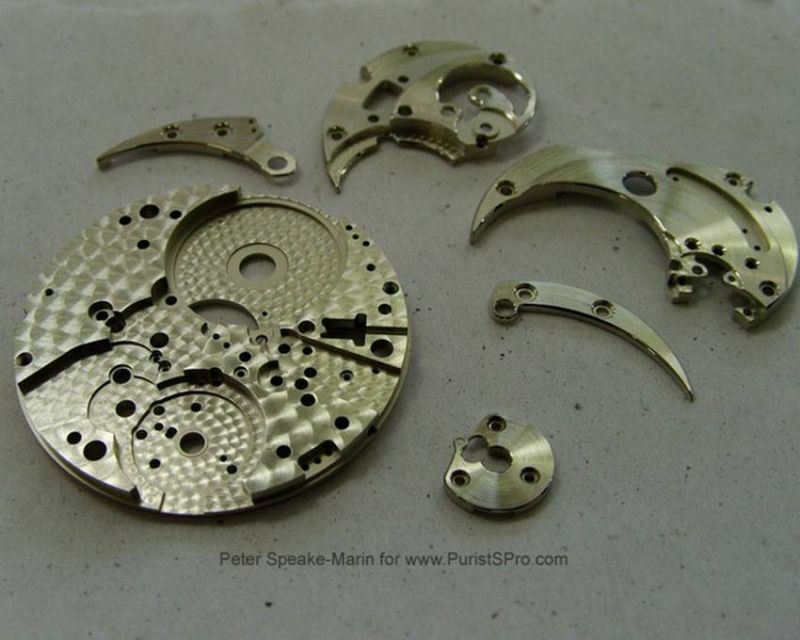
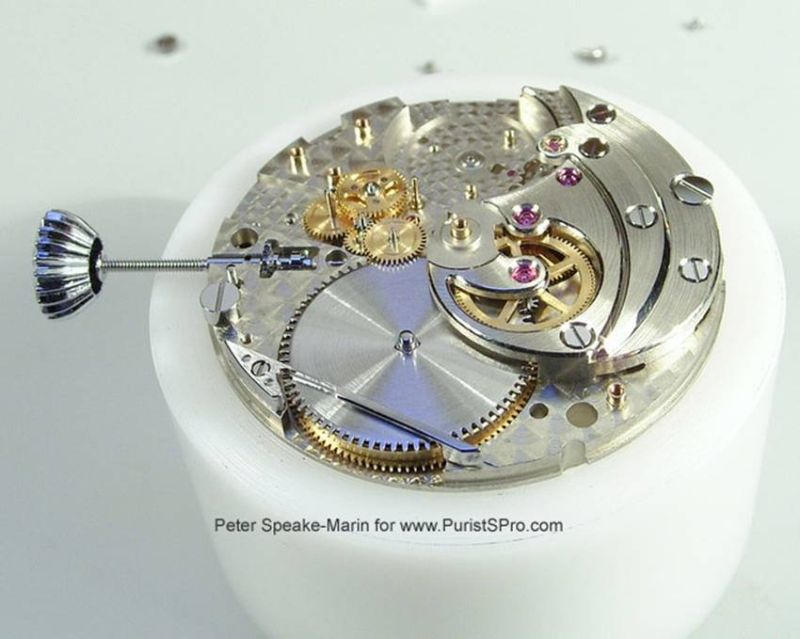
The bridges are positioned by the threaded inserts, pieds-vis, that the bridge screws screw into. The two pieds-vis for the balance bridge are seen at the top left here. This system assures maximum rigidity and positioning accuracy for the bridges. An added measure to assure robustness is that the bridges are all held with at least 2 screws, the train bridge with 4!
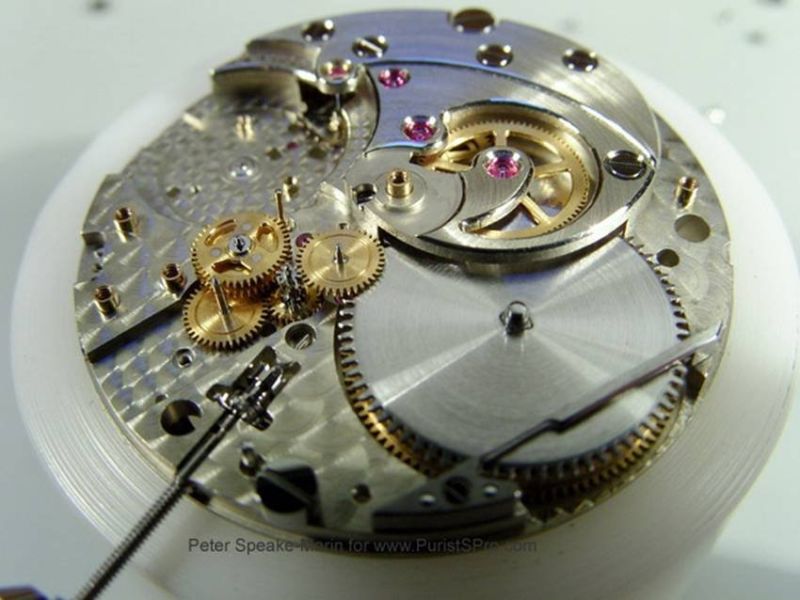
Here we can see the gearing for the automatic winding. The reversers bi-directional system is made of 19 components and ensure every movement of the rotor is transmitted into the barrel. The gear teeth in the reversers are not symmetrical. They are made so that they will work perfectly turning in one direction, but block when turning in the other. Between the high tooth count of the internal driving pinion and the threefold symmetry of the blocking gears an absolute minimal hysteresis has been achieved to assure maximum winding efficiency. The large barrel assures an autonomy of approximately 80 hours.
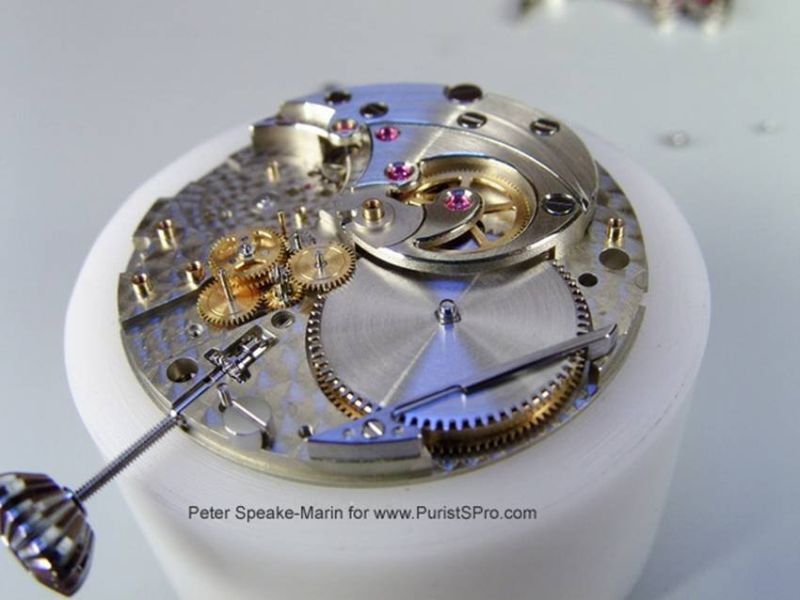
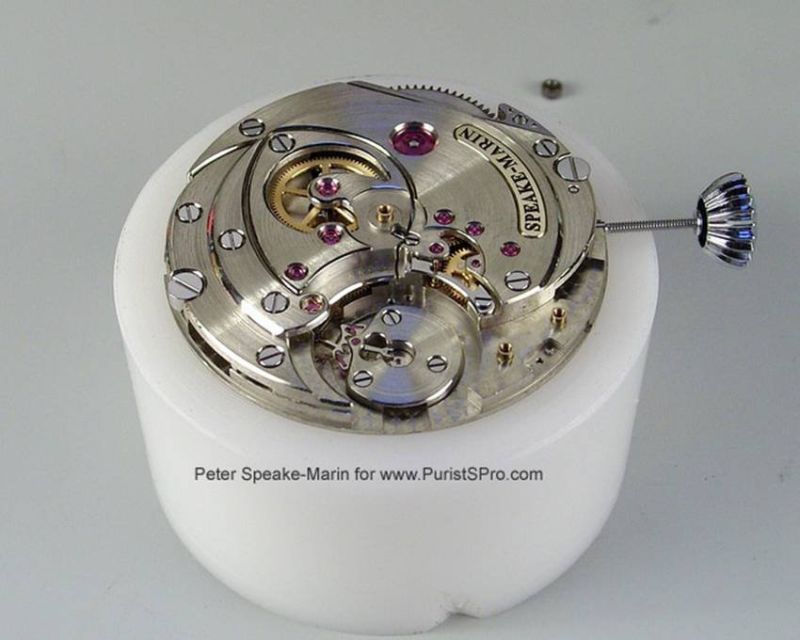
The anchor bridge is seen here in the foreground. The bridge is massively thick and held by three screws to assure absolute stability and robustness , the balance cock is also held by two screws again for rigidity of design. The movement is not plated, but retains the warm sheen of the natural maillechort. The surfaces are brushed circularly, all the angles polished by hand.
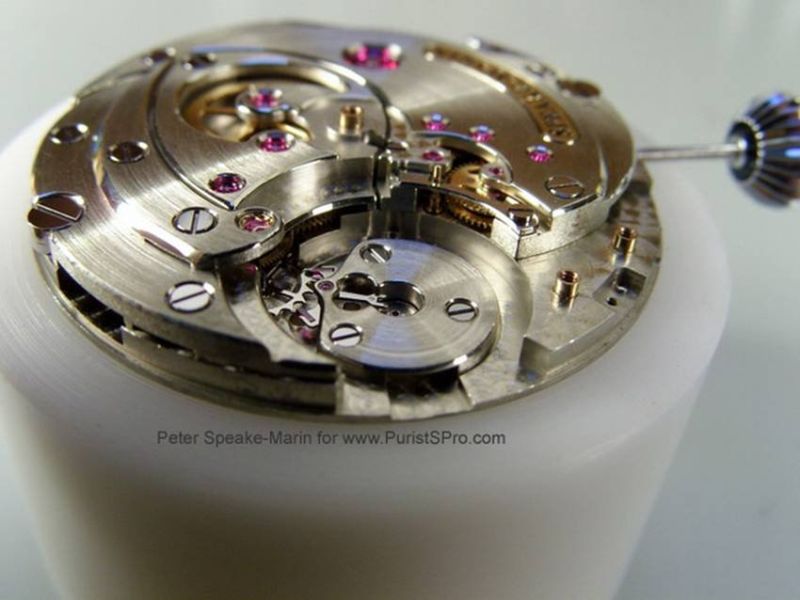
The opening window between the plate and the bridge at the left is an aid for the watchmaker allowing inspection of the going train , as is the low section around the balance to allow the watchmaker to view adjust the balance with ease.
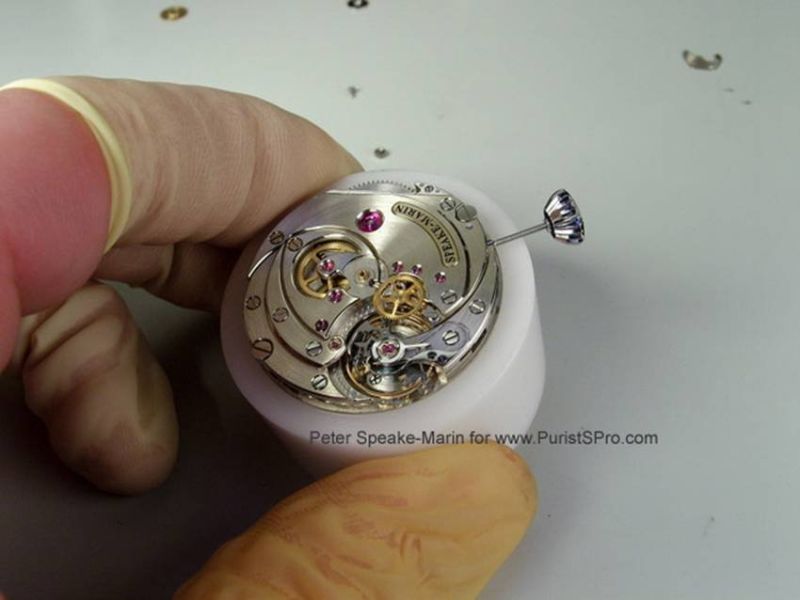
The number of large screw heads seen is witness to the robustness of the movement.
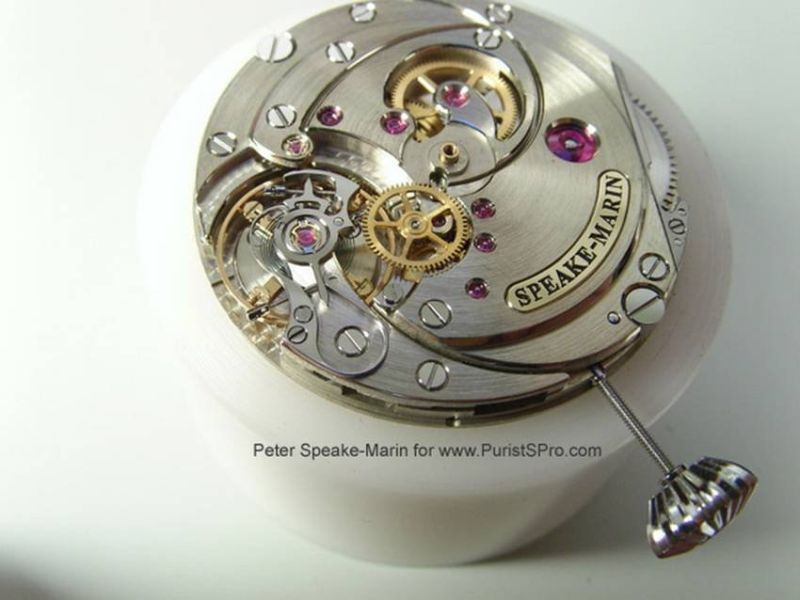
The wheel at the top of the movement transfers the rotor movement to the reversing system.
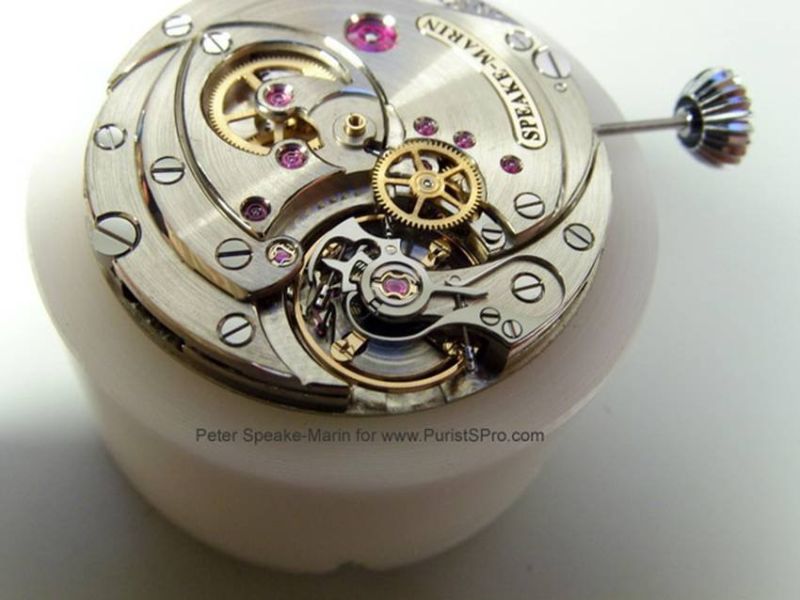
The regulation system is a double swan's neck integrated in one piece. Micro-threaded screws allow adjusting both the beat and the timing. The masslots on the glucydur chronometer style balance are to add mass and are not actively used for regulation.
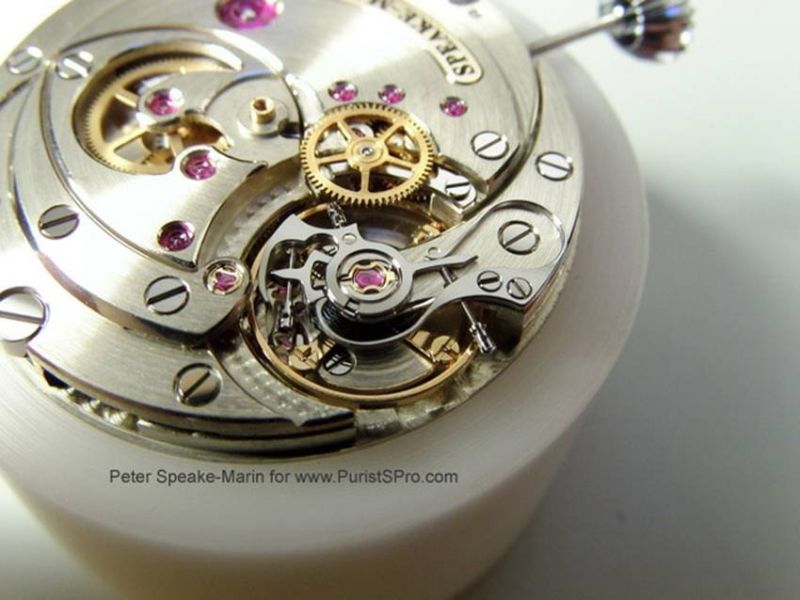
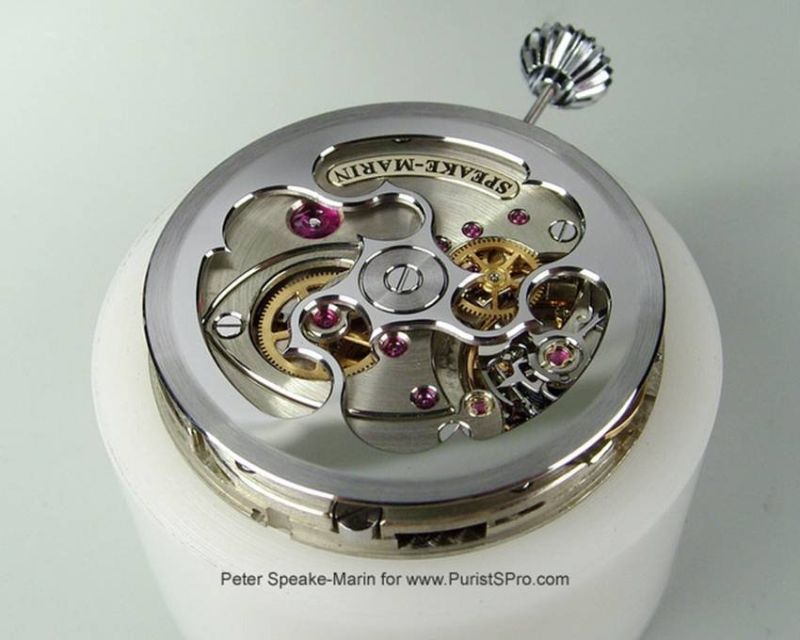
Finally the automatic rotor of brushed steel with hand polished angling is mounted. As Peter told me, the tungsten used in the rotor weight is the only portion of the movement that is sourced from his native England.
Now that we have seen the movement some more details:
- Frequency 21600 v/h
- Shock protection incabloc & kiff
- Power reserve 80 hours
- Single barrel
- Number of jewels 29
- Total number of components 211
- Weight of balance 0118gr inertia 25mg.cm2
- Material of bridges/main plate German silver
- Chronometer balance with masslots and breguet over coil.
- Movement assembled by hand
- All bridges, levers and mainplate finished by hand, circling, spotting and polished.
- The rotor wheel angles are hand finished then the surface is mirror finished.
- All pivots burnished and Breguet overcoil lifted by hand
This SM2 movement will be replacing the FW2012 movement in Speake-Marin watches during the year 2009. The pre-series of 20 have all ready been in part pre-sold and will be delivered starting in January, most equipped with anadditional Quantième Pérpetuel module, and will be made in Titanium and Gold cases.
I think this is great news from the Speake-Marin shop and wish Peter and his team in Rolle great success with this new caliber.
Don
This message has been edited by AnthonyTsai on 2008-10-30 21:54:16
I like that bridge arrangement. What does the screw above the pallet wheel do? I see the swanneck regulation screw but the screw adjustment above the pallet wheel is a mystery to me. Well designed caliber. Nice growth path for a tourbillon and power for additional modules. Love the look of that rotor. DaveB
Don, Thanks for the update and also to Peter for the details. Hong Kong and China fans can meet with Peter when he visits Hong Kong 11th November 2008. I have a point of order: " The movement is made of german silver - maillechort." Swiss watchmakers contend that german silver is NOT maillechort. At least the ones in Vallée de Joux do...... Regards, MTF
This thread is active on the Independents forum with 17 replies. Share your knowledge with fellow collectors.
Join the Discussion →