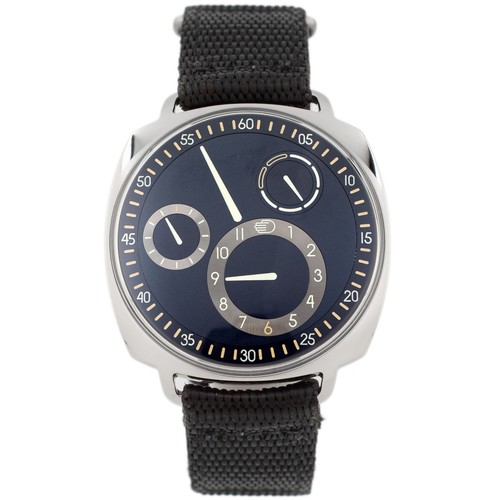
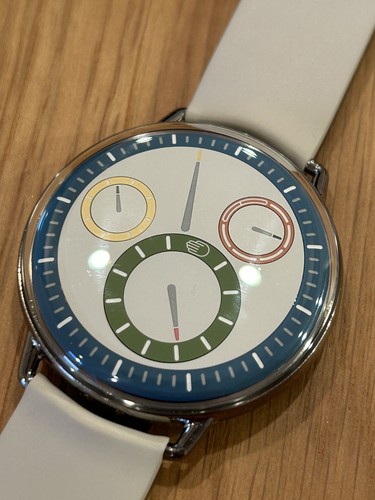
foversta provides a comprehensive hands-on review of the Ressence Type 5, exploring its innovative design as both a diver's watch and a technological evolution of the Type 3. This article highlights how Ressence leverages oil-filled chambers to achieve unparalleled legibility underwater and enhance the movement's efficiency. Readers will gain insight into the brand's commitment to pushing horological boundaries while maintaining wearability and distinctive aesthetics.
There are several ways of grasping the new Ressence Type 5. It can be considered as the first diver watch of the brand or as an evolution of the Type 3. I perceive it more as the outcome, as the logical conclusion of the advanced technology and the characteristics of the Type 3. In fact, I have the feeling that Benoît Mintiens reached the place to where he wanted to go with the Type 5, much like the Type 1 was the end of the development phase initiated with the Type 100x.
Of course, the Type 5 is presented as a diver watch with a waterproofness of 10 ATM. It is also the first mechanical diver watch fully legible under water and that, whatever the viewing angle. But I more analyse it as a truly versatile watch incorporating the best of Ressence innovation capabilities. If I had to highlight one point, it would be its wearing comfort and the fluidity of its lines that allow it to maintain a certain elegance in all circumstances. And here lies the prowess: this watch, which meets the requirements of the ISO 6425 standard, is absolutely not a "highly protected" transformation of the Type 3 and thus a thicker version of the latter. It takes advantage of the key element of the Type 3, oil, to improve its performance while keeping the typical style of Ressence.
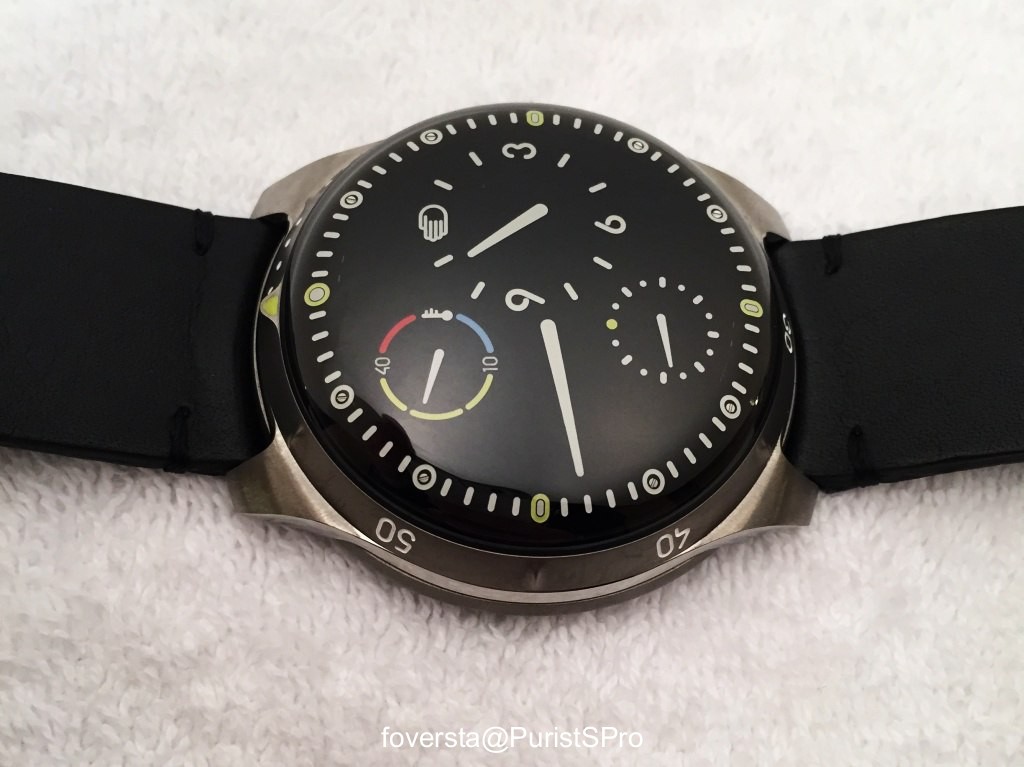
Having said that, the Type 5 is inspired from the construction of the Type 3: the case incorporates two sealed chambers, the top one being filled with 37,5 ml of oil. In the context of the Type 3, oil's main objectives are to optimize the energy of the movement and to improve the legibility by offering a spectacular dial opening. We only need to look at the location of the peripheral date display to consider that the full available surface is used. Oil plays an additional role in the Type 5. Of course, its asset remains the legibility and it is even amplified when the effects of luminescence come in. The watch becomes spectacular as the light elements also benefit from the shape of the dial and the domed sapphire crystal to stand out even more clearly.
Similar to the Type 3, the fact to make the display system immersed in the oil bath, and thus to ensure a permanent lubrication, reduces wear effects and especially controls energy consumption. Since it is less required, the basic movement, the modified ETA 2824 caliber whose sole purpose is to power the display system through the minutes axis still delivers a 36 hour power reserve despite the complexity of the module . A remarkable performance.
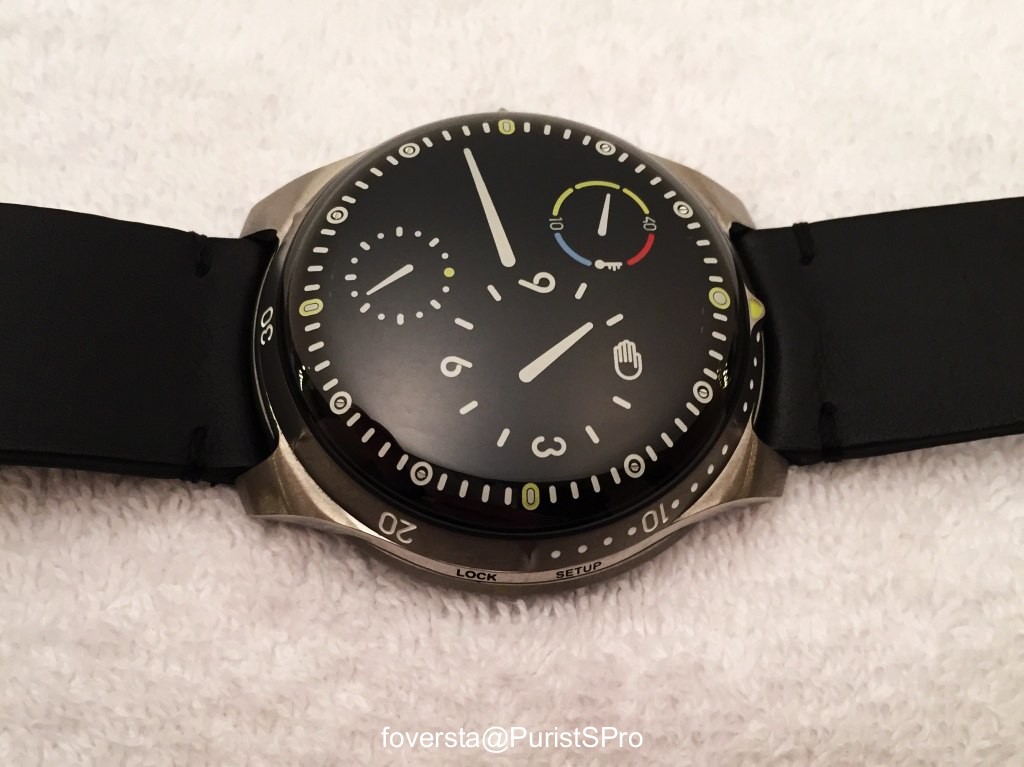
But the big novelty about oil is the use of its physical properties. The 37.5 ml of liquid compensates for the underwater pressure and allow Ressence to use for the Type 5 a light structure based on a titanium grade 5 case and a glass with a normal thickness. This notion of glass thickness is fundamental. Do not forget its shape and its ability to encompass the dial. If it was much thicker, the visual rendering would not have been made the same and the watch would have been a bit "clumsy".
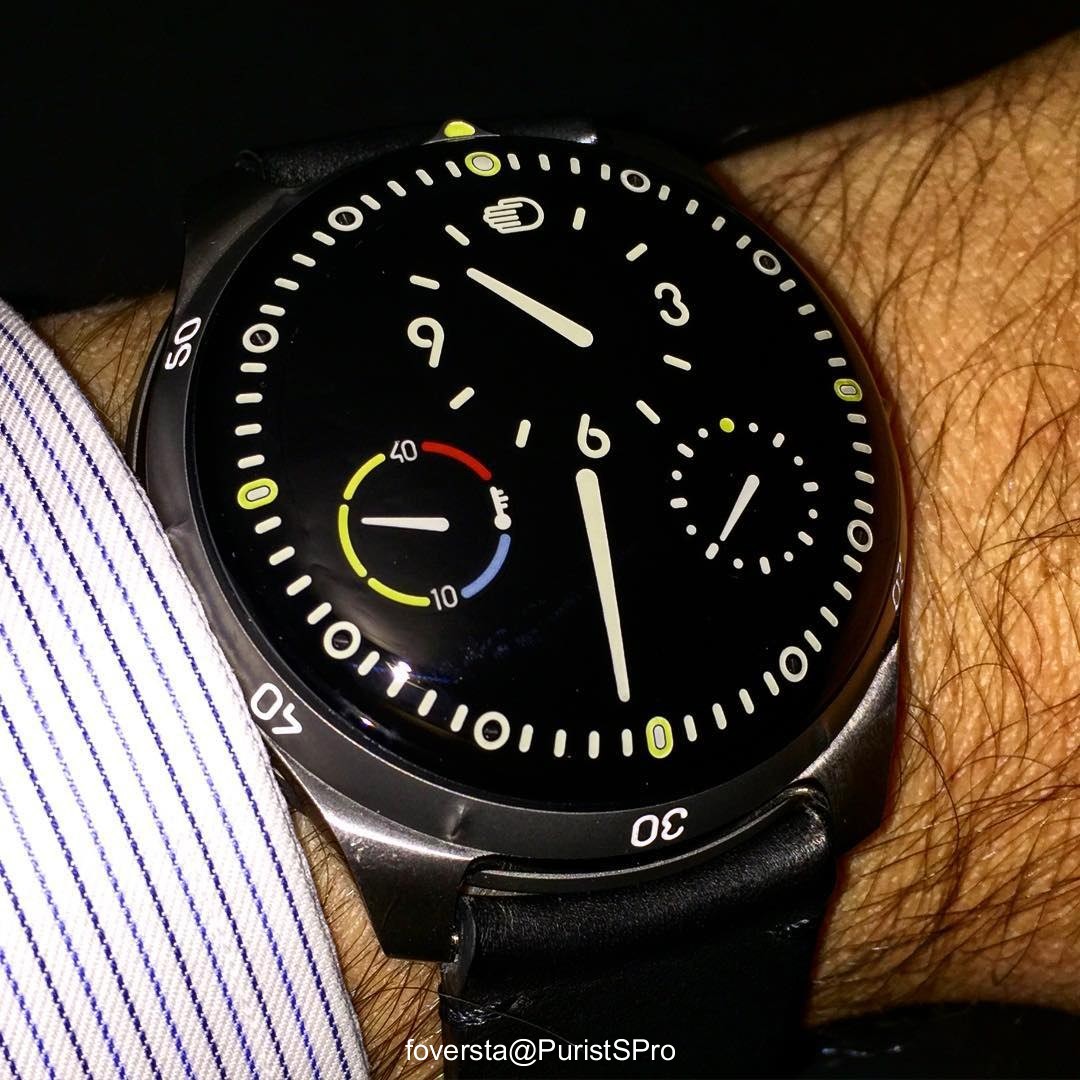
The dial layout of the Type 5 is different from that of the Type 3. The watch loses two functions: the peripheral date display which is replaced by the unidirectional rotating bezel and the indicator of the days of the week, unnecessary in the context of a diver watch. This withdrawal of the second function hides in fact another purpose: it sets the indicator that the watch is running on a much larger disk than the Type 3. The second hand, which does a full rotation in 90 seconds is indeed crucial for a diver watch because at any time its owner must be sure that it actually works.
The oil temperature indicator uses a similarly sized disk to that of the second hand while the main disk remains the hours one. All these discs are positioned on the rotating base dedicated to the minutes display. Like the Type 3, the display system, the ROCS 5 - Ressence Orbital Convex System, is based on the minutes. Minute drive the other discs in the permanent revolution and that is why only the axis of the ETA 2824 caliber minutes is maintained. The principle is ingenious and effective.
Like any Ressence watch from the current collection, the Type 5 has no crown. The reason is primarily aesthetic and as Benoît Mintiens reminds it, the target was to design a watch which had to get rid of this interface to obtain clean lines and a handling experience in direct contact with the object. For a diver watch, the removal of the crown brings an advantage: a weak point that requires special processing to preserve the waterproofness no longer exists. However, the Type 5 required the development of a new caseback. Indeed, the time setting is always done in the same way by turning this back. But for obvious reasons of safety and sealing, this back is protected against an untimely move through the RCLS, the Ressence Compression Lock System, that locks it (lock) or releases it (set) for the time setting. By manipulating the caseback, disks perform their rotations through a magnetic transmission to set the time.
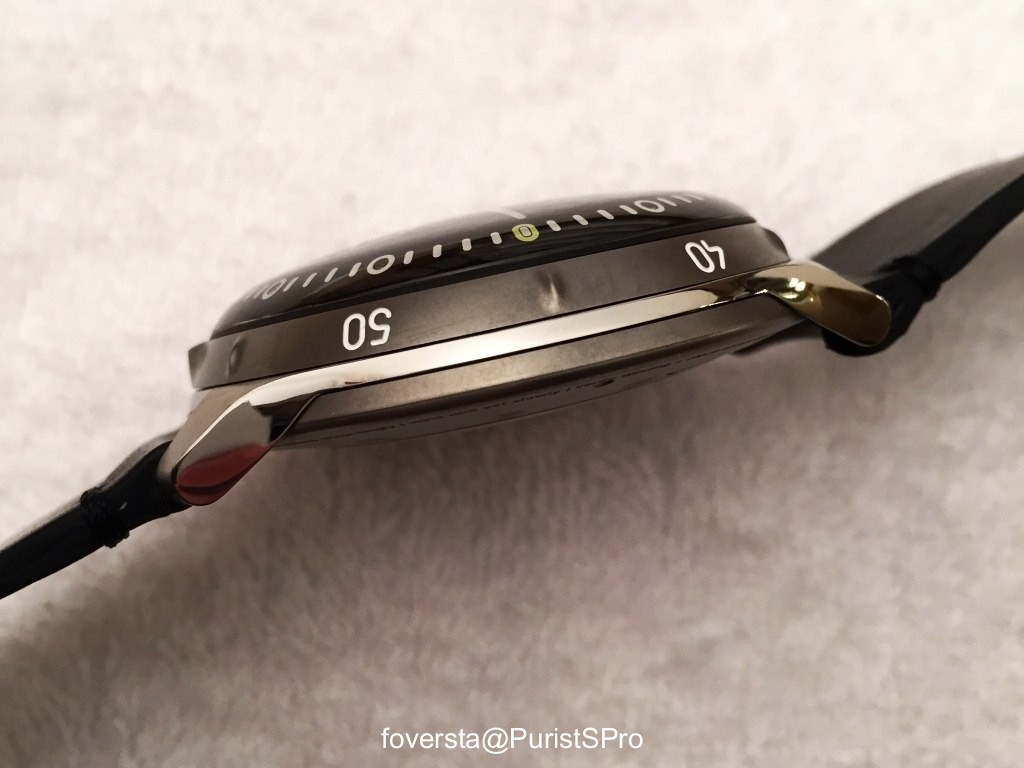
All such ingenuity would have been much useless if the Type 5 was unwearable or uncomfortable. And I speak now about what I like the most in this watch: its case. Inspired by the shape of a sea turtle, it offers curved lines, at the same time smooth and dynamic. I love how the bezel and the case base create a kind of crystal extension and the short and curved lugs. But the detail that I particularly appreciate is how the bezel was designed. The subtle prominences make its handling easier while fitting perfectly into the design. They almost look like small scales and the visual effect is successful. They bring some asperities in the main curves and energize the overall design.
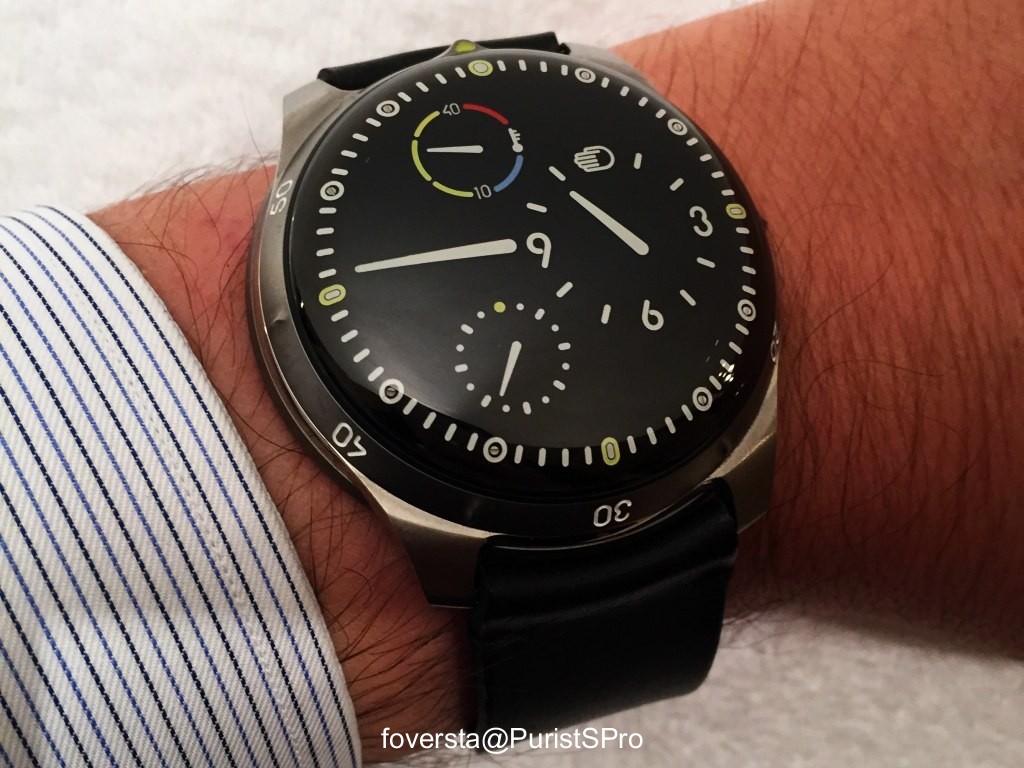
The logical consequence of such titanium case is the comfort on the wrist. The watch is not only light (87 grams) but is precisely positioned on the wrist. At the end, the Type 5 causes a surprise: despite its generous size (a 46mm diameter with a maximum thickness of 15.5mm), it seems smaller than it is.
For me, there isn't any doubt: the Type 5 is not only the most successful Ressence watch technically speaking, it is also the most attractive one. It is certainly not flawless and I think that the "regulator" type of dial is not necessarily the most convenient for a diver watch. Furthermore the graduated bezel "plunges" way too sharp behind the scale of minutes and this can be inconvenient from the practical point of view. But it is not a significant issue. The Type 5 is a wonderful inventive watch, original and intriguing at the same time. The characteristics of the oil are used to their maximum for a visually successful outcome. The Type 5 plays with the internal and external fluids for our deepest pleasure.
I would like to thank Benoît Mintiens and Gaëtan Gaye.
Pros:
+ a watch that symbolizes a technical and aesthetic achievement
+ the legibility of the displays
+ the smooth and dynamic curves
+ the comfort on the wrist
Cons:
- the time display can be confusing for a diver watch
- the graduated bezel is markedly inclined: an aesthetic success achieved to the detriment of the practicality
This message has been edited by foversta on 2015-12-30 15:51:26