Discussion
Bill's insightful comparison of Philippe Dufour and Patek Philippe delves into the nuanced world of haute horlogerie finishing. His article meticulously outlines the distinct philosophies and techniques that define these two titans, inviting collectors to consider the true value of artisanal perfection versus industrial mastery. This exploration is crucial for understanding the evolving standards of luxury watchmaking and what collectors prioritize in their acquisitions.

Philippe Dufour's Simplicity is renowned for its movement finishing, built on a base caliber derived from the LeCoultre 28/29. The key techniques that define his approach include:

credit: GaryG 2012
The production timeline tells the story of true craftsmanship: between 2000 and approximately 2015-2018, Dufour produced roughly 15 Simplicity watches per year. The total production run reached approximately 215 pieces, with about 120 destined for the Japanese market, where collectors particularly appreciated the personal connection to the maker. Current market values often exceed $150,000-200,000, representing significant appreciation from original retail prices.
Patek Philippe operates in a different realm entirely: haute horlogerie at industrial scale. With movements like the Caliber 240 (micro-rotor) and Caliber 324, Patek has mastered the balance between volume production and fine finishing.


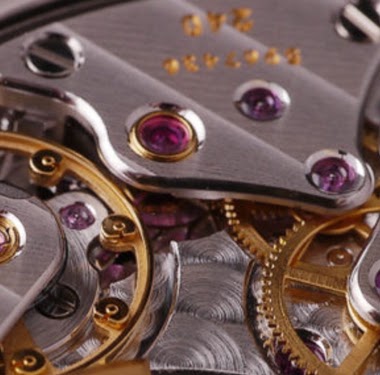
Patek Philippe movement detail – showcasing industrial precision and consistent finishing standards
Patek employs sophisticated CNC equipment, automated polishing systems, and batch finishing processes to maintain consistency across thousands of watches annually, while reserving extensive hand-finishing for high complications like perpetual calendars and minute repeaters.
The early 2000s witnessed heated debates across watch forums including TimeZone, ThePuristS, and Horologium, where collectors and independent watchmakers voiced concerns about industrial practices:
Rather than engaging in public debate, Patek Philippe responded by elevating finishing standards on their premium lines while maintaining efficiency in base models, effectively creating a clearer hierarchy within their collection.
The Simplicity has transcended mere timekeeping to become a symbol of uncompromising artisanship. Key factors driving its cult status include:
Patek maintains its position as the pinnacle of scalable luxury through:
The comparison between Dufour and Patek Philippe illuminates a fundamental tension in modern luxury: authenticity versus accessibility.
The Artisan Argument (Dufour): Absolute artisanal purity, where each piece contains the maker's individual touch and small variations. The investment of human time creates intrinsic value beyond mere function, and artisanal methods preserve traditional skills that might otherwise disappear.
The Industrial Excellence Counter-Argument (Patek): Consistent quality serves customers better than artisanal variations. Advanced technology can achieve finishing quality matching or exceeding handwork, while scale allows more people to experience haute horlogerie. Innovation requires industrial resources that individual artisans cannot match.
Dufour's Enduring Impact: The master's influence extends far beyond the ~215 Simplicities he created. His techniques and philosophy have inspired a generation of independent watchmakers, from F.P. Journe to Laurent Ferrier. The Simplicity serves as a benchmark against which all finishing is measured.
Patek's Evolution: Patek continues refining the balance between industrial efficiency and artisanal quality. Recent releases show increased attention to hand-finishing details, and the introduction of limited artisan series indicates recognition that certain collector segments value provenance and individual craftsmanship.
The debate between Philippe Dufour and Patek Philippe ultimately reflects different definitions of perfection:
Dufour represents the pursuit of absolute artisanal purity, where every surface reflects human skill and dedication. His watches are philosophical statements as much as timepieces—arguments for the irreplaceable value of human craft in an increasingly automated world.
Patek Philippe embodies industrial artistry, proving that sophisticated manufacturing can achieve remarkable beauty while serving a broader market. Their best pieces demonstrate that technology and tradition can coexist, creating watches that honor heritage while embracing innovation.
Perhaps the most profound insight is that both approaches have validity. In Dufour's workshop, we see the preservation of endangered skills and the pursuit of individual expression. In Patek's manufacture, we witness the democratization of luxury and the power of systematic excellence.
The watch world is richer for having both: the uncompromising artisan working alone in his atelier, and the grande manufacture balancing tradition with innovation. Whether perfection comes from the man or the machine may depend entirely on what you're seeking: the irreplaceable touch of a master's hand, or the reliable excellence of centuries-refined process.
The Patek Philippe World Time reference 2523, launched in 1953, is distinguished by its innovative two-crown system. One crown serves for winding the watch, while the second, positioned at 9 o’clock, controls the city disc. This design marked a significant development in the functionality and user experience of world time complications for the brand.
The reference 2523 was offered in two primary versions. The initial ref. 2523 featured larger lugs that extended above the bezel, with a case diameter of 35.5 mm. A subsequent variant, ref. 2523/1, presented a slightly larger diameter of 36 mm and thinner lugs that were integrated without extending above the bezel. Both versions were powered by the caliber 12-400 HU, which incorporated the world time module developed by Louis Cottier.
This reference appeals to collectors interested in Patek Philippe's historical advancements in complicated watchmaking, particularly the evolution of its World Time series. The distinct design differences between the 2523 and 2523/1, especially regarding lug integration and case dimensions, provide specific points of interest for enthusiasts tracking the model's development and variations.
are beautifully hand-finished, even the spokes of the wheels are hand carved and finished. Those glorious wonderful days.
Since 1998, and the release of the yellow gold version with its black dial, till 2008 and the birth of the platinum, which replaced the White Gold and the Rose Gold models born in 2003, Patek Philippe offered us their vision of THE manual chronograph, through the 5070, or better said, the Patek Chronograph History goes on, as the Past is rich of some beautiful models. Patek Philippe 5070 : An In Depth Review.
For example taking a 240 movement in a Geneva Seal 5130 and compare it to a Patek Seal 240 movement in a 5130 - are there really any differences? And how about a 240 in a 5230P vs 240 in a 6006G - exactly the same finishing standard, despite the much higher price of the worldtimer?
Finishing standard: When Patek Philippe moved from the Geneva Seal (which focused primarily on traditional finishing in the canton of Geneva) to its own Patek Seal in 2009, they stated publicly that the finishing requirements would at least match—and in some cases exceed—the Geneva Seal’s demands. Practical difference: The visual finishing of a 240 under both seals is essentially identical: Côtes de Genève, perlage, polished bevels, chamfered screw heads, and gold-filled engravings are all still
This thread is active on the Independents forum with 16 replies. Share your knowledge with fellow collectors.
Join the Discussion →