
Independents
Ant's post introduces the fascinating world of bespoke watchmaking through his experience with Coggiola, a company that transforms high-grade 19th-century English pocket watch chronometers into unique wristwatches. He details his close involvement in the design and finishing process of his custom piece, which features a Victor Kullberg movement from 1872. The post highlights the creative journey and the rewarding experience of owning a personalized watch with a rich provenance.




Victor Kullberg (1824-1890), 'Maker to the Admiralty', 105 Liverpool Road, London. Swedish émigré to London, would become one of England's and horology’s most celebrated watchmakers. Awarded with a multitude of gold medals at world fairs for his horological masterpieces. Kullberg had a successful company manufacturing stem wound reverse fusée pocket chronometers as well as his most famous and superb marine chronometers. Kullberg supplied England’s most famous retailers with his distinctive stem wound calibers. While his marine chronometers were supplied to the English Admiralty as is proudly displayed on this movement.
The present watch is an exceptionally rare full-hunter Kullberg signed 1-size/13 ½ ligne (30.45mm) movement. Movements manufactured by Kullberg in this size are very rare, especially with his company’s signature.
Movement: 3/4 plate hand gilded and hand-engraved hunter movement (winding and setting at 3 o'clock). Very rare use of black-polished (mirror finish) screws throughout the movement. Setting and winding steel works with satin, brushed and snail finishing. Bright brass screw-set chaton jewels settings for escapement to fourth wheel. Square center-wheel hour pinion to set time via key (movement shows signs of its use this way) with flat concave mirror-polished steel holder.
Balance cock: Hand-engraved balance cock with floral pattern throughout. High quality deep red ruby jewel, set in polished steel chaton.
Escapement: Traditional English right-angle lever escapement. Single flat-roller impulse jewel. Polished steel club escape lever. Distinct bi-metallic compensation balance wheel with sharp-figured terminal steel ends reserved for highest quality watches. Solid gold escape wheel with steel pinion. Rare double caped jeweling on escape lever and wheel.
Keyless winding: Traditional English ratchet customized to display Kullberg’s distinct design reserved for keyless reverse fusée pocket chronometers. Signature mainspring ratchet looped spring and click, and the screw fixed mainspring ratchet wheel typical of the German and Danish watchmaking traditions.
Train: Solid brass gilded train with thick hand finished steel pinions. Solid gold escape wheel. Jeweled to the fourth wheel.
Jewels: 17 Jewels – balance work (5), escape lever (4), escape wheel (4), fourth wheel (2).
Bespoke case order incorporating ebony into brass case.
Hand manufactured case and parts in Rome, Italy:
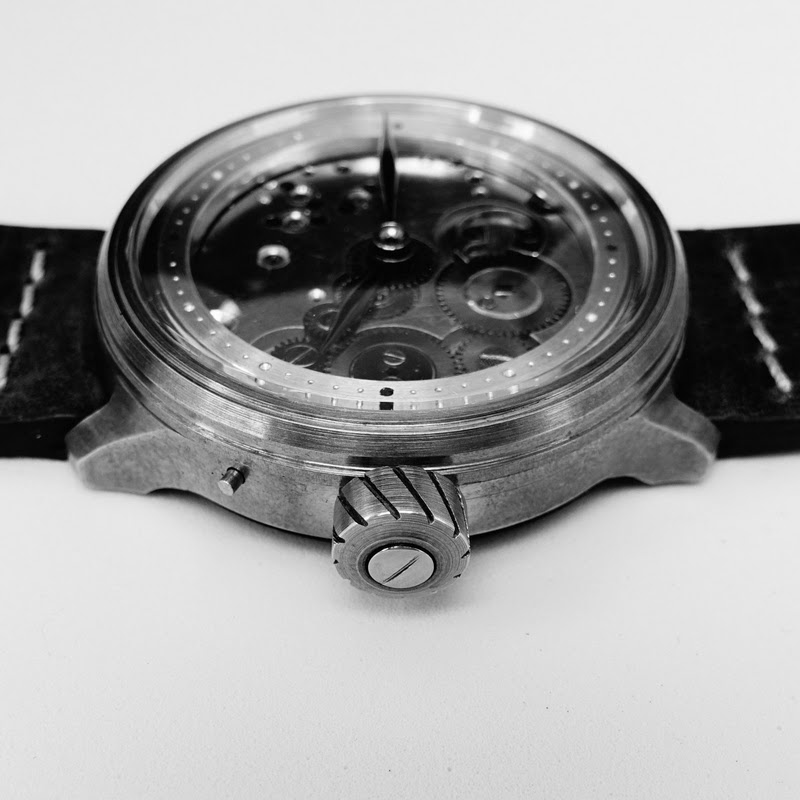
Case: Two-piece solid brass case with snap on dial. Ebony insert as case back bezel. Crown, stem, case crown sleeve, time setting pusher, .
Dial: Aluminum, open. Milled out minute & hour dot markers.
Buckle: Four part brass buckle, three stainless steel screws.
Case dimensions:
Diameter, without crown: 40mm
Lug to lug: 44mm.
Height, including crystal: 15mm (12mm without crystal).
Strap: 22mm width. Length: Normal. ColaReb Roma, Italy. Hand-made leather strap made in Rome.
Restoration Work: This watch was subject to the sad fate of gold smelters very recently, having appeared at auction still in its original 18K 1872 hallmarked full-hunter case as lot no. 74 at the Fellows & Sons ‘Pocket Watches & Accessories’ November 24, 2014 auction. At the moment it was removed from it’s case the top plate was scratched and balance wheel pivot badly bent. It was kept in a poor environment where the keyless winding work received moisture and rust. Restoration work included: Repairing the balance staff, replacing the hairspring (original rusted and split), new mainspring safety stop, replacement of mainspring, selective restoration of finishing, cleaning, timing.
Particularities when handling this watch: When winding the watch, the safety stop will create a 'dry' stop. Do not attempt to wind past this point. It is best to set the time clock wise.
Case care instructions: Do not use abrasives to clean the case. The watch is not water proof.
And sounds like you truly enjoyed being part of the creation process. Enjoy!
I love the movement, the case, the hands, the whole thing. Great job Sebastian. Keep it up buddy. Ondrej
but the whole case is quite angular and industrial: finish and material. I felt that the size and general feel of the winder was in keeping with the overall visual. Given that the Kullberg mechanism is far from pristine (Sebastian and I agreed not to refinish it)....it's an antique and has it's own patina I felt that a generally heavier look was fitting. Just my taste. Nevertheless it is an intriguing watch.....and the price!! Kind regards, Antony
Bravo! You are a lucky man to have found this watchmaker. And to have this documentation of what he did for your watch. When I was apprentice to a watch repairman I learned why and how to do many of those procedures - but that is not to say that I could do it properly, or that I would even know which tools to use OR see well enough to do the work. Thank you for giving us a chance to come along on the journey. Cazalea
it was an eye opening experience seeing the manufacturing and design steps happen and evolve in almost real time. ATB Antony
I can tell a lot of passion is invested in this watch, both by you and the watchmaker. It must be extremely rewarding on the wrist.
This thread is active on the Independents forum with 15 replies. Share your knowledge with fellow collectors.
Join the Discussion →


