
Manufacture
Gadalex offers WatchProSite readers an exclusive look into the world of Charles Frodsham, a name synonymous with the revival of English watchmaking. His detailed account of a visit to the London offices of Phillips auction house, where he encountered Richard, provides a rare glimpse into the brand's meticulous craftsmanship and philosophy. This article illuminates why Frodsham timepieces, with their exceptional details and thoughtful design, continue to captivate collectors and horological enthusiasts alike.


On the 26th October last year I made one of my regular visits to 30 Berkeley Square, the London offices of Phillips auction house, to view some of the consigned timepieces that were to be up for sale in Geneva, Hong Kong and New York the following month. As is my usual practice I worked my way around the room and ended up browsing the vitrine containing a few choice pieces from the New York section.
Attempting to be as polite as one can be yielding a camera and hogging numerous watches at a time, I noticed, in my peripheral vision, a gentleman standing quite close to me and assumed I was in his way. Having shuffled aside and apologised, I then glanced at his wristwear (seen below).

In a shot, I asked: “Is that a Frodsham?” to which he replied, “Yes”. I glanced again and suddenly had a flicker of recognition, “Are you Frodsham?” he smiled and concurred. I had just met Richard Stenning, watchmaker and auctioneer turned watch company owner and one half of the modern Charles Frodsham brand (Philip Whyte, the other director is a somewhat more elusive character with whom I have conversed on a couple of occasions). Richard briefly challenged me to capture the colour of the numerals on the dial of his prototype and I duly obliged.

Richard Stenning and I subsequently made an arrangement to meet at the showroom in Mayfair a few days later and what follows is a series of photographs and commentaries following our lengthy conversation. Much of the material I gathered was posted on Instagram over a week’s worth of posts in November. Richard and I discussed the postings that were planned and he corrected any lapses in my memory. It was arguably the most detail I’ve gone into on any brand or watch and it was more than helpful to have had his input. Not only did it prevent egregious errors, but it also meant that privileged information was not disclosed publicly. I have of course expressed my gratitude for the access afforded me on many occasions, normally over a drink or a meal. And full disclosure: Richard took my wife and me out for a meal a little while ago to thank me for the attention I gave the brand; he's a true gentleman and now purveyor of one of the finest time only watches in production today.
Various journalists and enthusiasts have expounded on the technical genius of the movement so that will not be my main focus. I hope that all who read this and view the photos are able to gain an appreciation, or further appreciation, for a groundbreaking piece of watchmaking.
Baruch
@budgecoutts
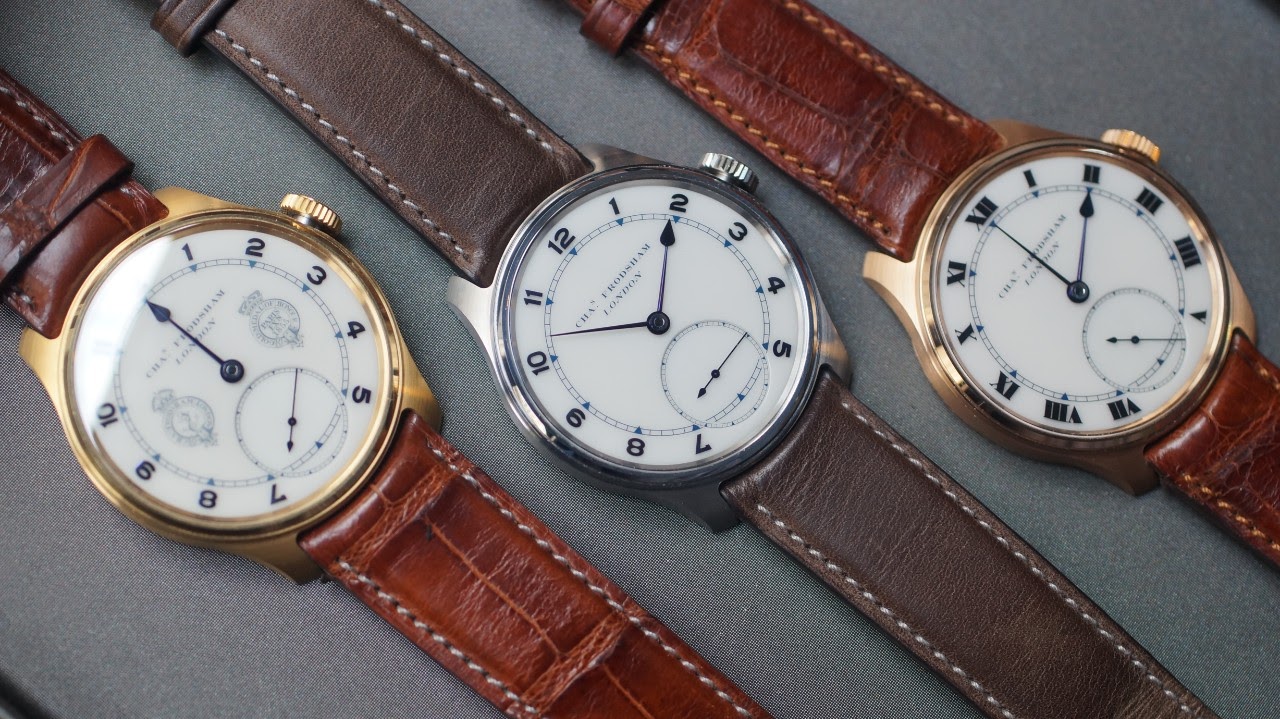

Reimagining the traditional watch dial. Antique enamel dials, whilst beautiful, are prone to damage and hairline cracking. Frodsham uses a combination of zirconium oxide dials and vapour deposition to achieve a visual look not dissimilar to that of an antique enamel dialled pocket watch. The main difference is longevity of materials. The dial is formed from 2 ceramic plates to allow for the large diameter sunken seconds, each dial plate is 0.45mm thick, (lapped from 1mm), giving a total thickness of 0.9mm. Each plate is first frosted, before the vapour deposition process takes place. The process of vapour deposition is carried out by a British company that specialises in the manufacture of microscope products for the medical industry. Frodsham, unsurprisingly, is their only horological client. The thinnest line visible on any of the dials is a mere 13 microns wide and forms part of the cypher, or medallion, on the heritage dial. Frodsham here referencing their past accolades: suppliers of marine Chronometers to the British navy (amongst many others) represented by the British Admiralty Foul Anchor and a past gold medal won in Paris.


Case materials: The cases may look ordinary, and they are notable for their exceptional finishing, but there is more to them than meets the eye. 22k (916) yellow gold, was the standard for gold cases up until 1797/8 and notably used for discerning clients by watchmakers like Mudge for the King of Spain, for example. It may seem like an unusual choice for a modern watch, as it is generally softer and susceptible to dents and scratches. Frodsham were keen to use 22k (the watch on the left of the image below) because of its warmer hue and soon established that it could be hard rolled to match the durability of 18k. The other gold case that I viewed was made from 18k hard rolled rose gold (to the right of the image below): the contrast between the case and the annealed steel numerals is striking and can be seen in the second image. (There is a white gold option without rhodium plating so the brushed finish of the case looks more like steel than gold).


For their steel cases they use Sandvik Sanmac 316L steel (seen below along side the 18k rose gold case and above in the first image), which is a molybdenum-alloyed austenitic chromium-nickel steel with improved machinability. The grade is used for a wide range of industrial applications where steels of types ASTM 304/304L have insufficient corrosion resistance. It is also very resistant to intergranular depletion due to a low carbon content; a weakness where the surface of the metal is susceptible to damage due to a vulnerability of the corrosion-inhibiting element of the alloy. Sanmac is normally used for commercial pump and valve components. This is no ordinary steel and the full spec list is frightening.


As for the case, I really have to get a closer look, but overall, I like what I am seeing, a lot. Thanks for this superb post, Baruch. Thanks for allowing us to discover this brand! Best, Nicolas
When you're next in London you should drop Richard an email and I've no doubt he'll be delighted to host you for a visit. There's nothing more he enjoys than a good chat with a fellow horophile and collector. Best, Baruch
With the "Frodshams" being so selective regarding the journalistic coverage of the watches, it is superb to have such detailed information supported by excellent photos here. The additional bonus when enthusiasts are reporting is the personal part of the story, as so nicely presented as an introduction to the post. Björn
Frodsham has really allowed only a handful of reports about their new wristwatch, so yours is really a treasure!
Those movements look fantastic. Thanks for sharing. Vte
Thank you for the detailed look into the Frodsham watch. Truly superb watchmaking going on here. As a fellow Brit, it makes my heart swell a bit to see these watches being made in old Blighty! I too hope to get a chance to drop in and see Richard on my next trip to London. We missed each other last Nov. when I was in town briefly for the Salon QP. I must say, your photos are top notch! Very well captured. Cheers, Tim
This thread is active on the Independents forum with 33 replies. Share your knowledge with fellow collectors.
Join the Discussion →


