ED209 shares a personal journey through his Audemars Piguet Royal Oak Perpetual Calendar collection, comparing an 18k yellow gold model with a stainless steel skeletonized version. His detailed review highlights the evolution of his preferences, focusing on features like the leap year indicator and transparent caseback. This comparison offers valuable insights for collectors interested in the Royal Oak Perpetual Calendar.
I can’t believe that it’s already the 40th Anniversary of Audemar Piguet’s iconic watch, the Royal Oak. From the first time I’ve saw one at my local AD I’ve always been attracted to the 39mm size of the Royal Oak more so than the currently popular Offshore versions.
In terms of watch complications, I’ve always been fascinated by the perpetual calendar movement because of the complexity of what it can do. I’m still amazed that a bunch of tiny gears, springs, levers and other parts are able to accurately indicate the day, date, month, and the leap year cycle.
So during my early stages of building up my watch collection I finally had a chance to own one of my dream
watches, an AP Royal Oak perpetual calendar in 18 carat yellow gold. It
was nearly perfect for me, the size fit nicely on my small wrist, the
sharp angles of the Royal Oak case combined with the alternating brushed
and polished finish was so attractive. And the yellow gold case and
bracelet gave it a nice heft on my wrist. It was a substantial solid piece of art that I could wear. To top it all it has a flat
gold colored dial that made the watch easy to read.
My RO perpetual calendar has performed extremely well but I never really
paid attention to the exact details of the leap year movement until a
few years ago when I attended the first 1st Perpetually Purists GTG in
2008. The Southern California event was held at the Rainbow Bar &
Grill: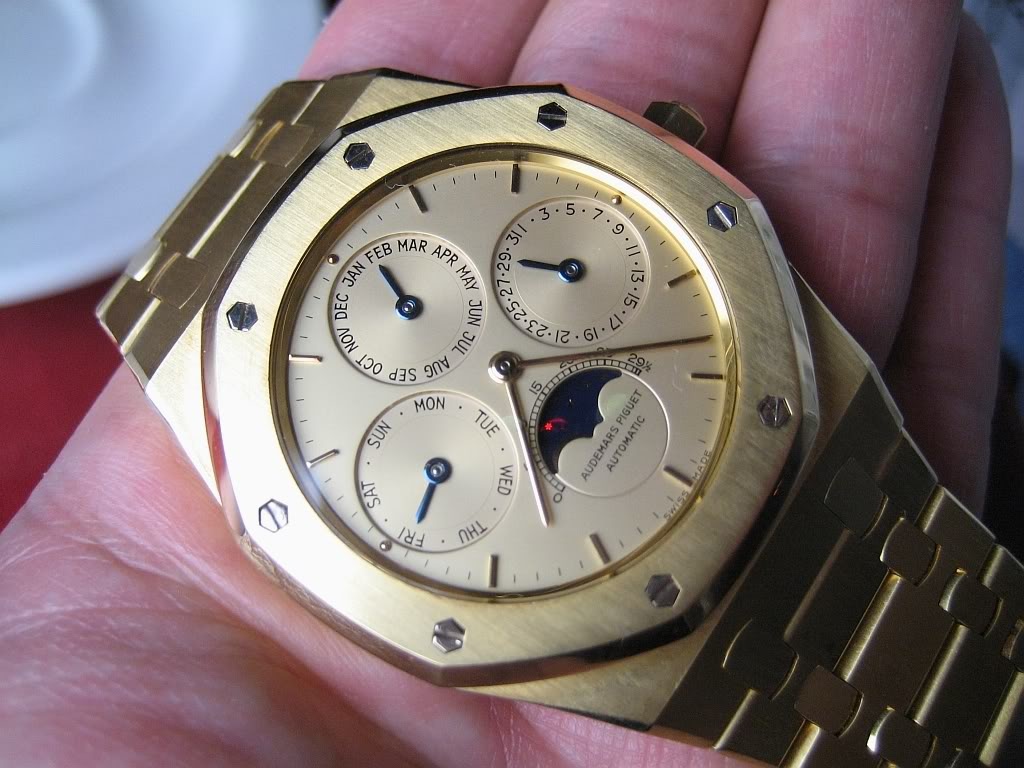
I loved wearing the gold perpetual calendar but I have to admit that it wasn’t exactly perfect. There were a few minor details that I felt was missing on being the grail watch for me. My first issue was on the dial side. My Royal Oak model subdial at the 12 o’clock position indicated only the month. Especially during the transition from February 29th I really wished that it had the leap year indicator. Another dial side item that I didn’t really care for is the shape of the hour and minute hands. I felt that it looked really plain having simple straight gold hands. It also was a little hard to read the time because the gold hands blended in with the gold dial in strong sunlight.

Turning the watch over the case had a solid gold caseback. Besides perpetual calendars I like having skeleton watches so that I can view the intricate engraving and polishing done on the movement. So my third wish for the perfect perpetual calendar would be a transparent caseback so that I can enjoy staring at the decorated movement.
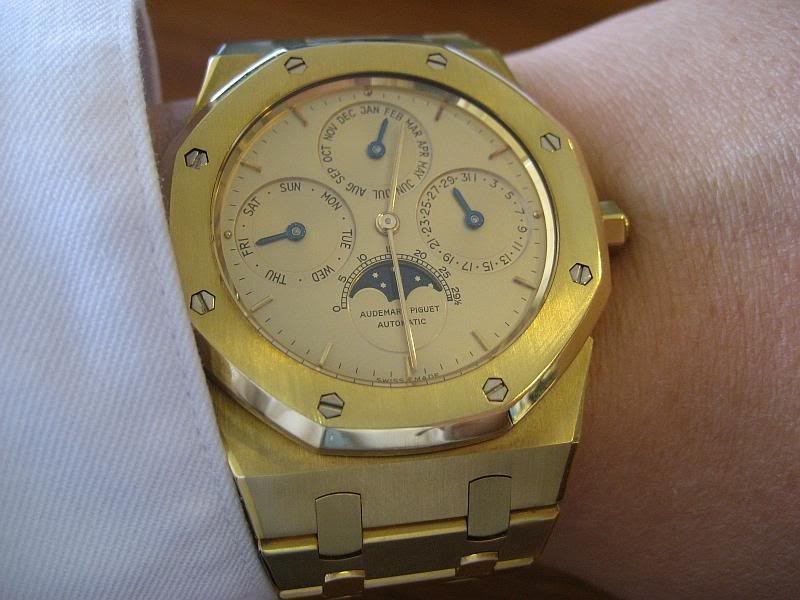
Well fast forward to 2011 when I made a trip out to (where else?) Las Vegas to attend IGOTT2. I’ve been seriously thinking about getting another AP Royal Oak Perpetual Calendar mainly for the transparent caseback and the leap year indicator. A fellow PuristS was wearing the model 25829ST which is the perpetual calendar skeleton version. It was so beautiful that I knew that I had to get one.

So a few months later I ended up with the Royal Oak stainless steel perpetual calendar skeleton. It’s such an amazing watch to see in person and it had all the qualities that I really wished for when compared to my original gold version. So let’s take a closer look at this complication.

The following series of photos were taken on February 29th so that I can see the performance of the perpetual calendar transition for leap year. I was on business travel during this time and was just arriving back home so unfortunately I couldn’t join with fellow SoCal PuristS for the Perpetually PuristS GTG but I did the best I could with a few pics capturing the time starting at 10:35pm. As you can see the subdials indicate Wednesday but the date subdial at 3 o’clock position has already started the transition between 30th and 31st.


Even when the time was around 11:30p there really wasn’t much happening
to the subdials. Most of the movement was still at the date subdial at
the 3 o’clock position:



But once the time approached 11:50p things were starting to really move:
After just a few minutes when the time past 11:55p the day subdial at the 9 o’clock position was nearly on Thursday and the subdial for the date at 3 o’clock was almost on the 1st. The month was still in February.
I then switched my little point and shoot camera to video mode and captured some shaky video of my watch at it swept past midnight. I’ll try to post the video as soon as possible but I’m really proud to say that the AP watchmakers did a great job with this piece since it transitioned properly to March 1st at midnight.

Next let’s take a look around the various angles of the Audemar Piguet Royal Oak Perpetual Calendar Skeleton. Just like my gold version, the case thickness is a thin 9.3mm. I wear a suit and tie to work every day, not even a single casual Friday  , and it fits fine under my dress shirt. I think it works well with a suit and sport enough to pair with casual weekend clothes.
And speaking of comparing the gold versus the stainless steel skeleton, I’m really surprised by how light my new watch really feels. Everyone that has handled it always comment about the lightness.
Still in the side views of
the case, the month and leap year indicator has corrector buttons at the
2 o’clock position. The moon phase has the corrector located at the 4
o’clock position.
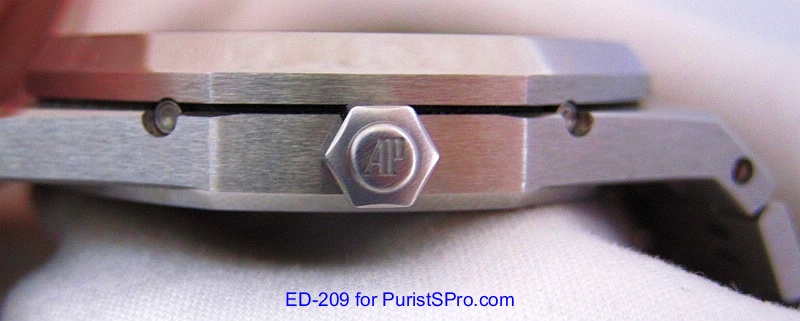
On the side opposite of the crown we have two more correctors. The day can be updated with the corrector at the 8:30 position and finally we have the fourth corrector for the date at the 10 o’clock position. An interesting note about the correctors is that if the watch is stopped for less than 3 days I can simply use the crown and adjust the time and all of the functions (day, date, month, leap year and moon phase) are all synchronized. But if the watch has been stopped longer than 3 days I’ll need to adjust the watch using the correctors.
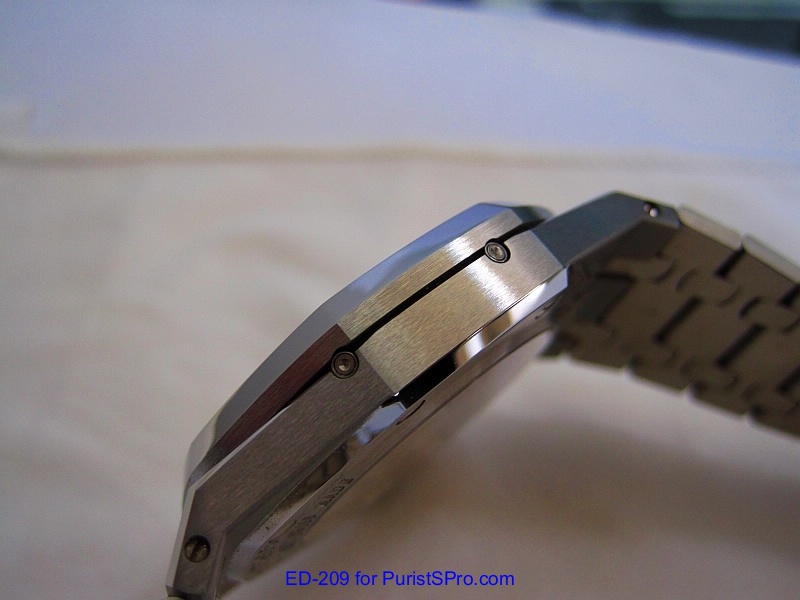
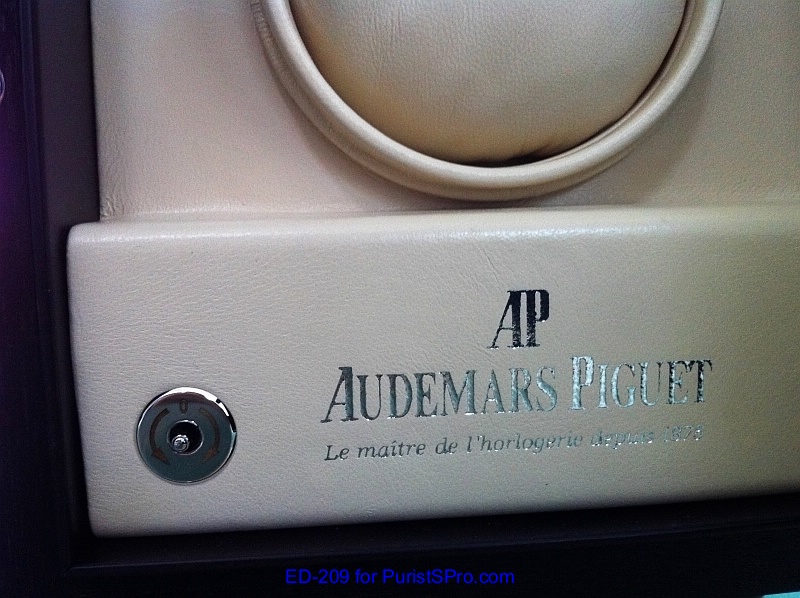
Luckily I haven’t really need to pull out the stainless steel stylus to make any adjustments. I usually wear this perpetual calendar on a daily basis but on weekends I sometimes put it in the winder to keep it fully activated. My Royal Oak does come with it’s own winder which is also the storage box or as the AP instruction booklet calls it ‘presentation case’. The exterior is the typical wood finish of the Royal Oak boxes with a dark slightly reddish tinted wood. It has a faceted glass display window and is a little bit larger than the regular box.
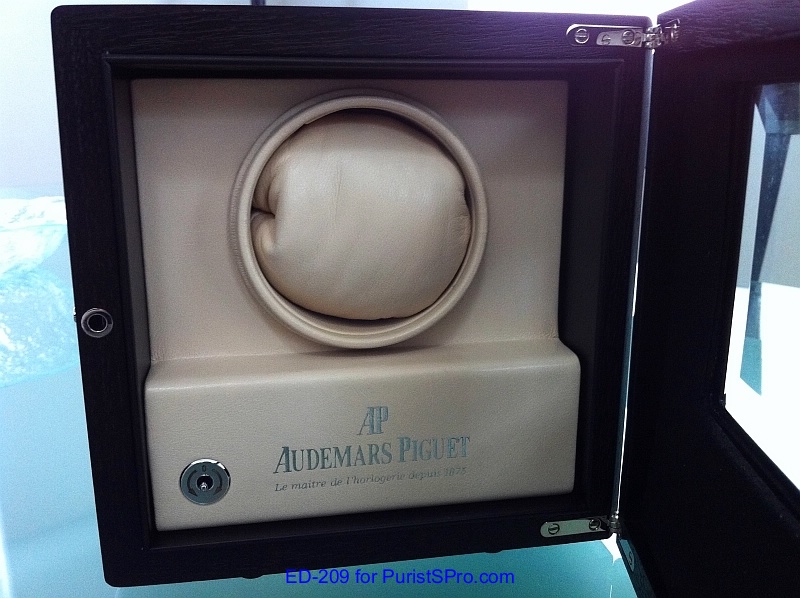
On the inside lower left
corner is a 3 position switch. When activated on the left switch
position the watch winds in a counter clockwise rotation. Center is
stop and the right switch position is clockwise rotation. According to
the instructions the winder performs 1200 rotations in a period of one
and a half hours and does this on a 24 hour cycle. Works for me as I
had it in the safe during extend travels where I had my watch on the
winder for about a week. The winder is battery powered with alkaline
batteries and fairly quiet. I also have a Audemars Piguet winder made
by Swiss Kubik but I haven’t tried it yet.
Back to the watch, once again the skeleton work on the dial size is just simply beautiful. In some ways it is slightly difficult to read but I don’t mind it at all. I’m used to the positions and can always tell the time along with the day, date, and month very quickly. You can see from the pictures that the subdial hands are in polished blue but does sometimes look blackish colored depending the viewing angle. The hour and minute hands are in blackened gold leaf shaped hands and provide a nice contrast to the subdial hand. It also addresses my issue of the shape when compared to my gold version.

Flipping the watch over I can see the beautiful movement from the transparent sapphire caseback. All the bridges and rotor are skeletonized and engraved.
You can see the transparency of the skeletonized movement at diferent angles like this picture here:
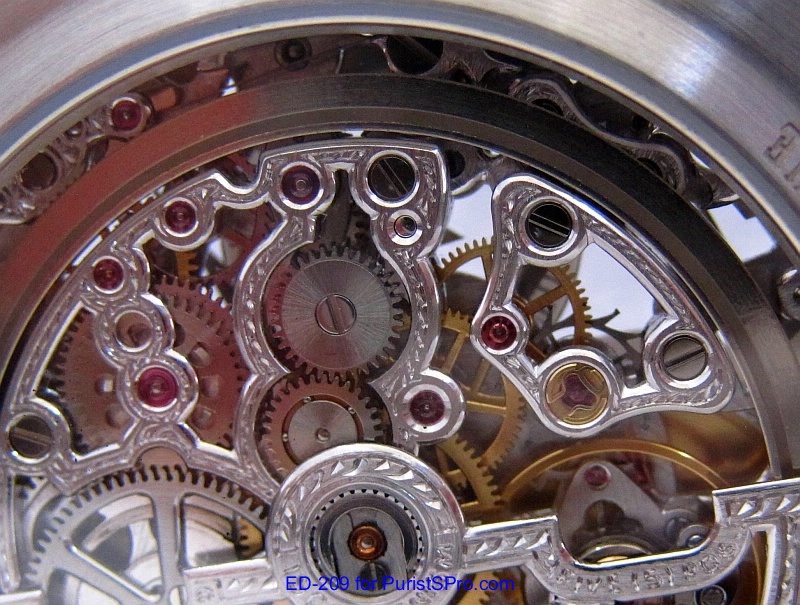
The pictures speak for themselves:
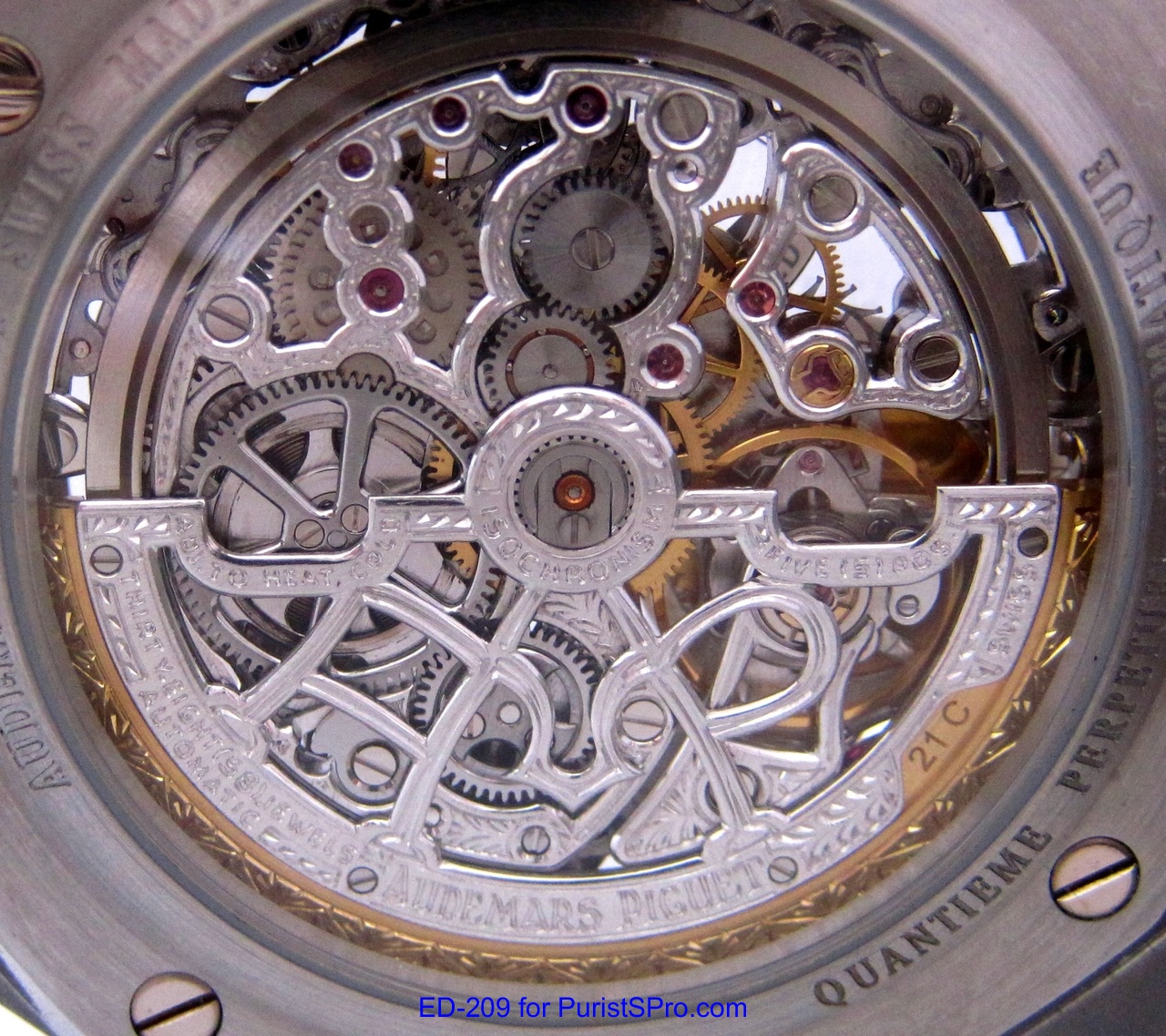
During my visit to Audemars Piguet Headquarters in LeBrassus back in 2008, I had discovered that AP offers a customized automatic rotor (oscillating weight) that can be decorated to my specifications including initials. I’m considering this option sometime in future and will probably get my initials done on the rotor when it’s in for the next scheduled service. Has anyone else swapped out their rotors to a custom one? I recall that the AP watchmakers mentioned that it only take a few weeks to do the swap but a few months to order the actual rotor.

The skeletonized automatic movement AP caliber 2120/2802 is based on legendary caliber 2120. It was first presented in 1967 and was the world’s thinnest mechanical self winding movement with central rotor. At a mere 2.45mm thick, caliber 2120 has been used in the original Royal Oak in 1972 with the date display, and in 1978 with the world’s thinnest self-winding perpetual calendar with central rotor, and in even more complex watches like the Jules Audemars equation of time with the sunrise and sunset indicators.

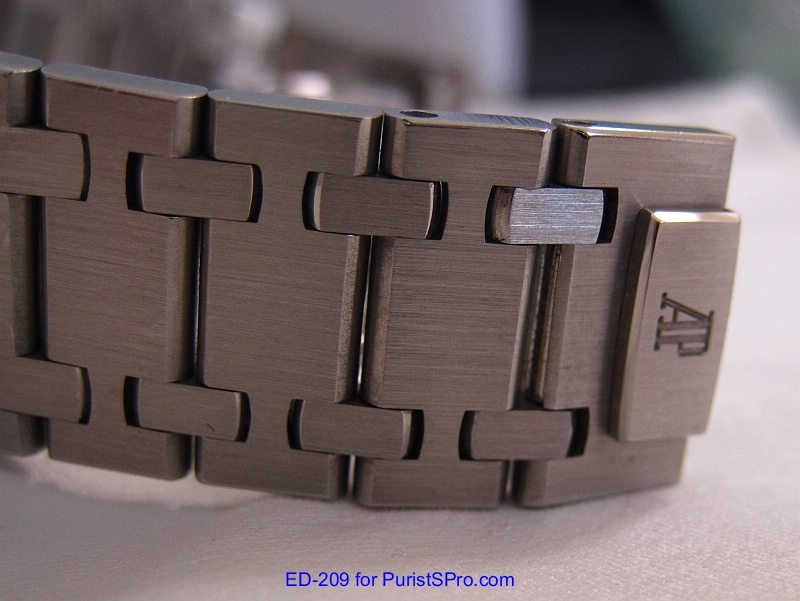
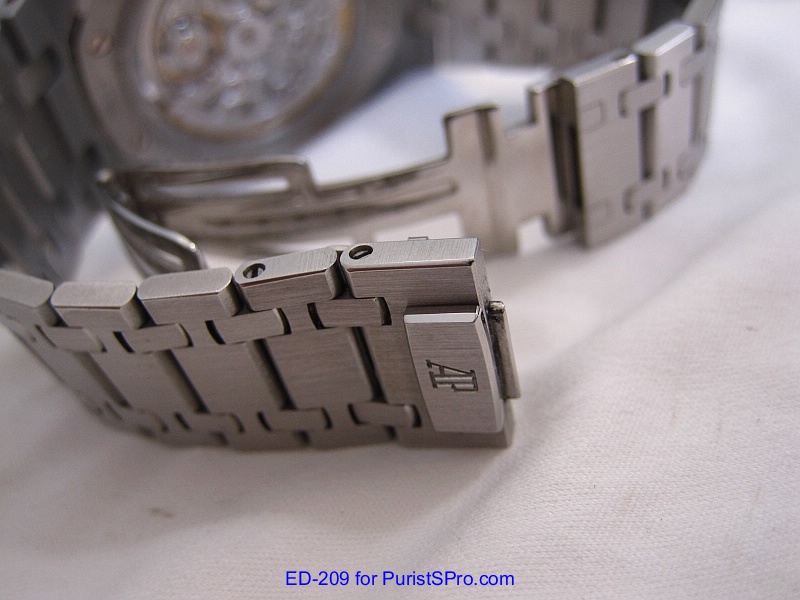
The bracelet is the standard bi-fold deployant in stainless steel. It has the signature alternating brushed and polished finish of the Royal Oak. The clasp is release by sliding the rectangular button. As many other AP Royal Oak owners have done, I’ve swapped the bracelet over to the opposite side because it places the deployant in a more comfortable position on my small wrist. I personally prefer a double deployant with a side pushing button (like on my previous Royal Oak Dual Time 26120) but in my opinion the bracelet I have pretty comfortable. I wonder if the new 15202 with the double folding clasp would work with my 25829?
I’ve worn this AP Royal Oak perpetual calendar skeleton as my daily watch for slightly under a year and has been my companion on some fun trips. We had a celebration birthday dinner at the Joel Robuchon restaurant inside the MGM Grand Las Vegas for an amazing 16 course dinner:

Then a few times next door at the other Robouchon restaurant at L’Atelier de Joel Robuchon:
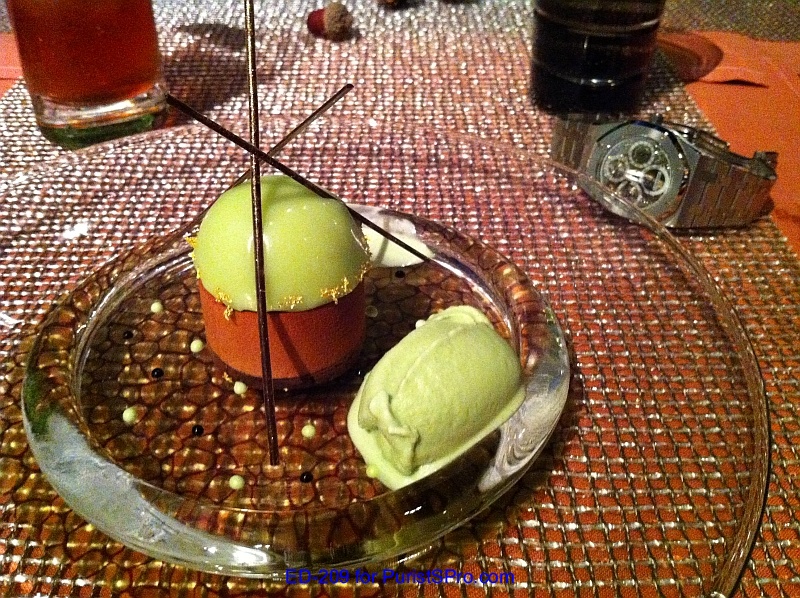
My AP Perpetual Calendar Skeleton taking a back seat to the the dessert:

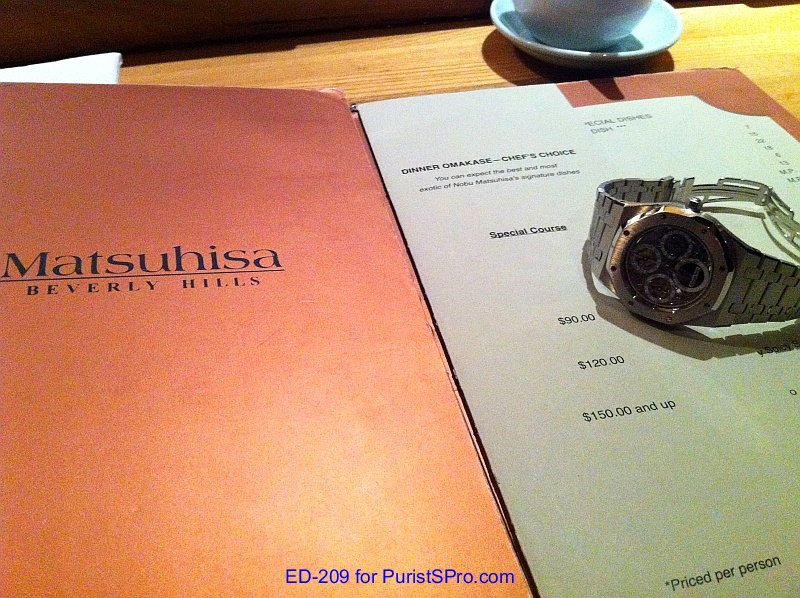
And even locally here in Los Angeles at a great standby restaurant Matsuhisa:
And of course back again in Vegas to celebrate New Year’s Eve at my favorite Vegas hotel Aria Resort and Casino:

Finally, a little more information specifically on the perpetual calendar: In 1978 at Baselworld, AP unveiled the world’s first self-winding wristwatch with perpetual calendar, in the thinnest watchcase ever to contain this complication. The movement was conceived and developed by Michel Rochat and Jean Daniel Golay, respectively horologist and engineer at Audemars Piguet. At 4.05mm it still remains the thinnest movement of it’s type. The first skeleton Royal Oak with perpetual calendar and self-winding mechanism debuted in 1987.
Here are some additional specifications on the Royal Oak Perpetual Calendar Skeleton:
Variable –inertial balance, flat balance spring, 19,800 beats per hour (2.75 Hz), 38 jewels, 355 parts
Movement: 28mm diameter, 4.00 mm thickness
Case: 38.8mm width, length 48.8mm, thickness 9.3 mm
Hours, minutes, perpetual calendar indicating day, date, month, phases of the moon and year of the leap-year cycle
Moonphase made with physical vapor deposited metal onto sapphire
Steel case, sapphire dial and transparent caseback
Blackened gold leaf shaped hands for hours and minutes, blue hands for indicators
Collection reference 25829ST.00.0944ST.01
Water resistance to 20m
Available in platinum, 18 carat yellow gold, and 18 carat pink gold
I hope you enjoyed my
little review of my favorite AP. It’s perfect and I love every little
detail of the watch and kudos to the watchmakers at Audemars Piguet for
crafting such a beautiful timepiece!
Regards,
ED-209
This message has been edited by ED209 on 2012-03-31 02:21:19
About the Audemars Piguet Audemars Piguet Royal Oak 15202 YG Ref. 15202
The Audemars Piguet Royal Oak "Jumbo" ref. 15202 is a significant reference within the Royal Oak collection, known for its close adherence to the original 1972 design. It maintains the distinctive slim profile and integrated bracelet that defined the initial Royal Oak, distinguishing it from other Royal Oak models that introduced different sizes or complications. This reference is particularly valued for its historical continuity and minimalist approach to the Royal Oak aesthetic.
This reference features a 39mm case, typically crafted from yellow gold, with a thickness of 8.1mm. It is fitted with a sapphire crystal and offers a water resistance of 50 meters. Powering the watch is the self-winding Caliber 2121, a movement known for its slimness and a power reserve of approximately 40 hours. The dial is presented in blue, complementing the yellow gold case and bracelet.
For collectors, the 15202 represents a direct link to the Royal Oak's origins, appealing to those who prioritize historical accuracy and understated design. Its production run from 2012 to 2019 makes it a sought-after reference among enthusiasts of the "Jumbo" lineage. The combination of its classic dimensions, integrated bracelet, and the Caliber 2121 solidifies its position as a key reference in the Audemars Piguet catalog.
Specifications
- Caliber
- Cal.2121
- Case
- yellow gold
- Diameter
- 39mm
- Dial
- Blue
- Water Resist.
- 50m
- Crystal
- Sapphire
About the Audemars Piguet Royal Oak Selfwinding Ref. 15305
The Audemars Piguet Royal Oak reference 15305 is a notable variant within the Royal Oak line, distinguished by its openworked dial and movement, offering a direct view into the intricate mechanics. This reference represents a more elaborate and technically complex interpretation of the standard Royal Oak, appealing to collectors who appreciate haute horlogerie and the art of skeletonization. It was produced in limited quantities, making it a less common sight compared to its solid-dial counterparts. The openworked design allows for an appreciation of the finishing and architecture of the movement, a hallmark of Audemars Piguet's craftsmanship.
The watch features a 39 mm case crafted from 18k yellow gold, maintaining the classic Royal Oak proportions. It houses the self-winding Caliber 3120, which is meticulously openworked and finished to expose its components. The movement provides a power reserve of 60 hours. A sapphire crystal protects the dial, and the watch is water-resistant to 50 meters, suitable for everyday wear. The fixed octagonal bezel, a signature element of the Royal Oak, is also in 18k yellow gold.
This reference appeals to collectors seeking a Royal Oak with an enhanced level of mechanical artistry and exclusivity. Its openworked nature sets it apart from more common Royal Oak models, positioning it as a piece that highlights Audemars Piguet's technical prowess in movement decoration and design. The 18k yellow gold construction further emphasizes its premium status. While not a double-signed piece as mentioned in the collector's post, the 15305 stands on its own as a significant openworked Royal Oak.
Specifications
- Caliber
- 3120
- Case
- 18k Yellow Gold
- Diameter
- 39 mm
- Dial
- Blue
- Water Resist.
- 50m
- Crystal
- Sapphire
About the Audemars Piguet Chronograph Ref. 26120
Audemars Piguet Royal Oak Offshore Chronograph Reference 26120
The reference 26120 represents a 42mm chronograph variant within the Royal Oak Offshore collection, produced from 2006 to 2012. This stainless steel model features a black dial configuration and positions itself as a sports chronograph offering within the Audemars Piguet lineup.
The 42mm stainless steel case incorporates a fixed octagonal bezel and sapphire crystal, with 100-meter water resistance. The automatic movement utilizes caliber 2226/2840, providing a 50-hour power reserve. The watch is fitted with a rubber strap and presents the chronograph functions against the black dial surface.
This reference appeals to collectors seeking a discontinued Royal Oak Offshore chronograph in stainless steel. The six-year production window and 42mm sizing make it relevant for those focused on mid-2000s Audemars Piguet sports watches. The combination of steel case construction, rubber strap, and automatic chronograph movement defines its position within the collection's chronograph offerings.
Specifications
- Caliber
- 2226/2840
- Case
- Stainless steel
- Diameter
- 42 mm
- Dial
- Black
- Water Resist.
- 100m
- Crystal
- Sapphire


