Audemars Piguet Royal Oak Perpetual Calendar Ultra-Thin 26586IP
Review

Audemars Piguet Royal Oak Perpetual Calendar Ultra-Thin 26586IP

By foversta · Dec 30, 2019 · 18 replies
foversta
WPS member · Audemars Piguet forum
18 replies6894 views6 photos
f 𝕏 in 💬 🔗

Foversta's hands-on review of the Audemars Piguet Automatic Perpetual Calendar Ultra-Thin 26586IP provides an in-depth look at this record-breaking timepiece. The article contextualizes its development from prototype to production, emphasizing the technical achievements in ultra-thin watchmaking and its practical implications for collectors. This review offers crucial insights into the watch's design, movement architecture, and overall wearability.

We could guess it, the prototype RD#2 presented during the SIHH 2018 was not going to remain without continuation and it is in all logic that the final and marketed version was presented a year later. It was certainly not a small matter because there is always a big difference between the creation of prototypes and the homogeneous production of a certain number of  pieces especially when the watch we are talking about is the thinnest automatic perpetual calendar in the world . In any case, as long as the watch remained in the prototype state, there remained an unfinished taste. For me, a record can only be validated if the watch is marketed and available to end customers. Otherwise, we stay in the concept area. The mission is accomplished for Audemars Piguet. The Royal Oak Automatic Perpetual Calendar  Ultra-Thin 26586IP has been delivered to its customers for several weeks and is as impressive as the prototype from which it arises.


In fact, this watch is very convincing because it is part of a logic. The purpose of the Royal Oak, as it was imagined by Gérald Genta, is to be an elegant, fine and slender watch. And besides, the Royal Oak Perpetual Calendar which were subsequently unveiled were also in this same aesthetic approach. The context was favorable and the quest for the  thinness record made sense with such a watch. It was still necessary to achieve this. We all know that every tenth of a millimeter gained inside a mechanical movement is a feat. It is necessary to optimize all the elements, mobile or not: wheels, pinions, bridges but very quickly the constraints appear: minimum heights are required for the movement to operate with reliability and performance.

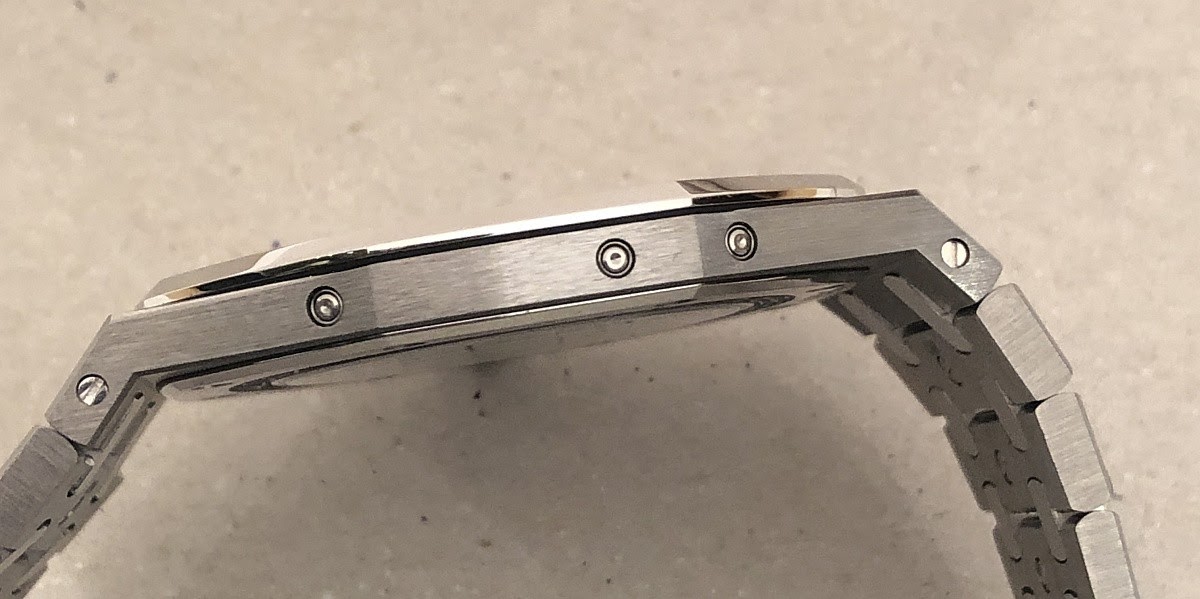
This is the reason why Audemars Piguet went further than this pure optimization by changing the architecture of the movement which offers a more rational and integrated structure. The caliber 5133 that powers the Royal Oak  Automatic Perpetual Calendar Ultra-Thin has a thickness of 2.89mm, which is a significant performance given the winding system and the complication. Imagine the prowess: the thickness of the case is 6.3mm what is more than 3mm gained compared to a traditional Royal Oak Perpetual Calendar. This was achieved by combining the perpetual calendar functions on one plane instead of the usual three levels. Two patents testify to this better integration: the integration of the end-of-month cam with the date wheel and the association of the month cam with the month wheel.


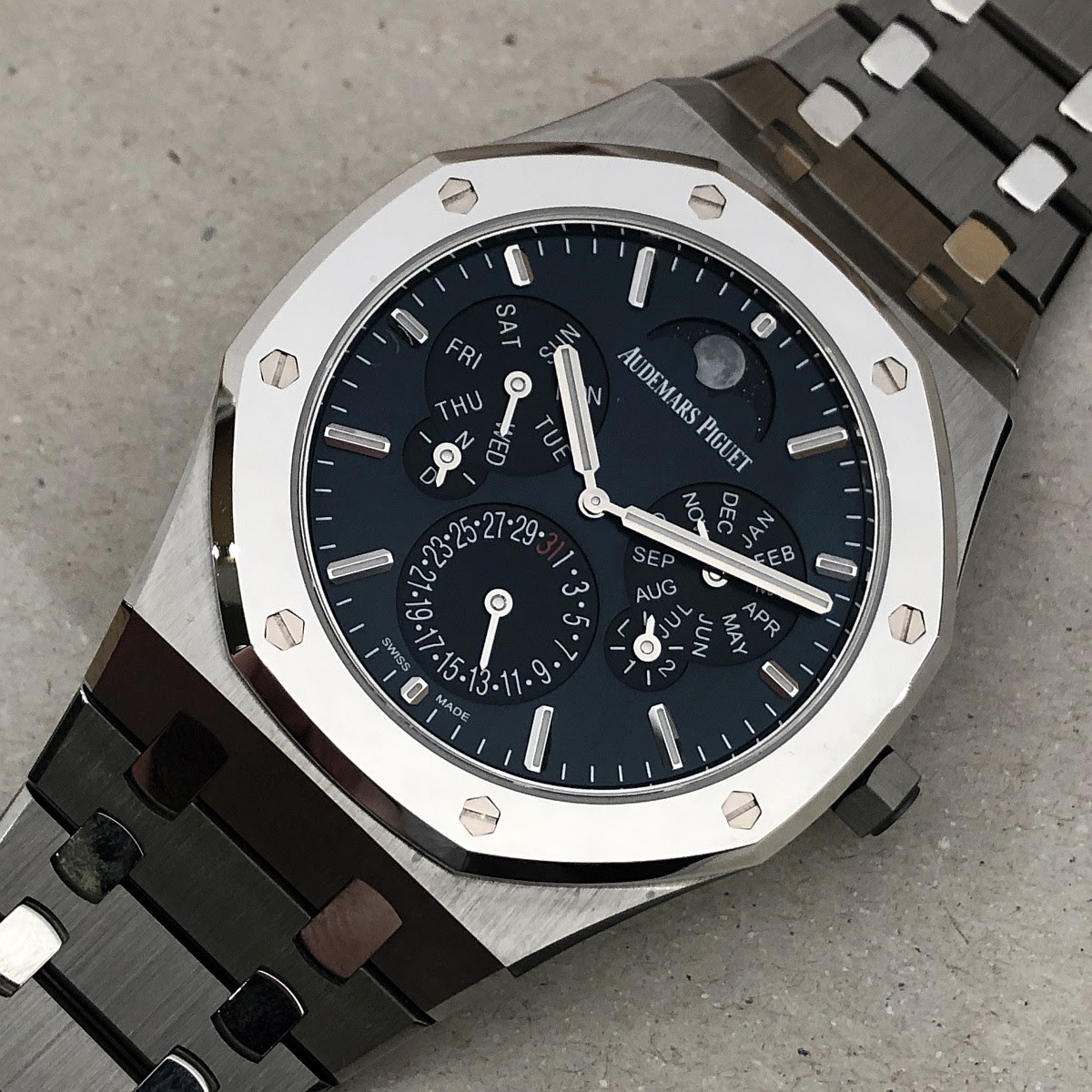
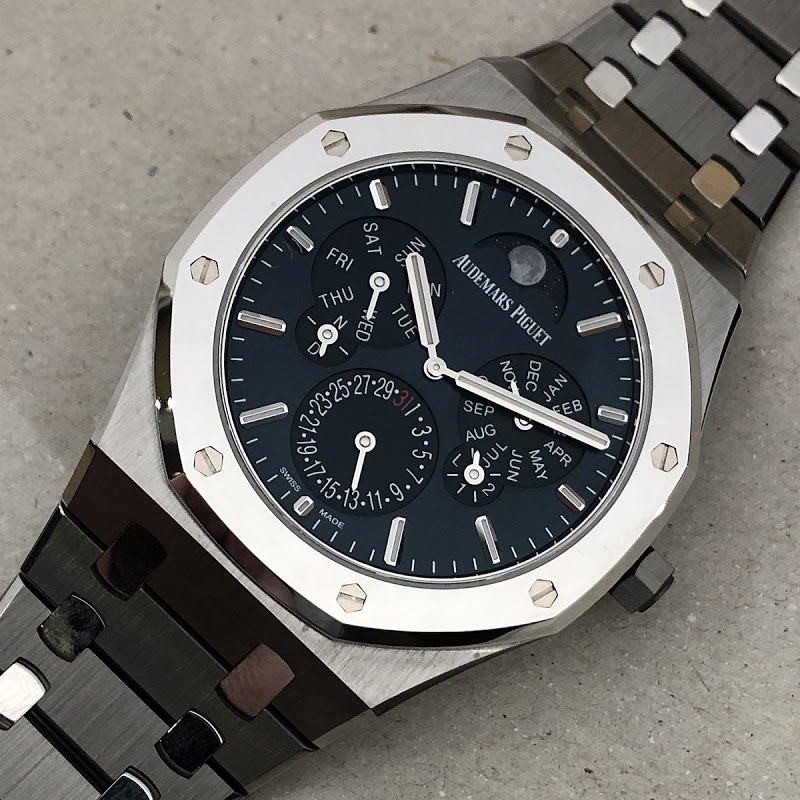
What is remarkable with this watch is that the result has been achieved without compromise from a practical point of view. The crown is handled like a normal crown. The traditional functions of the Audemars Piguet perpetual calendar are indeed present with, however, a different organization of the dial: the moon phases are at the top of the dial (usually at its base) and the dates are at 6 o'clock instead of 3 o'clock what I prefer: I find it easier to read them. Note that the leap year display is next to the month sub-dial instead of being inside and the presence of a very practical day & night indicator for the secure setting of the perpetual calendar functions. But above all, the displays have been enlarged, which significantly improves the readability, especially at the level of the dates, which remains the most important display.


If the reference 26586IP is the production version of the prototype RD#2, it is not however its clone. Two distinctive elements should be emphasized: the disappearance of the "Grande Tapisserie" pattern replaced by a satin blue finish with the most beautiful effect and the use of a titanium case which replaces the platinum case. The platinum bezel is however preserved. In fact, the final watch is lighter than the prototype: lighter in terms of weight but also visually speaking. The removal of the pattern from the dial finally gives a more contemporary appearance and favors the enlargement of the displays.

I must admit that I have a mixed feeling about the alliance between titanium and platinum. I understand the interest of combining two neutral color materials and which have different renderings. This gives a lot of subtlety and depending on the light conditions the contrasts can be strong. On the other hand, using a platinum bezel doesn't seem to me to be the best idea for a Royal Oak: the material gets scratches easily and, as a paradox, is very delicate to polish. The bezel is the most exposed part. Under these conditions, I would have preferred a case entirely made of titanium.


One thing is certain: from an aesthetic point of view, the Royal Oak Perpetual Calendar Automatic ltra-Thin is a real success. It is elegant, refined, contemporary. And above all, despite its slender style (a diameter of 41mm for a thickness of 6.3mm), it retains a very beautiful presence on the wrist. The quality of the finishes, the typical design of the Royal Oak, the way it plays with the light (the satin aspect of the dial, the alternation of the polished and satin parts), the realistic rendering of the moon contribute to this presence and to the incomparable charm of the watch.

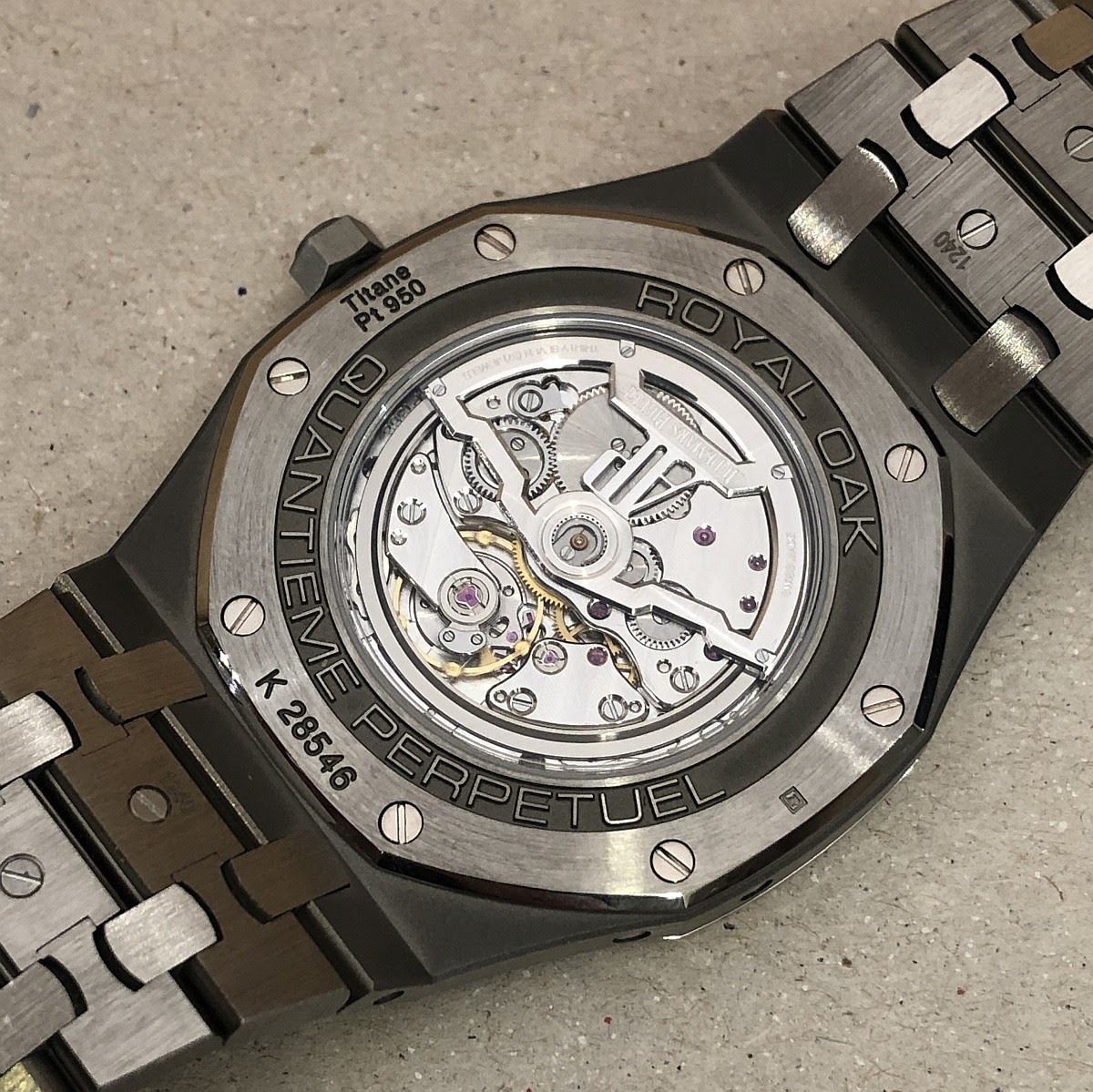
The back of the case also offers a very nice show. We are not disoriented since the 5133 movement was developed from a caliber 2120 which indicates that most of the work was concentrated on the specific perpetual calendar module. The consequence is that we find the performance linked to the basic engine, namely a frequency of 2.75hz and a power reserve, unfortunately too short, of 40 hours. The presentation of the movement is very neat while avoiding unnecessary spectacular effects. Audemars Piguet favored monochrome decoration and this is an excellent idea, consistent with the design of the watch. I really liked the rendering of the movement and its larger diameter is more aesthetic.


Audemars Piguet has therefore undoubtedly struck a blow with this Royal Oak. The thinness record is above all part of an aesthetic approach and the result is magnificent. The watch exudes an atmosphere that is both technical and elegant and depicts in a certain way the future ambition of the manufacture. The work carried out on the movement provides proof of all its capacity for development and improvement of the existing. The reference 26586IP is extremely innovative but it doesn't forget the roots and fundamentals of the brand. It is an aesthetic extension of the other Royal Oak Perpetual Calendar while offering small stylistic evolutions that make sense. Once put on the wrist, the reference 26586IP surprises with its comfort, its slender style and above all its readability. If I had to put under the spotlight only one element, I would underline the effort made on the enlargement of the date display. Because a watch featuring a perpetual calendar complication whose dates are not legible has lost all its meaning. And we know a lot in this case. Audemars Piguet has not forgotten the practical objectives in its quest for the thinness record and that is what makes this watch so successful and so attractive. Its price is unfortunately (and logically) at the height of the peak reached: 140,000 Swiss francs excluding taxes. But I am not very worried: carried by its beauty, its technical content and the Grand Prix of the Aiguille d'Or obtained during the GPHG 2019 a few weeks ago, it will not experience any trouble to find customers. It is rather the latter who will have difficulty to get it.


Pros:

+ a technical success in the service of the aesthetic approach
+ the dial lay-outand the enlarged date display
+ a refined decoration without unnecessary effect
+ the comfort on the wrist

Cons:

- the platinum bezel can easily get scratches
- the power reserve, too short especially for a perpetual calendar watch

Fr.Xavier

About the Audemars Piguet Royal Oak Ref. 26586IP

The Audemars Piguet Royal Oak Perpetual Calendar Ultra-Thin, reference 26586IP, represents a significant achievement in horological miniaturization. This reference is notable for its exceptionally slim profile, making it the thinnest automatic perpetual calendar watch available at its introduction. It builds upon the technical advancements first showcased in the RD#2 prototype, translating that innovation into a production model within the esteemed Royal Oak collection. Its design integrates the complex perpetual calendar mechanism into a remarkably slender case, distinguishing it from other perpetual calendar offerings.

This timepiece features a case crafted from a combination of titanium and platinum, providing both lightness and structural integrity. The case houses the self-winding Caliber 5133, an ultra-thin movement specifically engineered for this model. The watch is fitted with a sapphire crystal, ensuring clarity and scratch resistance for the dial. The intricate perpetual calendar display, including day, date, month, leap year, and moon phase, is presented on a blue dial, maintaining legibility despite the movement's complexity.

For collectors, the 26586IP appeals to those who value technical innovation and a discreet yet highly complicated watch. Its status as the world's thinnest automatic perpetual calendar at launch positions it as a landmark piece in modern watchmaking. The use of mixed materials for the case further enhances its appeal, offering a distinct aesthetic and tactile experience within the Royal Oak Perpetual Calendar series. This reference underscores Audemars Piguet's commitment to pushing the boundaries of mechanical watch design.

Specifications

Caliber
5133
Case
Titanium and Platinum
Diameter
41 mm
Dial
Blue
Water Resist.
20 m
Crystal
Sapphire

Key Points from the Discussion

Advertisement
The Discussion
MD
mdg
Dec 30, 2019

thank you. I agree about the power-reserve and the bezel. I am guessing (I hope) that the bezel may be replaced during service. Not cheap but at this price point I doubt owners would be too worried. Although I don't see any reason why the bezel cannot be made out of some sort of scratch-proof ceramic or carbon fiber. So the leap-year indicator goes counter-clockwise? Seems a bit odd. With the time on your photos shown at just after 10 (it appears to be a.m. going off of the D/N indicator) it see

K-
K-Lo
Dec 30, 2019

On a full ceramic 15202!!!! 40 year wait list?

MT
MTR
Dec 30, 2019

The calmed dial is mesmerizing and practical (= legible), too. I have been searching for the „right“ PC for quite a period now and not many dials have proven to be really legible which always stops my first enthusiasm. For me the PR of 40 hours isn‘t a big con. Ideally it should have 72 hours, so otherwise 40, 42 or 48 hours for an automatic movement make no big difference for me. With regard to the Platinum bezel I have one question: is this material really so delicate or does it depend on the

M4
M4
Dec 30, 2019

I must admit it is an object of lust even if I'm normally not inclined toward perpetual calendar watches or blue dials. This one, however, brings the bell. Thank you for the review. M4

MD
mdg
Dec 30, 2019

The movement seems a tad small from the photo, but just think what they could do with this in a time-only dress watch : )

AL
als1678
Dec 30, 2019

Everything you say makes sense. But to be honest, this kind of watchmaking is not my cup of tea. It is very challenging to make such uber thin perpetual, but that is all it is doing - making an already thin and elegant watch thinner. To my taste It is an artificial challenge, it doesn't address the power reserve limitations of a perpetual (VC), safe setting of the calendar indicators in both directions (MBF), moving all the indicators simultaneously (Lange). It looks great, but I would not choos

Advertisement

Continue the conversation

This thread is active on the Audemars Piguet forum with 18 replies. Share your knowledge with fellow collectors.

Join the Discussion →