
PeterCDE
10167

Under the Hammer: The DATOGRAPH PERPETUAL in the Test Lab
Under the Hammer: The DATOGRAPH PERPETUAL in the Test Lab
You may expect a watch made by A. Lange & Söhne to live longer than its owner.
Therefore, all new models are subjected to one of the most extensive tests in the
watchmaking industry. Even the most complex ones, such as the DATOGRAPH
PERPETUAL.
Any true watch aficionado would like to lock this model away in a safe and wear gloves
to take it out: A DATOGRAPH PERPETUAL by A. Lange & Söhne. With the ingenious
combination of a flyback chronograph and perpetual calendar, it is a watch made for
the moment and for eternity and one of the most complex calibres made since the
reestablishment of the traditional Saxon manufactory 18 years ago.


Since Christoph Schlencker has been responsible for A. Lange & Söhne’s testing lab, there has not been a single problem for which he didn’t find a solution eventually.
Christoph Schlencker, on the other hand, doesn’t even remove it from his wrist when he digs
up his garden or lays out the flooring in his living room. It is his job to find out how much
abuse this watch is able to withstand, how sturdy and stable its individual components are
and how well the watch maintains its precision when you do something with it that you really
shouldn’t. For example: Letting the DATOGRAPH PERPETUAL fall from a
height of one metre. This is the purpose of the hammer test; the watch is subjected to a
standardized hammer blow that is the exact equivalent of a fall from a height of one
metre onto a hard wooden floor. In the course of the test, the parts must withstand
sudden stress equivalent to 5,000 times their own weight. In other words: For a split
second, a watch part weighing one gram will have a "weight" of five kilograms – and
needs to hold up to it.

In an impact test, movements are exposed to collision forces equivalent to a free fall from a height of one metre onto a hardwood floor. The short-time loads exerted on the components correspond to 5,000 times their own weight.
It is Schlencker’s goal to make sure that the DATOGRAPH PERPETUAL remains in
perfect working order even after such abuse. When it comes to sturdiness and reliability,
every A. Lange & Söhne watch must meet the same requirements. He is looking for
ways to improve the construction and materials or to streamline the manufacturing
process. He is the head of the test lab. It is one of the most important positions at A.
Lange & Söhne. It is not, however, one of the most popular. A part of Schlencker’s job
is to make his colleagues’ lives as difficult as humanly possible. Whatever the designers
think up and the prototype engineers put together, he will do his best to destroy it.
He looks for the weak spots of every design. All new ideas must pass his critical
muster. Not a single watch design goes into production without being tested by him.
Schlencker established the laboratory eight years ago. When the manufacture was
looking to fill the position, the trained watchmaker seized his chance right away. It was
the job he had been waiting for all his life. For Lange, it was about establishing the
strictest quality controls in the entire fine watchmaking industry.

The button tester presses each button 50,000 times. Spring-mounted metal bolts with silicone caps simulate human fingers, because a precise bolt would put less stress on the mechanism than elastic skin.
A crash test laboratory was to be created according to the example of the automotive
industry, which would also be a place where technical treasures would receive their ultimate
fine-tuning. Basically, the test lab should not be a place of destruction, but one of research.
Schlencker was able to buy some of the necessary equipment and developed the other
tests himself. The "shaker test", for example. Essentially, it is a simple wooden box
rotating in all possible directions, back and forth, diagonally and with loops, and all this
at an irregular speed. Inside, a watch bangs against the wall four times per second,
and after 24 hours, the piece looks as if its wearer had just climbed the Nanga Parbat.
"The shaker simulates five years of mechanical stress caused by an athletic wearer,"
Schlencker says. Following this ordeal, all 556 parts of the DATOGRAPH PERPETUAL
still have to be firmly in place and work flawlessly.
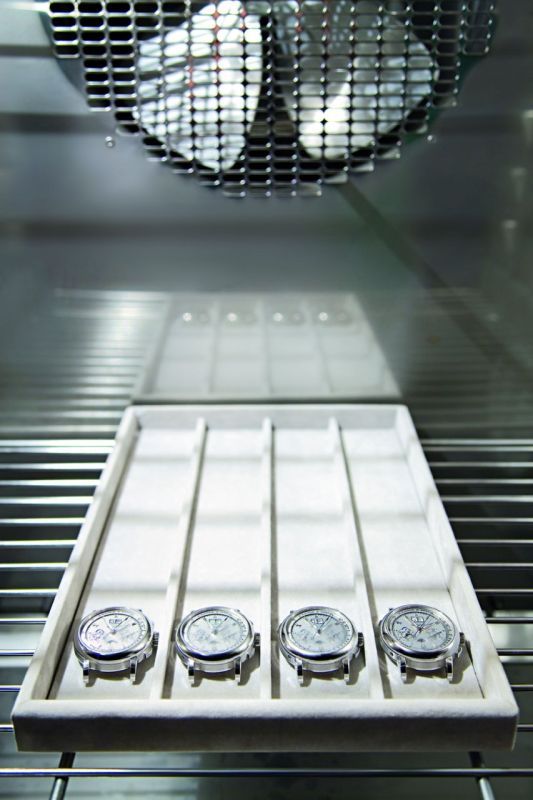

One of the biggest strains that can be put on a mechanical movement is a quick and extreme change in temperature. Therefore, Christoph Schlencker is able to simulate all climatic zones in the world with his climatic chamber. From 80 degrees of humid heat to minus 20 degrees of dry cold.
Then he developed a "pusher tester", which he modified to test the watch’s long-term
stability with a realistic simulation. From a distance, it looks like a huge spider. On
closer view, it consists of many little bolts pressing the pushers of the DATOGRAPH
PERPETUAL again and again; after 50,000 times each on start, stop, reset and
flyback, the buttons must work as precisely and with the same resistance as they did
on the first day. The main push piece, which advances all calendar displays, including
the outsize date, collectively by one day, is also pushed 50,000 times during the development
stage, advancing the watch more than a hundred years. This is the only way to
ensure that the perpetual calendar will actually work in perpetuity. The problem with
this machine is, however, that the stress caused by finger pressure is much greater
than that of a bolt, because a finger builds up the force slowly until it overcomes the
resistance of the button, then pushing the button against the base with a lot of excess
energy. Schlencker simulated this by mounting the bolts on springs and placing silicone
caps on the ends. In addition, he created a device that can wind up the movement
automatically during the tests, so that he doesn’t have to interrupt the torture on weekends.
Schlencker also procured a climatic chamber that is able to replicate all climatic zones
around the world from minus 20 degrees of dry cold to 80 degrees of humid heat. It
tests the temperature resistance of the movement. Schlencker also bought a "torque
testing machine" to measure the power reaching a gearwheel and the percentage of
power used by the wheel itself. The less energy lost, the better it is for the durability of
a movement. For a well-adjusted wheel, the power efficiency is estimated at 93
percent. The rest is lost to friction and power consumption. And every percent of lost
efficiency shortens the lifespan considerably. He can observe the consequences with a
high frequency camera that is able to take 10,000 images per second and show the
details of even the fastest motions. Errors not detectable by the naked eye, such as the
inertia-related overshoot of dynamically accelerated and abruptly braked parts – such
as the outsize date – or a mechanical conflict between two parts, can be revealed and
remedied with this method. It is an indispensible diagnostic device that was an
essential part of the development of the precisely jumping minute counter in the
DATOGRAPH PERPETUAL.

The laser of the balance spring analyzer scans the balance, measuring the frequency and amplitude of the oscillation. With this method, balance and spring can be adjusted to perfection during the construction phase. That in turn is one of the reasons for the precision of the new movement, which is unequalled in modern fine watchmaking.
Still, Schlencker wasn’t entirely satisfied. It was his vision to be able to examine individual
assembly groups within a watch, before the respective watch even existed. The
problem with watch construction is that design-based irregularities during operation can
be recognized only when the entire watch is finished. The interaction of spring and
balance in particular always proves to be problematic. For this reason, Schlencker
looked for a method to coordinate the two components exactly. Without interference
from the rest of the going train. This necessitated a device capable of measuring the
number of oscillations of a balance spring per minute and the movement in both directions,
because the amplitude would show the force behind the oscillations. Schlencker
needed a laser beam that scans an oscillating balance permanently, counting the
frequency and measuring the amplitude in any conceivable position, in order to simulate
the different influences of gravity. In addition, he needed software that would
calculate and turn this data into graphic curves. It took three years to develop the
device for Lange that is now officially called the "balance spring analyzer". It was a true
milestone. The analyzer was used for the development of the DATOGRAPH PERPETUAL.
For this watch, the Lange design engineers developed a balance spring that was
optimized for this type of watch, could be produced in-house and would ensure a
perfectly stable movement. With the help of the balance spring analyzer, different
prototype models were adjusted to the balance, until the result was flawless. The tests
were then repeated with the finished watch. All that hard work paid off. The average
deviation of the DATOGRAPH PERPETUAL was between 0.5 and 2 seconds per day.
A value under 6 seconds is generally considered to be very precise.
In terms of corporate organization, the test lab is a part of Product Development. It
employs the best watchmakers in the country. People who love problems and possess
a strong sense of logic and understanding of physics, with extensive knowledge about
all the watches of the manufacture. And they must be able to endure something that
causes every passionate watchmaker physical pain: Hitting a 100,000 euro watch with
a hammer.
*****

Data sheet DATOGRAPH PERPETUAL
Movement: Lange manufacture calibre L952.1, manually wound, crafted to the highest Lange quality standards and largely assembled and finished by hand; precision-adjusted in five positions; plates and bridges made of untreated German silver; balance cock engraved by hand
Number of parts: 556
Jewels: 45
Screwed gold chatons: 4
Escapement: Lever escapement
Balance: Shock-proofed glucydur balance with eccentric poising weights; superior-quality balance spring produced in-house, with patented attachment design (balance spring clamp), frequency 18,000 semi-oscillations per hour, precision beat adjustment with lateral setscrew and whiplash spring
Power reserve: 36 hours when fully wound
Functions: Flyback chronograph with precisely jumping minute counter; perpetual calendar with outsize date, moon-phase display, day of week, month, four year/leap year, and day/night indication, hours, minutes, small seconds with stop seconds, tachometer scale
Operating elements: Crown for winding the watch and setting the time, two push pieces for operating the chronograph, a universal corrector for simultaneously advancing all calendar displays plus one recessed push piece each for the day of the week, the month, and the moon phase
Case: 41 millimetres in diameter, platinum
Crystal and caseback: Antireflection-coated sapphire crystal (hardness 9)
Dial: Solid silver, rhodié
Hands: Rhodiumed gold; blued steel seconds hand, chrono hand, and minute counter
Strap: Crocodile strap with solid-platinum Lange prong buckle
Text and images by A. Lange & Söhne, 2008


Under the Hammer: The DATOGRAPH PERPETUAL in the Test Lab


Lange perform very well also under a different kind of hammers:


