
Marcus Hanke
[PuristSPro Moderator]
11295

Press release: UN Classico "HMS Caesar" cloisonné enamel
Press Release
June 28, 2011
HMS Caesar Classico Cloisonné.
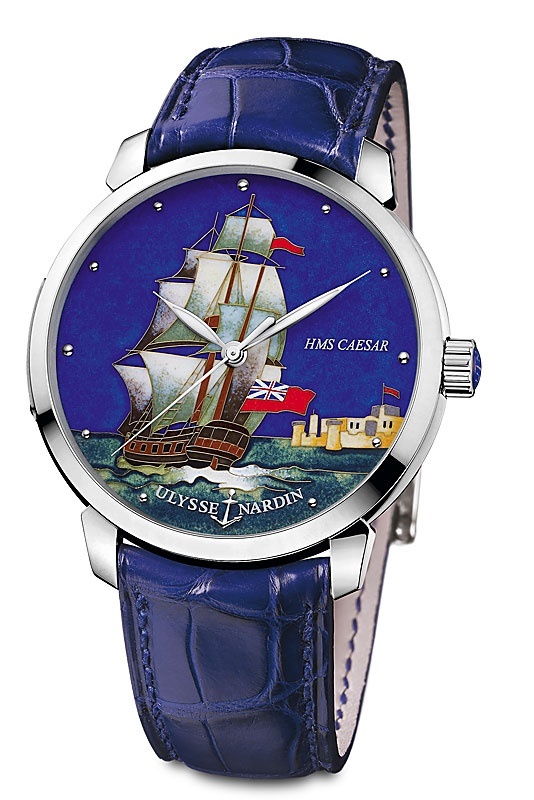
The Majestic class battleship, the HMS Caesar, an eighty-gun ship of the
Royal Navy was launched on November 16, 1793. The ship, named after
Julius Caesar, was designed by Sir Edward Hunt, and built at the
Plymouth Dockyard. It became known as a fierce fighting ship, most
notably remembered as one of six British ships in the famous 1801 Battle
of Algeciras Bay, between an allied French-Spanish fleet and the British
near Gibraltar.
In the Battle of Cape Ortegal in 1805, Sir Richard Strachan in the HMS
Caesar defeated and captured a French squadron. And, in 1809, the HMS
Caesar, with Captain Charles Richardson as commander, engaged in an
attack on a French squadron while blockading the harbors of the Atlantic
coast. The HMS Caesar emerged victorious in her many voyages. After
being converted to a depot ship in 1841 and proudly sailing for 28
years, the HMS Caesar was demolished in 1921.
Ulysse Nardin pays tribute to this noble Royal Navy seafarer with a
timepiece that features the HMS Caesar in all of its splendor, its regal
red flag drawing the eye in to view the intricacy of the cloisonné dial.
Special in many ways and a collector's item, the HMS Caesar combines a
great mechanical timepiece with the lost art of enameling.
With its stately sails blowing proud against a backdrop of deep blue sky
and resting on the greenish blue sea, the HMS Caesar impressively
represents this complicated technique while also appearing to embody the
lively spirit and history of this great vessel. In the process, a
variety of colors and tones ― opaque, transparent or translucent ― are
derived from the proportions in which the elements are mixed in order to
get amalgams, the composition of which is often a secret. Through the
ages, this technique has been well-used in watchmaking and desired by
collectors.
Remarkably, each segment is divided by a gold wire segment that prevents
the liquid powdered enamel to flow into other melting chambers. Over
500mm of fine gold wire is needed to make the cloisons, a practice that
requires 50 working hours and 26 processes to complete each cloisonné
dial. An authentic representation of the skill and creativity of the
enameller specialist, the cloisonné technique applied to the HMS Caesar
is one of the most refined and intricate artistic disciplines and is
mastered by less than a handful of artists.
The HMS Caesar joins other original and exquisite timepieces in Ulysse
Nardin's Cloisonné collection, and is available in a limited edition of
30 pieces each, in 18-karat white or rose gold, and measuring 40 mm in
diameter. The self-winding watch is powered by the UN caliber 815
movement that has been COSC Chronometer certified and has a power
reserve of 42 hours. Of course, no seafaring timepiece would be worth
its salt if it was not water- resistant – the awe-inspiring watch is to
50 meters.
The HMS Caesar from Ulysse Nardin stands tall as the ultimate symbol of
fine artisan craftsmanship combined with unrivaled mechanical know-how.
Undoubtedly, this is a timepiece that is destined to earn its own
legendary place in history.
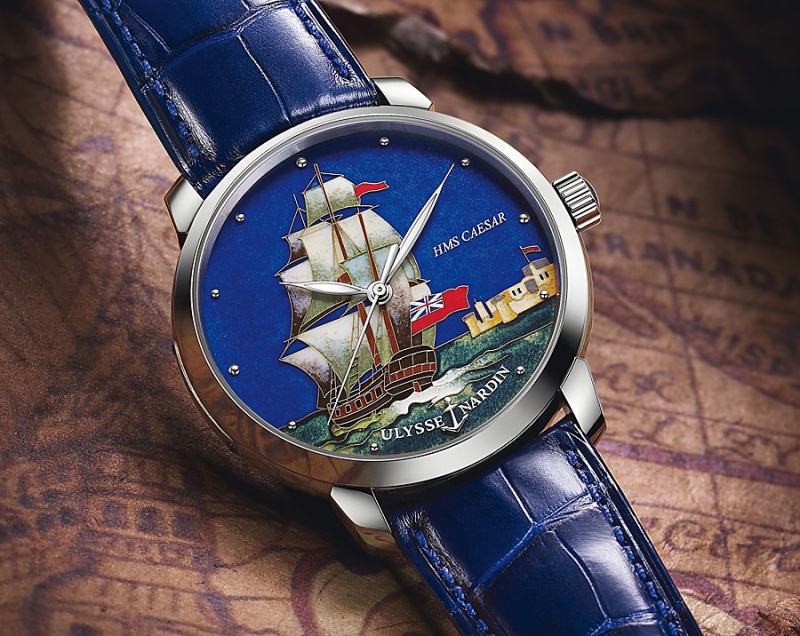
Technical Data HMS Caesar Classico Cloisonné
Ref. 8150-111-2/CAESAR 18ct white gold
Ref. 8156-111-2/CAESAR 18ct rose gold
Movement UN-815, COSC certified
Power reserve Approximately 42 hours
Winding Self-winding movement Functions H/M/s
Diameter 40 mm
Dial Enamel cloisonné HMS Caesar
Crown Water-resistant
Water-resistance 50 m
Crystal Anti-reflective sapphire crystal
Case -back Open case back with sapphire crystal fixed with screws
Bracelet Alligator
Limitation 30 pieces
Press release: UN Classico "HMS Caesar" cloisonné enamel
Press Release June 28, 2011 HMS Caesar Classico Cloisonné. The Majestic class battleship, the HMS Caesar, an eighty-gun ship of the Royal Navy was launched on November 16, 1793. The ship, named after Julius Caesar, was designed by Sir Edward Hunt, and bui...

Very nice!
The tradition is perpetuated with these new dials. Always a pleasure to see these marvels! Best, Nicolas.