
Cpt Scarlet
[Moderator - Cartier - WristScan]
38734

Incredible Journey...
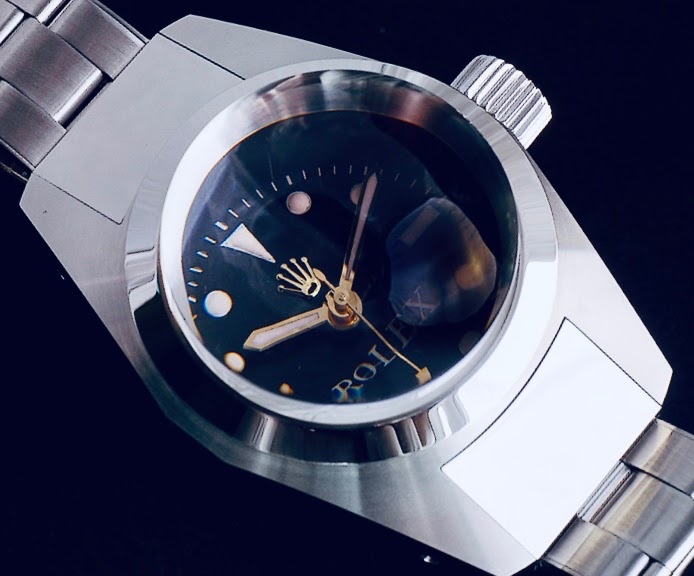
Diving is always dominated by innovation and the buying new equipment this is not just in the world of professional diving but even by sports divers and watches and instruments play a major role in this. Despite the ever increasing complexity of dive computers practically every diver still keeps a trusty sports or diving watch firmly strapped to one wrist. Rolex have built a strong reputation in diving based research, development and real experience in extreme conditions.
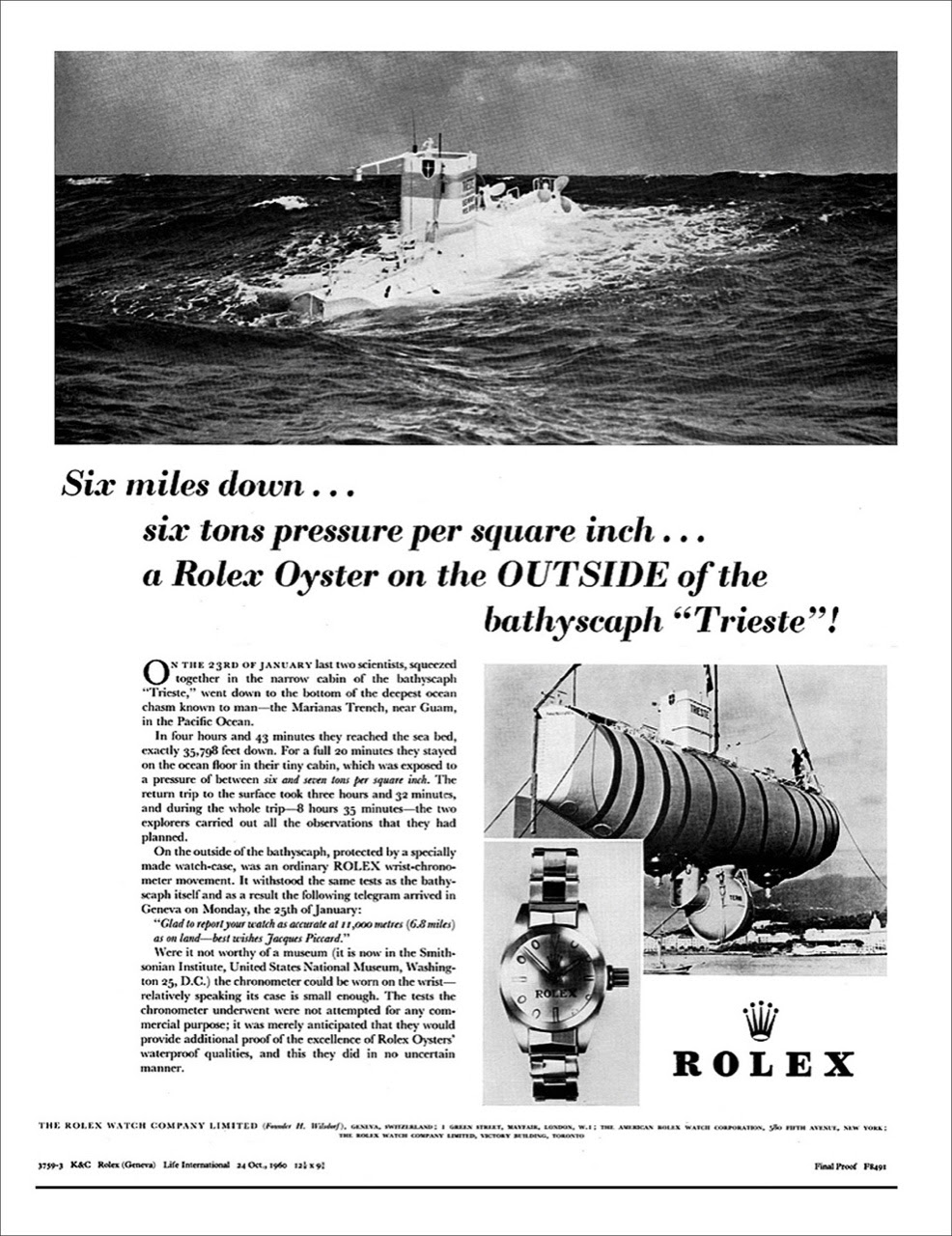
Rolex made the decision to take up a significant challenge as part of its extreme testing program and push the envelope of what was considered possible with diving watches. This began with a test expedition in 1953 to the deepest parts of the Earth’s oceans is the Mariana Trench in the Pacific Ocean and ultimately a record breaking dive in 1960.
Space exploration is often compared to deep sea exploration and to put this into perspective it wasn’t until 1957 that the first artificial satellite, Sputnik I was launched by Soviet Union and eventually 1961 when Soviet cosmonaut Yuri Gagarin completes the first manned space flight.
The deepest part of the worlds oceans is the Mariana Trench in the Pacific Ocean. The trench is about 2,550 kilometers long with an average width of 69 kilometers. It reaches a maximum-known depth of 10,994 m (± 40 m) or 36,070 ± 131 ft at a small slot-shaped valley in its floor known as the Challenger Deep, at its southern end. Rolex made the decision to send a watch, strapped to the outside of a submarine down to that depth. The Submarine was in itself an incredible piece of engineering and was designed by Swiss scientist Auguste Piccard and built in Italy. It was named Trieste and was launched on 26 August 1953
The expedition was a total success with the watch returning to the surface in fully functional condition. This is the Rolex Deep Sea Special, the first watch ever to dive to the depths of the bottom of Challenger Deep. People automatically assume that Rolex designed and built one piece that made the epic dive in 1960 but far more work went into this project by Rolex. Ultimately Rolex is the only watch company ever to have completed this challenge.
A test expedition was organized in 1953 where the watch was tested to a depth of 3,150 m was No. 3 and No. 5 and a later series were redesigned from what Rolex learnt from the 1953 expedition.
The watch used in in 1960 was Number 3 going to a depth of 10,908 metres.
Seven prototypes are known to exist with the possibility that two further prototypes were made. The first of the prototypes had a low glass over the dial, and the later versions had a much thicker high dome glass.
The black dialed Deep Sea Special with number 01 engraved, sold by Christie’s in 2005 for CHF 322,400. This was an early low glass version.
On the 2nd of December 2009, Deepsea Special No 31 sold at auction for HKD 3,380,000. £327,500 or $430,588 at today’s values.
Available on the marketplace
18,866 Rolex listings are live on the eBay market and 1886 collector listings on the WatchProSite marketplace.


Incredible Journey...


the prototypes are true - no ?

As Rolex is obviously not producing this watch, are there any companies out there that try to recreate this model? [nt]
Good point..
Yes there was a company and here it is ........
I probably did but that was a few years ago. I was more interested in this one ......

Testing depth ratings
you'll see this Rolex in the 'H' talking watches with R.Beyer....

Like the fact that it withstand the depth of the Marianas trench.
