

My review of the PP ref 5070G
The Patek ref 5070 chrono was initially offered in two metals, yellow gold in 1998 and white gold a few years later. It was to be the last of the Lemania based chrono movements with a new in house movement the 29-535PS to be used in the new chrono line, the reference 5170
The 5070 was large , at 42mm , it was based on a vintage reference 2512 split second chrono ( which incidentally was even larger at 45mm) but the movement ( 27-70) which some purists ( as opposed to Purists) feel is an iconic movement in horology is shared with another favourite of collectors the Omega Speedie reference 321.

This watch was special not only because of its size but it had a see through back and the wonderful movement could be seen in action , a rarity for a chrono.


The sibling Omega speedier with a 321 movement
Starting at the case.

- 1. The bezel is double stepped ( or triple if you include the crystal) giving it a vintage art deco appeal
- 2. The lugs are seamlessly welded to the case ( as opposed to the 150 anniversary ref 5975 where the lugs a e attached to the case. The lugs have a softer double step with a larger central area and a very small peripheral step, as opposed to the half and half step of the 5975.
- 3. The case back is a see through allowing full movement of the wonderful movement ( more on that later)
- 4. The pushers are square which befits a vintage styled piece like this- very masculine
- 5. Crown is slightly recessed into the case
Interestingly the large case size does not wear all that big (it is big, make no mistake) but he slim height of 12 mm and the down turn of the lugs makes for a subtle watch not in your face dinner plate on the wrist horology!

Lugs on 5070
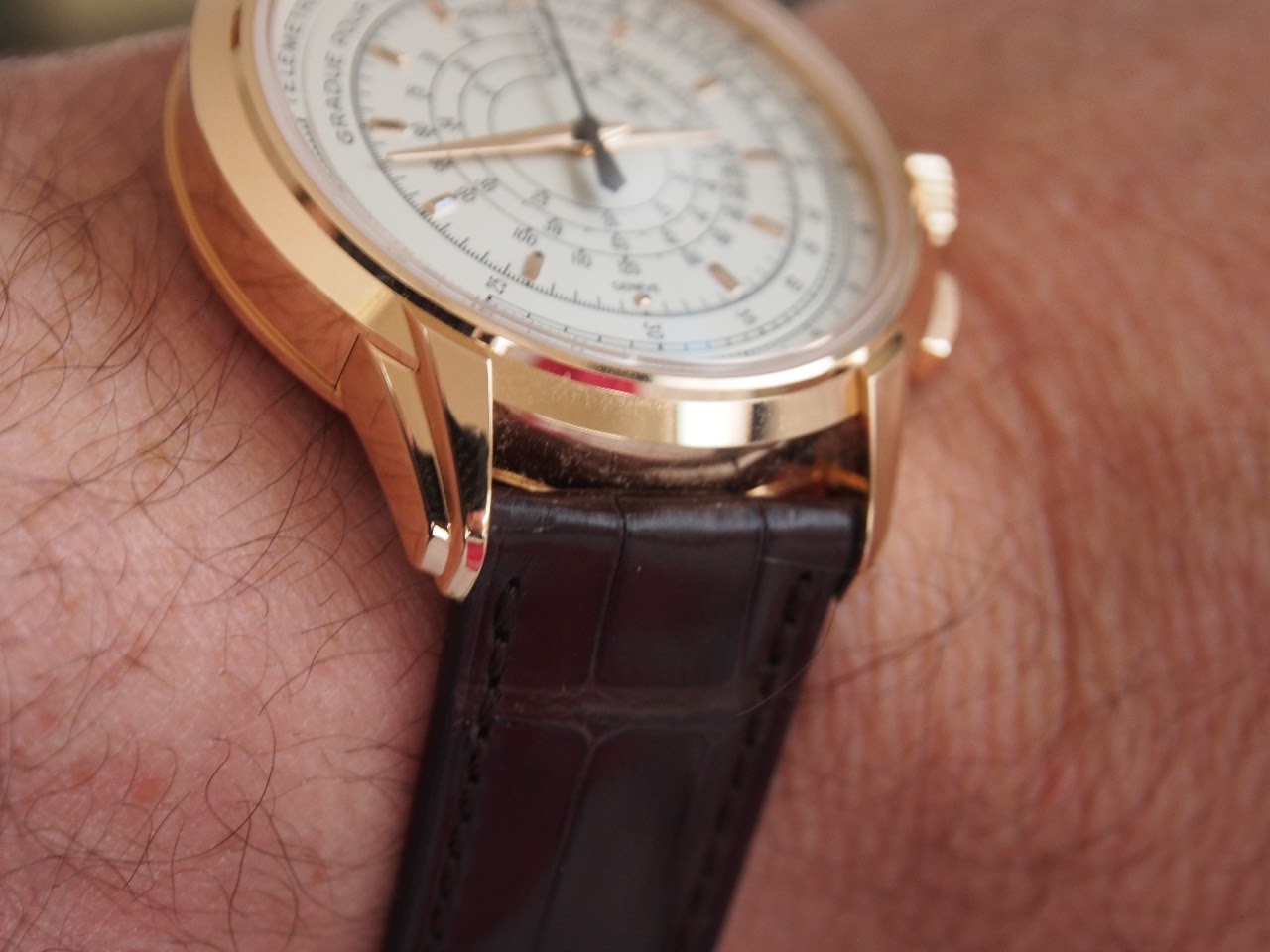
Lugs on 5975

Recessed crown with Calatrava cross
Dial and Hands
The dial in the white gold model is silvered with minimal texturing or brushing . It has an outer seconds ring with an inner tachymeter. The large size allows for both with the Arabic numerals in black applied to the dial. Strangely numerals 2,4 8,10 are all cut off by the two largish sub-dials which are subset below the original dial. If this was a Daytona it would be called “big eyes”

The blackened feulle hands are so easy to read, important for a presbyope like myself.
Movement
The classic lemania based movement is a reworked and re- engineered one CH27-70.It differs from the original by having an Breguet overcoil and a gyromax balance beating a 18 K Hz. It has Geneva stripes and lovely anglage with a finishing way beyond the original Omega ref 321. It has the the Poincion de Geneve on one of the bridges

Geneva stripes, perlage and Breguet overcoil with the Poincion geneve on the bridge
Large gyromax balance wheel
It has a horizontal clutch as opposed to the vertical clutch of the new movement in the 5975.

Another look at the movement
My impression of the watch after wearing it for a week
I generally wear smaller vintage pieces . This piece is large on my small wrist but not ridiculously so .
I love the legibility of the dial.
The white gold is a big plus in my opinion as it does not scream high end or expensive .
I generally love chronos ( even though I hardly use the function) This one is as smooth as silk. The stop /start/restart is very easy and no jump is seen at all.
I need some time to get used to wearing such a large watch. After swapping it for one of my vintage pieces , they appear small even at 35 mm.
The 5070 is destined to become a PP chronograph classic and it certainly deserves such accolades.
The design of the case and the lugs together with the magnificent yet quirky dial( who cuts numbers in half - really) makes this piece another one of my favourites in my collection
Julian


The down turned lugs makes the profile appear little slimmer
