
watch-guy.com
4580

Same. Same but different
2584 and 3417. two numbers which most probably mean very little to 99.5% of watch collectors.
Unless you are a WIS and collect Patek Phillipe.
Show these two watches side by side and most people including watch aficionados would not see much difference between. The obvious one being one in gold and the other not. I would hazard a guess most people would say they are the same model in different metals.
Looking from the outside, you can see why.
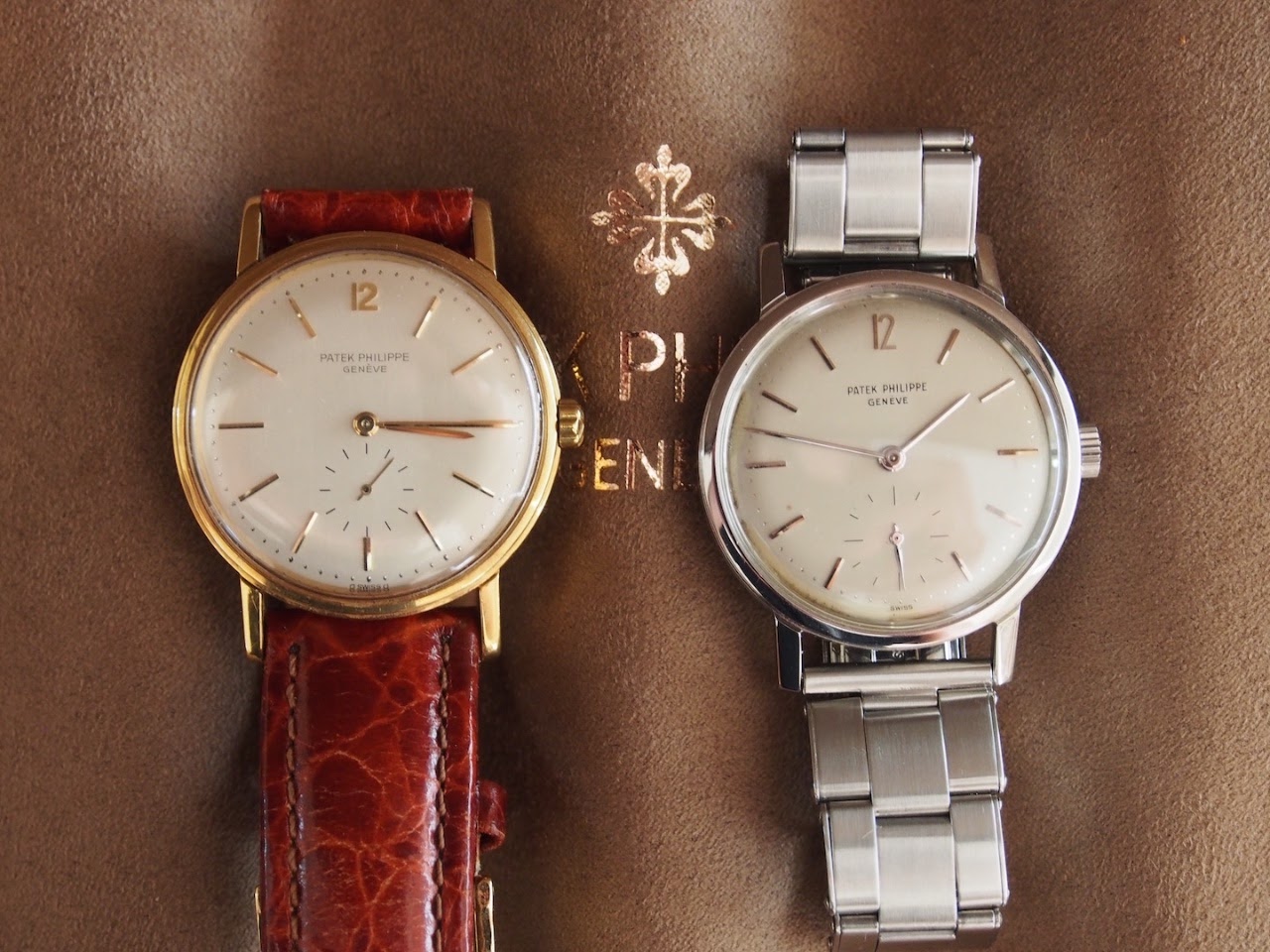
Similar case, similar lugs, similar dial and hands. Similar but not identical.
So why are these two models so different, in terms of watch collecting. One is in demand and the other not so much.
Ok one is stainless steel (3417), so it should be less valuable but as you may know stainless steel Pateks are much more sought after. Less were made and now I suspect less remain especially in such condition.
But the other 2584 is not only gold but also automatic. Not just any automatic movement. The king of automatic movements made by one of the most prestigious brands in the 1960’s when Patek was at the height of manufacture and design. The 12-600. The same movement that is in the ref 2526- a very desirable calatrava with an enamel dial.
The 3417 is a manual wind watch. Again not any movement but the moderately rare ref 27 AM 400. Those in the know understand that this movement is the antimagnetic movement. Similar to the Milgauss from Rolex, the Ingenieur from IWC , the Railmaster from Omega and the Geophysic from JLC.
Movements are not similar but all are protected from high magnetic fields but construction and a faraday cage construction.
The Amagnetic is protected to about 1200 Gauss , similar to the Milgauss
I will not go into the details of these two movements as they have both been covered extensively in the past. I have written about the 12-600 as has Michael Friedberg and Marco Stanga has an excellent treatise about the fine details of the 3417.
Let us examine the individual characteristics of each watch.
Casse, lugs, dial and crown
Case – similar round case . 3417 35mm – large by vintage standards . 2584- 36mm even larger
Thickness 3417 is 11mm thick to account for the Faraday cage whereas the 2584 is a tad thinner at a more comfortable 9.7mm

Lugs- similar but the 2584 has a curve or bump at the base whereas the 2417 is straight. But slightly thicker. Both , interestingly have a fine groove where the lug meets the case. A lovely touch.


Dial. Similar but different. Both have simple stick indices and the number “ 12” but the design of the number is slightly different on the 3417.A little more elongated and art deco in design whereas the 2584 is more classical”. Also both have a sub second dial at 6 o’clock.
This model 3417 does not have the “ Amagnetic” on the dial – which was present in only 60-70% of these models.


The crown. The 2584 has the classic double PP crown found on all automatic Pateks with the 12-600 movement. The 3417 has a lovely stainless steel crown with the calatrava crsoss embossed onto it.


Accounting for all these differences, why is one so much more desirable than the other?
This is one of the delectable things about collecting – watches or anything else. Human nature is so fickle that it is often impossible to predict why one watch which is so similar to another becomes more collectable. Now that does not not mean that the 2584 is a “ dog” and would not grace any collection- hell I own one and I love it but I am still not sure why the stainless model si so much more desired and thus more expensive. I get the stainless steel is much less common, I get the movement is different but hey , who these days lives in a magnetron?
Gold versus steel
Auto versus manual

Go figure…….


Same. Same but different


2 wonderful examples, many thanks for the post

Thank you for this great post!

Thanks for this delectable review, my friend.

A really great article....

Just read your post. Its very informative.
Thanks everyone for your kind words
