
Something interesting I missed at SIHH....
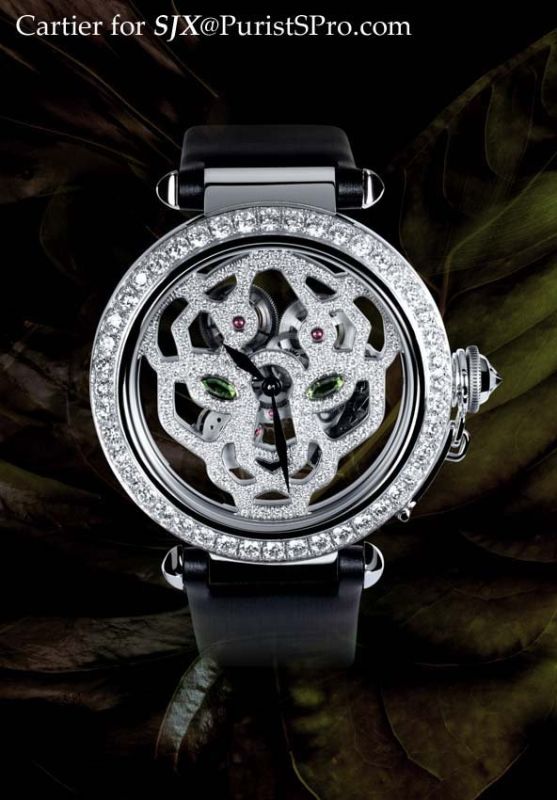
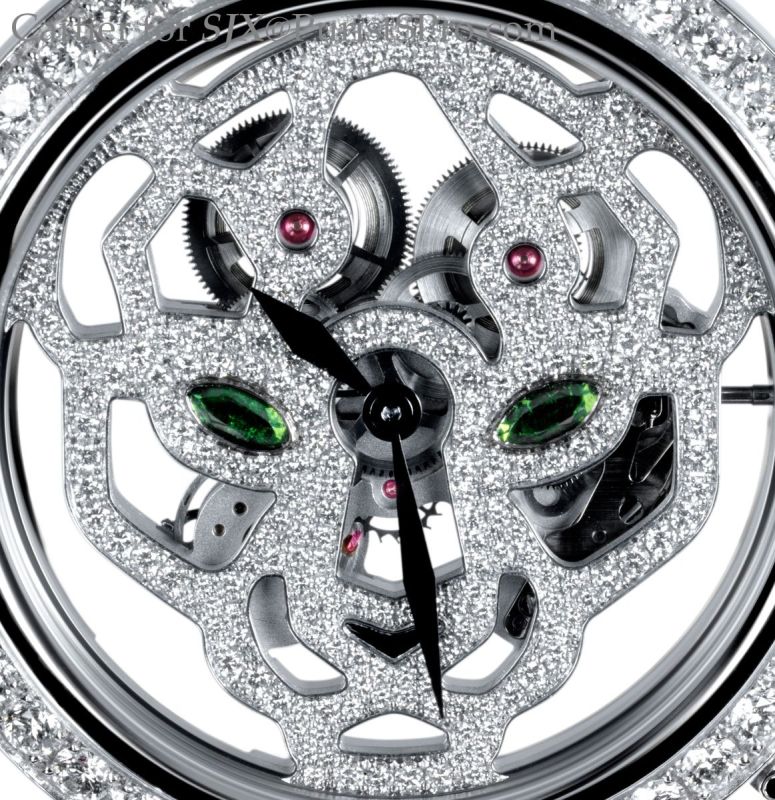
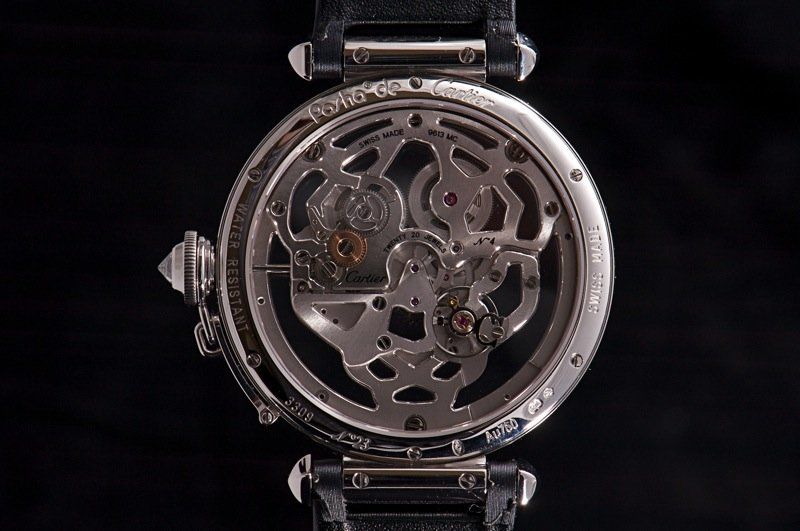
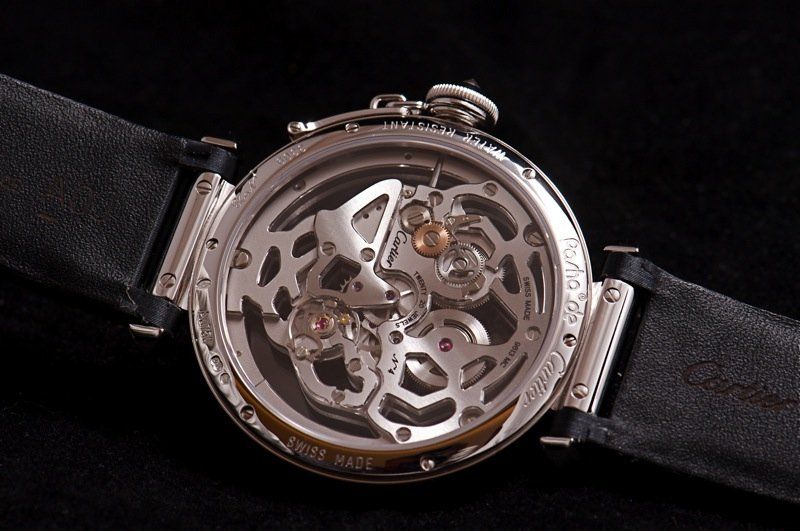
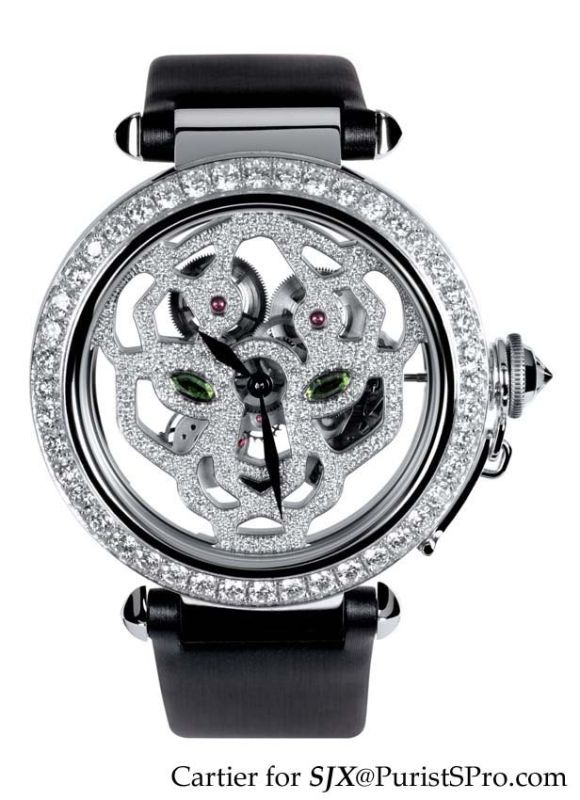
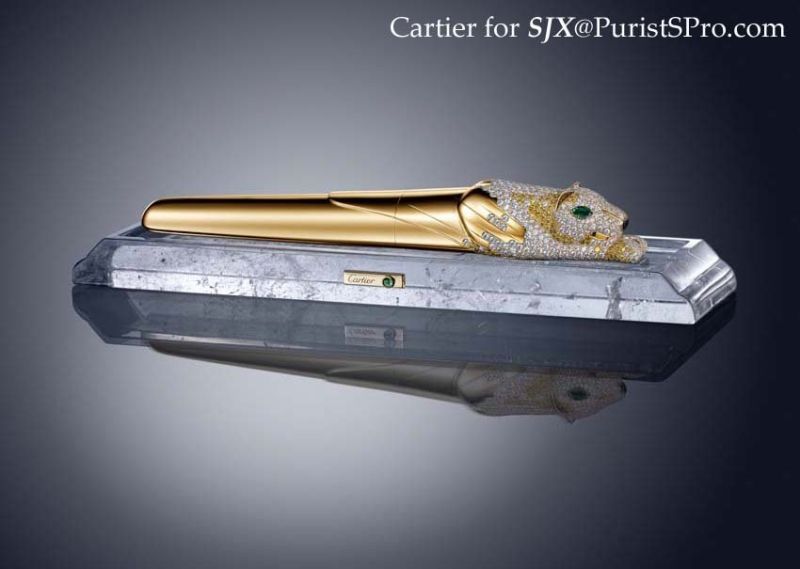
Case: 18 carat rhodium-plated white gold – Diameter: 42 mm – Bezel: set with round diamonds – Dial: panther head in 18 carat rhodium-plated white gold set with diamonds, created using the bridges of the movement – Crystal: Sapphire – Water resistance: 30 metres / 100 feet / 3 bar – Strap: anthracite-grey brushed canvas – Ardillon buckle: 18 carat rhodium-plated white gold set with diamonds – Movement: mechanical with manual rewinding, 9613 MC – Total diamonds: 4.1 carats
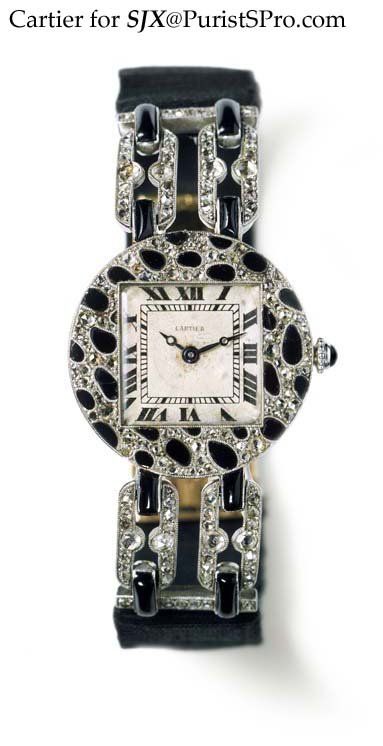

1915: The Cartier Paris workshops produce a rectangular brooch-watch suspended from a ring, decorated with irregular black spots that suggest leopard skin. It is bought by Pierre Cartier, then Director of Cartier New York, for his personal collection.
1919: First appearance of the whole cat in onyx and diamonds on a vanity case belonging to Jeanne Toussaint. A source of inspiration for Louis Cartier, she joined the company in 1918 and nurtures a passion for the aesthetic universe of the panther.
1925: In the Pavilion of Elegance at the Exhibition of Decorative Arts, Cartier links the theme of big cats with botany and displays a tiara of orchids with spotted motifs. This same year, the jeweller also presents a sumptuous vanity case with a panther decoration in black enamel, echoing the drawings of George Barbier and Paul Jove, who illustrated Kipling’s The Jungle Book.
1927: The designer Peter Lemarchand, a graduate of l’École Boulle, joins Cartier. His acute powers of observation – he spends many hours at the zoo in Vincennes – his sketching and his empathy with Jeanne Toussaint together with the talent of the Cartier gem-setters enables the panther to become one of the great legends of Cartier creativity.The first figurative brooches appear with a reclining panther in onyx and diamonds on platinum.
1931: In an extravagant setting inspired by the jungle at the Colonial Exhibition in Vincennes, French jewellery pieces incorporating the claws and teeth of big cats become all the rage. Cartier displays a necklace with a tiger’s paw motif.
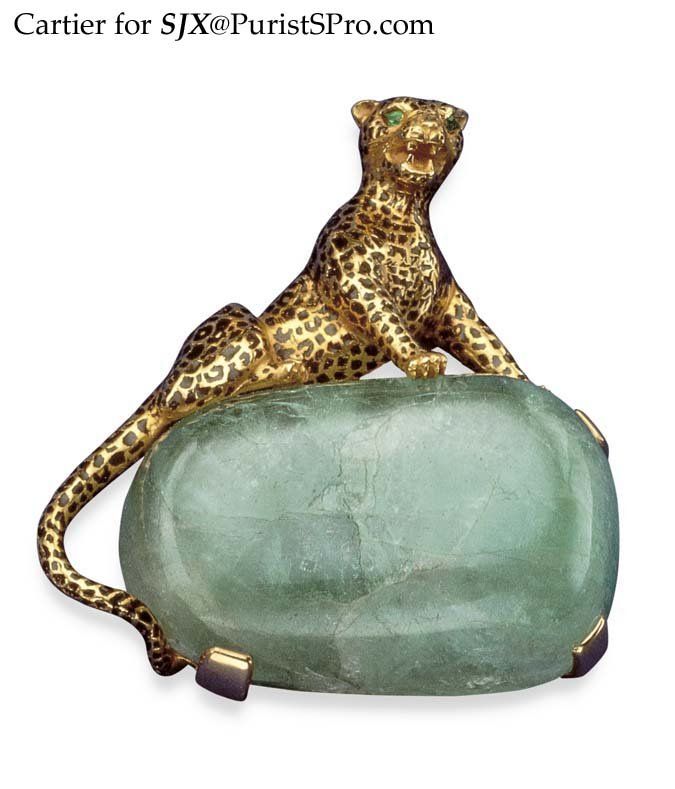
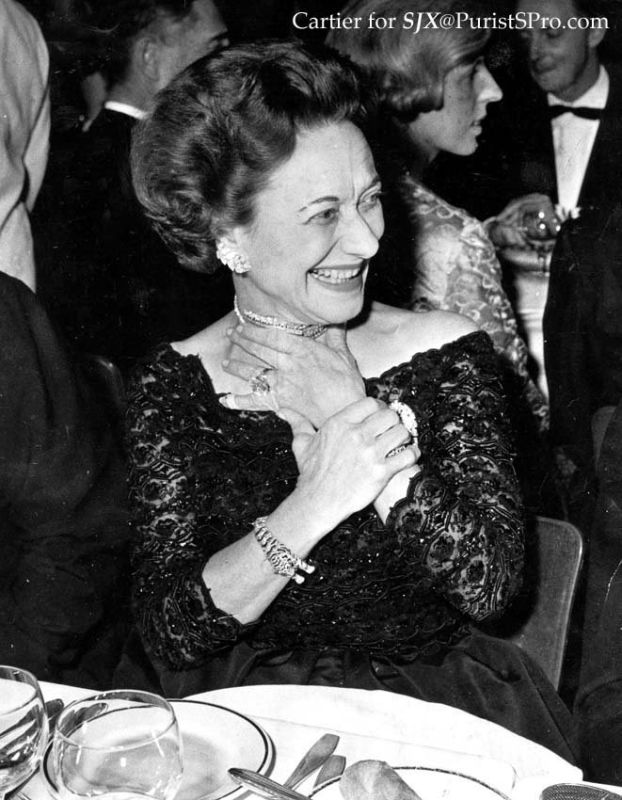
1948: An order from the Duke of Windsor for his wife encourages Cartier to develop a three-dimensional panther motif for the very first time: the brooch3 features a golden cat with black enamel spots crouching on an emerald cabochon. Known as one of the world’s most elegant women, the Duchess of Windsor makes the panther highly fashionable.
1949: The Windsors buy a second Panthère brooch in platinum, whose eyes glitter with yellow diamonds as it reclines on a sapphire cabochon weighing 152.35 carats.Describing the inauguration of the Cartier exhibition in 1949, a journalist writes of an “atomic bomb in the central window.” The creation that attracts Parisian Society is a Panthère brooch composed of diamonds and sapphires, Cartier’s interpretation of the legend of the Golden Fleece. It is acquired by Mrs Reginald Fellowes, born Daisy Decazes, the rich and influential head of the Harper’s Bazaar office in Paris.
1952: The Duchess of Windsor completes her collection of big-cat jewellery with the first entirely jointed, flexible bracelet that follows the curves of the feline body, dotted with onyx spots. Two years later, the devoted admirer acquires a lorgnette with, as its handle, a tiger in 18 carat gold, black enamel and emerald eyes.
1956: For the same famous client Cartier creates an articulated tiger bracelet4 which starts a fashion5 for the pairing of onyx and yellow diamonds mounted on gold and for onyx and white diamonds mounted on platinum in the first Panthère pieces.
1957: Barbara Hutton6, then the world’s richest heiress, places her first order: a tiger brooch-clip7 whose body – head, legs and tail – is fully jointed.
1958: The stunningly beautiful princess Nina Aga Khan is the next to develop a passion for panthers. As the fashion is for ornamentation, her second husband, le prince Sadruddin Aga Khan, orders a collection of sumptuous pieces: a blouse pin, an articulated panther brooch, a ring, an open bracelet with panther heads, and a gold fluted bracelet with panther heads that can be worn as earrings while it becomes the handle of one of Cartier’s convertible evening bags! Paved with brilliant-cut diamonds and spotted with sapphires (a pairing that is replaced by onyx until 1973), these pieces are among the most spectacular naturalist creations ever made in three dimensions.
1961: Barbara Hutton adds drop earrings and a bracelet to her collection. For her sister-in-law, Princess Nina Mdivani, she orders a black satin bag whose clasp is adorned with a prowling cat in yellow gold striped with black enamel.
1967: The actress María Félix, known as “the Mexican panther“, orders a solid bracelet with ends that represent the head and front paws of two panthers.
1980 marks progress in the research on the attitude and movement of a panther8. It can now be found sitting or semi-crouching, incorporating the stones or the Cartier logo.
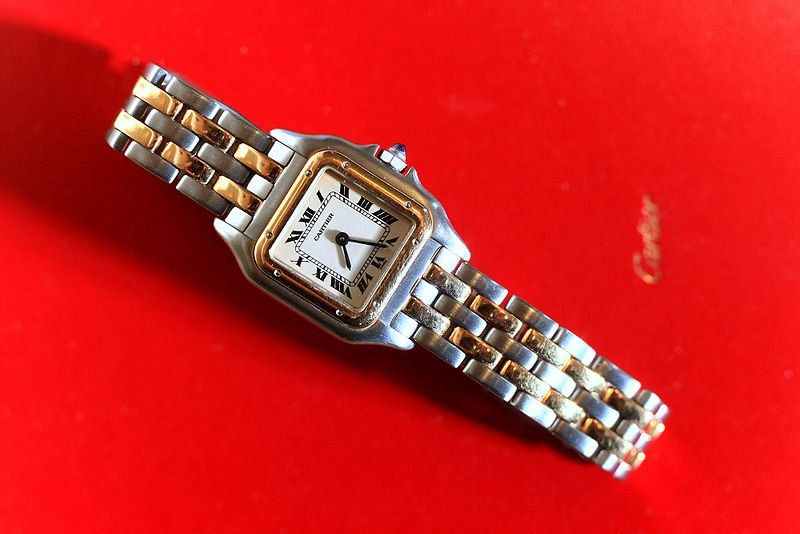
1983: Cartier launches the Panthère watch, a variant of the Santos de Cartier watch with extra-flat bracelet links all in gold. This renders the bracelet extraordinarily supple and truly feline. The Panthère watch becomes one of the most successful examples of watchmaking creativity in the 1980s.
1985: Introduction of the Silverium line of jewellery, which combines gold and silver in highly stylised, almost geometric, animal forms. The design moves towards a cleaner model characterised by large flat surfaces.
1986: The panther appears surrounded by jewelled bamboo and eucalyptus foliage. The pieces created at this time include the Khana necklace whose articulated, diamond-paved shank features two tigers crouching in a “V”.
1987: Launch of the Panthère de Cartier9 perfume. Two big cats clasp a bottle in the form of a facetted diamond. The creation appeals to Cartier’s grandest, most whimsical and fascinating clients, such as the Duchess of Windsor and Barbara Hutton. At a charity auction in favour of the Institut Pasteur, Cartier bought back two key pieces for its feline menagerie that had belonged to the Duchess of Windsor: the 1949 Panthère brooch featuring a sapphire cabochon and the 1954 tiger lorgnette, which are both now part of the Cartier Collection.
1990s: Cartier develops the idea of collections in which the panther stars as one of the key themes, including bangles with two heads10 in yellow gold spotted with black lacquer, and rigid necklaces clipped with a panther in yellow diamonds.
2003: Launch of a black and white Panthère collection in platinum, diamonds and onyx. Cartier moves towards an abstract style and geometric lines.
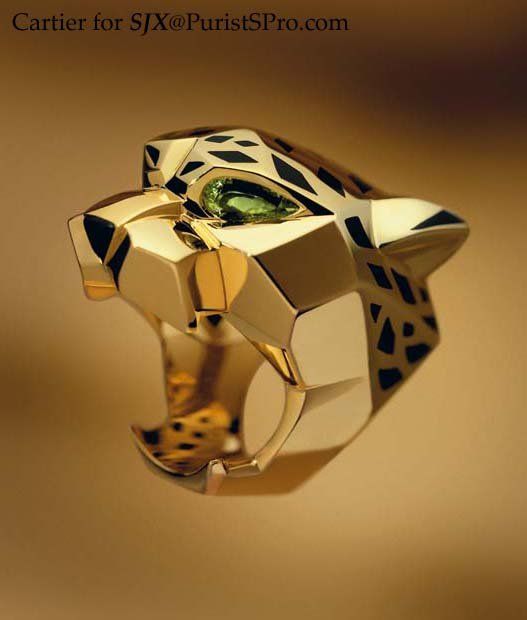
2005: Always increasingly modern, rare and fiercely civilised, the Panthère jewellery in yellow gold and diamonds develops radical shapes: sharp corners, a streamlined profiles and a gaping jaw11.
2009: The snow panther makes its appearance in celebration of an innovative fluffy coat that Cartier conveys through an original geometrical mesh.
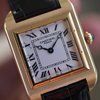
It's so refined.
but the back of the watch is almost more exiting.
That movement looks so clean & transparent.
Interesting to reading all the facts about the Panthere theme.
It was mentioned that the Panthere watch became a best selling ladies watch.
That certainly was the case, but do not forget that the large version with date was very popular
in the men's world as well.
Lots of male pop artists were often seen with the Panthere.
Iin 1983 the watch trend was much smaller and ladies were still wearing
the watches that were originally created for them, at that time.
It took until 1996 when the first Submariners on high heels were tripping up and down Via Napoleone.
Never forget that, when I saw that for the first time.
GEO
I just received a book on Les Must de Cartier today
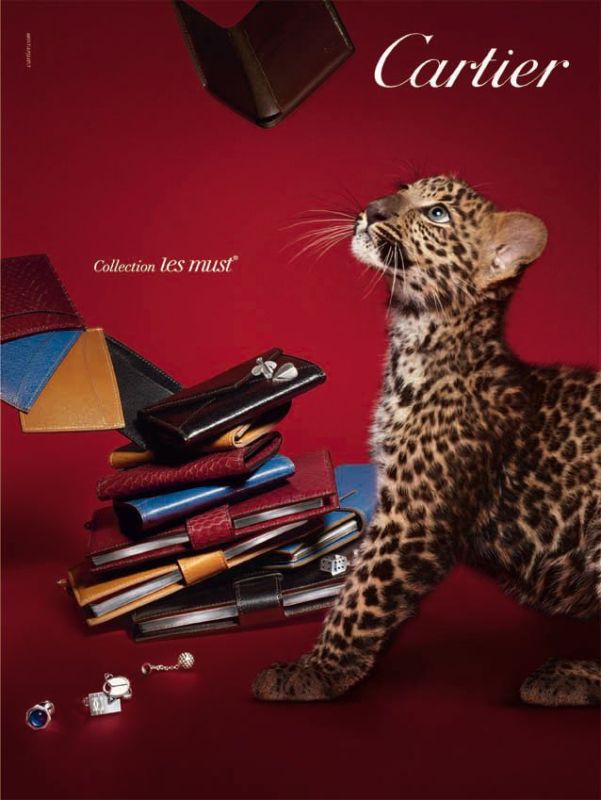
and it talks about the history of the brand from the 60s to the 90s and of course talks at length about the Panthere, as well as the other Les Must de Cartier watches. It is certainly a fascinating history. Cartier is a long way away from the kind of watches it was making in the 1980s, though those watches and all the other products (maroon leather with gold corners and huge double "C" logos) made the company what it is today.
- SJX
Another book to get
It gives an incredible over view of all different tank watches produced from the beginning
on wards.
Also the variety of bracelets for these watches is quite amazing.
GEO