Comments:


"For Piaget, developing the ultra-thin concept provided an opportunity to express two main features of its personality: on the one hand, the utmost discretion that reflects the ascetic isolation of its beginnings, and on the other, the lavish extravagance that burst forth in the early 1960s. "
well said! I had a chance to strap on some Altiplanos--and they are now on my shortlist of must-haves!
Jason

will have to view each piece on its side now!
and as an aside--I'm so happy that Purist Pro has a Piaget forum. It's the only one I know of. A shame. Piaget seems to fly under the radar....
Many thanks again,
Jason

Piaget Time Gallery Ultra-thin Exhibition in Geneva
As of November 1st 2010, the Piaget Time Gallery, located above the Piaget boutique at 40, rue du Rhône in Geneva, is hosting a new exhibition called PIAGET, THE ART OF ULTRA-THIN WATCHMAKING. Piaget Time Gallery is now showing to the public, historical and contemporary watches, along with historical documents retracing the fantastic history of this Swiss manufacture in the craft of ultra-thin watchmaking. For over 50 years, Piaget's ongoing quest for excellence and the development of new calibers has underscored their incredible capacity for innovation. The manufacture's unique ultra-thin creations have enabled it to cultivate its distinctive style, and position itself at the pinnacle of the art of fine watchmaking.
From the mid-1950s onward, Piaget worked to reduce the thickness of its mechanical movements through
developments that were to prove decisive for its future.

At the 1957 Basel Watch Fair, Piaget presented Caliber 9P, a hand-wound movement only 2 mm thick. Its
thinness and its technical qualities made it a benchmark in this demanding field.
In parallel, Valentin Piaget filed several patents for an ultra-thin self-winding movement. Revealed to the
public in 1960 and cleverly incorporating an off-centred micro-rotor, Caliber 12P was a mere 2.3 mm thick.
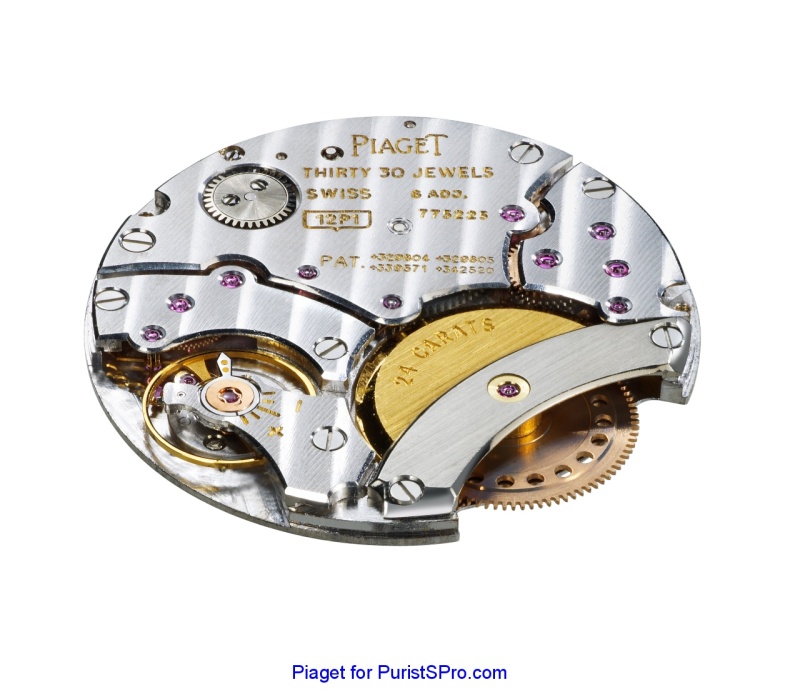
Over the last 12 years, Piaget has developed more than 30 movements, all of which illustrate the quest for thinness in their respective categories -- thinness being a hallmark of elegance in a fine timepiece. Noteworthy movements from this period include the Caliber 430P range introduced in 1998, and the 2003 launch of Caliber 600P, the world’s thinnest shaped tourbillon movement.
To mark the 50th anniversary of its legendary Caliber 12P, Piaget rose to a new technical challenge in 2010 by setting a double record for both the thinnest self-winding movement currently in production and the thinnest self-winding watch in the world, respectively measuring a mere 2.35 mm and 5.25 mm.
The new Altiplano watch features a generous 43 mm diameter that enhances its elegant profile.
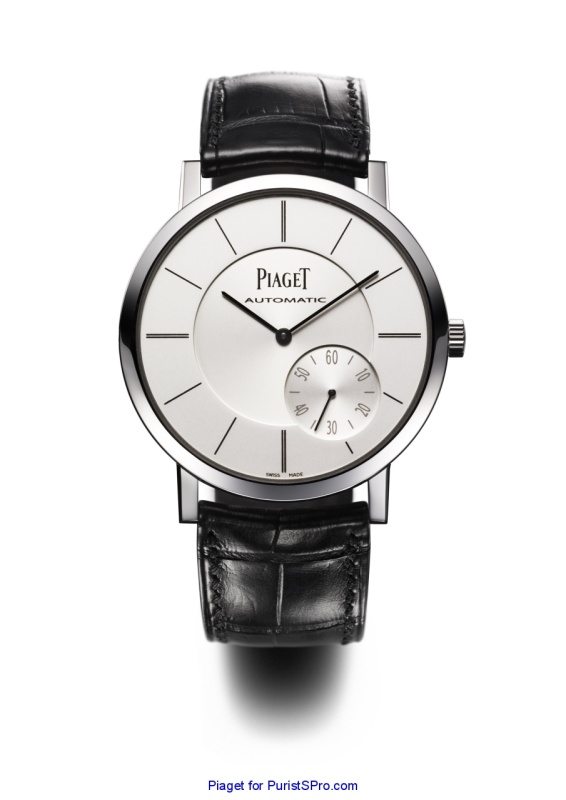
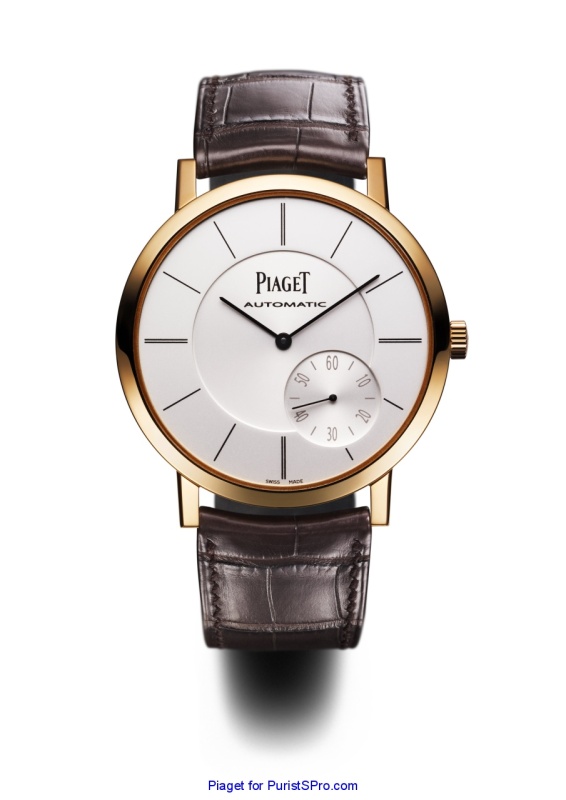
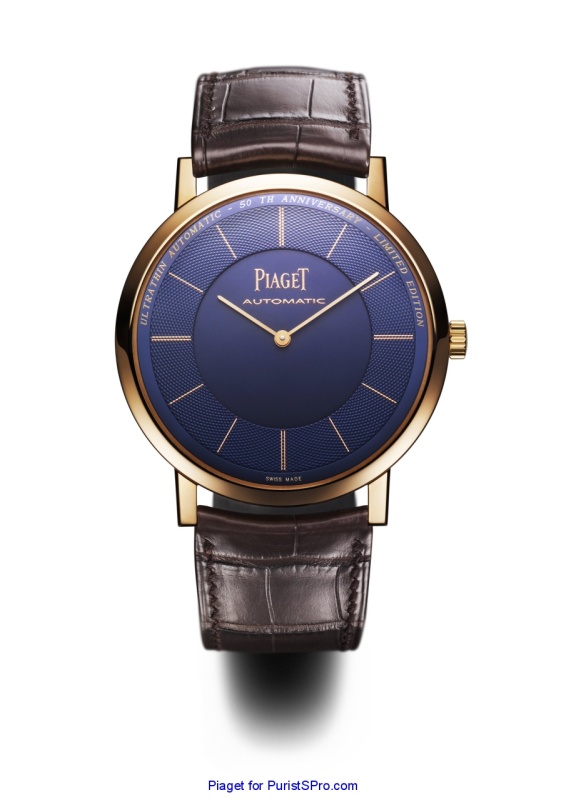
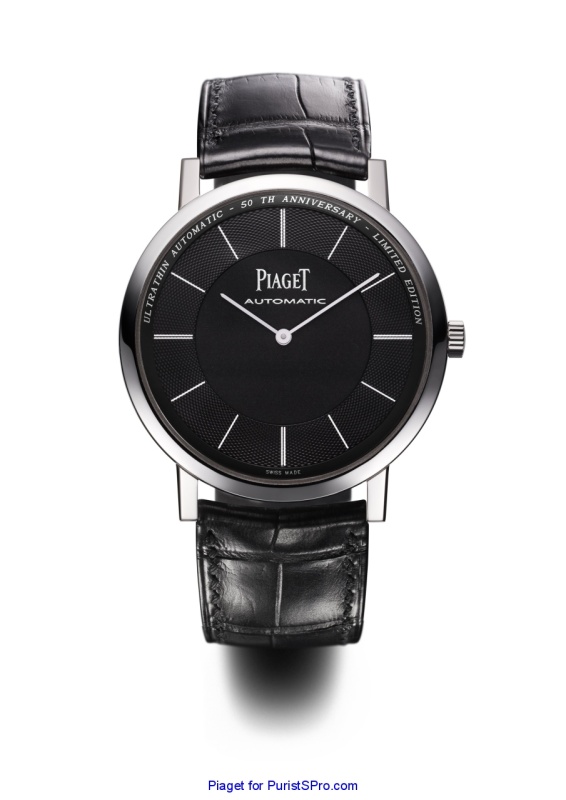
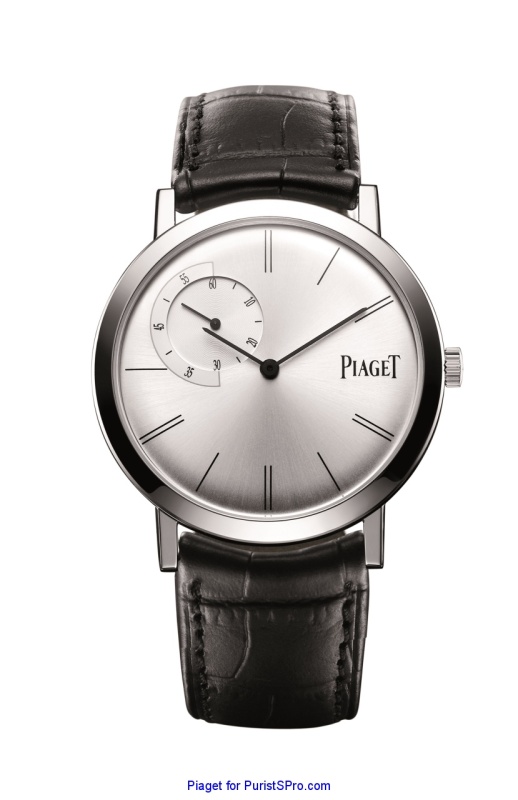
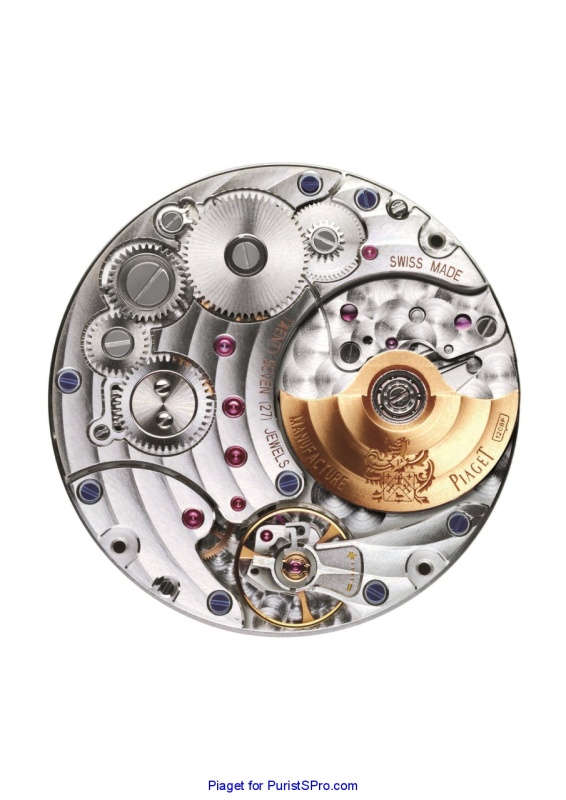
Calibers 1200P and 1208P powering these new models really push the limits of miniaturisation. The gear trains are only 0.12 mm thick, meaning scarcely more than a hair’s breadth (0.08 mm). To achieve even greater thinness, the self-winding system is incorporated into the movement mainplate, thus adopting the concept used in 1960 for Caliber 12P. The off-centred micro-rotor, with its oscillating weight in 24-carat gold or platinum, has sufficient inertia to ensure an approximately 42-hour power reserve.
For Piaget, developing the ultra-thin concept provided an opportunity to express two main features of its personality: on the one hand, the utmost discretion that reflects the ascetic isolation of its beginnings, and on the other, the lavish extravagance that burst forth in the early 1960s.
The pursuit of extreme slenderness thus lies at the very heart of the brand’s paradoxical nature. Resolutely one step ahead of its time, Piaget believed in the modernity of ultra-thin watches. As early as 1957, the brand was advocating great elegance and sobriety of style, a principle to which it has remained faithful ever since.
50 years on, the design of high-tech objects which are now part of our everyday life has proven Piaget right. The ultra-thin watch has always featured in Piaget’s collections as an embodiment of the brand’s distinguishing characteristics and its unique expertise. In 1998, this philosophy was embodied within a collection named Altiplano in reference to the Latin American high plateaux noted for their captivatingly beautiful bare landscapes. Piaget is now reaching new heights with its new self-winding watch, the slimmest in the world, and thereby giving full expression to the name that the company has chosen to symbolize the demanding art of ultra-thin watchmaking.
Although mastery of the art of ultra-thin watchmaking has enabled Piaget to develop an understated, refined style that is the brand’s true signature, it has also fostered an abundance of bold creativity. At the beginning of the 1960s, Piaget made its mark as a specialist in jewelery watches.
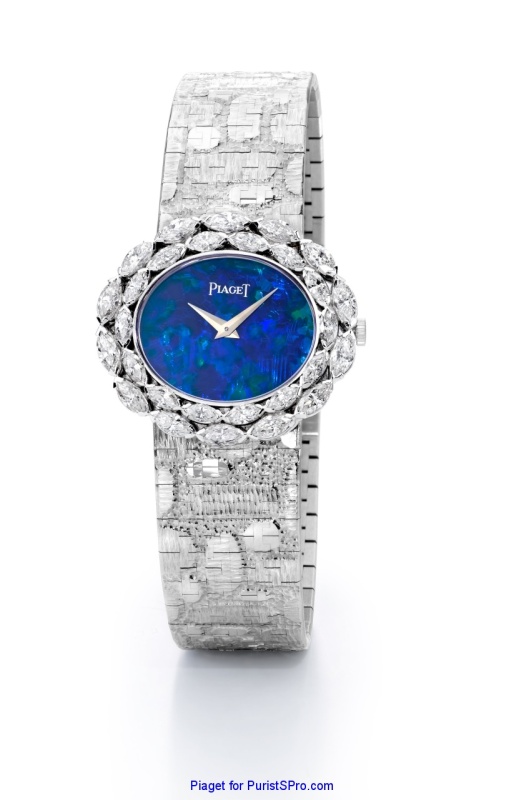
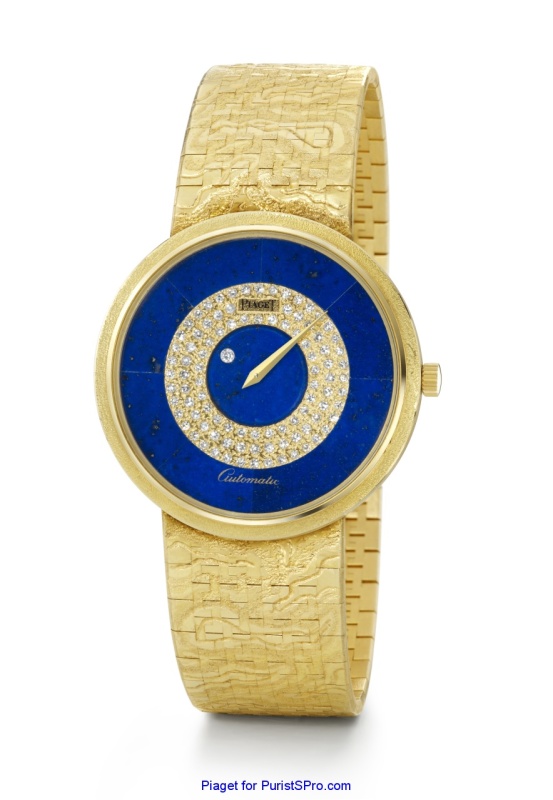
The slimness of the calibers and the resulting diminutive dimensions provided scope for complete freedom of expression. At the same time, Piaget bought several workshops specializing in gold craftsmanship. This policy of skills integration has given the brand an independence entirely conducive to fulfilling its wildest dreams. Bracelet watches adopt the softness and thinness of fabric. Dials take on the colours of hard stones such as jade, coral, turquoise and lapis lazuli, or the subtle shades of miniature enamelling.
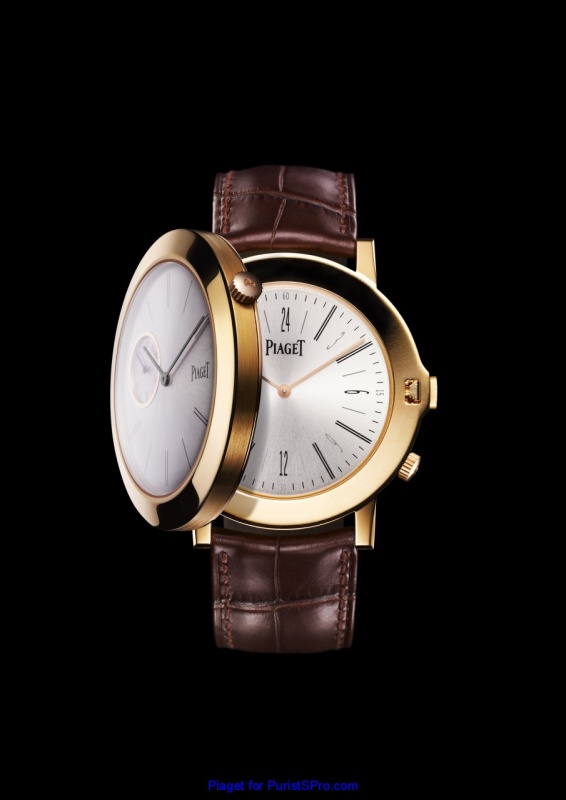
Watches are housed in gold cases, or double cases to provide a dual time-zone display.
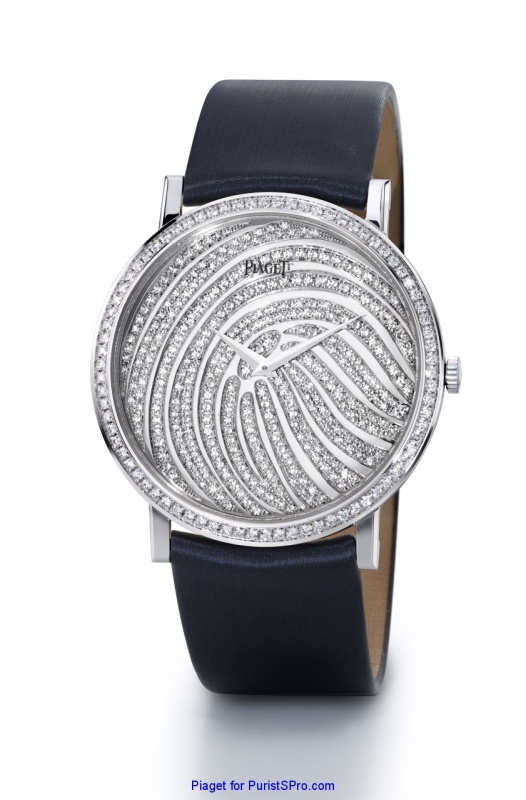
Diamonds could not fail to be included in this sparkling display of creativity. They light up watch cases and bracelets, or outline celebrity fingerprints on the dial of the Altiplano watch – offering a precious, timeless memento of a charitable gesture by luminaries such as Laetitia Casta, Vanessa Paradis, Liz Hurley and HRH, Prince Albert II of Monaco. At Piaget, the history of ultra-thin watchmaking is also a story of great generosity (these unique "fingerprint" watches were offered up for auction in support of various charities).
If you can travel to Geneva, Piaget invites you to experience this exhibit in person, by appointment only please, Monday through Friday from 10 am to 5 pm and Saturday from 11 am to 4 pm. To schedule a visit, contact Piaget at +41 22 817 02 00 or by e-mail at the following address: piaget-time-gallery (DOT) ge (AT) piaget (DOT) com (for the purposes of our website I've had to replace the dots and @ sign in the email, but you would add the symbols back into the email address, and remove any spaces before addressing your correspondence).
Cheers,
Daos
This message has been edited by dxboon on 2010-11-16 02:12:44
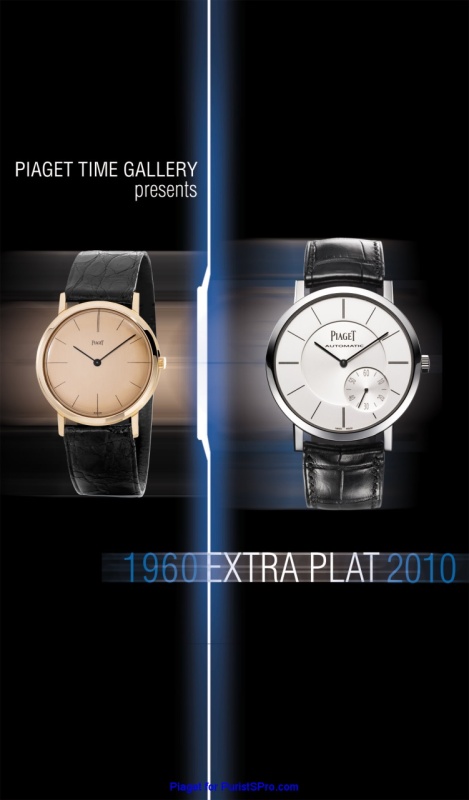
The flyer for Piaget's Time Gallery event celebrating 50 years of excellence in the creation of ultra-thin watches.
From the mid-1950s onward, Piaget worked to reduce the thickness of its mechanical movements through
developments that were to prove decisive for its future.
Circa 1950 -- the quality control studio at Piaget (Timothée Piaget is at the far right).
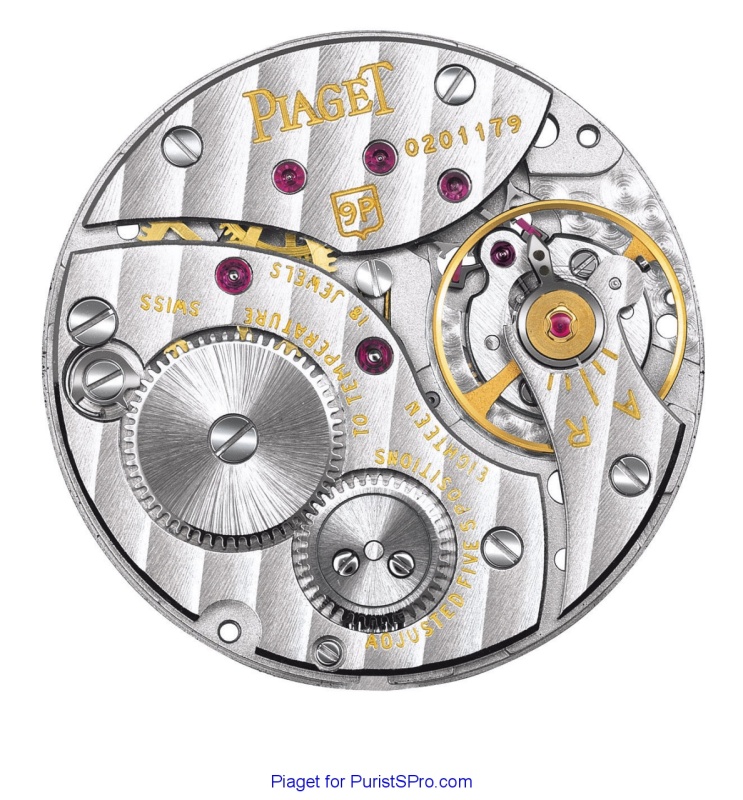
At the 1957 Basel Watch Fair, Piaget presented Caliber 9P, a hand-wound movement only 2 mm thick. Its
thinness and its technical qualities made it a benchmark in this demanding field.
Manufacture Piaget caliber 9P.
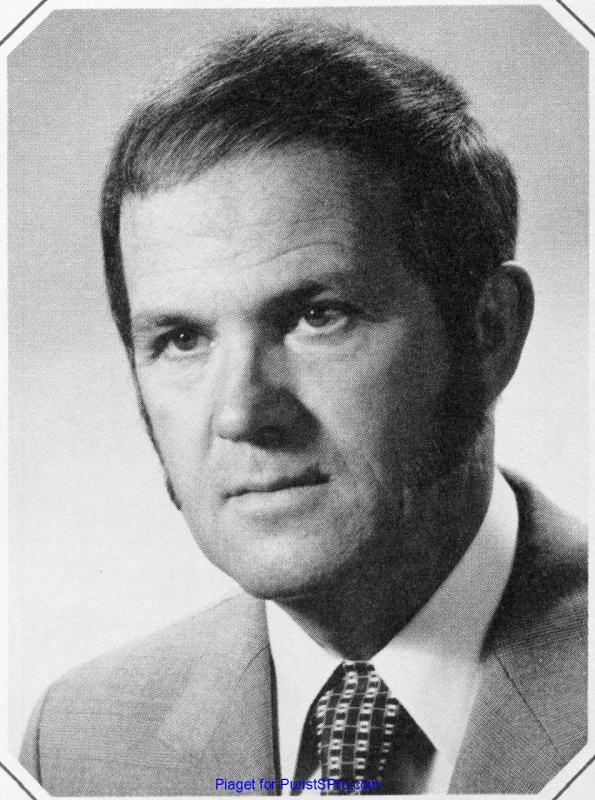
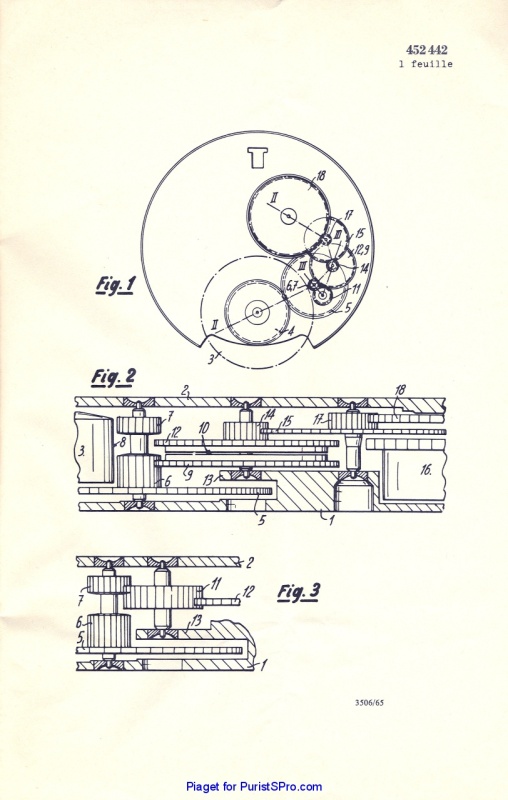
In parallel, Valentin Piaget filed several patents for an ultra-thin self-winding movement. Revealed to the
public in 1960 and cleverly incorporating an off-centred micro-rotor, Caliber 12P was a mere 2.3 mm thick.
A photo of Valentin Piaget.
Diagram of the off-set micro-rotor in the 12P.
Manufacture Piaget caliber 12P.
Over the last 12 years, Piaget has developed more than 30 movements, all of which illustrate the quest for thinness in their respective categories -- thinness being a hallmark of elegance in a fine timepiece. Noteworthy movements from this period include the Caliber 430P range introduced in 1998, and the 2003 launch of Caliber 600P, the world’s thinnest shaped tourbillon movement.
To mark the 50th anniversary of its legendary Caliber 12P, Piaget rose to a new technical challenge in 2010 by setting a double record for both the thinnest self-winding movement currently in production and the thinnest self-winding watch in the world, respectively measuring a mere 2.35 mm and 5.25 mm.
The new Altiplano watch features a generous 43 mm diameter that enhances its elegant profile.
Ref. G0A35130.
Ref. G0A35131.
Ref. G0A35132.
Ref. G0A35133.
Ref. G0A33112.
Calibers 1200P and 1208P powering these new models really push the limits of miniaturisation. The gear trains are only 0.12 mm thick, meaning scarcely more than a hair’s breadth (0.08 mm). To achieve even greater thinness, the self-winding system is incorporated into the movement mainplate, thus adopting the concept used in 1960 for Caliber 12P. The off-centred micro-rotor, with its oscillating weight in 24-carat gold or platinum, has sufficient inertia to ensure an approximately 42-hour power reserve.
Manufacture Piaget caliber 1208P.
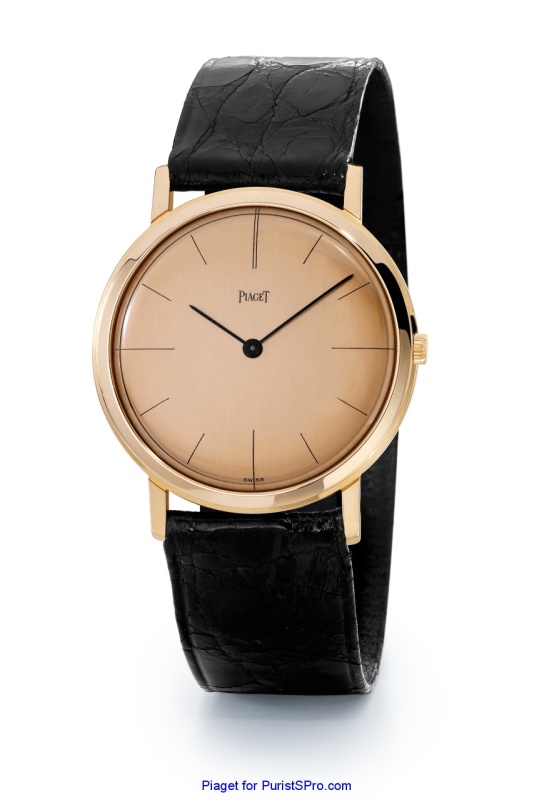
For Piaget, developing the ultra-thin concept provided an opportunity to express two main features of its personality: on the one hand, the utmost discretion that reflects the ascetic isolation of its beginnings, and on the other, the lavish extravagance that burst forth in the early 1960s.
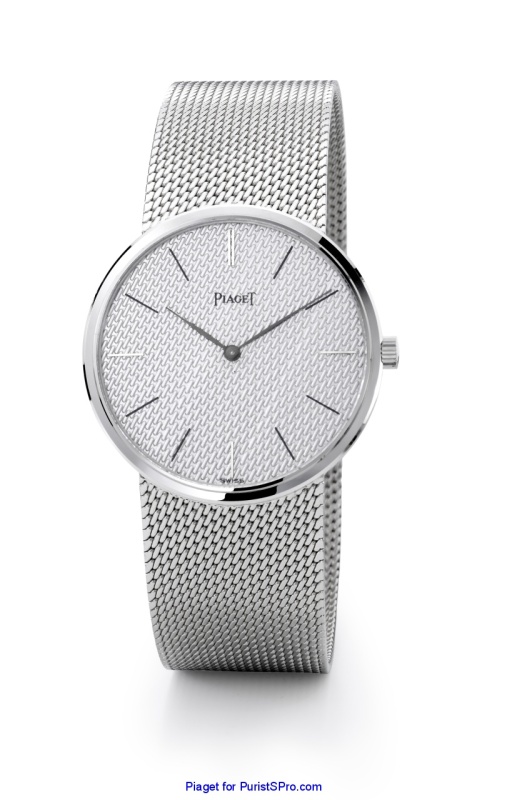
A vintage rose gold Piaget Extra-Plat.
Ref. 9633 B11.
The pursuit of extreme slenderness thus lies at the very heart of the brand’s paradoxical nature. Resolutely one step ahead of its time, Piaget believed in the modernity of ultra-thin watches. As early as 1957, the brand was advocating great elegance and sobriety of style, a principle to which it has remained faithful ever since.
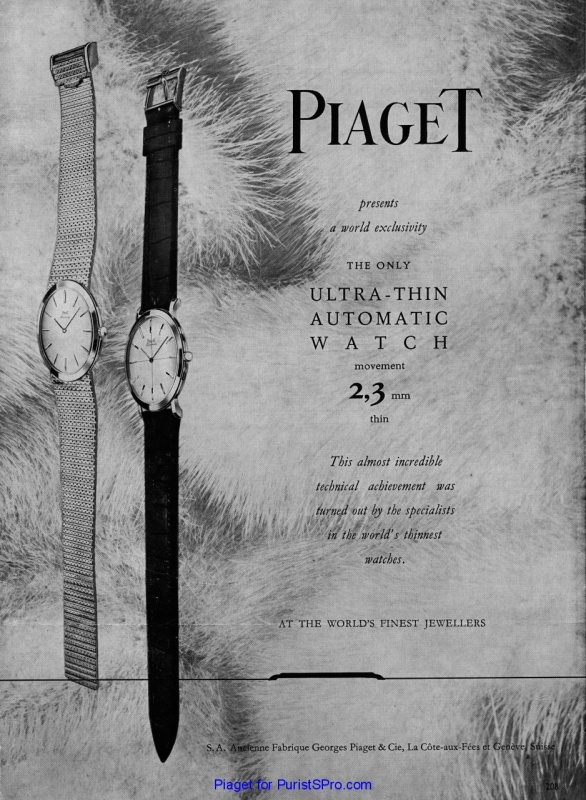
A black & white advertisement for extra-plat watches from 1960 in English.
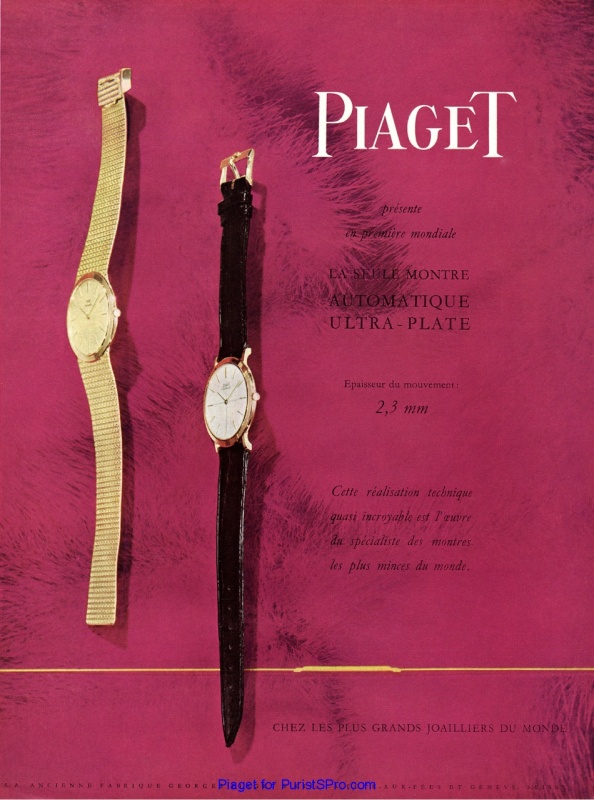
The same vintage Piaget advertisement in French (and in color).
50 years on, the design of high-tech objects which are now part of our everyday life has proven Piaget right. The ultra-thin watch has always featured in Piaget’s collections as an embodiment of the brand’s distinguishing characteristics and its unique expertise. In 1998, this philosophy was embodied within a collection named Altiplano in reference to the Latin American high plateaux noted for their captivatingly beautiful bare landscapes. Piaget is now reaching new heights with its new self-winding watch, the slimmest in the world, and thereby giving full expression to the name that the company has chosen to symbolize the demanding art of ultra-thin watchmaking.
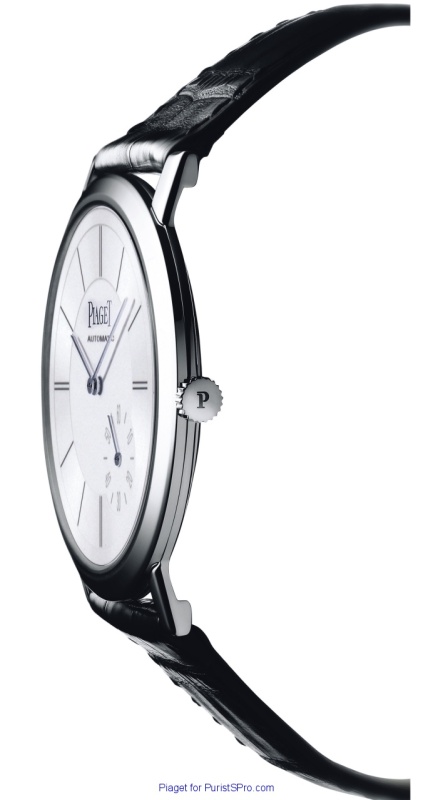
Profile of the 2010 Altiplano at 43mm in diameter.
Although mastery of the art of ultra-thin watchmaking has enabled Piaget to develop an understated, refined style that is the brand’s true signature, it has also fostered an abundance of bold creativity. At the beginning of the 1960s, Piaget made its mark as a specialist in jewelery watches.
Ref. 9395 A80.
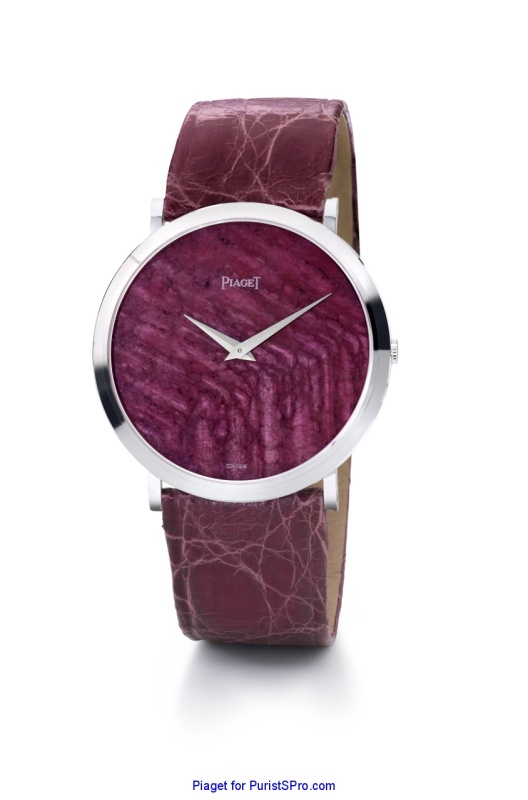
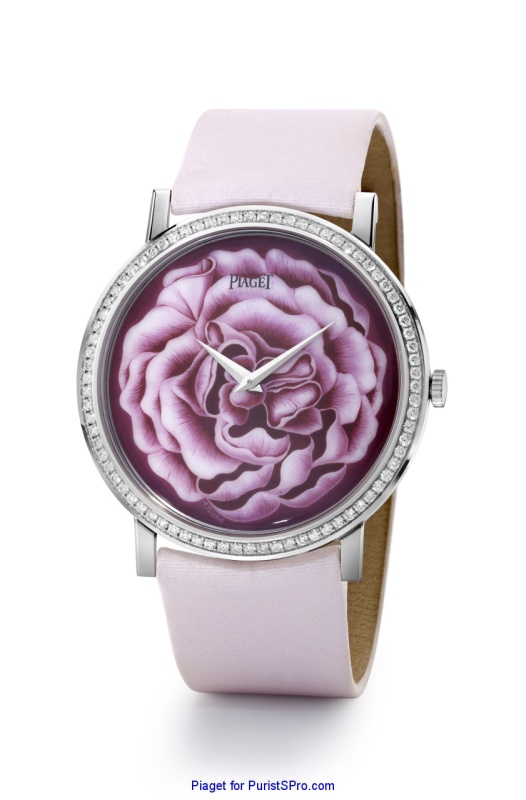
The slimness of the calibers and the resulting diminutive dimensions provided scope for complete freedom of expression. At the same time, Piaget bought several workshops specializing in gold craftsmanship. This policy of skills integration has given the brand an independence entirely conducive to fulfilling its wildest dreams. Bracelet watches adopt the softness and thinness of fabric. Dials take on the colours of hard stones such as jade, coral, turquoise and lapis lazuli, or the subtle shades of miniature enamelling.
Ref. 12343 A17.
Ref. 9032.
Ref. GOA30147.
Watches are housed in gold cases, or double cases to provide a dual time-zone display.
Ref. G0A35153.
Diamonds could not fail to be included in this sparkling display of creativity. They light up watch cases and bracelets, or outline celebrity fingerprints on the dial of the Altiplano watch – offering a precious, timeless memento of a charitable gesture by luminaries such as Laetitia Casta, Vanessa Paradis, Liz Hurley and HRH, Prince Albert II of Monaco. At Piaget, the history of ultra-thin watchmaking is also a story of great generosity (these unique "fingerprint" watches were offered up for auction in support of various charities).
Ref. GOA3062, Altiplano 'Fingerprint'
motif; this piece unique incorporates HRH Prince Albert II of Monaco's
fingerprint on the dial.
If you can travel to Geneva, Piaget invites you to experience this exhibit in person, by appointment only please, Monday through Friday from 10 am to 5 pm and Saturday from 11 am to 4 pm. To schedule a visit, contact Piaget at +41 22 817 02 00 or by e-mail at the following address: piaget-time-gallery (DOT) ge (AT) piaget (DOT) com (for the purposes of our website I've had to replace the dots and @ sign in the email, but you would add the symbols back into the email address, and remove any spaces before addressing your correspondence).
Cheers,
Daos
This message has been edited by dxboon on 2010-11-16 02:12:44
Very interesting
and informative. I have often been tempted by the ultrathins.
Thanks for the post.
Regards,
Richard.
Thanks for the post.
Regards,
Richard.
I am tempted as well.
I also find the vintage Extra-Plats to be very handsome. They are simple, but lovely.
Cheers,
Daos
Cheers,
Daos
thanks for sharing
"For Piaget, developing the ultra-thin concept provided an opportunity to express two main features of its personality: on the one hand, the utmost discretion that reflects the ascetic isolation of its beginnings, and on the other, the lavish extravagance that burst forth in the early 1960s. "
well said! I had a chance to strap on some Altiplanos--and they are now on my shortlist of must-haves!
Jason
The Altiplanos must be considered by any lover of thin watches...
...as they are the pinnacle of the art form IMO. Thanks for your kinds words, but I must admit to getting some inspiration for this particular excerpt of text from our friends at Piaget.
Cheers,
Daos
Cheers,
Daos
Recent intrest in thin watches
jason,
I admit bias as Piaget forum moderator but the recent resurgence in interest in thin watches has sent me trying a number of so-called thin watches from Piaget, Audemars Piguet, Chopard, Vacheron Constantin, Patek Philippe and JLC.
Despite clever playing around with case design and sapphire glass by some makers, Piaget is stll the thinnest out there. One trick is to make the edges of the case thin but widen it nearer the unseen centre where the movement is located. This tapered case profile fools the eye about the 'thin-ness'.
At Piaget, ultra-thin means ultra thin. 
Regards,
MTF
This message has been edited by MTF on 2010-11-19 10:55:41
devilish of them!
will have to view each piece on its side now!
and as an aside--I'm so happy that Purist Pro has a Piaget forum. It's the only one I know of. A shame. Piaget seems to fly under the radar....
Many thanks again,
Jason
Piaget does fly under the radar.
On the one hand, I think they sort of like that there isn't a Piaget on every wrist. However, I do think they wish they had more converts in the West (my opinion only). I feel Piaget is much more popular in Asia currently. Piaget make impressive timepieces that are beautifully designed and finished. I hope more people discover the brand!
Cheers,
Daos
Cheers,
Daos