
One my fav Big Bang: the Bullet Bang
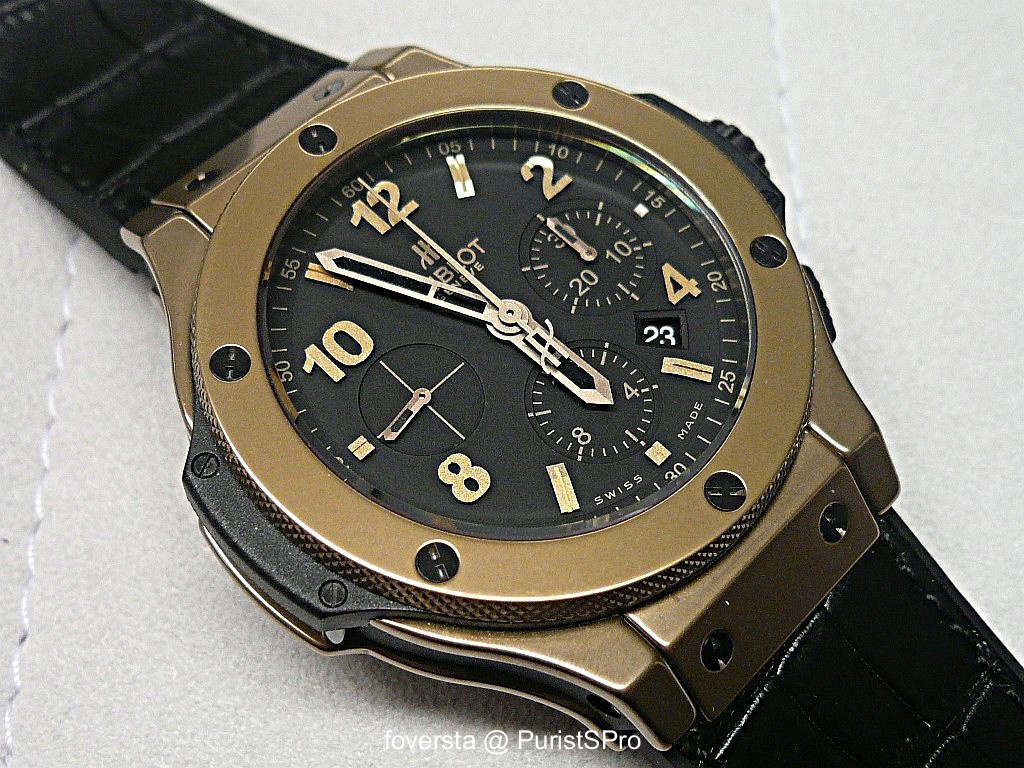
So, why did I choose to speak about this Bullet Bang which at first glance looks very similar to the other Big Bang? Quite simply because it incarnates perfectly the evolution of the concept of fusion imagined by Carlo Crocco 30 years ago, modernized and anchored in time present by Jean-Claude Biver and because its case material brings really an added-value.
In the current world of watchmaking, we discover day after day new material with names all stranger than the others. The problem is that we are seldom convinced by their properties and some seem moreover not very appropriate to the context of a luxury watch. We have to put ourselves in the customers' shoes: before, there were gold, steel, platinum with a range of understanding prices. Now, everything is mixed and it is difficult to know if such material is rarer or more exclusive than the others.
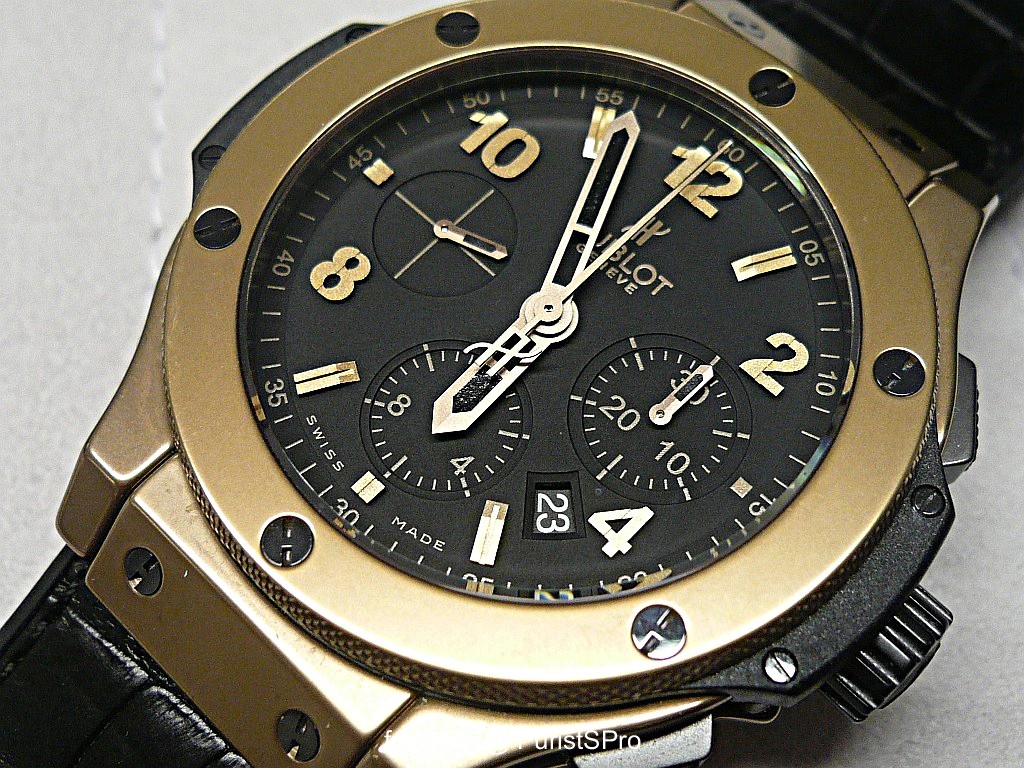
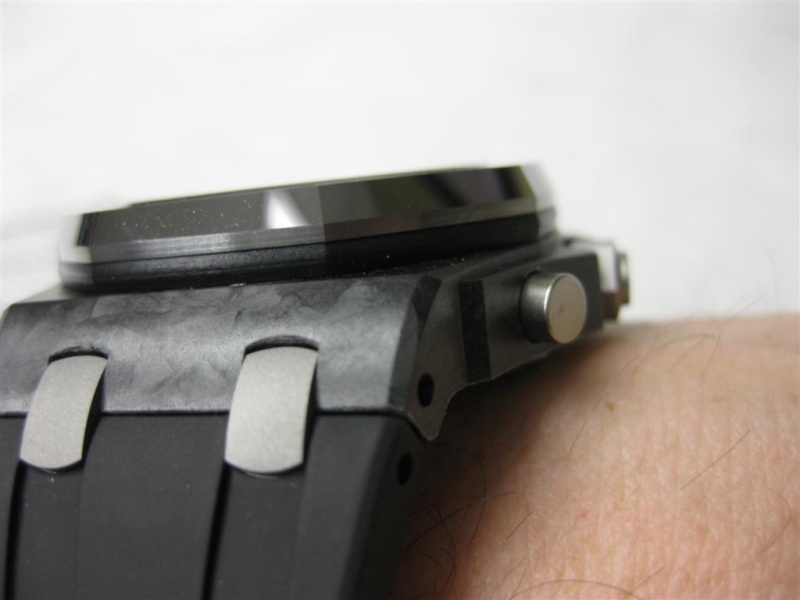
Bullet Bang is characterized by the use of a ceramic and bronze alloy combined with other metals: the Cermet (micro-blasted for this watch). This alloy has properties of optimal resistance and hardness so using it for a watchcase is quite logical at the end.
In order to properly test this watch, it is necessary to be equipped with a fork and a screwdriver to check if the Cermet is as unscratchable as Hublot wants to present it. With the owner of the watch, we hit several times the case with the fork and the screwdriver (please don't try this at home with with your Patek Minute Repeater!!!). And well, as extraordinary as that can be, the case was immaculate at the end of the test: absolutely nothing was visible, even the smallest scratch !!! Obviously, such properties give a new interest to this Bullet Bang. The watch can be considered as a true toolwatch (a true one, not a toolwatch to dive into the swimming pool or to go to the beach). The Bullet Bang can accompany you even during risky activities which could damage the case.
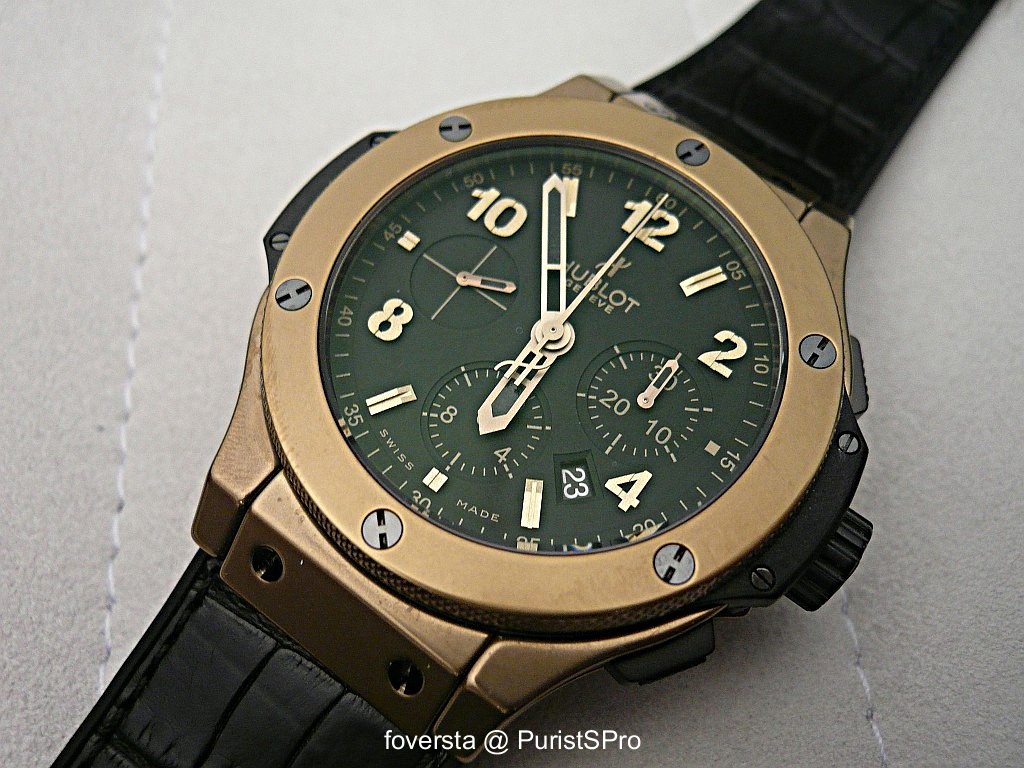
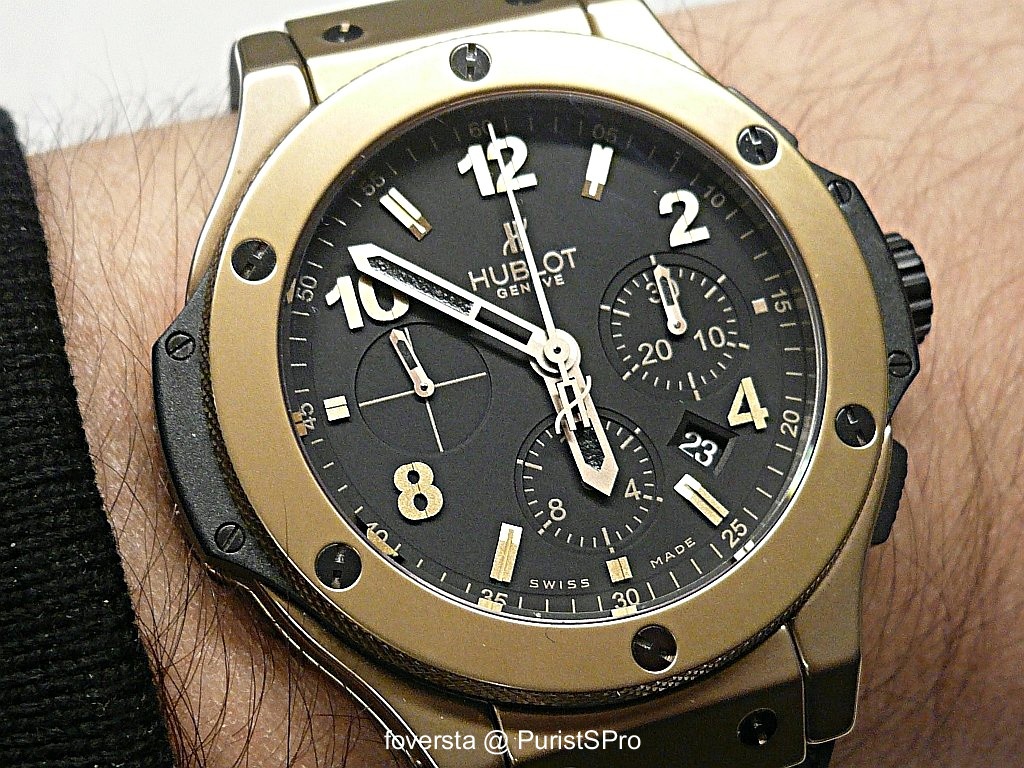
The other interesting point is the case color: thanks to bronze, it is quite original and contrasts nicely with the dial and the strap. The watch is not very discrete (the diameter of the case is 44mm) but the color is seldom seen and finally subtle. Due to its stability, it is different from the bronze cases like for example the Gefica one which is voluntarily unstable to evolve with time.
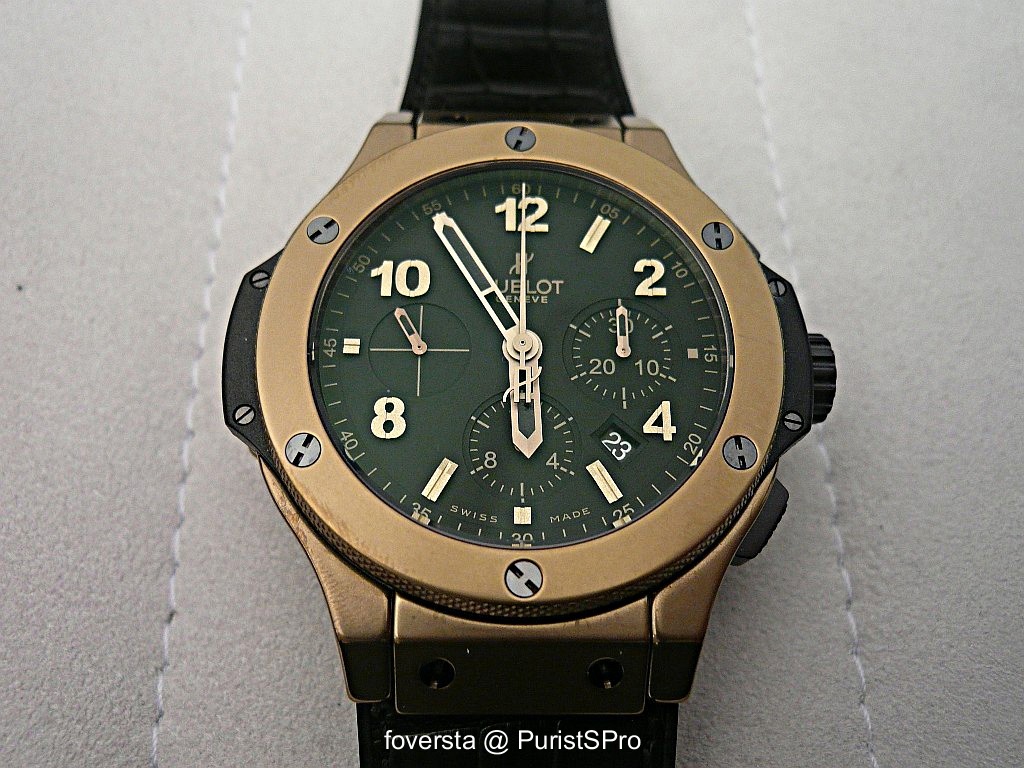
In addition to the Cermet case, we find in the Bullet Bang the usual Big Bang package, nothing more, nothing less:
- a great comfort (it is a true pleasure to handle the folding clasp)
- a very good legibility
- nicely applied indices and figures (here, of color Cermet). The dial is preserved from the logos, signatures of certain limited series which can sometimes... spoil the Big Bang design
- famous titanium screws on the glasses (I don't want to start again the debate about their alignment !)
- well designed pushers but which are relatively hard to press (due to the caliber). The pushers and the crown are made of stainless steel with black pvd while the side inserts and the "ears" of the bezel are made of black composite resin.
The caliber is the Valjoux 7750. This can be a bit surprising because if you browse the internet to read the original press release of the Bullet Bang, the caliber was supposed to be a column-wheel one. Actually, first Bullet Bang were delivered with a column-wheel movement modified by Lajoux-Perret but for reasons of availability, maybe also for delay reasons, Hublot took the decision to use the classic movement of the Big Bang for the Bullet Bang what lead to a logical decrease of the retail price. We believe that around 50 Bullet Bang were delivered with the Lajoux-Perret caliber. These watches have the 303.BI.1190.RX refere while the other ones (let's say around 450) have the 301.BI.1190.RX reference. Be careful about this point if one day you consider buying a Bullet Bang. The pictured watch uses the classic 7750. Don't expect impressive finishing here: that's not the point. It features the characteristic Hublot rotor and the perlage of its plate. The advantage of the use of such caliber is its reliability on the long run but of course, it is not a high-end movement.
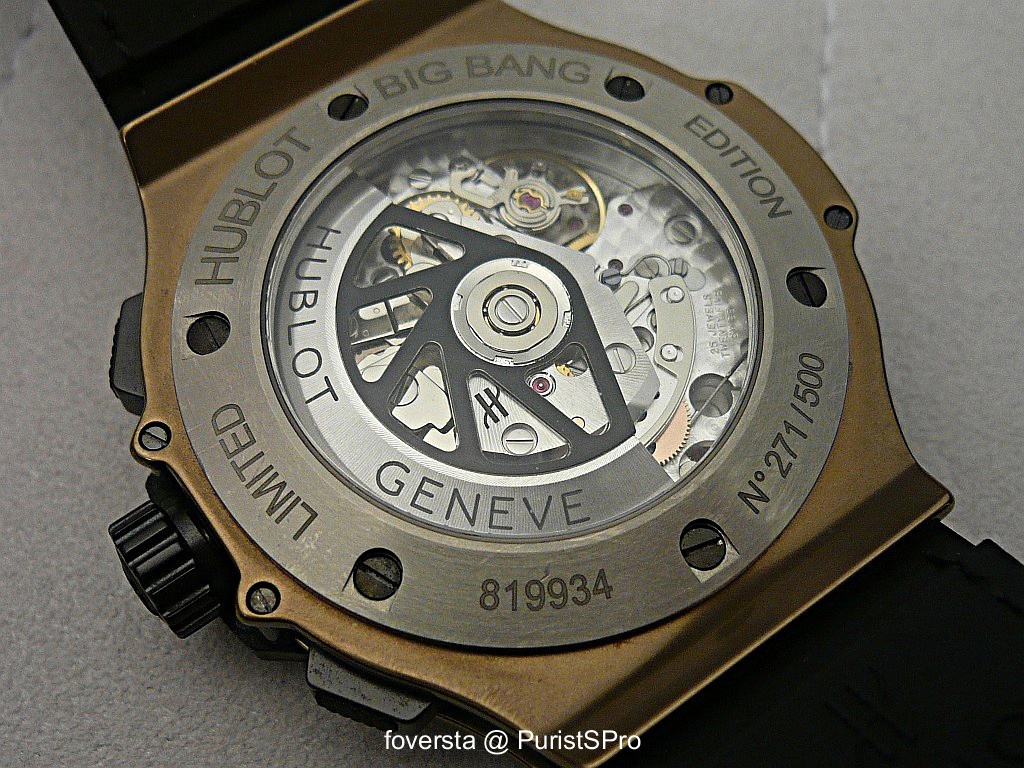
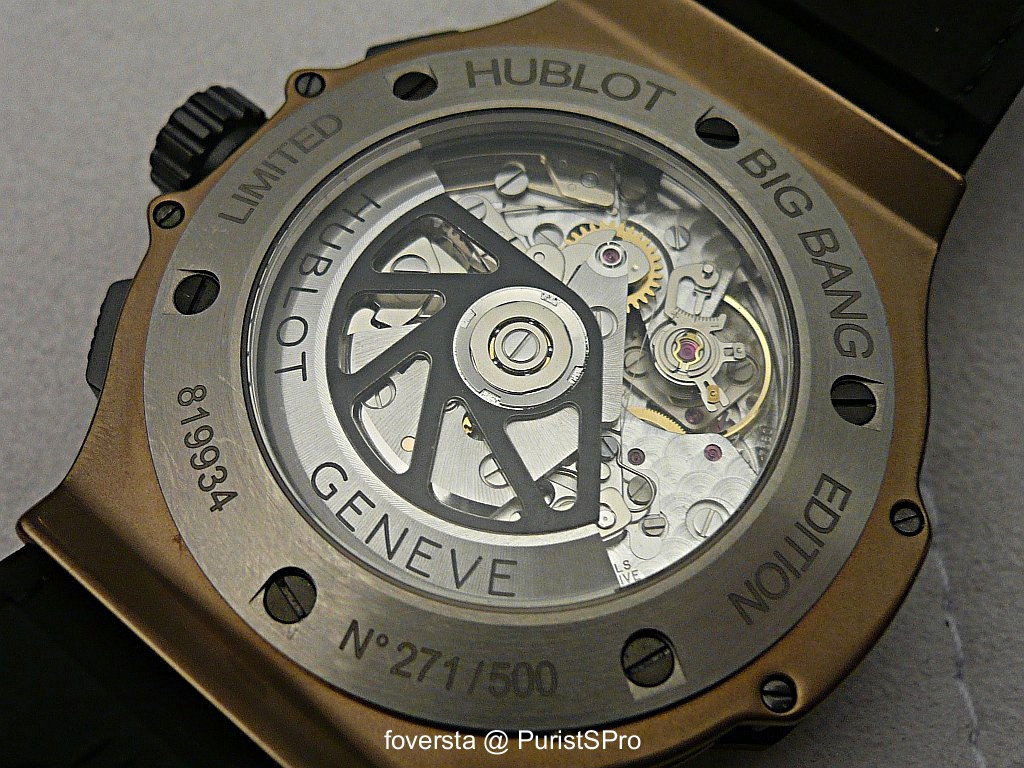
As you can see of the pictures, the owner of the watch replaced the original rubber strap by a gummy croco and the combo works very well I must confess. Actually, the gummy croco improves the style of this Bullet Bang.
The Bullet Bang was presented in 2008 in a context of a limited series of 500 pieces. Due to its case properties, the Bullet Bang quickly became a successful edition of the Big Bang, it is therefore a not so easy watch to find.
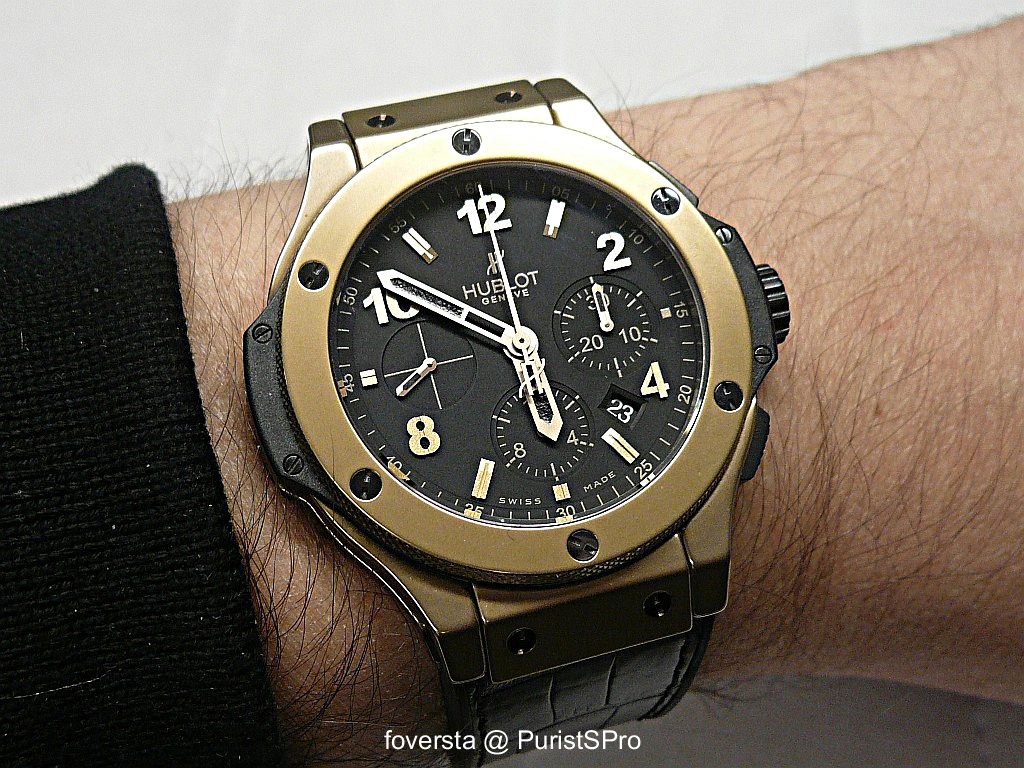
Several attitudes are possible when we stand in front of this Bullet Bang. We can say: and here we go again, this is the variation number X of this watch… and always with the 7750… But at the same time, we can consider that it is a relevant evolution of the fusion concept. The use of a new material gives here a new dimension to the watch. This Bullet Bang can be perceived at the end as an ideal Big Bang, solid, reliable, with an original case color and resistant to lassitude thanks to its neat dial without any unhappy inscription.
I would like to thank the staff at the Hall of Time boutique in Brussels.
Fr.Xavier

Thank you very much FX!
Very informative review, and interesting with a touch of history. Much apprecaited!
Ken
Excellent Fr. Xavier...
The case is made of "cermet," which is actually CERamic and METal (in this case powdered tungsten) which yields the hardest man-made material on earth. Cermet is used for tank armour and tiles for the space shuttle and bullet proof vests. This case is completely unscratchable, and is quite a conversation piece as nobody (even jewelers) can figure out the material, especially after I take my pocket knife to it!
To me this is a quintessential Hublot, clearly showing the fusion of innovative materials.
Here are a few photos for you...


Hi Mike, some questions:
A wonderful timepiece indeed.
Just want to clarify if indeed it is with column wheel? From the photo it is no different than my usual AeroBang and Big Bang SS?
Cheers!
Nien
Column wheel? YES
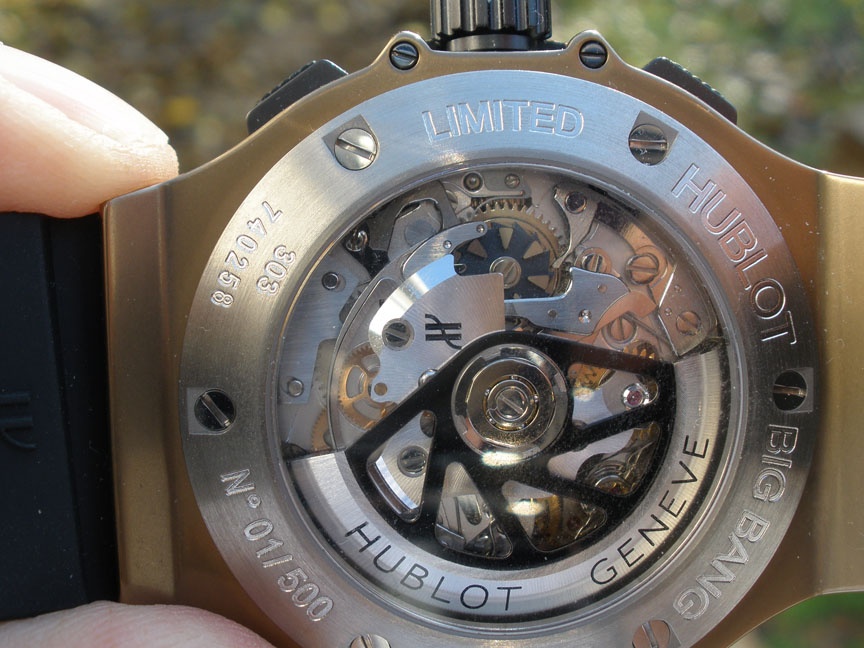
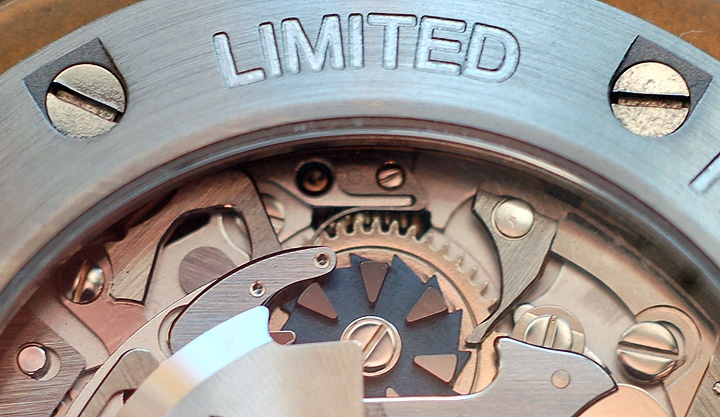
And a short little video too:
* Moderator's note: sorry, no link to outside site is allowed by the rule. Thank you for understanding. It is okay to post video via YouTube (refer to HELP tab to embed video from YouTube). Ken This message has been edited by KIH on 2011-02-22 16:31:31
check out Mike's reference and serial
This message has been edited by THE Paul Erhardt on 2011-02-25 12:21:21

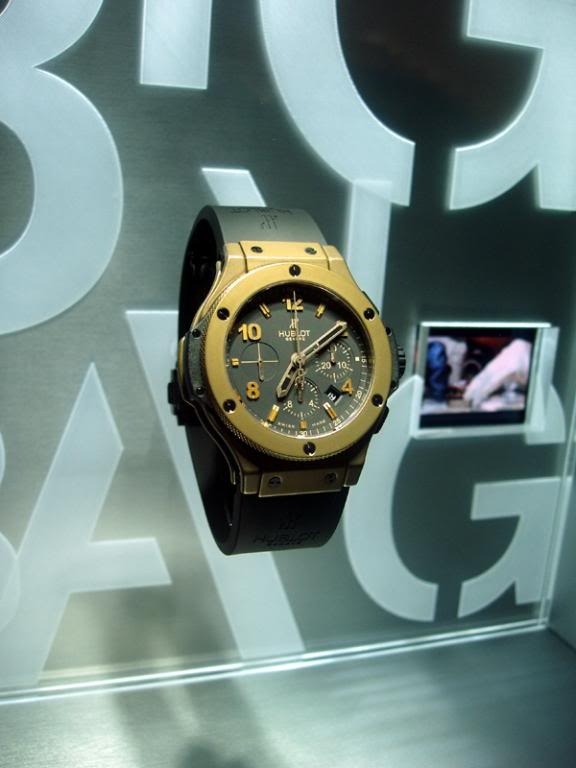
Love the Bullet
Andrew

Thanks Fr.Xavier
you've put all together ...ITS A TRUE BIG BANG , the ability of this bang to survive a brutal life above earth... its a bang which stand for it self far and special from any other sisters and brothers bangs .
personally im not a man with a brutal living ... yet i still appreciate and welcome such a bang .
Thanks again for putting it under the spot light.
Faisal

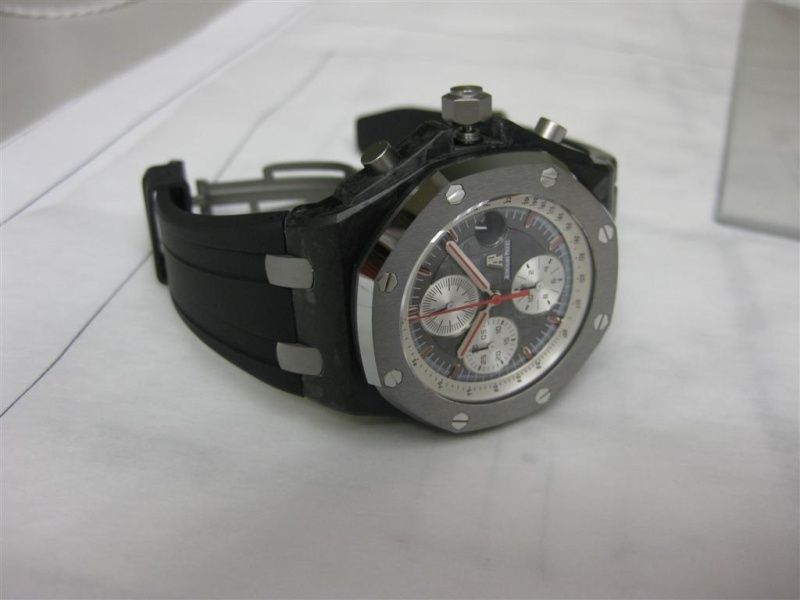
A different look at Cermet.
I have handled the Hublot Bullet in person. To me the color looks like a dull brass. Certainly unique.
AP's formula yields an incredible grey color. I would liken it to Hublot's tungsten, but definitely darker. The polished areas offer the highest shine I have seen on a watch. It makes me wonder how the Hublot cermet would appear if polished.
Anyways, a few pictures for comparison of the material.
Any chance...
Andrew
Not at all.
Ken, if you feel my post was not in this vein please delete it.
I was just teasing!
Andrew
No worries Andrew.
I don't see any reason to remove the post.
Don't worry. I believe this type of discussion is totally okay from my view point. Other brand forum do have cross-brand comparison post from time to time. Ultimately such comparison comes down to one's taste and that makes this hobby diverse and interesting. Thank you for bringing this up.
Ken
Thanks for a nice detail
vickers scale
18K Red Gold 160
Aluminium 167
Europium 167
Magnesium 175
Ytterbium 206
24K Gold 216
Silver 251
Cerium 270
Neodymium 343
Thorium 350
Copper 369
Stainless Steel 400
Praseodymium 400
Samarium 412
Palladium 461
Holmium 481
Lanthanum 491
Hublonium AG5 500
Thulium 520
Dysprosium 540
Platinium 549
Gadolinium 570
Erbium 589
Iron 608
Vanadium 628
Nickel 638
Terbium 863
Tantalum 873
Zirconium 903
Titanium 970
Cobalt 1043
Chromium 1060
Lutetium 1160
Rhodium 1246
Niobium 1320
Molybdenum 1530
Beryllium 1670
Hafnium 1760
Iridium 1760
Uranium 1960
Rhenium 2450
Tungsten 3430
Zirconium Oxide (Hublot Ceramic) 6200
Whoa, thanks for the hardness scale..
... very informative and impressive.
I am so intrigued and impressed with such material and fusion technology - begs the next question: how you shape it into case/ bezel. But I bet it is highly confidential and I respect that 
Thanks again, Mr. Biver!
Ken