
My first "vintage" Heuer timepiece
Forumners,
I was walking through a medieval market town when by happenchance, I came upon this Heuer timepiece in an olde shoppe.
It was still in its box and appeared unused or at least, little used.

Heuer I.F.R.
With only two pushers, one of which, also serves as the winding crown, I think it is a chronoscope of some sort.
When activated by the top pusher, a strange whirring sound emerges but the seconds hand moves, well...a circuit each minute.
That minute elapsed is indicated by a jumping digital display.
There are only 12 minutes available on the minute totalizer before it reverts to zero minutes.
Activating the top pusher again will stop the clock and the side pusher resets everything to zero.

Heuer I.F.R.
The power reserve is about an hour, albeit measured in epochs of 12 minutes.
Despite the very fast whirring sound of indeterminate frequency, the seconds are not subdivided nor is there a fractional seconds hand to show 1/10th or 1/100th of a second.
So, it appears to be a 12-minute chronograph with a resolution of 1 second only...
That's all I know...…

MTF

But what can you do with it?
I have many regular chronoscope watches that can display 12 hours of elapsed time with resolution of 1/4 second or 1/5th second or even 1/10th second.
Why have a (very) high frequency escapement (sounds like 360,000 vph) if it has only a seconds hand cycling once per minute?
Regards,
MTF
I found a use....
While testing the power reserve, I found the gentle buzzing chatter very soothing in the background as I was typing on my computer.
It's a mechanical 'white noise' machine!
MTF
☺ I need so little
A bloke with so little needs.
I find wonder in little things.
😉
MTF
P.S. It's really a soothing sound...

Damn! I've been looking for that for months!
You were also walking down the lane with the watch in a medieval market town...?
What twinned fates?
What coincidence?
Our wills and fates do so contrary run
That our devices still are overthrown;
Our thoughts are ours, their ends none of our own.

MTF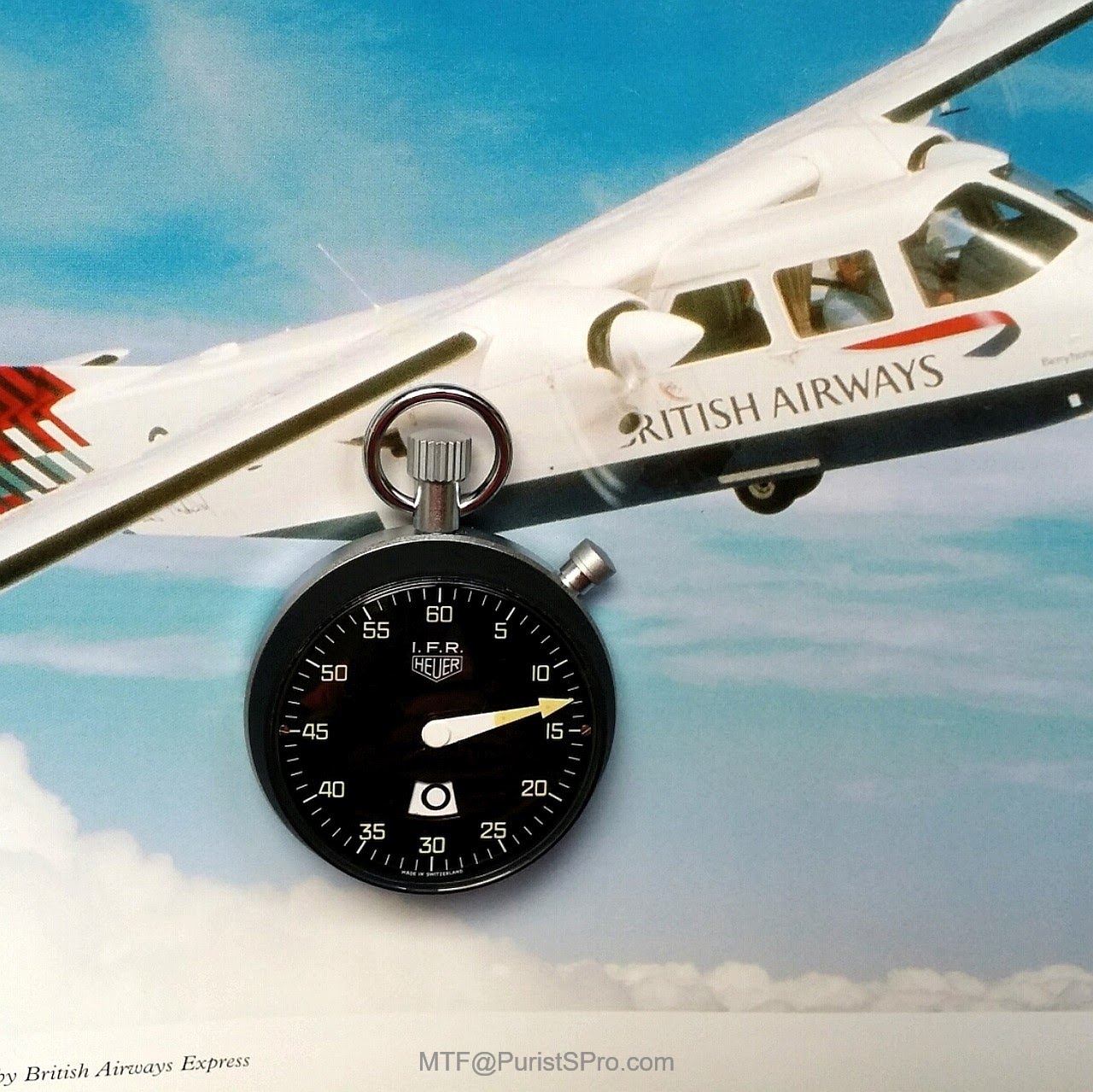
Heuer ref.542.838.xxx

Purpose?
A chocolate teapot comes to mind as a measurement device for short time intervals! Why this watch?
Best
Clive
I did more research
Obviously, 12 minutes is enough for that.
The 1 second resolution is good enough for aircraft separation.
There is an optional dashboard holder to attach to the instrument panel.
Regards,
MTF
6 minute holding patterns
That makes more sense MTF but not for a direct approach and landings. I have never come across such a specific stop-watch as shown here but in a former life as a transport pilot we used to carry out 6 minute holds (it still happens of course) over aerodrome and air corridor radio beacons awaiting in a queue for descent to land.
The holding pattern consists of flying an accurately flown (allowing for local wind direction and speed at the aeroplane's height) 6 minutes oval loop aligned in a defined direction with two parallel opposing straight legs for 2 minutes each and two 180º turns at each end of 1 minute each, all calculated to pass over the beacon at a precise time. Quite difficult in strong winds where the pilot had to mentally adjust headings for drift and add and subtract seconds to the turns and to the straight legs when allowing for the wind direction and speed to make sure each "pass" over the beacon is at a precise time. Each turn was flown at a rate of 3º per second (called a rate-one turn). 12 minutes duration would allow for two "holds" if required but sometimes more holds are required when air traffic is busy in perhaps bad weather. Sometimes holds are also used to delay/separate aircraft flying along air corridors to keep a minimum flight separation at particular flight levels. Now with GPS the "holding point" is defined as coordinates etc, but the same principle applies.
An ordinary "pilot" watch is usually sufficient although some pilots use a chronograph. Some aircraft had a suitable clock on the instrument panel. On a Piper 28 I used to share privately there was a handy simple bracket to hold a stop-watch on the control wheel.
Best
Clive
6 minutes
Then, a six-minute chronograph makes more sense than 12-minutes with your extra flight information. The power reserve is about an hour so there are at least 10 holding pattern cycles. 😊
Heuer use to sell the square bracket to fix a standard instrument panel. They also made IFR models with the bracket built onto the watch caseback.
I guess that's why the watches were 'On the Dash'.
Regards.
MTF

Lots of stopwatches back in the day...