Help needed in identifying watch
The only marks I can see on it are on the face. It says "Omega, Non-magnetic" and at the very bottom "Swiss Made." There is no symbol on the little knob, no numbers or anything on the back. I don't know what it's made of, but it looks like stainless steel. Could this be a military watch? Or is it just an old fake Omega?
I just have to say a few words about that watchband. It's so lightweight. One section of it slides through the end of the other section to whatever size you want, then you just press the end of the sliding section into one of the spaces between the links, and it's fastened. With all those spaces, I should think it's not only light, but cool and comfortable to wear. Even if the watch is a fake, somebody should still be making watchbands like that.
Well, I'm attaching some photos, and I hope you all can help me.
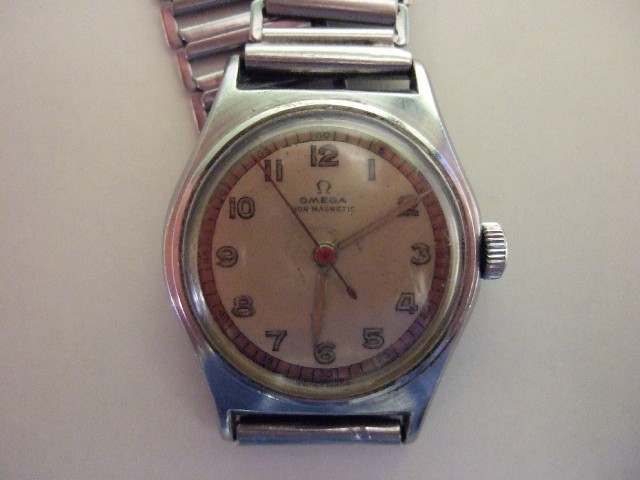
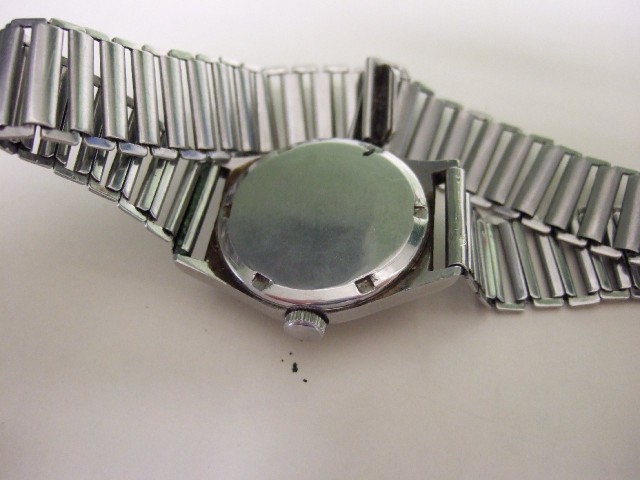
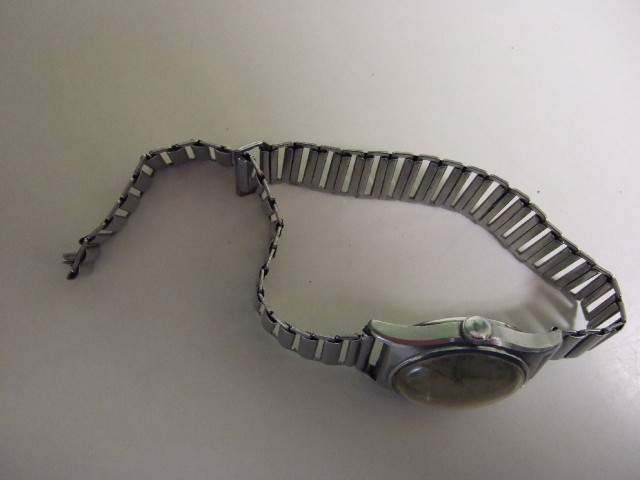
The watch is real , the braccelet is great. That is the short answer..
That is a great watch. It appears original to me. It would be helpful if you can have the watch opened and we can take pics of the movement.
This is an uncommon example for a few reasons. The case appears to be "waterproof" screwback case design. The dial being signed " non-magnetic" is also a bonus. What is the diameter of the watch in mm not counting lugs or the crown ? This watch looks to be from the late 30's or early 40s.
The bracelet is of a bonklip style. These were very popular on military watches of the time. They are very comfortable, i have a few on my watches. They pop up for sale from time to time in different end widths.
Looking forward to seeing movement pics of your "draw treasure".
Good Hunting
Bill Sohne
More on the mystery watch
Thanks so much for your very prompt and helpful reply. I have never seen a watch like this, and it was great to find someone who knew something about it. I wanted to reciprocate by sending you some answers, even though I haven't any more photos yet. I have to say frankly that I know nothing about watches, including basic watch terminology. Therefore, I am a little embarrassed to send you a measurement of this watch, but here goes. I'm assuming the lugs are those little indentations in the back, and I don't exactly know what the crown is, but here's how I measured: Across the face at the middle, starting and ending where that sort of raised metal ring around the face is, the measurement is 25 mm. It really appears quite small compared to many men's watches.
Here's another interesting thing I've noticed about it. When I look at it and turn it this way and that, the second hand starts moving by itself for a short time. I don't even have to turn the little winding knob.
I will try to have it opened and take some pictures of the inside soon. Can I take it to a watch repair place, or should I take it to a jeweler? And while I'm at it, should I try to have it repaired? And should I replace the glass part? Although the case looks fine, the glass is all scratched and scuffed, which I think may contribute to the dingy appearance of the face. Of course, maybe the coloring of the face is just rather dull and dingy itself.
The more I think about it, the more I think the watch probably belonged to my husband's father. He was the original owner of the desk, which I cleaned out after my husband's death. I think my husband overlooked the watch; in all the years he never wore it or kept it with his other watches. So 30's or 40's seems to fit. The family was South African, and during the war all of them served in some capacity.
One can get very philosophical contemplating old timepieces -- the times they have ticked off, the lives they have measured. I'm glad to have found this one, and very glad to know a bit more about it.
Thanks again.
P.S. I didn't mean to send duplicate photos last time; I think the uploader just doubled them, but whatever, the uploader was a big help, as I had no clue how to use the "insert image" dialog box that is part of this program. Kudos to you all for adding improvements to your site.
A couple of more thiings about your watch
Generally, one measures a watch's width directly across the face, excluding the crown (the part with which you wind the watch) by measuring just to the side of the crown. It tells you the size of the watch and the approximate size of the movement inside the watch.
The lugs are the protrusion from the watch case that are the attachment points for the bracelet or strap.
Watches today generally have spring loaded pins, called spring bars, which attach the strap or bracelet to the watch. Early wristwatches and many military watches had a fixed spring bar, that was not removeable. As wristwatches first became popular in the 1920s and 1930s, the technology for making spring bars was not practical or reliable, and miltary watch designers wanted to eliminate the possibility of losing the watch due to a spring bar failing. Thus, some spring bars are fixed. Ask your watchmaker if the spring bars are fixed.
We would love to help you identify and date the watch further. If you can obtain digital photos of the inside of the case back and the watch movement, it would be most helpful. Omega made identifying marks in several places to aid in identification, some of which have changed over time. In the era this watch seems to be from, this is what you are likely to see. I've posted photos of an example of a gold cased watch from 1926 (Omega didn't change this system often. Note this watch has a hinged case, which yours does not).

Inside of the case back:
-- Omega logo in a generally circular shape

-- indication of the case metal, perhaps acier Staybrite or inoxydable, which is stainless steel and a brand name of stainless steel (my example is "14K 0.585" indicating 14k gold.

-- a seven or eight digit number, which is a case serial number (and is not the same as the movement serial number)
On the movement:
-- Omega logo in script
-- number of jewels (almost always, although my example does not have it)
it may (but not always) say "unadjusted" or "adjusted in X positions"
-- a seven or eight digit number, which is a movement serial number (and is not the same as the case serial number)

-- hidden underneath the balance wheel (the circular piece which rotates back and forth) will be an Omega code for the movement.


This one is 23.7 T1.
Don't worry if your photosdon't turn out well and you can't get close ups. An in focus shot from further away is far more helpful than a blurry one close up. We all struggle to get photos that show what we see on our wrist, let alone the microscopic details of the inner workings of our watches.
Good luck
Thanks for the useful info
Thank you for the useful information. I am learning so much. The inside of a watch is like a whole tiny world. I was very impressed with your stunning photos. That is a beautiful watch you have.
I will post photos as soon as I can get the watch opened, and I will be looking for the things you described and illustrated in your photos. Thank you again for your help.
a question about this watch
thank you for the wonderful article. I have a few questions about this omega watch and perhaps you could give me your advice:
1. One of the jewells in the middle seems to be missing - what do you think?
2. what caliber is it?
3. given that you can not see Geneva stripes, is it a rather common movement or quiet collectable?
Sorry to hassle you with questions but I would be very grateful to have our opinion
Kind Regards
Alexander Von Rozen, PARIS