
Girard Perregaux SIHH 2011: A story of Tourbillons under 3 golden bridges.

Introduction:
Time has no effect on true love, never.
In the early 90ies, vwhen I was at the beginning of my horological aventures, I was sporting a Rolex GMT ( my very first " serious " watch ), and dreaming about some unaffordable watches.
Among them, there was a curious one, with 3 weird but magnificient gold bars, a pair of Dauphine hands, poetly called " Tourbillon sous 3 ponts d'or " ( Tourbillon under 3 gold bridges ).
I was done...
20 years after, I caught a serious virus called " Belle Horlogerie ", and, without any appointments, decided to pay a visit to the Girard Perregaux booth, at the SIHH.
Welcomed by a friendly and passionate team, we started with the Vintage 1966, and ...
What had to happen happened...
Our host showed me some horological summits, 3 exceptional, superlative watches, housing the Tourbillon under 3 Gold Bridges, this Tourbillon which made my heart beat faster, 20 years ago.
I dare say that, as no other watch, the Tourbillon under 3 Gold Bridges is the best expression of THE Girard Perregaux D.N.A.
To better understand its importance and interest, let's have a journey into Time...
1/ The History of the Tourbillon under 3 Gold Bridges.
As you all know, GP is not the inventor of the Tourbillon born in 1801 under Mr A.L Breguet's genius, BUT, somewhat, the brand contributed to improve it, aesthetically and mechanically, as, at this time, the form and the substance were intimately linked.
When we read G.P History, we can distinguish two steps, which are rather classic in horology:
- First, you have to work on precision and accuracy.
- Then, you can improve and develop the technics, the aesthetics and the complications / sophistications ( is the Tourbillon a complication or a sophistication, this is an eternal discussion ).
For Constant Girard, as well as for all the other true watchmakers, this was the way and the method he adopted.
We are now in the middle of the 19th Century.
From 1865 onward, Constant Girard submitted his work to the Neuchatel Observatory.
One of his watch, presented in 1867 at the Neuchatel Observatory, was awarded and held a precision record for as long as 17 years!
The second step drives us, directly, to the purpose of this topic: Constant Girard improved his horological work in two ways: The STRUCTURE of the movement, and the SHAPE of its parts.
So, circa 1860, the 3 Gold Bridges movement was born.
The purest expression of the 3 Gold Bridges actually appears later, as the result of a long genesis, with roots as far back as 1860.
For instance, this pocket watch from 1867 already features the architecture of the movement with parallel bridges:

The definitive arrow shaped bridges, and the use of gold to craft them came later...
In the following years, the 3 Gold Bridges Tourbillon, which was awarded in 1889 ( patent pending and patented, finally, in March 25th,1884 ), during the Paris Universal Exhibition ( Gold Medal ).
This pocket watch is now famous for every watch fan, more known under the name " Esmeralda ", which belonged to Mr Porfirio Diaz, President of Mexico, at this moment ( from 1876 to 1911 ).
Some pictures of the Esmeralda: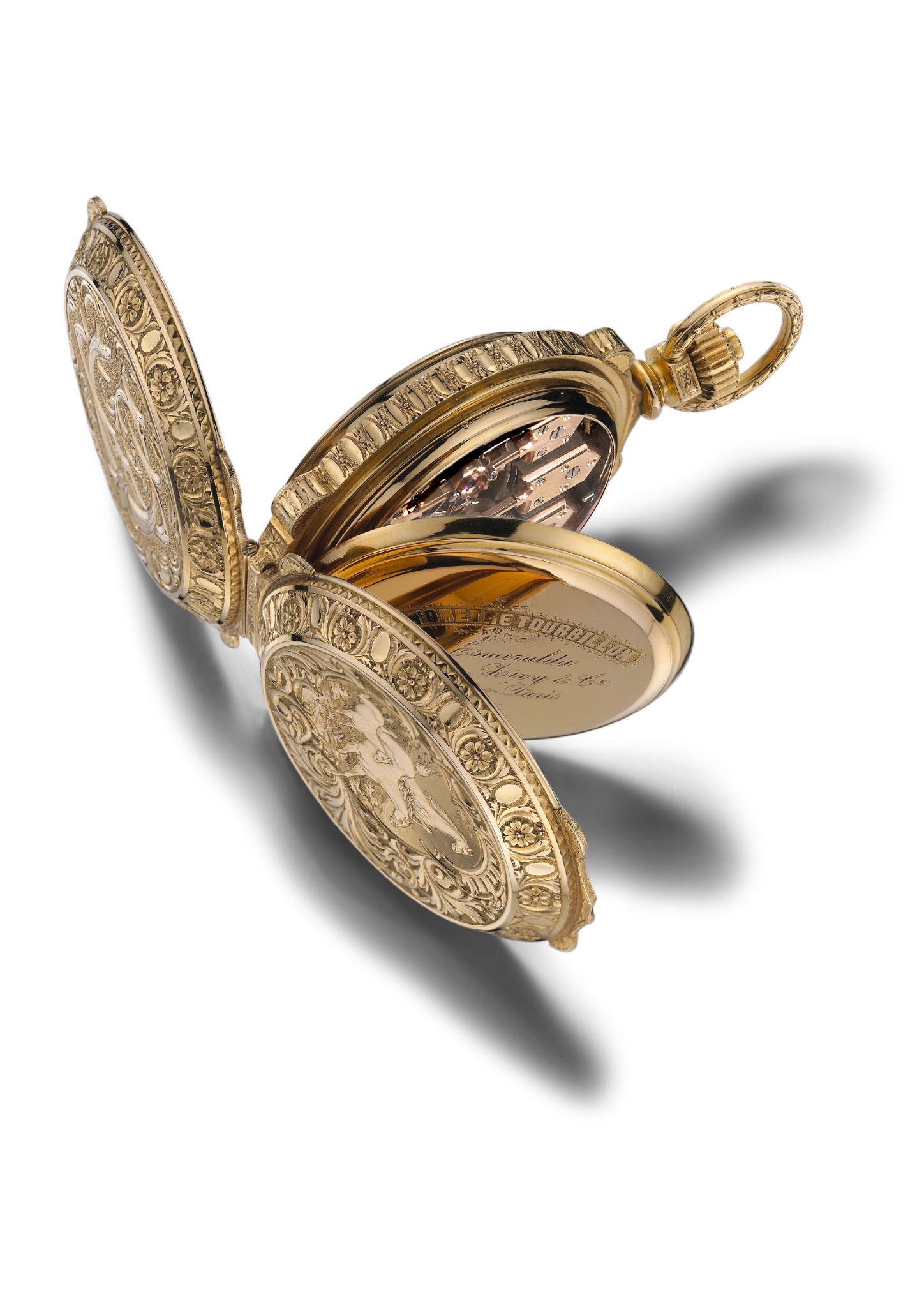


The fascinating white enamel " Grand Feu " dial and the fine polished and heated blue hour and minute " Stuart hands, " pear shaped ".

The magnificient work of engraving...
The movement was a 20'" with 3 gold bridges whose extremities were arrow shaped, jewels screwed in golden chatons, a finely worked one minute Tourbillon with a detent escapement, a bimetallic Guillaume balance, and Phillips balance spring.
The screws are bevelled and polished, as well as the cage.
Some numbers to better get the importance and the interest of the Tourbillon for a brand like G.P:
Between the Mid 19th to the ealry 20th Century, GP submitted 57 Tourbillons to the Neuchatel Observatory.
24 of them came with the famous 3 Gold Bridges Tourbillon.
4 were awarded prizes.
For several decades, the Tourbillon under 3 gold bridges was not in production anymore, and, to be complete, we have to say that the bridges were not ALWAYS made in gold, but also in nickel silver, nickel plated brass or in platinum.
We had to wait- call it a paradox or resistance- the reign of the Quartz movements, to see the resurrection of such a marvel, first in a pocket watch ( since 1981 ), then from 1991 till nowadays, in wristwatches.
2/ The rebirth of the tourbillons under gold bridges.
- The pocket watch was, as previously said, re introduced in 1981, in a limited series of 20 pieces, being precised that, each year, only one or two watches are made.
The case, in yellow or rose gold is 60, 3 mm big ( Ref 00700 ), and can be engraved.
There is also a smaller pocket watch ( 49, 5 mm ) referenced 00760.
The dial is enameled white.
The spirit and the aesthetics are faithful to the original pocket watches from the middle of the 19th century, so we can say that it is a re edition ( The movement is indeed a reproduction of a watch which comes from the Girard Perregaux Museum ).
Here are some of them.
This one has been manufactured in 2003:
And this one in 2010:


Some details on the Tourbillon and the gold bridge, to appreciate, better than in words, the amazing work of the watchmaker:


And a close up on the detent: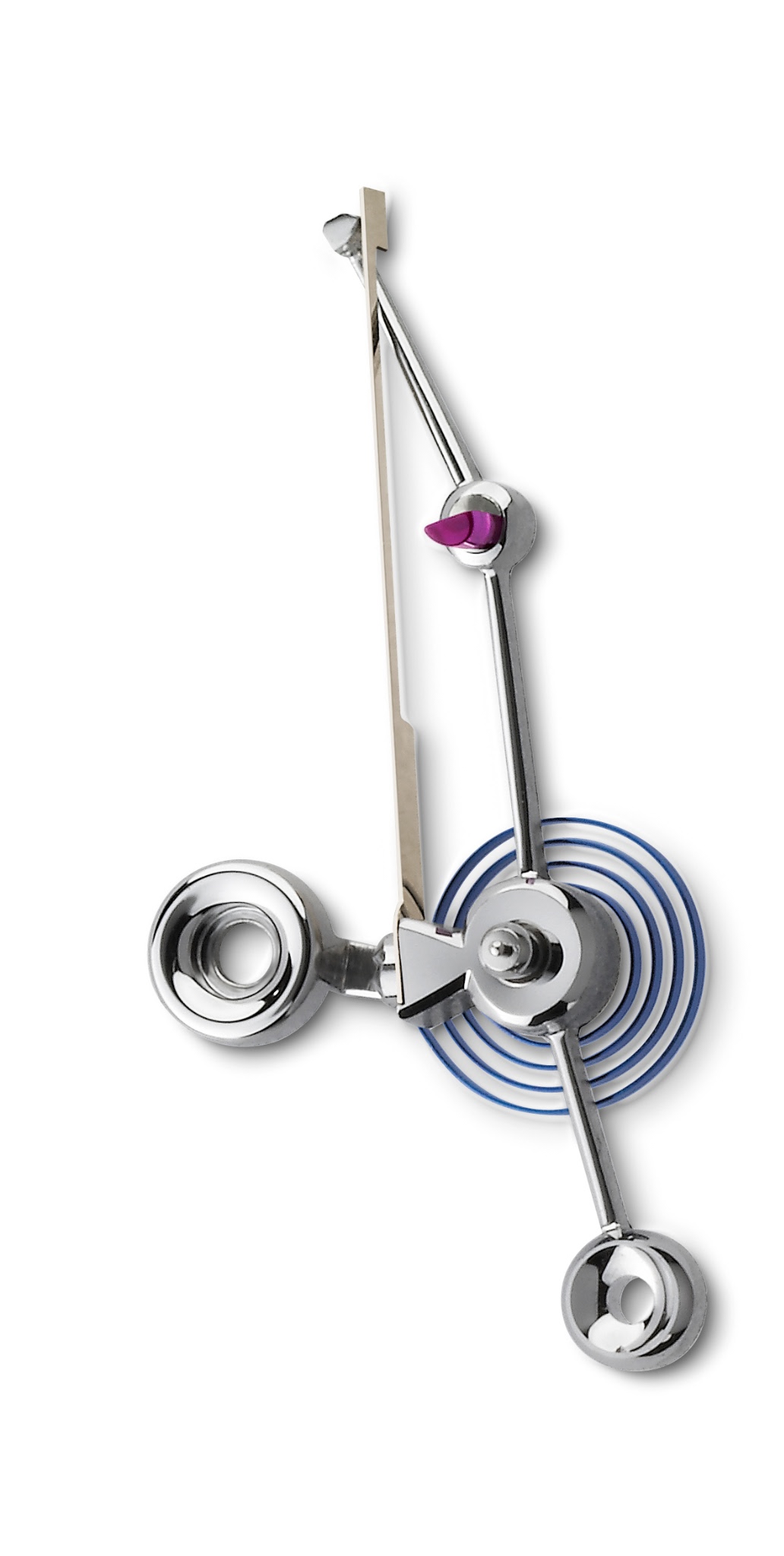

A view on the movement, the well named Cal T ( for Tourbillon ) 3P ( for 3 ponts ), the heart and the soul of this pocket watch. A 45 mm 18 jewels movement, beating at 21 600 alternances per hour.

Of course, like on the original movement, all the parts, the components are polished and the angles are bevelled with a lot of care:
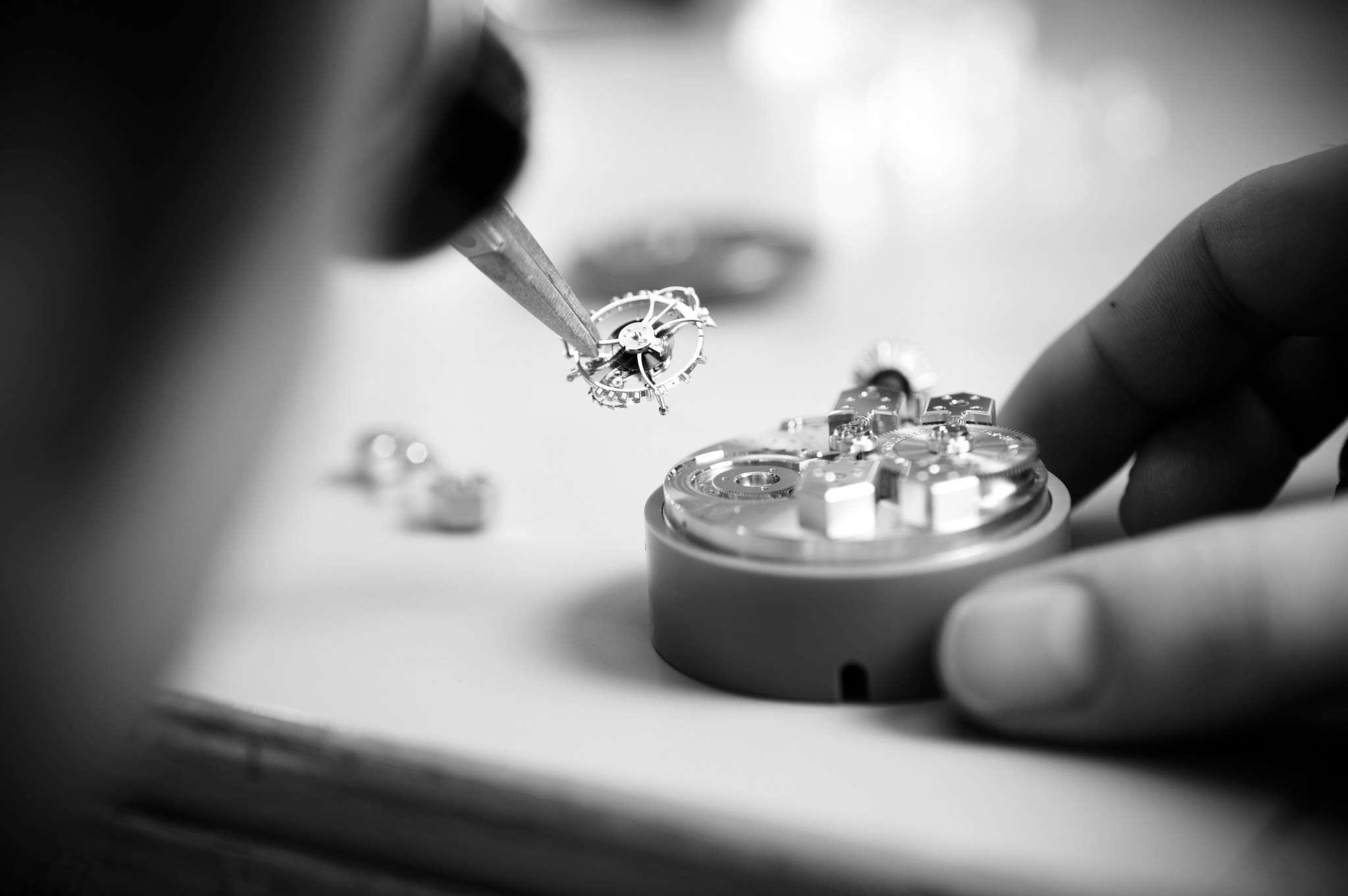
The watchmaker at work during the delicate operation of the assemblage of the movement:

- In 1991, for the bicentenary of the brand, came a new defy:
Miniaturizing the monstrously sublime 45 mm Cal T 3 P, to house it in a more convenient and decently sized wristwatch, and, at the same time, keeping in a faithful way the spirit of the ancester.
The new Tourbillon under 3 gold bridges was born, the first of a long and impressive line of gorgeous wristwatches.
This family is so rich that an exhaustive list would require a dedicated book, but to try to sum it, I would note that:
All types of cases have been used to house the Tourbillon under ( 3 ) gold bridge(s): Round, Ovale, Tonneau, Rectangular, from 31 mm to 45 mm, in yellow gold, white gold, rose gold and on some very few watches, platinum, stainless steel or titanium,
The hands are mainly Dauphine, but they can also be baton, dagged, " feuille ", " poire " or losange shaped.
One or three gold bridges, or not necessary gold, as platinum and sapphire were also ( rarely ) used,
With or without complications ( World Time, Perpetual Calendar, Chronograph, Minute Repeater, and even some funny ones, like the Slot ),
The movements were manual, first, with a 75 to 96 hours power reserve, then, since 1999, automatic ( which didn't replace manual movements, though ), which was also a big difference with the pocket watches, which were, of course, only manual winding.
The micro rotor, all made in platinum, to give it more density and to compensate its small size, which allows a 48 hours power reserve:

Another technical difference between the pocket and the wristwatch is that on the wristwatch, there is no more pivoted detent, but a lateral lever escapement.
Of course, the same care and the same obsession of the details and finish are brought in these Gold Bridges Tourbillon wristwatches with superb bevelled angles and polished parts.
I would also add that Mr Macaluso played an important part in the rebirth of these horological marvels.
It was under his impulsion that they were re issued, and he even designed the round case of the first 3 Gold Bridges Tourbillon wirstwatch.
Let's have a look at some of these pieces which, certainly, made all of us dream, one day or another.
The Ref 9900, a 39 mm platinum case, Cal 9900, 75 hours power reserve, manual wind ( 1991 ).

The Ref 99050, a 39 mm platinum, rose gold or white gold case, with a skeleted manual wound 75 hours power reserve Cal 9900 ( 1995 ) :

The Ref 99 150, a Chronograph Tourbillon with 3 gold bridges, in a 40 mm rose gold or white gold case, coming with different dials, jewelled, or not.
Cal 9981, Manual wound, 75 Hours power reserve ( 1996 ) :

Ref 99 070, Stainless Steel 40 mm case, Cal 9900 ( 1997 ) :

Ref 99030, in a 31 mm platinum or rose gold case, housing a Cal 9700 manual wound, 75 hours power reserve skeleted movement ( 1998 ) :

1999: The first Tourbillon with 3 gold bridges automatic movement, Cal 9600, 48 hours power reserve.

Ref 99750, more known under the Opera One appellation, a Tourbillon under 3 gold bridges, associated to a minute repeater on 4 gongs, playing the Westminster melody, 40 mm yellow gold, rose gold, white gold or platinum case, Cal 9899, manual, with a power reserve of 75 hours. ( 1999 ) :

Ref 99850, Tourbillon with one gold bridge, Vintage 45 case, in platinum, or white, rose, yellow gold case, Cal 9610 C, Automatic, 48 hours power reserve ( 2000 ) :

Ref 99080, 36 mm rose or white gold case, Cal 9700, manual, 75 hours power reserve ( 2001 ) :

Ref 99890, 32 x 32 mm Vintage 45 in rose, white yellow gold, or in platinum, Cal 9600 CS, automatic, 48 hours power reserve ( 2004 ) : 

Ref 99490, Cat's Eye one gold bridge tourbillon, in white gold or pink gold, 31, 3 x 36, 3 mm case, Cal 9700, manual, 75 hours power reserve ( 2005 ) :

Ref 99071, 42 mm Laureato titanium case, platinum bezel, tourbillon under 3 sapphire bridges, Cal 9600 OS, manual winding, automatic, 48 hours power reserve ( 2007 ) :

Ref 99720, the famous Jackpot, Vintage 45 43 x 43, 95 mm case, Cal FAY 08, manual winding, with a 96 hours power reserve and a Tourbillon with one gold bridge ( 2007 ) :

Ref 99880, Vintage 45 36, 1 x 35, 25 mm case, in rose or white gold, manual 48 hours power reserve Cal 9600 C OOOS movement ( 2009 ) :

Ref 99810, Tourbillon bi axial, 45 mm white or rose gold case, Cal EO 201, manual, 72 hours power reserve ( 2009 ) :


Not too dizzy? So, let's see what GP offered us, this year...
3/ The GP SIHH 2011 3 Gold Bridges Tourbillons:
- The Reference 99 193:
The window at the G.P Booth, in Geneva, was a promise of some exciting moments in perspective.

A link between the Past and the Present, the important pocket watch I mentioned above, side by side with its distant descendant, the latest, or should I say one of the latest, Tourbillon with 3 Gold Bridges?
Indeed, the Reference 99 193 was first released in 2010, in a limited Edition of 50 pieces in Rose Gold.
This year, it comes in white gold, limited to 50 pieces, and the big difference between the former Rose Gold version and this one, is that this latest has a see through sapphire case back.
The white gold ( dream ) 99 193: 


The case is 41 mm big and 11 mm high ( distance between the lugs: 20 mm ).
It houses the Cal 9600 C, which is a 32 mm self winding 30 jewels movement, beating at 21 600 vibrations per hour, and offering a power reserve of 48 hours, and displays the hours, minutes and a small second on the Tourbillon.
A view on the 72 parts of the Tourbillon, which weight only ... 0, 3 grams:

Numbers and technical characteristics are one thing, seeing this watch in the flesh- or, at least, in pictures- is a completely different matter.
The masterpiece is not an abstraction anymore, it is here, in front of you, revealed to your senses, to your pleasure, a kind of intellectual, artistical and emotional feast.
First of all, the white gold case and gold bridges gives a lot of modernity to the watch, in my opinion.
Maybe it is due to the fact that the white gold bezel is brushed, which contrasts with the other parts of the case which are polished?
Anyway, the volumes of the case don't look too big nor too thick, and the crown is well integrated, even if, on this matter, the Vintage 45 goes further, as we'll see.
Then, your eyes will focus on the dial which offers an harmonious combination of geometrical shapes, rectangular ( the bridges ) triangular ( the arrows at the extremities of the bridges, which make echo to the long and slim Dauphine hands ), circular ( the Tourbillon cage and the delicious platinum micro rotor, without forgetting the finish of the " dial ", if I can call it this way, as it is part of the movement, as the movement is part of the dial ).
Yes, the case and the dial give an intense impression of purity, harmony, blending at the perfection the Tradition ( the Tourbillon with 3 gold bridges ) and Modernity ( the way this traditional sophistication is expressed, through this watch ).
The case back generates the same sensation of Modernity.
The same care has been brought in the finish and the decoration of the movement.
Sculptural, epured, which is the advantage to have located some of the other parts on the dial side, are the wors which come immediately to mind to describe it.
I love the circular engravings which decorate the bridges and the plate a lot.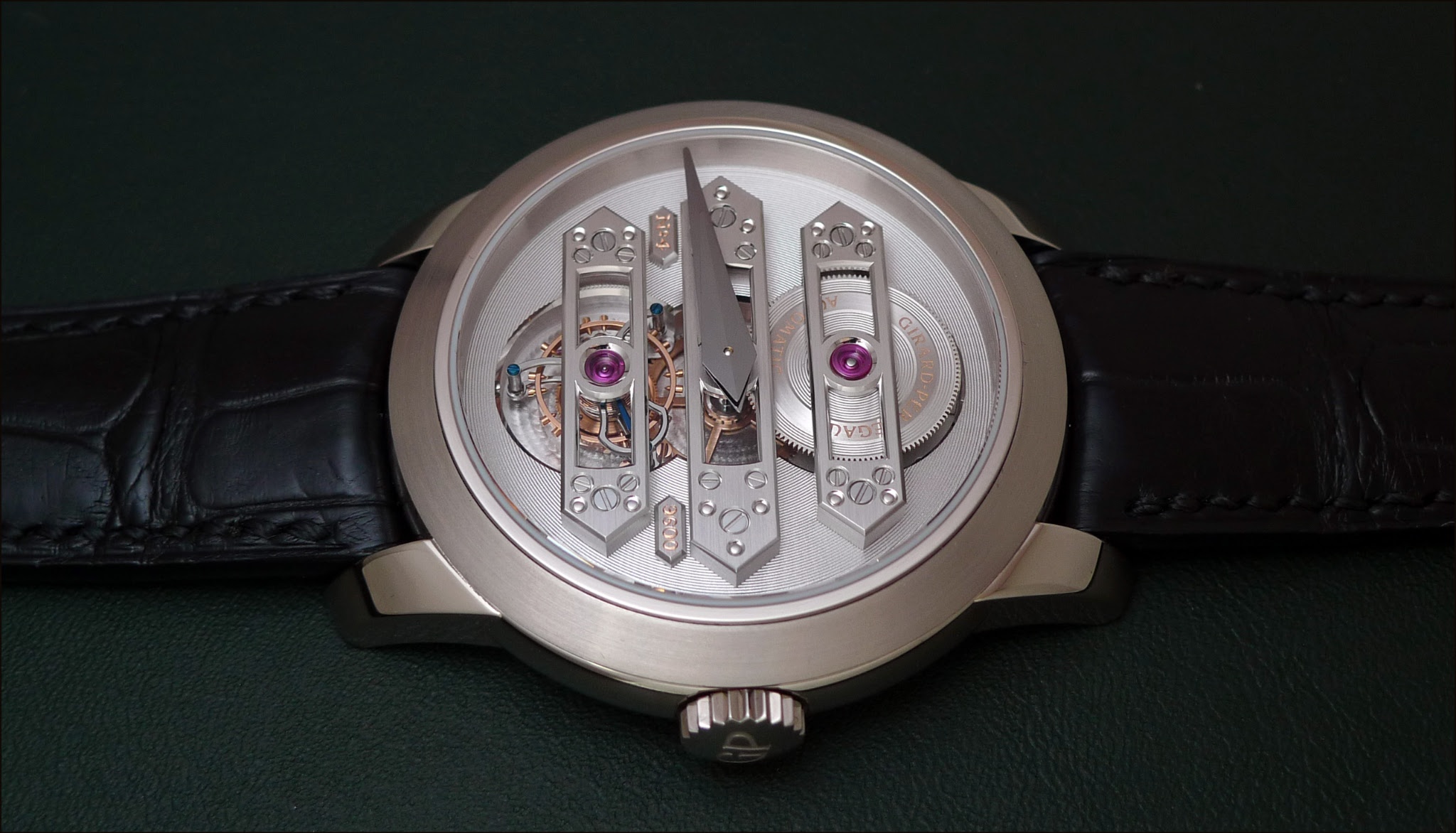

Who could guess that this movement is automatic?
And, by the way, who could complain that this movement is automatic, rather than being manual?
Not me, as I absolutely love the way this micro rotor is integrated on the upper bridge.
- The Ref 99880:
This reference was first introduced in a limited edition of 50 pieces, in rose gold, in 2009.
As for the 99 193, this year sees an edition of 50 pieces in white gold, which, as its round " sister ", gives up the solid case back for a see through one.
This 3 tourbillon with 3 gold bridges is built on a generous Vintage 45 case ( 36, 10 x 35, 25 mm and 11, 48 mm high ).
A lot of things have been said on the 99 193 which won't be repeated here, for the 99880.
We'll only mention the differences, here.
The main difference is of course the rectangular case.
I always felt a certain weakness for the Vintage 45, and I'm happy to see it housing such a presitigious sophistication / complication.
What is really amazing is that the case is curved, in a very sensual way, and that the sapphire glass makes echo to the case as it borrows or follows the curves, which doesn't look that easy to do, but it is a characteristic we find on all the Vintage 45.

The case looks a bit bigger and thicker than on the round 99193, but it is difficult to compare, as they are no shaped in the same way.
I have to say that to me, the crown on the Vintage 45 is better integrated to the case, as it is fitted into it.
Another detail is shown on the picture above: The decoration of the dial, which sees some vertical engravings instead of the circular lines on its" round sister ".
Let's now have a look at the case back and the movement.
As for the case, the case back is lightly curved, which is not only aesthetical, but which also allows a bigger comfort on the wrist.
We find the same movement than in the 99 193, the Cal 9600 C, with the same technical datas, BUT with smaller dimensions ( 28, 60 x 30, 30 mm ), which is noticeable through the sapphire case back.
Like on the dial, no more circular, but vertical engravings on the bridges and the plate.

Which one do I prefer between these 2?
That is a tough question.
I love a lot the round case, with its brushed bezel, and the case back which shows a better coherence between the movement and the case.
BUT, the curved case, case back and sapphire glass are a must on the Vintage 45, as well as its better integrated crown.
To each his own.
If only we could always have this kind of delicious dilemma in life...
For those who are suffering and hesitating between these 2 marvels, I may have a solution, as GP introduced a third Tourbillon with 3 gold bridges, a totally different offer...
- The WW TC Tourbillon enamel dial: When enamel meets horology.
And now, what if you add another traditional Art to the Tourbillon with 3 Gold Bridges?
You know that enamel was used on pocket watches dials, in the 19th and early 20th Century.
In 2007, GP released a WW TC Tourbillon with 3 Gold Bridges:
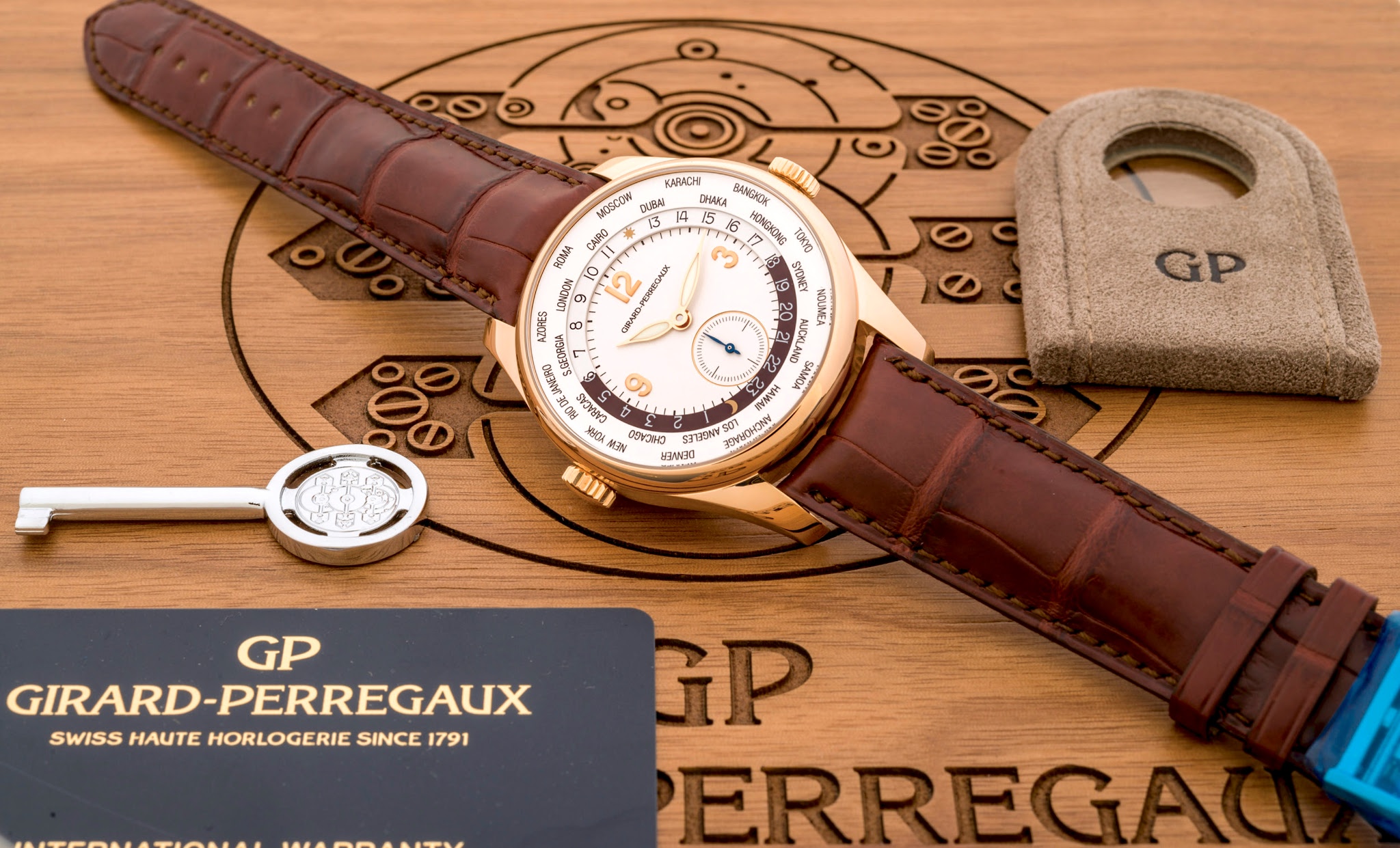

This year, GP associates a " Champlevé " enamel dial to its famous Tourbillon, and goes a step further in the complexity and the sublime.
Here is a definition of the Champlevé, I found on the net, to understand all the work this technique requires:
Champlevé is an enamelling technique in the decorative arts, or an object made by that process, in which troughs or cells are carved into the surface of a metal object, and filled with vitreous enamel. The piece is then fired until the enamel melts, and when cooled the surface of the object is polished. The uncarved portions of the original surface remain visible as a frame for the enamel designs.
Champlevé is distinguished from the similar technique of Cloisonné in which the troughs are created by soldering flat metal strips to the surface of the object. ( Definition to be credited to Champlevé dot com ).
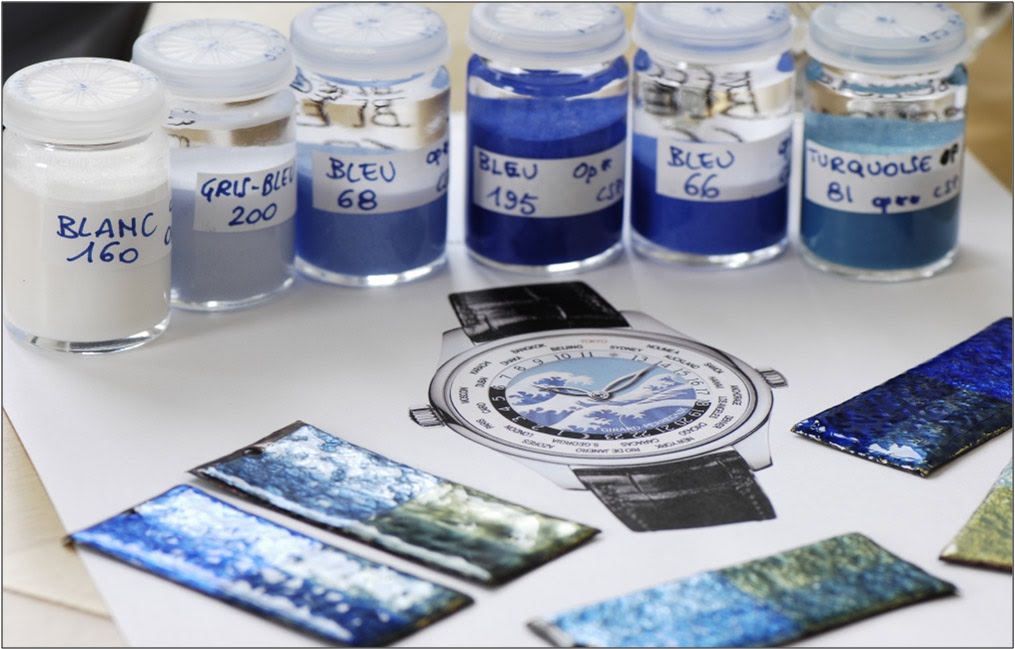
The Champlevé enamel dial is crafted in house at GP.
Here are a few pictures of the work in progress, on another enameled WW TC, but not Tourbillon, this time: 



So, what is this WW TC enamel?
I should say THESE, as there are 3.
The Middle East:

The South Asia:

The Americas:
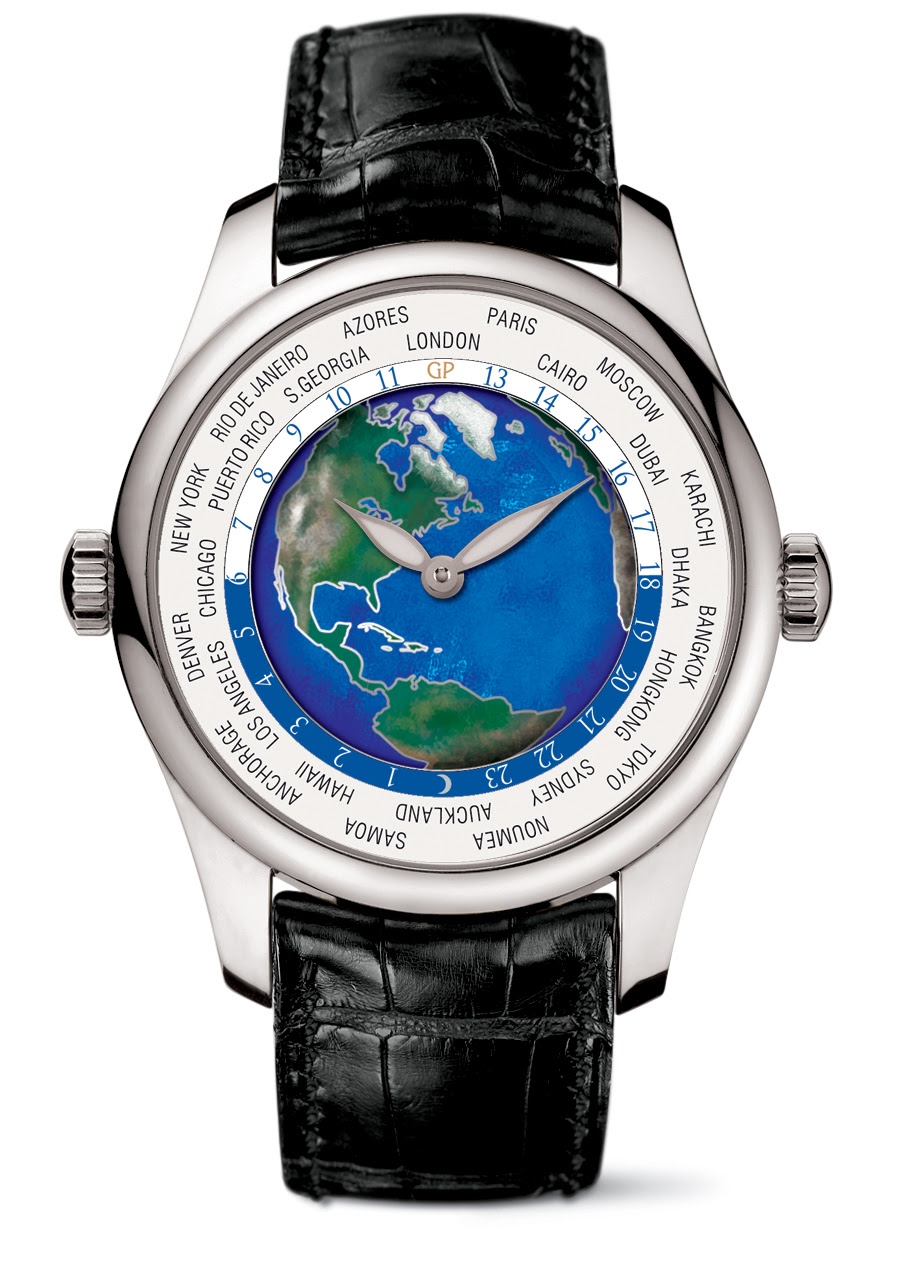

It is a 43 mm white gold case, 13, 15 mm high.
Despite its generous size, it is still very elegant, and somewhat sensual.
The only problem with this watch is that you'll never see what face to admire, because the the dial is a pure pictorial piece of Art, but what to say about the case back?
Some live pictures of the " Americas ", first, which is, to me, one of the nicest, even if I could happily live with each of these.


You have to pay attention to the chromatic work on the dial, and you will certainly fall for the bewitching nuances of blue, white and green:
As for the back side, it is just spectacular: The movement is the manual wind Cal 098G0, beating at 21 600 alternances per hour, displaying the Hours, Minutes, small second ( on the tourbillon cage ), and, naturally, the world time complication coupled to a day / night indication.
It is an aesthetical success: How to resist to the exceptional finish of the plate ( hand guilloché and circular grained by hand ) and of the 3 gold bridges, whose surfaces are mirror hand polished, with rounded off bridges " arms " and hand bevelled sides?
The 3 Gold Bridges are placed on nickel silver supports.
Even the screws are bevelled and polished.
Here is the beauty:

As you can read on the case back, each of these 3 WW TC enamel is a piece unique, but there may be a few toehrs, with a different chromatic tone, and some other countries.
Anyway, let's guess that it will still be a very rare and desirable timepiece.
Conclusion:
Manual or Automatic, roun or straight arms, I think that all the Tourbillons with bridges are equally appealling.
Maybe the straight bridges look a bit more modern, while the round arms are a tad more retro?
Both of them superbly perpetuate the " Belle Horlogerie " knowhow, at the price of a total lack of compromise in quality.
Having the pleasure to see one of them in the flesh is an unforgettable moment of poetry and magic.
And with such an awesome diversity, no doubt that each of us will easly find the " Bridge " of our dreams!
I would like to thank the GP team, and specially Xavier M, for their great welcome and availablity, in preparing such a report, and to wish all the best to Mr Macaluso's family in their projects and idea for the brand.
Looking forward to hearing your thoughts and comments,
Best.
Nicolas.

You've done it again Nicolas
Fantastic article, I am speechless, somptuously presented, beautiful pictures pure poetry in time. Bravo.
Cheers
Francois
Merci beaucoup, Francois.
You can't imagine the pleasure I had when working on this topic.
A bit like a child in a ( high end ) candy store.
Best,
Nicolas.

I don t know how this might ve happened my friend...
I ve been into reading the story,concept and development of the "magic"GP bridges lately and reached my personal answer to the same question me and you bounced so many time....What Tourbillon would you go for?I think the answer is right before our eyes...
Must rush to work now but I will be back soon.
How in hell did you know that my latest obsession were these marvellous creations?
Do you also read minds?
You have super powers..
Mo
Easy, Mo... We have very similar tastes.
Then reading in your mind is an easy formality.
Best.
Nicolas.

Whew! I'm exhausted.
Not because of the many wonders you presented or the beautifully written text to accompany the gorgeous pics. but because I had to click on each frog to view the photos. (What's with this Imageshack; is it just me?)
However, you fully delivered my friend and my hats off to you for such a thorough and interesting review. You truly deserve the misnomer of Vlad,666.devil etc. This review is deadly and will lead us into temptation.
The 99193 is for me to dream about tonight and perhaps try to figure out where that damn micro Pt. rotor is. Who needs manual when such a glorious movement is in full view? Brilliantly executed!
Thank you, thank you Nicolas Perhaps one day? You first .... this time?
Best
fernando
This message has been edited by fernando on 2011-03-08 02:47:43To get it before you will be my highest deisre, Fernando ...
Although I wish you to be the first, as it will be a bit complicated for me, right now.
When it comes to this level of beauty and perfection, I doubt nobody will complain about an automatic movement.
Thanks for your nice comments, my friend.
All the best.
Nicolas.

You provided the answers 5 hours before i asked the question...
I know you... :)
More seriously here are some answers:
1/ NO.
2/ It seems so.
3/ Maybe, too.
4/ Don't forget that the 2 last winners of the chronometry contest, in 2009, were the JLC Master Tourbillon and the Gyro I....
The watch has its own virtues, the Team who works on it too.
Best,
Nicolas.

Paramount, in every sense of the word! An article to
read and read again, thank you so much Nicolas. I just had foot surgery this morning and to come home and open this article, I forgot all about my foot. The WW TC is the ultimate stealth piece for me, that simply elegant face, black and white--then turn the watch over for a look at the movement and "voila" there is a humming tourbillon under three gold bridges, it makes you weak in the knees. The pictures and graphics are so sharp and clear with the spacing in the text to give you time to catch your breath and ponder the beauty and artistry put before you. I am afraid that you have even out done yourself this time Nicolas. Thank you, thank you, thank you.
Best to all,
Tim
Well, Tim, all the glory comes to GP ...
It is ALWAYS easier to write something about GREAT and SUPERB watches, it doesn't require any talent.
Therefore, I had a lot of email exchanges with Xavier from GP each time I felt the need to have further explanations or informations, especially non the detent escapement, and on the History behind the 3 Gold Bridges.
Back to the WW TC you mentionned, I loved it so much that I dedicated another post on this watch, which associates a superb movement to a complication which is very dear to my heart.
These watches are a true achievement in the Horological Journey, for me.
Best, Tim, and thanks for your input.
Nicolas.

Perfectly written
Cheers
SamEE

So many dream watches
You posted a great tribute to this ever young series of great dream watches.
I can't seriously tell which one is my favourite as I'm constantly thinking of three or four same pieces comparably appealing.
The best of Girard-Perregaux for sure.
Cheers
Dje
I have the same problem, Jerome.
Well, first problem is to fund one Tourbillon with 3 GB.
Then, which one?
A WW TC, or '" just " focusing on the Tourbillon with 3 ( or one, why not, after all? ) GB?
And what to say about the Opera One?
Well, I'm not ready, yet, and still have to do my homework to get a conviction on this matter.
Best,
Nicolas.

Que decir? :)
Impressive job, Nico.
You made a PERFECT review of one of the most beautiful movements that can be seen in the watch industry, to me.
I really enjoyed your words and pics.
Eres el puto amo.
Gracias.
Vte
Pesadillas, a lo mejor? :)
You could thank me, my friend.
Now, if you have some sleepless nights, you will have some " material " to spend them in the nicest possible way!
Best,
Nicolas.

beautiful indeed
thx for the great post!
cheers,
Ed~

Beautiful watches
All the examples shown are fantastic, but if I had to pick, the vintage 45 white gold model is my favorite. I would love to see a white gold case with red gold bridges as seen on some previous models you showed us. The enamel work is beautiful on the wwTC, but I would always be taking the watch off to look at the back. Having the bridges/movement on the front side is amazing. Thanks for all the great pictures. Unfortunately for many (myself included), these are truly watches for the few, hard to attain.
Stewart
Delicious ( virtual ) dilemmas, indeed.
Who knows, maybe one day, we'll be lucky enough to get one of these Beauties, the Epitome of the " Belle Horlogerie "?
Best,
Nicolas.

Fantastic Review of the Evergreen 3GB
Hey Nicholas, great work!! Just the hint of a story about the Tourbillon With Three Gold Bridges on the home page was enough to draw me from the VC forum for a visit ;-) Like you, I was first seduced to another world of high horology by this magnificent watch (the wrist watch version actually) and your story was a great reminder of that early romance. I must admit to anarchist leanings nowadays in favoring the Laureato versions. Here is another pic from SIHH to add to your impressive post. Cheers!
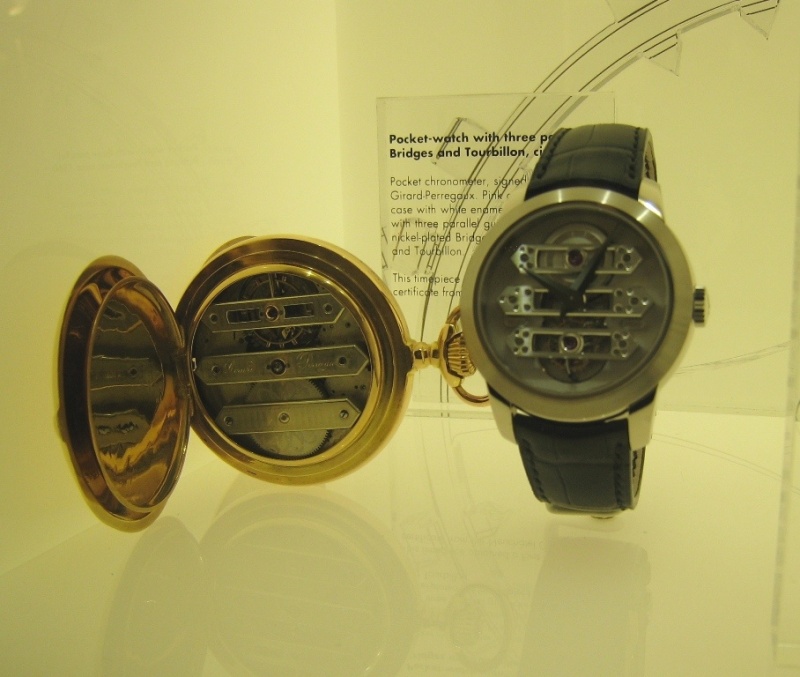
Hello, Tick Talk...
Funny what you said...
When I saw some of these GP marvels, at the SIHH, I couldn't help thinking about another true marvel: The VC Minute Repeater skeleton.
To me, a GP 3 Gold Bridges ( no matter which one ) and this VC both belong to my absolute top 5 watches.
Epitomes of Elegance, of Dream ... Pure Horological Myths.
2 out of 5 ... That let some place to a few other " happy few " myths!
Best,
Nicolas.
I am reading over and over....
thank you once more Nico for thesuperb mega dream post.
As I said I am learning anything I can these days on the Golden Bridges story and development.This is the beauty of this wonderful world of Haute Horologerie.
What can I say apart from the fact that I am absolutely in owe of Gp for carring on such a rich tradition.
My favourites?The Laureato in Titanium...it must be a beast in the flesh.....how does it wear?What a blend of tradition and modern innovation...those 3 see through bridges and the titanium case and bracelet give such a "high tech"feel to the watch,totally my taste ..modern,sleek,cool....
The latest WG version?I shake just looking at the pics,I can t even imagine what it must be like live.
I am not a fan of automatic movements,in fact I tend to go only for manuals,there is a certain charme that I cant explain with manuals,UNLESS there is a specific reason:1)either the watch is such an iconic automatic that it s unthinkable to consider manual(AP RO,Sub etc....)or2)you are in the presence of a perfect blend of poetry and harmony....this is the case of the WG 3GB from this year.OUTSTANDING!
Lets dream some more........
Mo
I lost any notion of Time, at the GP booth, my friend.
I asked for an improvised meeting ( in fact, I'm the champion of improvised meetings... ), it had to last 20 minutes, which became more than one hour.
It means all.
Of course, I was puzzled by the amazing diversity of the 3 GBs, but to be able to see, IN THE REAL, so many in the same time and at the same place was, to me, like if I was in Wonderland.
To say all, I am totally unable to say which one I prefer, as they ALL express the same vision of " Belle Horlogerie " ( it sounds terrificly good, in French ), but in a different way, sometimes, more modern, sometimes more conservative.
I fear it all depends on the ( expensive ) mood of the day.
I well see myself wearing a Laureato 3 GBs, some day, when, the day after, I would love to wear a round T 3 GBS in white gold, like the latest one.
AND, if I have to travel, a WW TC 3 GBs would be the " Creme de la Creme ".
So, one thing is certain, 2 doubts:
The certain thing is that I would like to get one.
The doubts can be summed in 2 words: Which and How.
Best, Mo.
Nicolas.

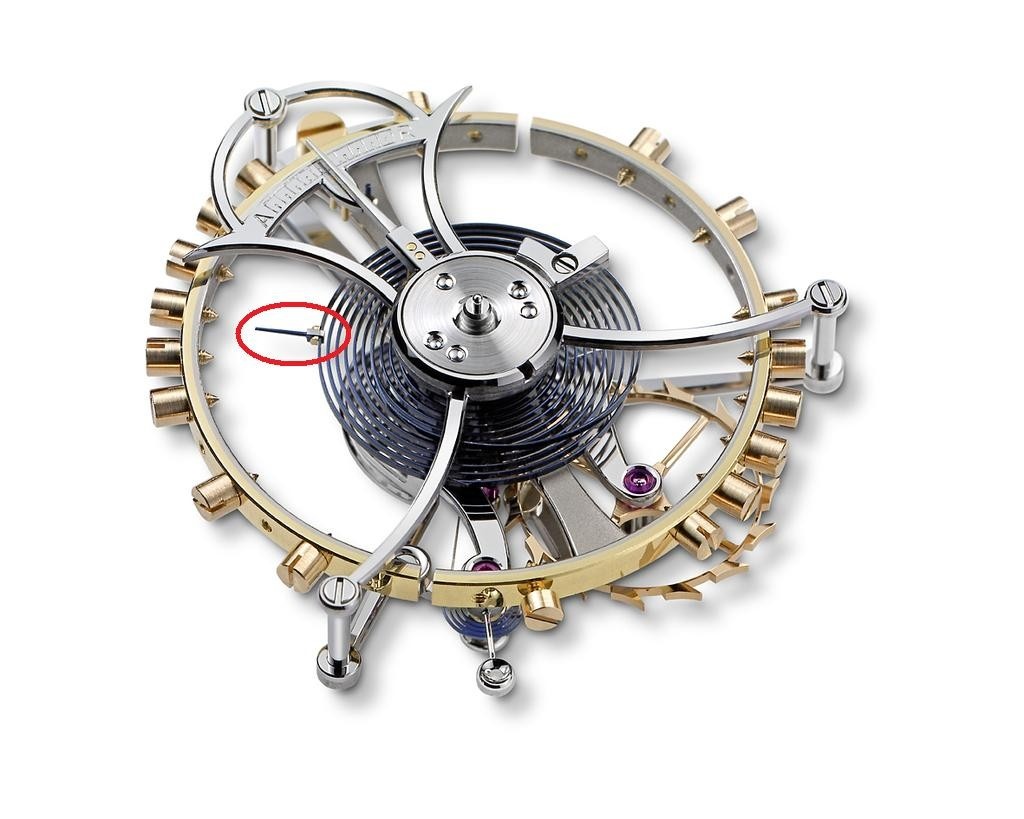
Here you are ...
An anti tripping safety pin.
Here is the explanation from my contact at the Manufacture:
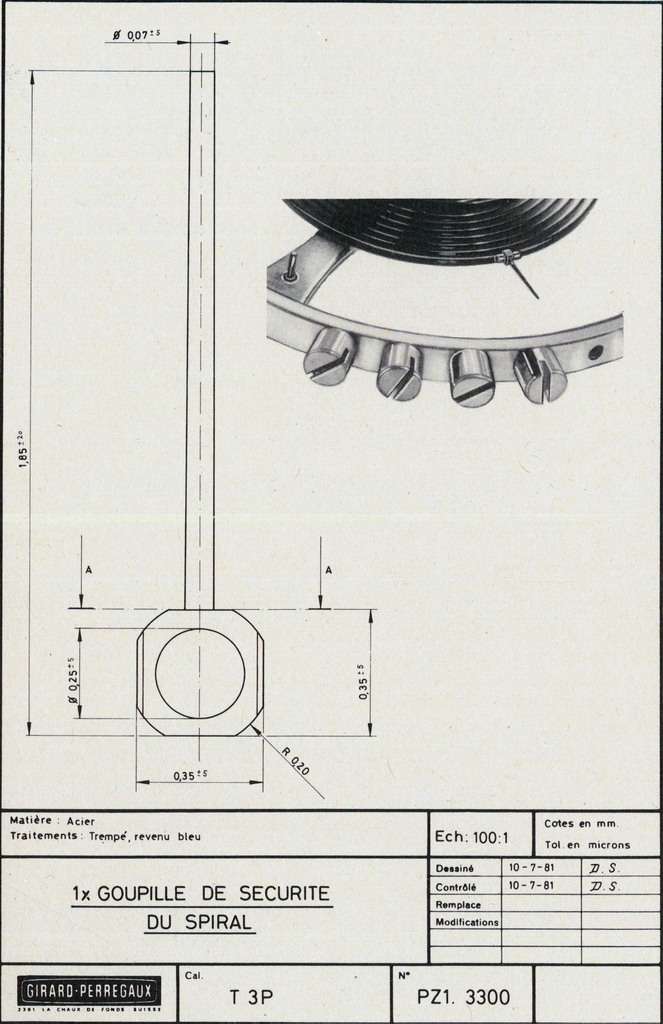
" In order to guarantee optimum rate accuracy, the detent escapement has a highly uncommon and extremely hard to make safety system: an anti-tripping safety pin placed on the hairspring.
A detent escapement watch starts to “trip” when the balance over-rotates, for example due to an impact, and releases the detent a second time, i.e. when a single balance oscillation releases two teeth on the escapement wheel, and therefore moves the small seconds hand forward by two seconds instead of one.
To prevent this phenomenon, a pin is fashioned from a small steel bar and then threaded onto and fastened on the hairspring to prevent the detent from being released a second time. Since this pin measures 1.85 mm in length with a diameter of 0.07 mm, we can imagine the difficulty of making this part and positioning it with great accuracy on the balance to ensure that the safety system works. ".
Best,
Nicolas

One of the biggest small secrets in horology
amanico,
Thanks to you and your secret mole at G-P, one of the biggest small secrets in horology has been 'out-ed' !
The detent-pin shows the thought behind the watchmaking at G-P.
Regards,
MTF