JLC fraud! beware DBS number 14 of 999 was stolen from me
i was scammed out of my JLC Amvox 2 DBS. a fraudulent cheque was used to pay me and was returned after 7 weeks as a forgery.
Please be aware that number 14 of 999 was ssent to an address in Malaysia.
it is a serious blow in these times.
ger

Noted! I am truly sorry for you! May I suggest you all
When trading/exchanging or selling your watch:
1. Do not Ship your ‘watch’ till the funds are ‘irrevocably confirmed’ by your bank
2. Even if you see the related credit line at your bank (or online), verify with your bank that the payment is ‘irrevocably confirmed’ .
Known Case 1.
Some buyers pay for the purchases with Banker’s Draft (certified cheque) which are real but have been forged. The purchasers get an issued banker’s cheque for $1 or $10 etc and forging it for much larger amount. When remitting such a cheque to your bank, usually it takes your bank 3 or more weeks to be notified by the issuing bank that the cheque is crooked.
Known Case 2
You receive your bank payment as a ‘bank wire’, in this case what can happen is that the person deposited a fake cheque at one of your bank’s branch, whilst you would believe the payment to have arrived as a bank wire. You will then be informed by your bank, usually within 7 or more days, that the cheque remitted is a fraud/fake.
In any case Always get your bank (preferably your bank manager or someone you know) to confirm that the credit is ‘irrevocably valid’
This message has been edited by PoyFR on 2009-04-27 01:04:20
you ought to Post this message/image, everywhere you can
By posting this suggested message as often and everywhere you can, it will be 'googled', it may enhance your possibilities to one day hear something about it.
Title:
Jaeger-LeCoultre STOLEN AMVOX 2 DBS 14/999
Description:
STOLEN WATCH
Jaeger-LeCoultre
Amvox 2 DBS
Ref. 192 T4 50
Wach-case Number: 14/999
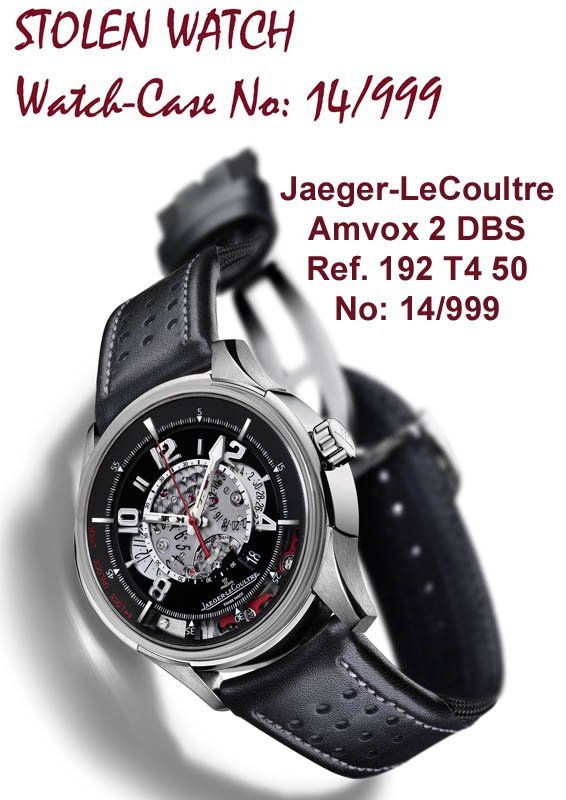


Sorry to hear your lost
I am from Malaysia and its people like this that makes us honest person hard to purchase anything from the forum because the trust is not there.
Would you mind PM me details of the person and address?
I know of some places in the city which sells used watches and i will have a lookout for you.
It is always the same... The Good Guy pay for the Bad guys
No one should ever decimate a person a regardless of his origins. Here all we are saying is to be aware and serious especially when dealing large sums'.
Although I am not here the victim, I appreciate your willingness to help, that’s very kind and honorable from you.
Also good to know: Foreign fraud hits U.S. e-commerce firms hard
(Needless to say that this is affecting all countries)
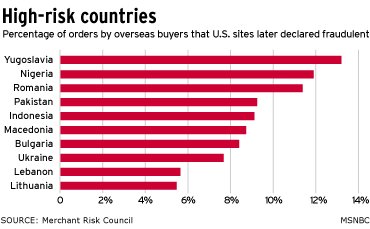
Top offending countries: Yugoslavia, Nigeria, Romania
Selling stuff online? Beware orders from Yugoslavia, Nigeria, Romania, Pakistan and Indonesia. A study released Thursday claims that more than 40 percent of all credit card fraud suffered by U.S. companies online is committed by overseas crooks, with orders from those five countries the most likely to be cons.
But selling internationally isn't automatically risky. The study also showed that fraud rates among sales to New Zealand, Switzerland, Japan, France and Italy are lower than fraud rates for domestic U.S. sales.
Yugoslavia ranked first among high-risk countries, the study found. About 13 percent of purchases initiated from that country were fraudulent. By comparison, the fraud rate in the U.S. is about 1.7 percent, according to Cybersource Corp., which sells anti-fraud software.
Many online merchants just avoid global sales all together. A full one-third of medium and large Web sites simply won't sell to international customers, according to a separate recent survey, conducted by Cybersource. International fraud rates are four times higher than domestic rates, the company says.
Despite the high risk of selling overseas -- better than 1 in 10 purchases made from Romania are fraudulent, for example -- the Merchant Risk Council says electronic commerce Web sites shouldn't shy away from the potential revenue source. The council is a consortium of 1,500 companies that do business on the Web.
"Our recommendation is you should always ship internationally," said Julie Ferguson, a council board member. "But if you are shipping to a higher risk location you ought to mark it for review."
 |
What companies can do
Bruce Frymire, spokesman for Cybersource, says there are steps Web sites can take to protect themselves from international fraudsters. The most brutal is to simply exclude entire countries from even viewing the Web site by blocking a range of Internet address. Fraud scrubbing software, which uses formulas to estimate risk for each transaction, are also used. Purchases made from higher-risk countries are assigned a higher fraud score.
"It's an enormous and fast growing market. If you want to be a leader, you don't just walk away from it," Frymire said. "You find a way to do it."
The Merchants Risk Council study ignored the billing and shipping addresses used during the transaction. Instead, researchers determined the Internet address of the computer which placed the order, which generally provides a rough geographic location for that computer.
But there is no sure-fire way to establish an Internet users' country of origin, says Dan Clements, who operates credit card fraud watch Web site CardCops.com . Clever criminals can hijack computers from other countries, or mask the Internet address, he said.
"These guys are that smart," he said. "Many don't even bother trying to order from Eastern block nations like Belarus [that] they know they are blacklisted. They just find a proxy in another country, and it looks like they are coming from that location."
Criminals also use satellite delivered Internet access to get around location-based fraud detection, Ferguson said. Many frauds now appear to originate from a satellite service in Denmark, for example, but the users could be connecting from anywhere.
Still, that's probably overkill by the con artists, said Ferguson, since many merchants still don't take basic anti-fraud steps like checking the location of the consumer ordering the merchandise. Only 28 percent of the associations' members did so in 2003, she said.
The persistently high fraud rates -- and lack of inexpensive, effective fraud-fighting tools --has really put a damper on the notion that electronic commerce is truly global, said Gartner analyst and fraud expert Avivah Litan.
"Everybody said the Internet would level the playing field, that every mom and pop store could compete with the IBMs of the world, and have access to the same customers," she said. "That's simply not true at all, and one big reason is fraud. The big companies can afford to put in some kind of controls, but the small companies just can't."
In fact, each year, more than 10 percent of e-commerce sites that sell overseas stop doing so, Litan says, because of high fraud rates. One e-commerce firm she spoke to experienced fraud rates as high as 90 percent from Indonesia.
"It's just not worth the effort," she said.
© 2009 msnbc.com
Spain and Malaysia are also well known to other analysts
for scams and frauds on electronics and high-end wristwatches


I am really sorry to hear that, Ger
That is extremely unfortunate.
I saw the address you posted on another forum and did a search. That address appears to be that of a hotel.
Anyways, I will keep a look out for the watch at the watch dealers.
Moses

So sorry to hear about this.
I can only imagine how you must be going through. I do hope you are able to resolve this one day.
reporting to JLC
I have reported it to the JLC wesite, but have heard nothing back.
I do have an independant valuation stating i was the owner and the value on the watch, this was got last year when i need something for the insurance company.
i would imagine that I still own this piece number 14/999 so if and when it comes in for service, repair it will be returned to me.
any input from the experts?
JLC website
JLC have confirmed that they have the information i sent regarding the fraud.

i'm very sorry to hear about this, but the best advice i can give any online seller is
ALWAYS USE PAYPAL!!!
that goes for buying as well. i have bought and sold about 2000 items online, mainly watches over the last 10 years. i use Ebay all the time(i'm possibly the forums king of ebay), but i ALWAYS pay by Paypal using a credit card. no exceptions unless i know the buyer/seller. people slag paypal and fleabay off, but in the last couple of years their protection has become faultless. it doesnt matter what the situation is, you will get your money back. no problems whatsoever. even if i bought/sold on CM i would only use paypal unless i know you. with the backup of using a credit card if buying you cannot lose a penny. split the 3-4% fee, its got to be worth it. the same goes for SELLING. no chance of a duff cheque, any duff credit card is paid for by paypal.
i am very very sorry to hear that this has happened and hope the perpetrators bodyparts are found floating in several different rivers with your watch ticking happily away on his severed wrist.
best regards
Graham
It is not as easy as it sounds
You did one of the right things by informing Jaeger-LeCoultre. However it will not be simple. The watch will be sold to an innocent party who may (or yet someone else) returned it to JLC for repairs/services. Despite JLC willingness to help you, unless it is send to JLC by your purchaser, legally JLC will have to return the watch to the client who sent the watch in to them. How could JLC police this affair? They will have no grounds apart from a marginal behavior.
But you have done the right thing, because if ever the watch is returned to JLC, it could help you to follow the route right back at your purchaser.
Sadly, it's never easy.
Poy, is french law very...
law?
into a UK AD for service it will/should be passed over to the police to
investigate. the watch remains the property of the original owner and the
innocent subsequent buyer loses out. 'buyer beware'. it sounds unfair, but thats
the law and its very fair if your the loser of the watch.
are a lot of stupid people who buy cars without the log books
etc.

UK vs. Continetal European Law...
I know that there are quite substantial differences between UK and "continental European" laws, but I am sadly not an expert on the subject and cannot elaborate much on the present subject. However, I know that there are much fewer differences between French/Swiss Law and Denmark Laws, and when I asked my AD to read the case and movement numbers on my PP, I was told that they could not do it on the spot as they (the AD) had to communicate the numbers to PP and get their confirmation that the watch was not reported stolen.
I trust and hope that JLC exercises a similar policy as it - although it could be percieved as slightly suspecting towards a rightful owner - ensures that a stolen watch is returned to its owner.
I am deeply sad to hear about Irishgers loss and pray that the watch soon find its way home.
Best regards
Nikolaj
I beleive in the UK 99% of ownership goes to the possesor
I believe in the UK too, the possessor has ownership title unless proven otherwise >
In this current example, the watch was sold by Mr. A to Mr. B (who paid with false bank cheque).
In this case if the watch is presented to JLC by Mr. B, in a non-legal way (unless a court instruction is given – meaning that Mr. A obtained a judgment against Mr. B) JLC could return the watch to Mr. A without too much complications* (*because Mr. B could sue JLC for breach of contract; ‘confidentiality’ or for taking actions without authority.)
Imagine that Mr. B, sold the watch to Mr. C, then it becomes more complicated, Mr. A need to go after Mr. B, and Mr. C after Mr. B, and if JLC returns the watch to Mr. A, JLC could be sued for taking actions without authority.
In any case, to begin with Mr. A wherever he is from (no disrespect intended), he should fill a report to the Police, and notify ‘Interpol’ (as well as the Buyer’s Embassy and the buyer’s local Police); those reports should be made known to JLC, who would then be ‘sort’ of covered to justify their decisions and actions in returning the watch to Mr. A
Still it could be a problem if Mr. A received compensation from an insurance company… and it goes on and on…
By the way, Mr. A ought to seek compensation from his home insurance, he is probably covered… food for thoughts
In France and in most places I think it works the same for ungoverned goods. Mind you in the UK between Scotland and England ownership title for cars can be as for the above watch… complicated matters…
But you may have something in saying that MJLC could return the watch to the original buyer's JLC AD who would turn it back to the local police...
Poy, after many years in...
that you are not quite correct. if something is misappropriated, stolen or
obtained by illegal means the title remains with the original owner so in this
case the police would return the watch to irishger. it doesn matter how many
times its been sold on since it was misappropriated, it will always belobg to
irishger and everyone else purchasing since would lose out.
have title of a vehicle which is sold by the 'owner' it still belongs to the
finance company and the new buyer loses out when it is taken away.
the UK.
From a Police stand point I am sure you are correct
The issue here is what authority does MJLC (Switzerland or …) have to take its decisions and actions…
As for possession being 9/10th of the law, (in my experience of a lost case) it is not a myth to me, from a legal stand point between England and Scotland laws! It may have changed since the early 90’s…
In France concerning cars, thanks to our log book system it is very difficult to be fouled as ownership and financing is recorded and audited by our government.
Now I want you to know something, I have great respect for all UK Police officers, they are to me an example of what I would want every nation Police to be. My hat off to you.
This message has been edited by PoyFR on 2009-05-01 14:10:41thanks Poy, if only more...
difficult work the police do. i'm glad i'm now retired.
the owner would have to prove ownership which is often difficult.
to the police and let them investigate the case and pass it back to whoever the
courts say which i think would be Mr A.
BCD or E.
Give it back to Mr. Irishger
Oh yes, I agree with you to Mr. A aka 'Irishger' and no one else! Sometimes I wish we could take our own rights in hands, at times it would be so simple... but that is another story.
I wish you a good, long, peaceful and healthy continuation in your well deserved after-work-time ;-)
