
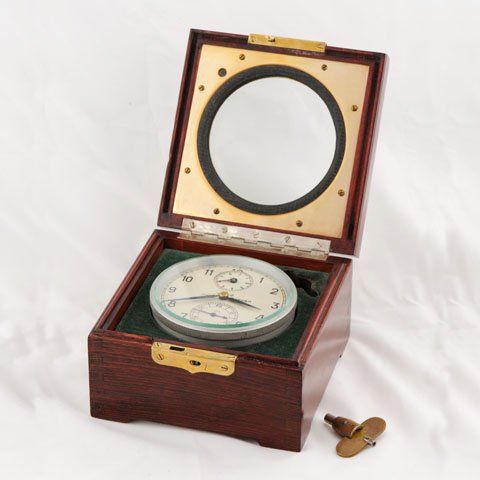
A Rare Constant Force Escapement 8-Day Chronometer From Soviet Russia
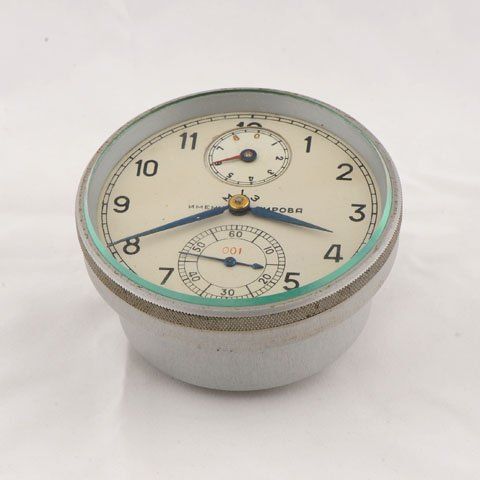
The clock, serial number 001, was produced as part of a very small production run for the Soviet military; probably fewer than 100 of these clocks were produced over a period of about 4 years.
The model designation of the clock in Cyrillic is 2M3X (2MZH). the caliber of the movement is 70 mm.
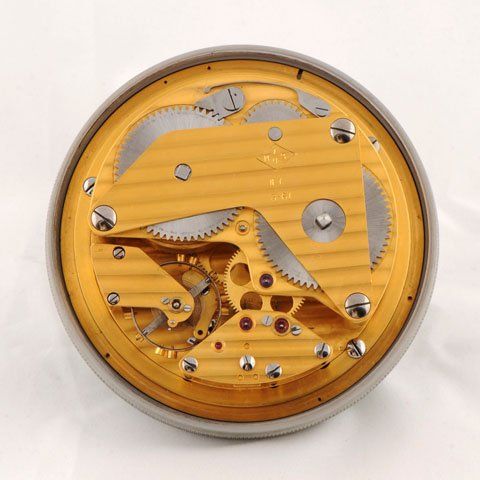
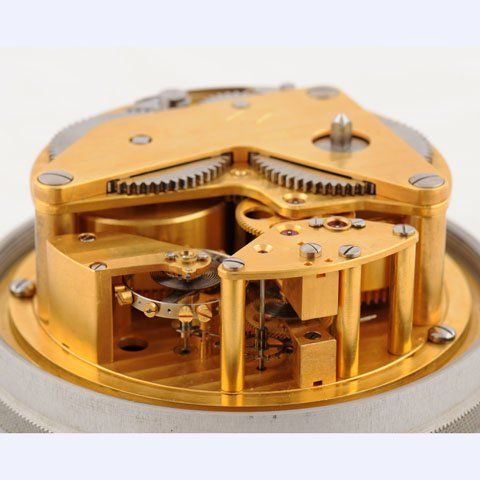
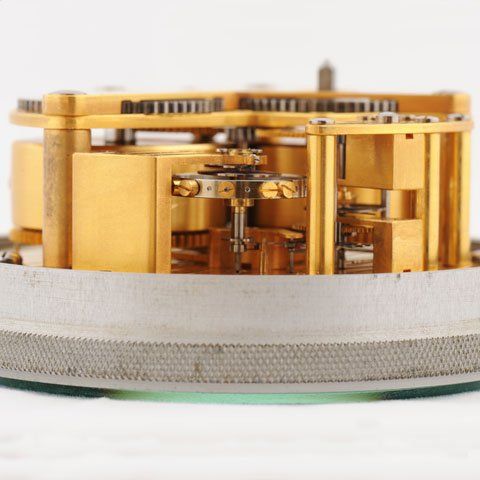
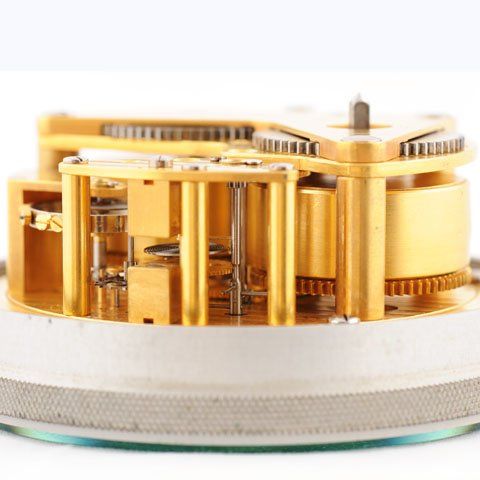
All components and plates are gold plated. The balance end-cap jewels are diamonds in excess of .5 carats. Other jewels are ruby. Factory specifications indicate that the average daily variation is below +/- 0.75 seconds.
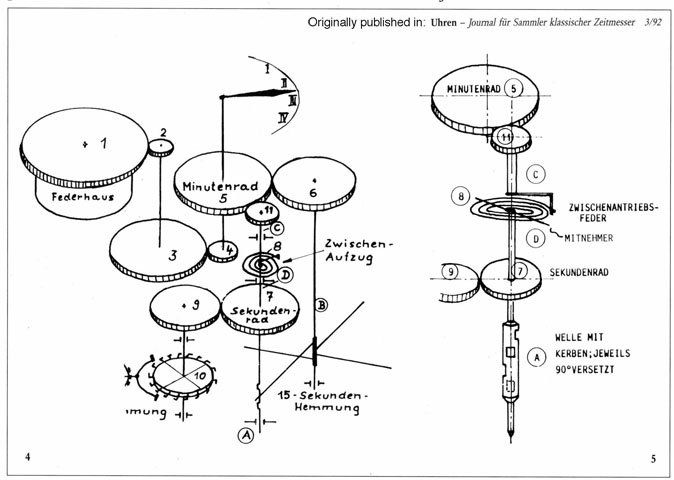
The clock utilizes a constant force escapement mechanism that is powered by two barrels that share a single winding crown. This highly unusual mechanism is derived from a similar mechanism originally designed by Harrison in 1761.
One interesting feature of this clock is a minute hand that jumps every 15 seconds. It is quite pleasing to watch!
It is reported by Steffen Rohner in an article published in Uhren – Journal Fuer Sammler klassischer Zeitmesser (No. 3, 1992, pp 16-18) that this Soviet chronometer the first & last use of this technology in a chronometer in the 20th century. The attached diagram is borrowed from this article.
It is also interesting to speculate on the why the Soviet military would require such a complicated and delicate (not to mention expensive) clock .
Although it has been described by other sources as a submarine clock, this is highly unlikely based on the lack of a watertight case & the extreme delicacy of the movement.
We (Dmitri Troshin, Andrey Ivochkin, Dirk Lask and myself) conjecture that it was probably produced for field units of the Strategic Rocket Forces. In the event of nuclear war, electronic clocks & radio time beacons would be rendered useless by the electromagnetic pulse produced by the detonation of nuclear weapons. This highly accurate mechanical clock with an 8-day power reserve would have ensured accurate timekeeping by field units in the aftermath of a nuclear exchange.
Enjoy the photos…
-- Mark

This message has been edited by asiaassoc on 2010-05-03 02:24:51 This message has been edited by asiaassoc on 2010-05-03 02:29:30 This message has been edited by asiaassoc on 2010-05-03 02:33:49 This message has been edited by DRMW on 2010-05-05 09:35:23

this is something pretty special Mark
i've owned over 10 marine chronometers from lange & sohne to Longines and this beats all of them by a mile. just think on the value of the end jewels not to mention the fact that its 001 of only a few.
lovely find
best
Graham
Some more photos...


The Date!
Oh yes, one more thing. This movement was produced in the 3rd quarter of 1961.
-- Mark

Where do they hide these fossils?
mark,
Thanks for sharing this.
I'm amazed that nearly 48 years after the last serious risk of nuclear war and nearly 20 years after the end of the USSR, these old clocks still come out in pretty good shape.
Who looks after these fossils as it must cost something to maintain them?
Who even thought of keeping them when resources were scarce after Glasnost and modern disposable lifestyle has also reached Russia?
Regards,
MTF
Horror story...
nick