
so we think we know all there is to know about escapements, rate stability, and that
tourbillons are completely useless in a wristwatch, because "it was designed for use in pocketwatches that stayed in one vertical position?"
So riddle me this - why does a wristwatch that keeps perfect time (+ - seconds a week) end up minutes off on a winder over the same period?
Even on a winder that
a. can be set and runs bi-directionally?
b. can be set and runs randomly ?
c. can be set and runs in set rotations in each direction?
(comments are not meant to "prove" that tourbillons are helpful or not helpful with timekeeping, just that the so called "even an idiot can understand that" reasons why a tourbillon is NOT helpful in a wristwatch are...well, not so simple and easy to conclude. The main point is, of course, that the so called "science" of horology is probably more of a hard science than psychology or economics, but probably not so "hard" as Newtonian mechanics or mathematics.
 )
)
Am I serious?!?
Depends on how, if at all, this thread develops...
TM
amplitude
Those are some good points, some parts of an overall
fairly complex calculus.
Hi, dknespl,
Isochronism specifically addresses the issue you are raising, and theoretically, the cycle frequency is supposed to be independent of amplitude. But of course, in the real world...
State of wind of the mainspring is of course one of the first things that come to mind in similar scenarios, but I tried to take out that variable by noting that the running performance on winder was watched for various "winding settings" including random.
Your second point is a good one also, and more closely approximates "on the wrist" behaviour than a fixed plane winder. I have not tested on that and it would be interesting to see how this specific watch does on such a winder.
"Why would anyone need a RDM indicator on an automatic watch?" I cringe when I read such statements, which also indicates a lack of knowledge of the history of automatic watches and RDM indicators (early autos were viewed with suspicion by the buying public and RDM indicators were included on early autos to provide some comfort to buyers)
Thanks for your comments!
TM
manual watch on winder

Excellent idea.
I like that idea, dknespl.
Also with you on the state of mainspring wind on a winder affecting the rate.
What about the adjustments being performed at defined positions for a defined period. So, when on a winder, these positions and periods will not be 100% replicated? Perhaps also a (minor, for a well maintained watch) the constant change in friction in the system as the watch rotates?
This message has been edited by BDLJ on 2010-04-15 03:42:20
interesting idea, would love to see your results.
which, by the way, would be eye opening but not conclusive - like my example of a watch that keeps great time on the wrist but horrible time on winder (random, bi directional, unidirectional) which should not be universally extrapolated for any global conclusions, I have many examples of just the opposite - not so stable on the wrist, but very much so on winder. And of course, reliable on both.
This message has been edited by ThomasM on 2010-04-15 11:13:01Up Down
I know the history of up/down indicators...And I'd happily make that statement about a non-vintage watch.
Especially when there's some nice script on the dial telling you so...Reserve de Marche...ick. Better to have "Levery-thingy-from-the-Mainspring...
Why not just call it a fuel gauge?
Hi, BDLJ,
With your knowledge and experience, you can reasonably conclude anything you want.
;-)
"Why would anyone need a RDM indicator on an automatic watch?" I cringe when I read such statements, which also indicates a lack of knowledge of the history of automatic watches and RDM indicators (early autos were viewed with suspicion by the buying public and RDM indicators were included on early autos to provide some comfort to buyers"
But you also lead a fairly active lifestyle (from what I gather from your posts)
I tend to lead a mostly sedentary lifestyle - behind a camera viewfinder; at the keyboard; in an airplane seat.
I find that it is very, very common (too common) for an automatic watch on my wrist to actually not receive enough motion to stay wound, and would "stop" from lack of mainspring power in a few days from a full manual wind.
So for me, a power reserve/reserve de marche/up down/Levery-thingy-from-the-Mainspring/dynamographe/fuel gauge indicator is not only useful for the watch, but a potential lifesaver (literally) for me, as it reminds me to get up and actually move around.
So yes, for me, an automatic watch NEEDS a power reserve indicator.
TM

Me too !!
Where have you been all of my life, TM? J Whenever this issue of RdM indicators on automatic versus manual wind watches comes up in discussion I feel on the outer because the consensus seems to be that they are more useful on manual than automatic watches, but I find the exact opposite is true.
I wind my manual wind watches each morning, and I know exactly their state of wind. A PR indicator is of no use to me, and if I lose track of when I last wound it, I just fully wind it again. [Note that I make an exemption on emotional grounds for the RdM on the 8-day manual-wind Reverso Grand Date, but that’s another thread.]
But with my automatic watches I rarely know the state of wind of the mainspring. And my days vary dramatically from running around non-stop to sitting in meetings. And this is made worse by the fact that I might change watches frequently, depending on mood and situation. The only way I have any idea of the state of wind is from a PR indicator, and too few autos seem to have this.
Andrew
Ps. I should have said the above in 2 sentences, but heck, this is PuristS.
I am surprised..
...at your experience of automatics.
(And I'm not trying to be facetious). I would have thought that as long as one is walking about, even around the office (and I do work in an office so am sedentary for hours at a time, sadly) the automatic winding would be enough. Very interesting. . . an eye opener.
Most of my automatics don't even have the ability to hand wind so the autowinding must be pretty effective....magic levers!
So, yes, in your situation, I understand it and it has some use.
Fuel Gauge...Surely the likes of Richard Mille would have used that...
A potential lifesaver ...
I knew I had seen an advert that followed the sentiments in your post, but it took me a few days to remember where ...
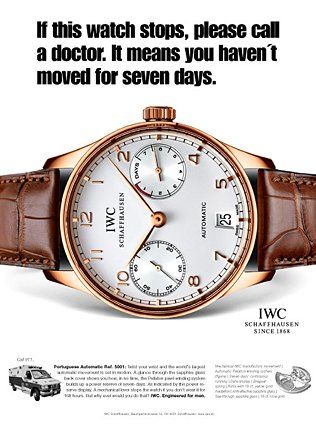
External influences
Compare the watch in question with an uber-precision clock in a clock vault:
The clock is designed to run in an environment where as many external influences as possible are removed, nullified or taken into account in the design. Previous experience, experiment and research mean that the vast majority of systemic factors are known and quantifiable. What are left are new systemic factors (eg inherent in a new design) and external factors. The watch is running in an environment where there are many external factors (shock, vibration, temperature, pressure, position...). The components and forces involved in the clock are relatively massive compared to the external forces acting on them (vibrations in a clock vault are small compared to a pendulum weighing several kilos, but the jolts from playing tennis or mountaining biking are enormous compared to the inertia of the balance or the locking forces). So, assuming the design is good, the clock has to cope with a very small number of low-magnitude external influences. But the watch has to cope with a large number of high-magnitude external factors.
The operation of the clock always takes place in the same orientation, so any unlocking, for example, is always operating against the same forces acting in the same direction. This means that the actions can be designed to operate with the lowest forces and smallest travel consistent with good operation. The operation of the watch can take place in any orientation, so the design has to take into account a huge variation in the forces and direction of operation. Given the very small components, the manufacturing tolerances are relatively large compared to the component sizes and acting distances, which adds another variable.
Because the clock is inherently stable compared to the magnitude of the random or non-random external forces it is easy to detect the error and trace it back to its root cause. In a watch that is worn normally, there are an enormous number of high-magnitude forces involved and it's difficult to trace any given effect back to its root cause (is it fast because of the jolting or the cold or whatever?).
So, the watch that's running +/-0s/d on the wrist has found an equilibrium where the adjustments/regulation balance out the average of the external influences. On the winder, these factors aren't present, so it goes to hell in a bucket (or vice versa).
I think the tourbillon discussion has become futile as it doesn't take into account the major impact of the magnitude and variability of the systemic errors in the old pocketwatches Breguet targeted, and similarly doesn't take into account the very different situation in a modern wristwatch.
nick
Thank you, yes, I agree.
Well put, Nick
This:
"So, the watch that's running +/-0s/d on the wrist has found an equilibrium where the adjustments/regulation balance out the average of the external influences. On the winder, these factors aren't present, so it goes to hell in a bucket (or vice versa)."
is my experience with a couple of my watches - a 70's Seiko 6105 and a 50's cal 353 Seamaster. Both are nothing special movement wise, the timekeeping is good on the wrist (my regulation consists of wear, check, nudge lever, wear, check, nudge lever, until they are OK (by my slack standards). But when I visited my watchmaker friend and I put them on the Witschi...they were alarmingly awful...wandering ticker marks staggered all over the place.
Interesting result, and comforting too in a way, for a very amateur watch tinkerer. I can get my old clunkers to 'work' for my wrist.

I would like to thank everyone for contributing...
Escapements are my favorite topic!
Brandon
thank you for your post. There is much enlightening feedback in this thread
and certainly food for thought to get closer to understanding what is, actually, a fairly complex "environment" masquerading as simple physics. (complex in terms of variables, not conceptually)
tribology (study of friction and lubrication)
micro-mechanics
the fact that gravity and friction do play a role on not only balance spring "breathing" (the whole point of Breguet overcoils and the tourbillon) but also on the gears and pinions themselves
secondary effects like isochronism and spring power delivery in various states of compression and over banking
etc
I'm not sure all points are relevant given my original statement of conditions but all comments are helpful and welcome, and help to understand "the greater picture."
Be sure to share with us your knowledge and opinions; what interests you? (in a new thread, if more appropriate)
Cheers,
TM
Among other reasons, I think single-plane winders are hard on lubrication.
1. The watch's state of wind is different on the winder than on the wrist. Wrist movements normally are vigorous enough to keep the watch fully wound, while some winders seem to keep the watch only partially wound.
2. The watch's range of positions is different on a single-plane winder than on the wrist. It's different on a windmill-type winder too, but the windmill-type approximates the wrist more closely.
3. When you wear the watch you probably leave it flat every night while you sleep, or at least in a consistent position. If that happens to be a lucky position and the watch also is correctly adjusted for way your wrist moves when you wear it, you will get good timekeeping. On the winder, the watch will rest in different positions. If one of those positions is particularly weak, on the days the watch happens to rest in that position you will get a big variation.
4. If you keep the watch on a single-plane winder consistently, the pivots will always be rubbing against the same parts of the jewels. That could lead to wear, or at least make it difficult for those parts to remain lubricated.

I tend to think positional variation
is the most likely culprit. A single plane winder is usually keeping the watch in a vertical or semi-vertical position. A proper test winder (a.k.a. windmill style) does eliminate this to a degree. If the delta (difference in rate across positions) is low you will see less effect than if it is high. Certainly a watch can have large positional variation and still run well on the wrist - all about how well the errors average out.
Cheers, Al
Over winding leading to overbanking
Thomas this can happen in the following way. Generally when you wear a watch in civilian life, an automatic watch will not achieve completely full wind. However, a watch winder can easily take a watch to full wind. And sometimes just that extra bit of power that comes from the mainspring at completely full wind, will cause the watch to overbank, leading to rather gross errors in timekeeping.
How do I know this? Because I had a watch that had this problem. Perfect timekeeping when worn; off by minutes when left on the winder. The manaufacturer fixed the watch and ended the problem.
Jeff
Lubrication fault
Knocking is tytpically due to too much braking grease in the barrel, so the mainspring does not slip at the correct level of power. Of course there are other contributing factors, but this would be the most common reason. Another can simply be the wrong mainspring used, or one that is simply too strong for that watch - some manufacturers supply a range of spring strengths for a particaular movement for this reason.
There are simple tests that can be performed on a timing machine after servicing a watch to make sure this does not happen. I typically wind the watch fully through the crown, put the watch on the timing machine, and with the automatic module fitted I slowly turn the rotor and watch the amplitude to make sure it never reaches a level where it could knock. On watches where the barrels have notches to grab the bridle, you can see the amplitude rise and then drop as it goes in and out of the those notches....
Cheers, Al
Too strong a spring
In the example I know best, my own watch, it was that the strength of the spring when fully wound was too great. That's why rate was great under all conditions, except fully wound. Of course since daily wear did not fully wind the spring, but the winder did, the problem manifest itself when the watch was left on the winder.
I should add that I could duplicate the problem easily on the bench. Without being fully wound, placed on a timing machine the watch was one or two seconds a day fast. Then winding the watch fully, it was off by minutes a day. Clearly the strength of the barrel spring under full wind conditions was overpowering the escapement.

user error?
I agree with the honorables Mr.s Kingston and 1440 that rebanking is the most likely suspect (assuming it is runninng fast on the winder).
Postional variation may have something to do with it, but unless we're talking about a very cheap, poorly adjusted or desperately sick watch, it shouldn't account for minutes a day.
Very gentle, consistent torque on the mainspring by way of consistent rotation of the oscillating weight on a winder can cause the mainspring to slip at a higher torque than it might when subjected to the uneven and irregular motions of the rotor when worn. If the watch is already running at pretty high amplitude, this difference can push it into overbanking territory (yes, I am using this formerly incorrect terminology these days: language is egalitarian afterall). This doesn't happen to have a JLC 889 or related base movement, does it?
If it's minutes slow however, then I'd have to suspect it's stopping and IF it's happening CONSISTENTLY on the winder and NOT on your sedentary wrist (show me the data), then I'd have to guess at an escapement error related to a postion the watch doesn't much see on the wrist (11H?).
_john
You know, I think you may be right.
I think I might have been confusing my Geneva set clock with the watch on my wrist when I was keeping track of the timekeeping marks.
Afterall, they're about the same size and with middle age presbyopia, my eyes can't tell the difference anymore anyway.
;-)