
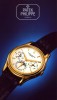
Patek Philippe 3940G 175th Salmon dial
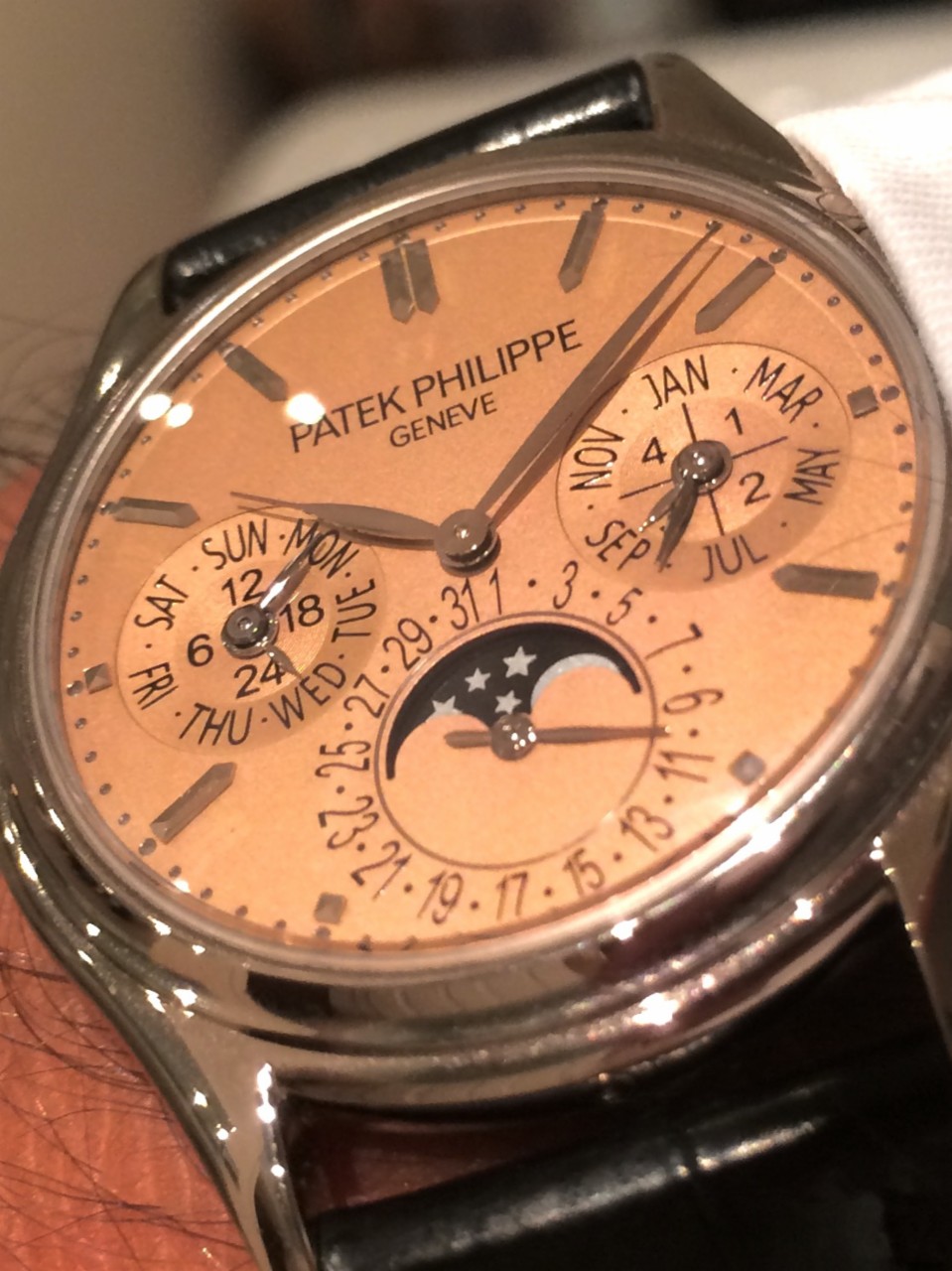
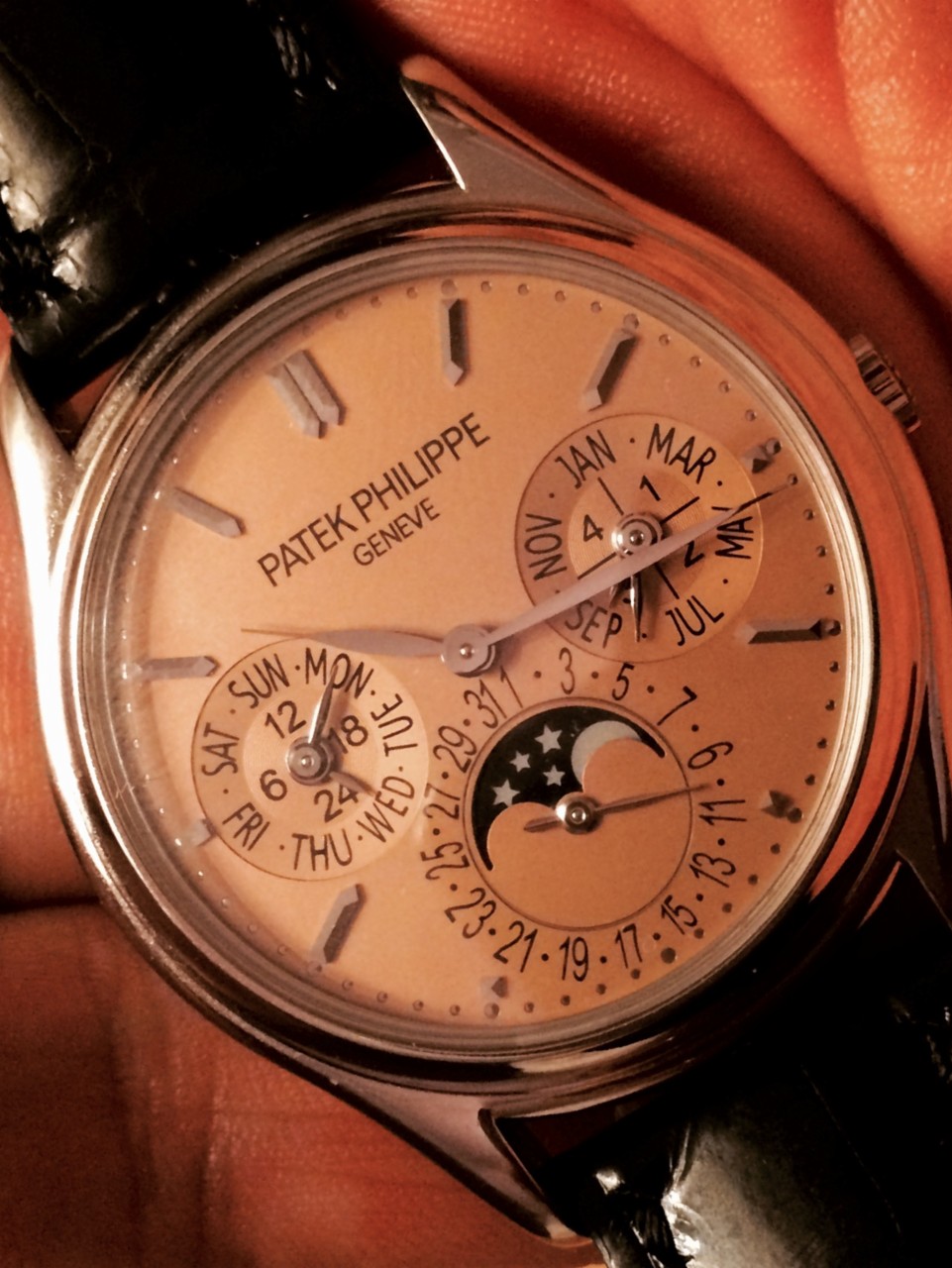
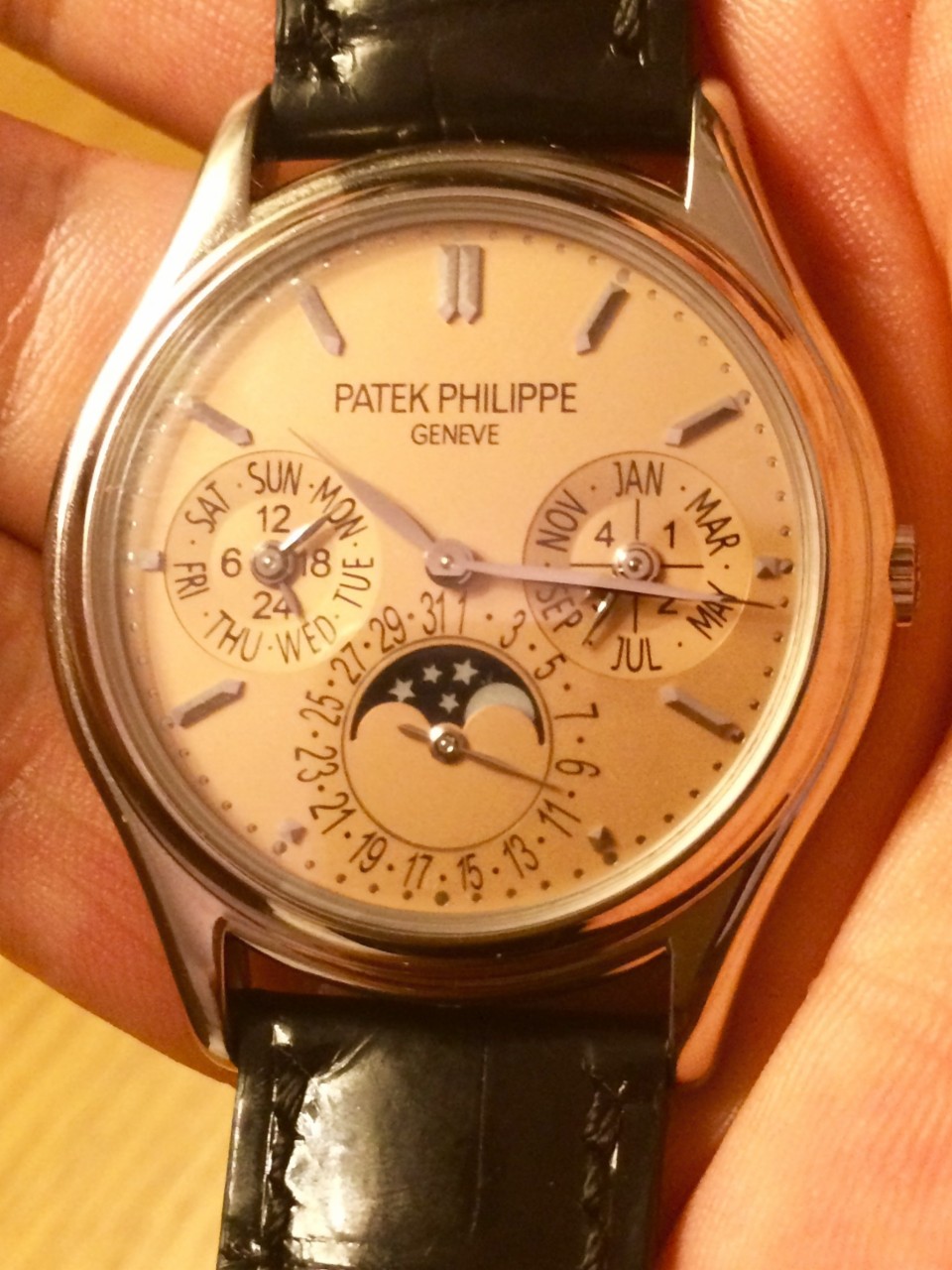
A few weeks ago I had posted a very poor pic and a number of you asked for more. Here they are, still not great (iphone!) but a bit better.
As you can see, this incarnation of the 3940 is somewhat of a curiosity, not just because of the salmon dial (which no photo can do real justice to).
The dial appears borrowed from the 5140, but that's an over-simplification of what we see here. The compressed "27" and "5" around the date sub-dial are 5140 rather than classic 3940, but there are other unusual features.
The batons are 3940, but note the stud batons which at the 3 and 9 positions are 3940 though those at 5 and 7 are also such, and I don't believe one finds those on a classic 3940.
Note also the hands, for which I find no 3940 precedent. They are feuille, rather than dauphin, and have no tail beyond the central pivot. The minute hand resolves to a particularly fine point. The later series 3940s with the roman numerals had alpha hands, but they are bulkier than those seen here, and there is also the related 5550 advanced research (love that piece) that has feuille hands, but with tritium. Also, the secondary hands for the 24hour and leap year indicators are of identical material and finish to the primary ones in those sub-dials, unlike the contrasting finishes in some 3940s.
The differences are subtle but, taken together, I suppose that the design team put a premium on delicacy of form, over function. For me, legibility is maintained and in some respects enhanced. The hands are very slim but are cambered so one half of each hand is in shadow while the other half gleams, so time is immediately and clearly legible at a glance (though i am still in the honeymoon of wanting to stare rather than glance!). Likewise, the subsidiary hands in the 3 and 9 sub-dials are sensibly de-emphasised as their associated functions (is it a leap year this year?) are not ones meriting regular scrutiny.
No photos of the back, it is classic 240 with exhibition back (there is a replacement solid back in the box). The packaging was the usual (zebrano?) winder box.
Love to hear the thoughts of those more expert than I!
This message has been edited by Mark in Paris on 2015-08-13 05:48:39

Always found the 3940 more to my liking compared to the 5140.
But both are very nice. It's just that the 5140 is little bigger
in case diameter. The 240 movement is a reliable movement
, very elegant. Thanks for sharing.
Best
Geross.

I spent a long time with the re-edition 5070P


Fantastic!
I've seen the 3940P not long ago and was impressed by how elegant it looked, especially about the size.
It is very unique due to the salmon dial and I imagine how it feels like to wear such a reference.
I see you've studied the differences very seriously and it is nice to share this with us (I'm not a specialist and would have missed them).
I must say as many here, that I have a very soft spot for the "leaf" hands.
The font size and type in the subdials and the "cross" in the leap year parts also seem to be different.
A great pleasure to read about your impressions Chimaera.
Wear it in the best of health!
Cheers, Mark
Thanks for sharing..
the pictures of the Salmon dial and also carefully pointing out the similarities and differences. This certainly has helped to answer most questions. Cheers !
Logo
Suum Cuique
"Hideous" is a wee bit harsh, but I know that you are a first series guy and (though new here) I see that all views are respected!
Thanks all for your comments.
Re:
If something is not your taste, I'm sure there is another way to say it, rather than "hideous". You wouldn't like someone to say that about your 3940, would you?
Play nice

Thanks!
Mark
Logo2
Hmmm
I think the discussion is cluttered by reducing comparisons to "it's a 3940" or "it's a 5140". As may have been concluded from my first post, the reality here is that the dial is in fact neither of those - it is a mixture of both, together with some altogether novel changes such as the hands and batons, as well as the colour. Also missing from the comparison is the treatment of the minute track: on original 3940s the fonts etc were necessarily small because the already small (relatively speaking) real-estate on the dial was not fully utilised because the minute track was stepped in from the dial edge. "My" 3940 has the minute track further out so the dial diameter/area is greater. The larger font is therefore capable of being accommodated, and indeed the larger font on the PP logo is consistent with the larger font of the day/month. In fairness I too would in fact prefer a smaller logo because I'm a believer (like all here) in understatement. I do wonder though if that would have created some disharmony against the day/month script that is nearby. Who knows, but beauty is in the eye of the beholder and we all have our preferences!
I do not think

That question about the seal: bravo Kari!
It proves that you have reached a considerable amount of connoisseurship.
Best
Moritz
Re: and my guess
Saying " make it look unattractive" as you do now is much nicer!
Of course we appreciate your honest opinion on that watch
As for your question about why they chose the upsized fonts, well, I don't have the answer.
My guess is, as the new sizes standards are getting bigger and bigger, because the clients ask for it (case's size for instance, from the 36-38 to 40-41 now), I imagine that standards for markings are also evolving.
I noticed on many vintage or pre-90's watches that the markings (brands, numerlas, etc...) were much smaller before.
They have become much bigger today and I guess they applied this new font size standard to the 3940.
Hence, it must be very difficult to accept for a 3940 but I imagine for someone who never possessed the 3940, it is much more acceptable?
This is my guess rcg!
Thanks,
Cheers, Mark

Beautiful , congrats to you on a very special piece, just to clarify, these are not 175th
collection pieces, but lireally a handful of special dial pieces,utilising "left over cases etc)
Best
Imran
Geneva Seal
You are almost late for service!
First let me congratulate you on your fantastic catch.
I find it beautiful and well composed and simply a great collectors watch and a piece I would like to own myself.
On the other hand I find it also a "strange" watch as it is like a concoction made of left overs like in cooking.
The oddness is again enhanced by the use of an at least six year old movement in a new watch.
Why that?
Anyway, at times Patek can not be understood fully and therefore the composition as a whole watch is still superb and very desirable.
Best
Moritz
Fascinating...
..fascinating, fascinating.
Thank you for your comments and for furthering my education. This 3940 is indeed a strange one! Just one point of possible disagreement - I think the Geneva Seal certification process is limited to an evaluation of quality of workmaniship eg. polishing/chamfering of screws. There's an optional "rate" evaluation that can be added to the process but it isn't required to achieve the Geneva Seal, though I think that is effectively mandatory if it's a chrono and the manufacturer wants to designate it as such. So, if the workmanship was up to standard whenever this 240Q was manufactured/inspected, then it will be up to standard today.
Then, of course, PP broke ranks and introduced its own seal. That has much to commend it (leaving aside jibes about how the process, being in-house, cannot be "independent"). It embraces rate as well as workmanship, and it bears on the whole watch rather than the movement only. So, my resurrected 240Q and the watch as a whole do not carry that stamp. But am I concerned that PP would ever say that this watch wasn't produced to their exacting standards? Absolutely not!
I guess the only other option in PP's hands would have been to take the Geneva Sealed movement, then add a PP Seal too (if they could find room..). That would have been something really unique. Anyone out there heard of/seen a double-sealed movement??
Geneva Seal compared to Patek's Seal
Hi there,
in asking you, and others, in my last post "Why that?" I was "hoping" some people could answer it, although I have a possible answer myself to why Patek is using a Geneva Seal bearing movement in a special edition.
I am not a fan at all of the Patek Seal and have some, actually one very big, "worrying" issues with it.
As my concern could spoil the joy that these watches bring to the people here I would like to wait and see if somebody has the same concern and reply to this.
Best
Moritz
Geneva / Patek Seal
Hi Moritz
The difficulty is that as far as I know PP have not published the specific criteria needing to be met to merit the PP seal. In contrast the Geneva Seal is the subject of formal legislation, and regulations made thereunder. As such it is more transparent, even if the PP seal is superior to the extent that the (unspoken) criteria extend beyond the movement to the entire watch.
A cynic might say (though I do not) that PP's introduction of its own seal was to work around the absolute foundation of the Geneva Seal: that the movement be manufactured in the Canton of Geneva. It is quite possible that PP had in mind the then or future need to manufacture elsewhere, but could not do so if it stuck with the Geneva Seal. Related to this are the wholly separate regulations around having "Swiss" or "Swiss Made" on a dial: I am not expert on those but understand them to be flexible in the sense that a manufacturer can so designate a watch even if the parts (inc. movement) are manufactured elsewhere, but those parts are "assembled" in Switzerland.
Just my thoughts!
exactomundo!
That is also my opinion and question: is the watch still Swiss watch???
Or more specific: a watch made by the traditional Swiss way?
To bear the Swiss logo it needs ONLY to be made more than 50% of the value in Switzerland.
The Geneva Seal is going much, much further and saying it has to be produced in Geneva.
You can find infos about the PP Seal on their webpage.
I have cross read it again and did not find any hint about "being produced in Geneva".
This is not a matter of fact what I am saying here and only my opinion. ( I feel a little caution in writing this is appropriate :-/ )
Best
Moritz
It would be exiting to learn that Pateks
Hmmm...
This is a fascinating discussion. Let us also bring into account "advanced research". It is a matter of received wisdom that the ne plus ultra of traditional watchmaking is Switzerland - on that basis most everyone finds comfort in Swiss manufacture. But is that wisdom susceptible to challenge if we bring into account exotic materials such as Silinvar? Is it necessarily the case that a beautiful Swiss pastoral setting is a better place to design and manufacture such things than, say, an ultra high-tech "clean" facility in Taiwan?
Now, the Geneva Seal is a wonderful thing but, of course, it exists in part to "protect" the traditional watchmaking industry in Geneva. Nothing wrong with that. But if PP (or others) want to experiment with exotic things then life becomes complicated if "tied" to the Geneva Seal. Kari, would be interested to know what your (laden with "new" tech) 5550 has by way of seal. Since the Geneva Seal requirements are quite specific in some cases but otherwise rather general, I suspect that the 5550 could still qualify despite the exotic materials. So, was PP's introduction of the PP Seal a look to the future when evolutionary or revolutionary techniques/materials would make it impossible or prohibitively expensive to meet the Geneva requirements? Equally, was the introduction of the PP seal a hedge against future changes to the Geneva Seal requirements, over which PP would have no control?
To be fair to PP we must also bring into account a loosening of Geneva Seal requirements, as well as a tightening. There is no doubt that the high-end watchmakers have expressed frustration at the arrival in the market of upstarts that have done the barest minimum to comply with the regulations and yet get a Seal of identical/equivalent standing to those that have invested much more in quality and design. Certainly, the sub-text of PP's move and the impression they sought to give in 2009 was: "Geneva Seal not rigourous enough for our tastes, so we are introducing something much more difficult and challenging by way of the PP Seal".
Many "speculate to accumulate". Here, I am just speculating!
Yes, interesting.
Yes, precisely.
"Advanced research" and silicone are incompatible with traditional (!) watchmaking
Silicone parts are "clones" of a clock work part that will always fir perfect, function perfect each time they come out of the "oven", without no need of ant human touch.
These parts are incompatible with traditional watchmaking.
It is a "great" modern feature ... nothing else.
Best
Moritz
Yes and no :)
That's why the word "traditional" is very important in your sentece.
However, I would say it is more thanjust a "great feature" in the sense it is more precisely and evolution in the watchmaking field in order to improve timekeeping. In that way, it can be considered as an important move in watchmaking.
Then, I guess it will leave people choosing between the 100% traditional one and the modern evolution of the art.
I think both are good as long as we still have the choice
Cheers Moritz, Mark