Introducing De Bethune's neo-mechanics
Twelve years ago David Zanetta, an art lover and connoisseur of traditional watchmaking, and Denis Flageollet, an innovative designer and constructor of watches, set up the De Bethune project, ranging from the development of watchmaking techniques to research applied to the horological arts. Their research follows on from that undertaken by the great horologists of the age of enlightenment, while assimilating the new technologies and materials to which the fundamental calculations and principles of conventional mechanics have been applied. The various innovations emanating from the De Bethune laboratory not only bear witness to these intentions, they also express the conviction that there is much unexplored territory in the field of watchmaking technology. Work on the regulating organ that is at the heart of every watch obeys well-known physical properties: inertia, mass, elasticity, surface friction and magnetism. Fundamental to the improved precision and efficiency of watch movements are such technological advances as the patented balance-spring with flat terminal curve, balance-wheels in silicon and white gold or in titanium and platinum featuring maximum inertia for a minimum weight, as well as the development of a real tourbillon for the wrist in silicon and titanium. The DB29 Maxichrono Tourbillon, the result of seven years of research and development, is the only one of its kind. This exceptional patented chronograph, packed with innovations, embodies the essence of De Bethune's watchmaking. A mono-pusher chronograph
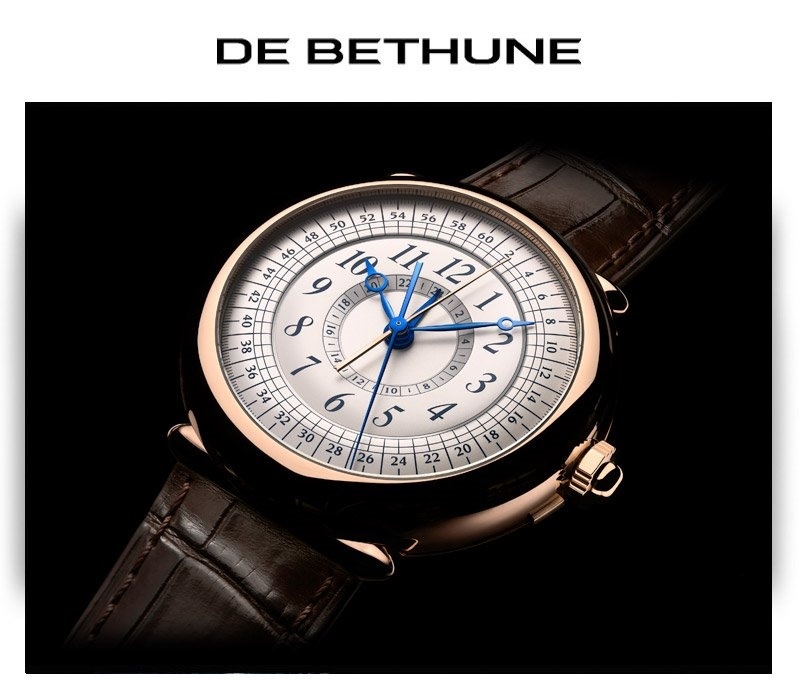
The rose-gold case of the DB29 with its smooth curves features the brand's trademark cone-shaped lugs. The double case back of this time-measuring instrument is fitted with an invisible hinge so as not to detract from its clean lines. A single push button, coaxial with the crown at 3 o'clock, operates the chronograph. Five central hands
The design of the DB29 Maxichrono Tourbillon's dial with its five central hands aims to make it easier and more attractive to read the chronograph indications by doing away with the small subdials of the conventional chronograph. The hands that give this watch its identity are designed to follow the different shapes and curves of the silver-toned dial. They are all in hand-polished steel that has been flame-blued by the company's craftsmen, apart from the chronograph minutes hand, which is in rose gold. Measuring long elapsed times: 23 hours, 59 minutes and 59.9 seconds
This instrument measures long elapsed times with counters for 60 seconds, 60 minutes and 24 hours. The central chronograph hands are mounted on co-axial stacked wheels, a complex system that requires real technical expertise to achieve. Thanks to the precision ensured by the De Bethune 30-second Tourbillon in silicon and titanium oscillating at a rate of 36,000 vibrations per hour – one of the fastest and lightest on the market with its 63 parts weighing a total of 0.18 grams – time is accurately measured and the maximum duration of elapsed-time measurements amounts to a generous 23 hours, 59 minutes and 59.9 seconds. A push button at 4 o'clock opens the cover on the sapphire-crystal glass of a titanium case back to reveal the modern construction of the calibre DB2039 movement with its polished steel bridges, the tourbillon at 3 o'clock and the complex mechanism of an innovative time-measuring system featuring three column-wheels. |